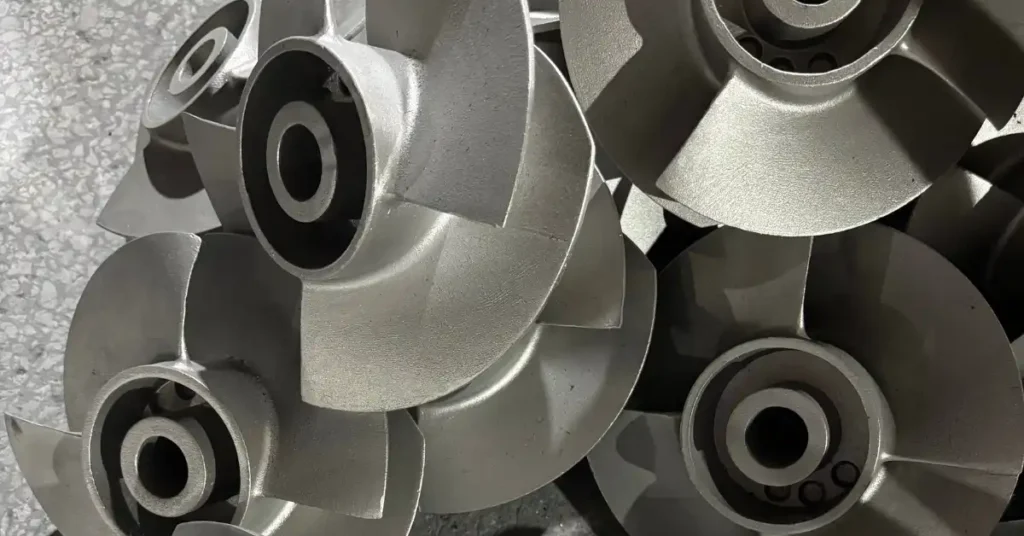
Cast stainless steel is everywhere in industrial equipment. Valve bodies, pump housings, impellers, pipe fittings, food-processing components, marine hardware, and many complex machine parts can all be made from it.
But the term itself can be confusing.
Is cast stainless steel a special type of stainless steel? Can ordinary 304 or 316 stainless steel simply be melted and cast? Why do casting drawings often specify grades such as CF8 or CF8M instead? And how does a stainless steel casting compare with a part machined from stainless steel bar or plate?
Cast stainless steel is stainless steel shaped by pouring molten alloy into a mold, rather than producing the component from rolled, forged, or otherwise mechanically worked stock.
The manufacturing route changes the available grades, microstructure, properties, design possibilities, and sometimes even the way the material should be specified.
What Is Cast Stainless Steel?
Cast stainless steel refers to a group of stainless steel alloys produced as metal castings.
Like other stainless steels, they contain enough chromium to form a thin passive oxide layer on the surface. This passive layer is what gives stainless steel its characteristic resistance to corrosion.
The word “cast” describes how the component is manufactured, rather than identifying one specific stainless steel grade.
A manufacturer melts the required stainless alloy, pours it into a mold, allows it to solidify, and then removes, heat treats, cleans, machines, and finishes the casting as required.
Cast stainless steels are commonly used where corrosion resistance is needed together with shapes that would otherwise require extensive machining, welding, or assembly. Different grades serve different environments, as illustrated in the SFSA Steel Castings Handbook’s corrosion-resistant alloy data sheets.
Is Cast Stainless Steel the Same as Regular Stainless Steel?
Chemically, they can be very similar. Metallurgically, they are not always identical.
Most stainless products people see—sheet, plate, tube, round bar, and profiles—are wrought stainless steel. After the steel is initially solidified, it undergoes operations such as rolling, forging, drawing, or extrusion.
A stainless steel casting solidifies much closer to its finished shape and does not undergo the same mechanical working afterward.
This distinction is why cast stainless steels often use their own grade designations.
For example:
| Common Cast Grade | Approximate Wrought Reference | General Description |
|---|---|---|
| CF8 | 304 | General-purpose austenitic stainless |
| CF3 | 304L | Low-carbon austenitic stainless |
| CF8M | 316 | Molybdenum-bearing austenitic stainless |
| CF3M | 316L | Low-carbon, molybdenum-bearing stainless |
| CA15 | 410-type | Martensitic stainless |
| CB7Cu-1 | 17-4PH-type | Precipitation-hardening stainless |
| CD3MN | 2205-type | Duplex stainless |
These are useful correspondences, but they should not be treated as exact substitutions. Cast and wrought specifications can have different chemistry limits, heat-treatment requirements, microstructures, and mechanical-property requirements. The SFSA’s summary of steel casting specifications provides an overview of the dedicated standards and grades used for cast components.
That means a drawing calling for “316 stainless steel” should not automatically be converted to CF8M without checking the applicable material specification and service requirements.
Why Cast Stainless Steel Instead of Machining the Part?
Casting becomes attractive when the geometry starts working against conventional machining.
Imagine a pump housing with curved internal passages, several mounting bosses, ribs, flanges, and changes in wall thickness. Producing that shape entirely from a solid stainless steel billet could mean removing a large amount of expensive material and spending many hours on CNC equipment.
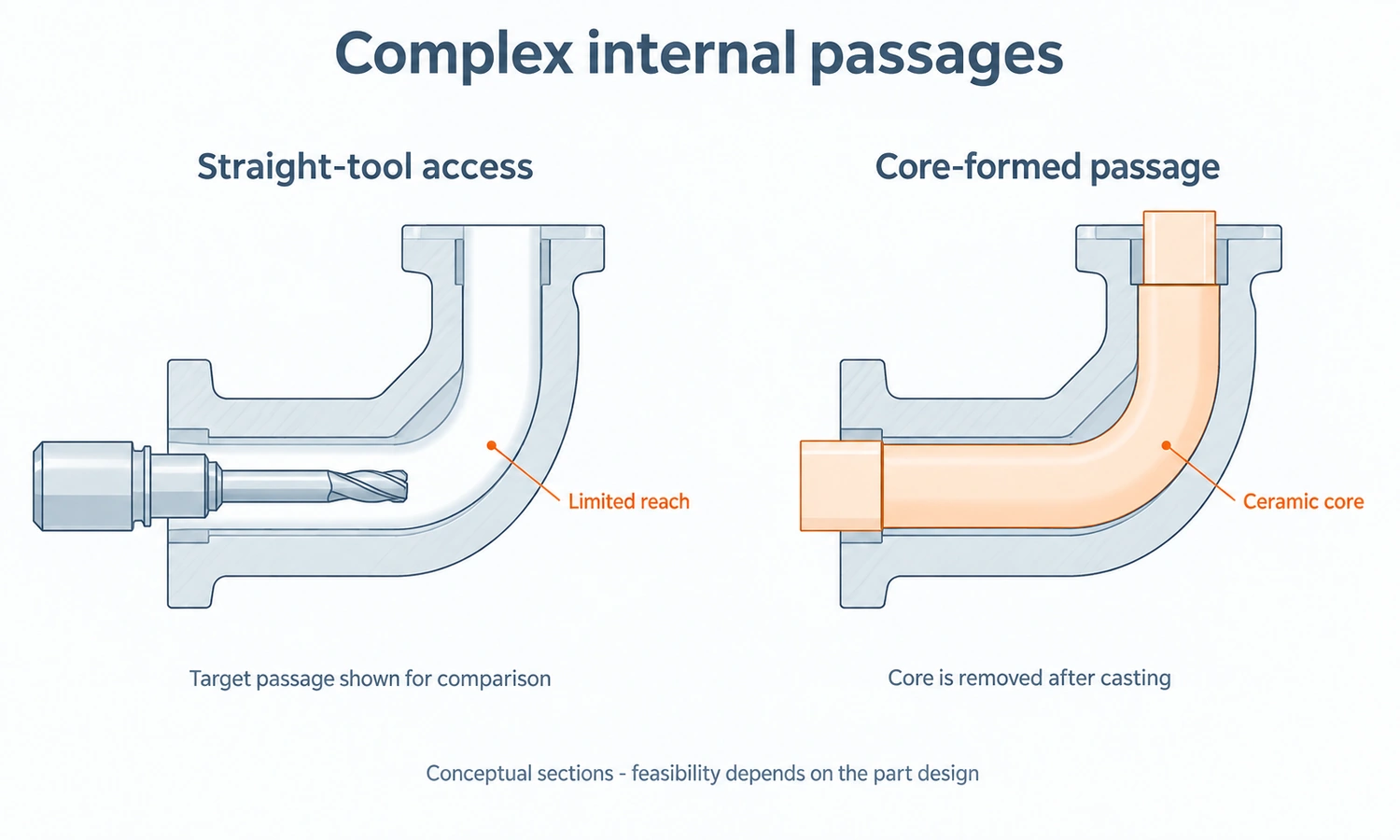
Casting creates much of that geometry directly in the mold.
It can also allow several pieces that would otherwise be machined and welded together to become one integrated component.
This is especially useful because many stainless steels are relatively demanding to machine. Austenitic grades such as 304 and 316 can work-harden during cutting, while complex internal shapes may simply be inaccessible to conventional tools.
Casting does not eliminate machining. Bearing seats, sealing surfaces, threaded holes, and other critical features often still need CNC finishing. At YTD Foundry, we can cast the part and machine these features in the same factory, so you can order a finished component rather than arrange a separate machining supplier. The advantage of casting is that much of the overall geometry is already there, leaving less material to remove.
Cast Stainless Steel vs. Wrought Stainless Steel
The important difference is not simply that one is “better” than the other. They solve different manufacturing problems.
| Factor | Cast Stainless Steel | Wrought Stainless Steel |
|---|---|---|
| Manufacturing | Molten metal solidifies inside a mold | Material is rolled, forged, drawn, or otherwise mechanically worked |
| Typical Form | Near-net-shape components | Plate, bar, tube, sheet, and forgings |
| Geometry | Well suited to complex three-dimensional shapes | Usually requires machining, forming, welding, or forging to achieve the final component shape |
| Internal Features | Can produce passages and difficult contours using suitable cores and mold design | Internal features may require extensive machining or fabrication |
| Material Utilization | Near-net-shape production can reduce machining waste, although gates, risers, and process losses remain | Heavy machining from stock can generate substantial scrap |
| Microstructure | Solidification structure; may contain controlled ferrite depending on the grade | Mechanically worked structure, influenced by subsequent heat treatment |
| Fatigue and Toughness | Depend on alloy, heat treatment, casting soundness, surface condition, and component design | Wrought or forged material can offer advantages in demanding applications, depending on processing and loading direction |
| Production Strategy | Tooling and process development followed by repeat casting | Stock material or a forging followed by forming, machining, or fabrication |
Austenitic cast stainless steels also commonly contain some ferrite in their microstructure, unlike many solution-annealed wrought austenitic products. This can influence weldability, corrosion behavior, mechanical properties, and magnetic response. The British Stainless Steel Association specifically notes the higher ferrite content and magnetic permeability of austenitic castings compared with wrought parent materials.
So describing CF8 simply as “304 in another shape” misses an important part of the story.
Common Types of Cast Stainless Steel
There is no universal cast stainless steel that fits every environment.
Austenitic Cast Stainless Steel
Austenitic grades are among the most widely used stainless casting materials.
CF8 and CF8M are two familiar examples. CF8 is commonly associated with the 304 family, while CF8M contains molybdenum and corresponds broadly to the 316 family.
These alloys combine corrosion resistance, ductility, and good general manufacturing characteristics, which makes them common in pumps, valves, food equipment, water systems, machinery, and chemical-processing components.
CF3 and CF3M are lower-carbon alternatives broadly corresponding to 304L and 316L.
Martensitic Cast Stainless Steel
Martensitic stainless steels are selected when hardness, wear resistance, or higher strength is more important than the broader corrosion resistance available from many austenitic grades.
CA15, broadly related to 410 stainless steel, is a common example.
These materials can be hardened through heat treatment and appear in components such as impellers, valve parts, turbine components, and wear-resistant mechanical parts.
Duplex Cast Stainless Steel
Duplex stainless steels contain both austenitic and ferritic phases.
Their combination of relatively high strength and resistance to chloride-related corrosion makes them useful in demanding fluid-handling, marine, chemical, and energy applications.
The thermal history of duplex castings is particularly important because the desired phase balance and freedom from harmful phases depend on proper processing and heat treatment.
Precipitation-Hardening Stainless Steel
17-4PH-type cast alloys are used where designers need significantly higher mechanical strength while retaining useful corrosion resistance.
The casting is normally solution treated and subsequently aged to develop the required properties.
These alloys are used in heavily loaded industrial and mechanical components where a conventional 300-series stainless steel would not provide sufficient strength. The required aging condition should be specified because strength, toughness, and other properties change with the heat treatment.
CF8 vs. CF8M: Why Do These Names Appear So Often?
If you work with stainless steel castings, you will encounter CF8 and CF8M frequently.
A simple way to understand them is:
CF8 belongs to the 304-type family, while CF8M belongs to the 316-type family.
The major practical difference is molybdenum.
CF8M contains molybdenum, which improves resistance to localized corrosion such as pitting and crevice corrosion in many chloride-containing environments. This is one reason 316-type materials are frequently considered for marine, chemical, and other more aggressive conditions.
CF8 is often sufficient for less aggressive water, food-processing, general industrial, and mildly corrosive environments.
However, material selection should never be based only on the words “marine,” “chemical,” or “outdoor.” Temperature, chloride concentration, pH, cleaning chemicals, stress, exposure time, and other operating conditions all matter. Neither CF8M nor a 316-type designation guarantees suitability for every seawater or chloride-containing application.
The SFSA alloy data sheets describe CF8 and CF8M separately, including their heat treatment, fabrication considerations, and service limitations. They are distinct casting grades rather than merely alternate names for 304 and 316.
How Is Stainless Steel Cast?
The basic principle is straightforward:
The alloy is melted, its chemistry is controlled, molten metal is introduced into a mold, the casting solidifies, and the component is then cleaned and processed to meet its final requirements.
The difficult part is controlling everything that happens between those steps.
Stainless steel is poured at high temperatures, and its solidification behavior must be considered when designing gates, runners, risers, wall transitions, and machining allowances. Shrinkage, inclusions, hot cracking, incomplete filling, and porosity all have to be managed during foundry production.
Heat treatment may then be necessary to obtain the required corrosion resistance or mechanical properties.
After casting, operations such as cleaning, grinding, machining, and surface finishing bring the component closer to its final condition. Which steps are needed depends on the drawing and how the part will be used.
For investment casting projects at YTD Foundry, we handle tooling design and manufacture, casting, CNC finishing, heat treatment, and standard surface finishing in-house. Specialized surface treatments are arranged through our partner factories when required. You can include these operations in one project, rather than source each manufacturing stage separately.
Investment Casting or Sand Casting?
Both processes can produce cast stainless steel, but they occupy different manufacturing spaces.
Investment casting uses a wax pattern surrounded by a ceramic shell. It is well suited to complex components that require fine details, good surface quality, relatively thin sections, and dimensions closer to the finished part.
Sand casting forms the cavity in a sand mold. It is often more suitable when parts become significantly larger, geometries are less intricate, or the precision offered by investment casting is not necessary.
Neither process is automatically the better choice. Part size, geometry, quantity, tolerances, surface requirements, tooling budget, and machining needs all affect the decision.
Investment casting is our in-house process. For parts better suited to sand casting, YTD Foundry can coordinate production with a specialist partner. This gives you another manufacturing route to consider without having to begin a separate supplier search.
Does Cast Stainless Steel Rust?
It can.
“Stainless” does not mean completely immune to corrosion.
Its corrosion resistance depends on alloy chemistry, heat treatment, surface condition, environmental conditions, and manufacturing quality.
A CF8 component working in a suitably mild water environment may perform well, while the same material exposed continuously to warm chloride-rich liquid could experience localized corrosion.
Moving to CF8M may improve performance because of its molybdenum content, while more aggressive environments may require duplex or another specialized stainless alloy.
Surface contamination can also create misleading rust staining. Iron particles introduced during grinding, handling, or machining can corrode even when the stainless substrate remains sound.
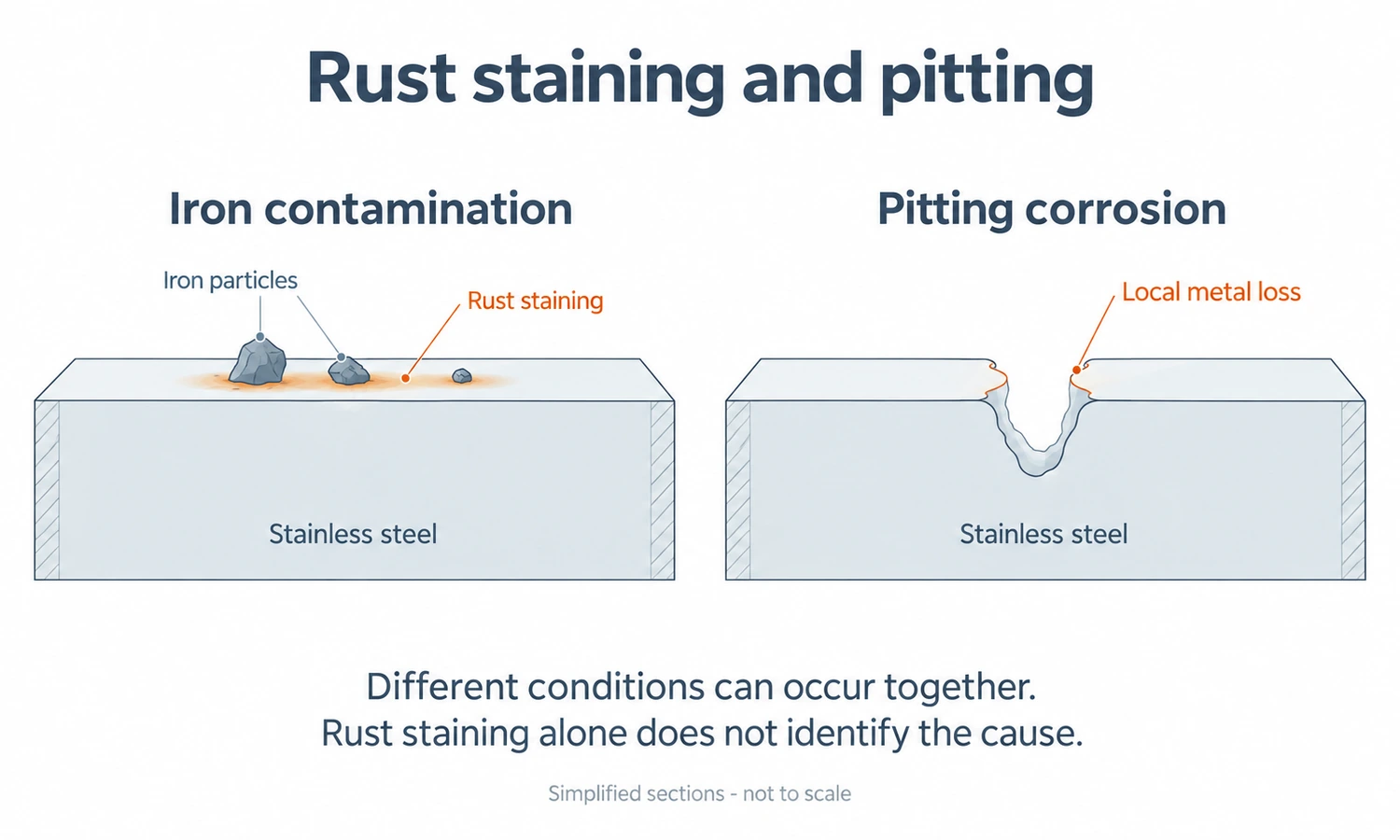
Cleaning and passivation are therefore important for many finished stainless steel castings. However, surface treatment cannot compensate for choosing an unsuitable alloy for the operating environment.
Is Cast Stainless Steel Magnetic?
Sometimes.
The answer depends on the alloy and its microstructure.
Martensitic and ferritic stainless steels are normally magnetic. Duplex stainless steel also contains a substantial ferritic phase and is magnetic.
Austenitic stainless steels are normally associated with low magnetic response, but cast austenitic grades such as CF8 and CF8M can contain delta ferrite formed during solidification.
As a result, a cast CF8 or CF8M component may show magnetic attraction even though its solution-annealed wrought 304 or 316 counterpart is usually described as non-magnetic.
That does not automatically mean the casting contains the wrong material. The relationship between stainless steel structure and magnetism is explained in the BSSA’s guidance on magnetic properties.
A magnet alone is not a reliable way to identify the exact stainless steel grade.
What Parts Are Commonly Made From Cast Stainless Steel?
Cast stainless steel is particularly useful where corrosion resistance and geometric complexity occur together.
| Industry or System | Typical Cast Components |
|---|---|
| Pumps | Impellers, casings, covers, and diffusers |
| Valves | Valve bodies, bonnets, discs, and internal components |
| Water Treatment | Pump parts, fittings, manifolds, and flow-control components |
| Food and Beverage | Housings, sanitary equipment parts, and mixing components |
| Chemical Processing | Valve bodies, pump components, fittings, and process equipment parts |
| Marine | Hardware, pump components, fittings, and fluid-handling parts |
| Machinery | Brackets, housings, arms, and structural components |
| Energy | Flow-control components, turbine-related parts, and pump and valve components |
These examples describe the range of applications, not a universal material recommendation. The SFSA’s application notes similarly distinguish typical uses from alloy selection for a specific operating environment.
How Do You Choose the Right Cast Stainless Steel Grade?
Start with the environment, not with the casting process.
For a relatively mild environment, a CF8 or other 304-type casting may provide the required corrosion resistance without paying for unnecessary alloying elements.
When chloride exposure or more aggressive chemicals become important, CF8M or a related 316-type grade may make more sense, provided the actual operating conditions remain within the alloy’s capabilities.
If welding and sensitization resistance are major concerns, lower-carbon CF3 or CF3M grades can become relevant.
When considerably higher strength is required, a precipitation-hardening alloy such as a 17-4PH-type casting may be considered.
For demanding chloride exposure combined with high mechanical loading, a suitable duplex grade can become attractive.
Martensitic grades are more appropriate when hardness and wear resistance are major design requirements.
Material selection should ultimately consider the actual medium, concentration, operating temperature, load, required mechanical properties, applicable standard, welding requirements, heat treatment, and expected service life.
What Should Be Specified When Buying a Stainless Steel Casting?
Writing only “stainless steel” on a drawing leaves too much open to interpretation.
A useful casting specification should identify the applicable material grade and standard together with the critical engineering requirements.
For example, the customer may need to define the cast grade, required heat treatment, mechanical-property requirements, dimensional tolerances, machined surfaces, corrosion-related requirements, inspection methods, pressure testing, surface finish, and material certification.
Standards such as ASTM A351, A743, and A744 cover different categories of stainless steel castings and should not simply be treated as interchangeable names. Broadly, A351 covers austenitic castings for pressure-containing parts, A743 covers corrosion-resistant castings for general applications, and A744 addresses corrosion-resistant castings for severe service. The applicable scope and edition should be checked against the project requirements using the ASTM steel standards directory.
Proper specification becomes increasingly important for pressure-containing or safety-critical components.
A complete drawing package is not the only way to start a discussion. If you have an existing part but no usable drawing or CAD model, we can help reconstruct its geometry through reverse engineering. The material specification, critical tolerances, and any intended design changes still need to be confirmed, but an existing sample can provide a starting point.
Cast Stainless Steel or Machined Stainless Steel: Which Should You Use?
If the component is simple, quantities are low, and suitable bar or plate is readily available, machining may be the easiest solution.
As geometry becomes more complex, however, machining everything from solid material can become increasingly inefficient.
Casting becomes particularly attractive when the design contains curved surfaces, internal passages, integrated bosses, ribs, irregular transitions, or several features that would otherwise require separate components and welding.
Production quantity matters as well. Casting normally requires tooling and process development, so its economics become more attractive when those initial costs can be distributed across repeated production.
The right question is therefore not:
“Is casting better than machining?”
It is:
“Which process can produce this particular component to the required performance, quantity, and total cost?”
Final Thoughts
Cast stainless steel is not a single material, and choosing it involves more than pouring an ordinary stainless alloy into a mold.
The casting route introduces its own alloy designations, microstructures, manufacturing limits, heat-treatment requirements, and quality considerations.
For designers and buyers, the most important first decisions are usually the operating environment and required performance. From there, the appropriate stainless family can be selected, followed by the casting process, heat treatment, machining, finishing, and inspection plan.
When those decisions are made together rather than independently, casting can turn a complicated stainless steel component into a repeatable near-net-shape part while reducing unnecessary machining and assembly.
Have a stainless steel component to produce, or an existing part to reproduce? Send YTD Foundry your drawing, CAD model, or sample details, together with the required quantity and service conditions. We can review the manufacturing options with you, including what should be cast, what needs machining, and how the part should be finished.
FAQs
Is CF8 the same as 304 stainless steel?
CF8 is commonly described as the cast counterpart of wrought Type 304, but the two designations are not interchangeable. They have related compositions and uses, while their allowable chemistry, microstructure, product specifications, and guaranteed properties are defined for different product forms.
Can stainless steel be sand cast?
Yes. Stainless steel can be produced by sand casting as well as investment and centrifugal casting. Sand casting is often considered for larger or relatively direct shapes, but the appropriate process still depends on geometry, quantity, surface and dimensional requirements, alloy, and the foundry’s equipment.
Does cast stainless steel rust?
Cast stainless steel is corrosion resistant, not corrosion proof. Its performance depends on the grade, heat treatment, surface condition, environment, temperature, stress, and exposure time. Chlorides, crevices, deposits, contamination, and an unsuitable alloy can still lead to corrosion.
Can stainless steel be die cast?
Stainless steel is not a conventional high-pressure die-casting alloy. Mainstream die casting uses lower-melting aluminum, zinc, magnesium, and copper alloys, while stainless steel components are commonly made by investment, sand, or centrifugal casting. A process described as “die-cast stainless steel” therefore needs clarification.
Can 304 stainless steel be cast?
Yes, but engineering drawings commonly use a dedicated casting grade such as CF8 when specifying a 304-type cast stainless steel. CF8 and wrought 304 belong to similar alloy families but are not identical specifications.
What is the cast equivalent of 316 stainless steel?
CF8M is widely regarded as the cast counterpart of wrought 316 stainless steel. CF3M similarly corresponds broadly to 316L. Exact specification requirements should still be checked rather than assuming direct interchangeability.
Is cast stainless steel weaker than forged stainless steel?
Not necessarily for every property or application. Forged or wrought materials can provide advantages where demanding fatigue resistance, toughness, or directional mechanical performance is required. However, the actual comparison depends on the alloy, heat treatment, material quality, component design, and loading conditions. A properly specified and manufactured casting can meet the requirements of many industrial components.
Can cast stainless steel be machined?
Yes. Machining is a normal secondary operation for stainless steel castings. Sealing faces, threads, bearing bores, mounting surfaces, and tight-tolerance dimensions are often CNC machined after casting.
Can cast stainless steel be welded?
Many cast stainless steel grades can be welded, although the correct procedure depends on the alloy, service conditions, filler material, and heat-treatment requirements. Some grades require preheating or post-weld heat treatment, so the procedure should be selected for the specific material rather than for “stainless steel” in general.
Is investment casting the best method for stainless steel?
It is one of the most useful methods for complex stainless components requiring good dimensional accuracy and surface quality. Larger or less intricate parts may be more economical to produce by sand casting. The practical choice depends on the component’s geometry, size, quantity, and finishing requirements.