Cast iron is a family of iron-carbon alloys made primarily for casting. Most engineering cast irons contain roughly 2–4 wt.% carbon, but carbon content alone does not explain how they behave.
The bigger difference is what happens to that carbon during solidification. Graphite flakes, graphite nodules, compacted graphite, or hard carbides can turn broadly similar iron-based alloys into materials with very different strength, ductility, damping, wear resistance, and machinability.
What Is Cast Iron?
Cast iron contains more carbon than conventional steel and is designed around melting and casting rather than extensive mechanical working.
Most engineering cast irons fall roughly in the 2–4% carbon range. Steel, by comparison, is generally defined as an iron-carbon alloy containing less than 2% carbon. (World Steel Association)
Silicon is also important because it influences whether carbon forms graphite during solidification.
This combination of relatively high carbon and silicon gives many cast irons good fluidity and a lower melting range than typical cast steels. That makes them particularly suitable for large housings, machine structures, pump bodies, engine components, and other shapes that would require substantial machining if produced from solid stock.
For a broader comparison with steel, aluminum, copper alloys, and other foundry materials, see our Metals for Casting guide.
How Graphite Shape Changes Cast Iron Properties
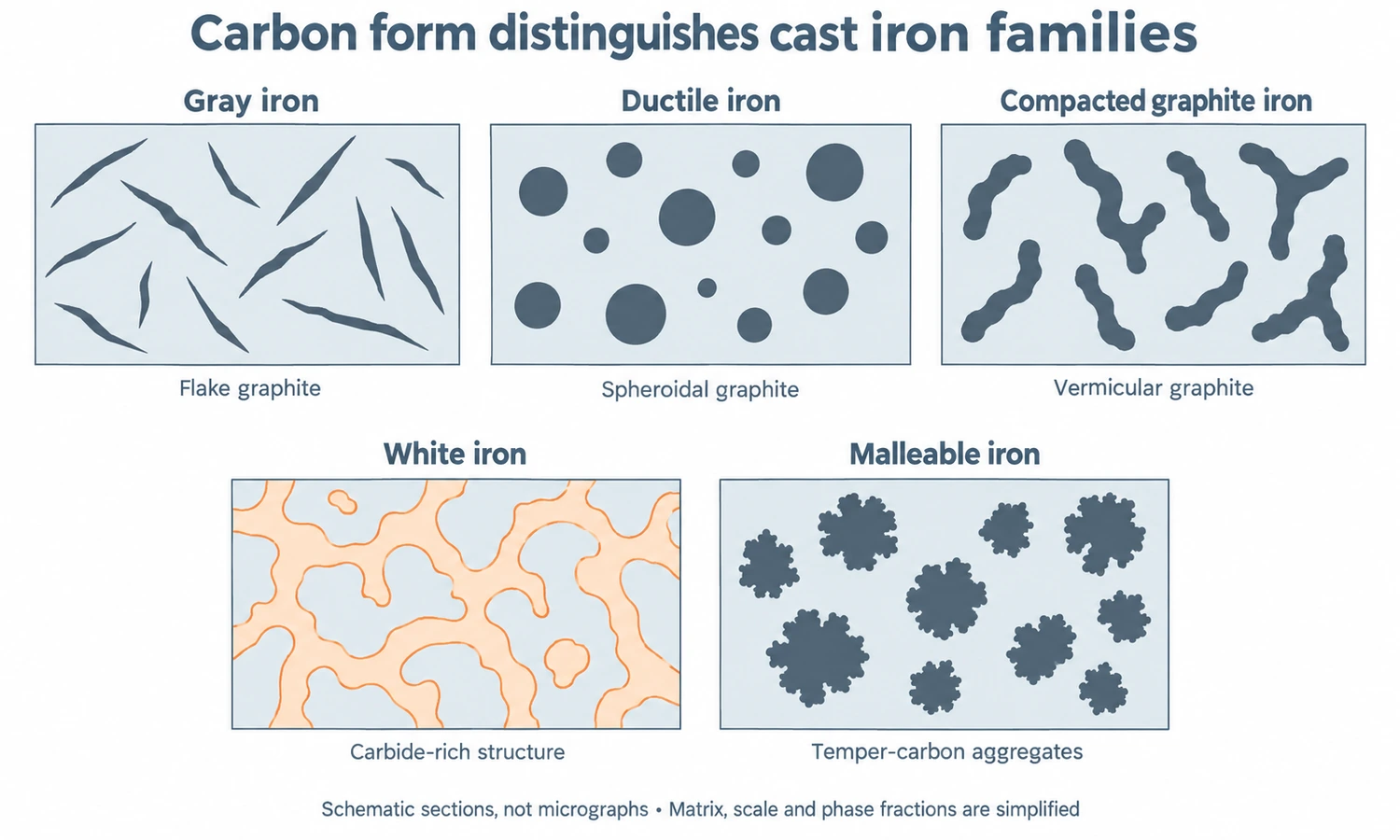
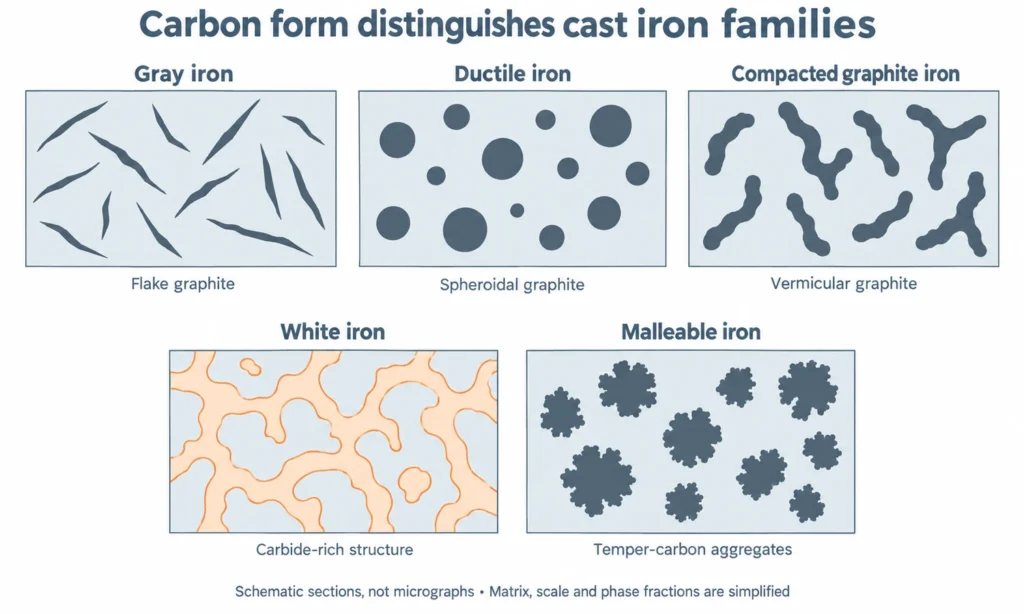
The easiest way to understand cast iron is to look at the form of carbon inside the material.
In gray iron, much of the carbon appears as graphite flakes. Their sharp ends interrupt the metallic matrix and concentrate stress, limiting tensile ductility. The same flake structure contributes to good vibration damping and machinability.
In ductile iron, controlled melt treatment causes graphite to form as rounded nodules. These shapes create much less severe stress concentration, allowing the surrounding iron matrix to carry higher tensile loads and deform further before fracture.
Compacted graphite iron, or CGI, contains shorter vermicular graphite forms between flakes and full nodules.
In white iron, much of the carbon remains tied up in hard carbide phases instead of forming free graphite. The result is high hardness and abrasion resistance but low ductility.
So the term cast iron covers several distinct material systems, not one set of mechanical properties.
Main Types of Cast Iron
| Cast Iron Type | Carbon Form | Typical Engineering Characteristics | Common Applications |
|---|---|---|---|
| Gray Iron | Flake graphite | Good damping, machinability, castability | Machine bases, housings, brake components, engine blocks |
| Ductile Iron | Spheroidal graphite nodules | Higher strength, yield strength, elongation, and toughness | Valves, hubs, fittings, machinery parts |
| White Iron | Carbides / cementite | Very hard, abrasion resistant, brittle | Wear plates, mill liners, slurry components |
| Malleable Iron | Temper carbon after heat treatment | Better ductility than gray iron | Fittings, brackets, hardware |
| Compacted Graphite Iron | Vermicular graphite | Strength above gray iron with useful thermal and damping properties | Heavy-duty engine and exhaust components |
These are separate material families. Choosing between them is more important than simply deciding whether a component should be “cast iron.”
Gray Cast Iron: Tensile Classes, Damping, and Machinability
Gray iron is one of the most widely used cast irons for general industrial parts.
ASTM A48/A48M classifies gray iron primarily by the minimum tensile strength of separately cast test bars. The current standard also makes clear that properties in the actual component can differ from the test bar because section thickness and cooling rate affect the microstructure. (ASTM A48/A48M)
Two common examples illustrate the class system:
| ASTM A48 Class | Minimum Test-Bar Tensile Strength |
|---|---|
| Class 30 | 30 ksi, about 207 MPa |
| Class 40 | 40 ksi, about 276 MPa |
Gray iron is not normally graded by yield strength and elongation in the same way as ductile iron because its tensile behavior and low ductility make those values less useful for classification.
Its flake graphite structure is particularly valuable in machine bases and housings because it dissipates vibration well. Graphite also assists chip breaking during machining, which contributes to the relatively good machinability of many gray iron grades.
The tradeoff is low tensile elongation and poorer impact performance than ductile iron or most cast steels.
Ductile Cast Iron: Tensile Strength, Yield Strength, and Elongation
Ductile iron is also called nodular iron or spheroidal graphite iron.
ASTM A536 defines it as cast iron in which the graphite is substantially spheroidal and specifies grades using tensile strength, yield strength, and elongation. (ASTM A536)
The grade designation itself shows the minimum mechanical-property requirements:
| ASTM A536 Grade | Min. Tensile Strength | Min. Yield Strength | Min. Elongation |
|---|---|---|---|
| 65-45-12 | 65 ksi / about 448 MPa | 45 ksi / about 310 MPa | 12% |
| 80-55-06 | 80 ksi / about 552 MPa | 55 ksi / about 379 MPa | 6% |
These two grades show a common material tradeoff. Moving toward higher strength generally reduces elongation.
The matrix is the other half of the picture. Graphite form describes how much the carbon disturbs the surrounding iron, but the matrix controls how the iron itself behaves. A ferritic matrix is softer and favors ductility, while a pearlitic matrix—alternating layers of ferrite and cementite—raises strength and hardness at some cost in elongation. Two ductile irons with equally good nodules can therefore differ in strength and elongation because their matrices differ.
ASTM A536 also notes that 65-45-12 and 80-55-06 can be supplied in the as-cast condition, while other grades use treatments such as ferritizing anneal, normalize-and-temper, or quench-and-temper routes. (ASTM A536)
The standard also cautions that test-specimen properties cannot be assumed to represent every point inside a real casting. A thick hub and a thin wall can cool differently and develop different local structures even when they come from the same melt. (ASTM A536)
White Cast Iron: Hardness and Abrasive Wear
White iron contains a large proportion of hard iron carbides instead of free graphite.
That carbide-rich structure gives it high hardness and strong resistance to abrasive wear, but very little ductility. It is used deliberately in equipment such as wear plates, mill liners, grinding components, and slurry-handling parts.
ASTM A532/A532M covers high-alloy abrasion-resistant white cast irons used in mining, milling, earth handling, and manufacturing. The standard controls chemistry, heat treatment, and hardness by class and type. It specifically excludes simpler low-alloy white irons, so A532 values should not be treated as universal properties for every white iron. (ASTM A532/A532M)
In practical terms, high-alloy abrasion-resistant grades typically fall in the range of about 450–650 HB (Brinell), well above ordinary gray or ductile iron. That hardness is the reason they survive severe abrasive service—and also the reason conventional drilling, turning, and milling can become difficult.
White iron should therefore be selected because the application needs wear resistance, not simply because a harder casting sounds better.
Malleable Cast Iron
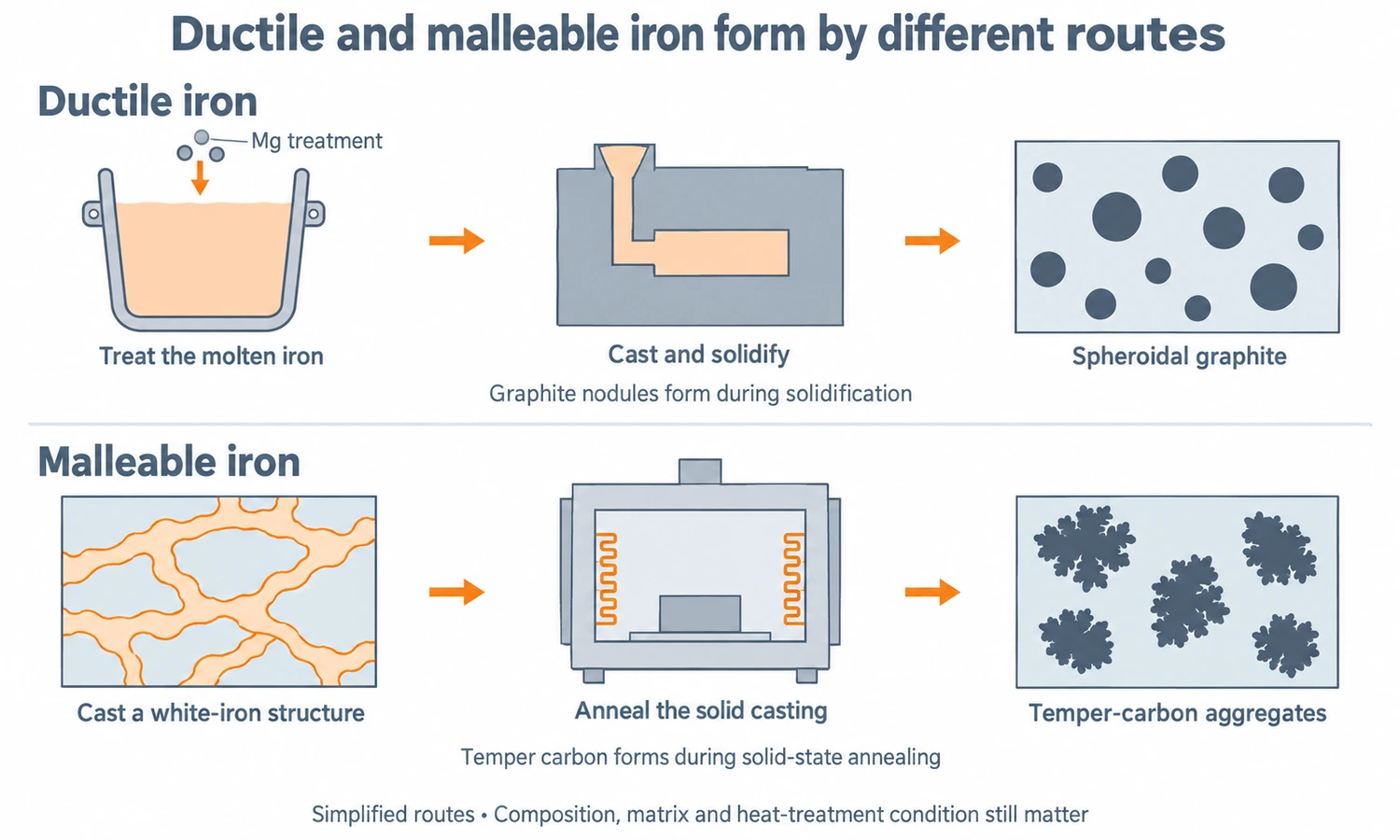
Malleable iron is produced through a different route.
The casting initially forms with a white-iron structure and is then subjected to a prolonged annealing treatment. During that treatment, carbide decomposes and characteristic temper carbon develops.
The resulting material has better ductility and machinability than the original white iron.
Malleable iron has traditionally been used for fittings, brackets, hardware, and relatively small components requiring more toughness than gray iron provides.
Today, ductile iron has replaced malleable iron in many new applications because spheroidal graphite can be created directly during casting rather than relying on a long post-cast annealing cycle.
ASTM lists separate specifications for ferritic and pearlitic malleable iron, including ASTM A47/A47M and ASTM A220/A220M. (ASTM Cast Iron Standards)
Compacted Graphite Iron
Compacted graphite iron, or CGI, contains graphite in a short, thick, vermicular form.
Its properties sit between gray and ductile iron in several useful ways. CGI can provide greater strength than gray iron while retaining useful thermal conductivity and vibration-damping behavior.
The vermicular graphite is not simply a smaller flake. In three dimensions the particles are interconnected, with rounded edges that resist crack initiation and growth better than gray iron’s sharp flakes. SinterCast’s CGI material data links this compacted form directly to that mechanical behavior. (SinterCast)
ASTM A842 covers compacted graphite iron castings and requires the accepted microstructure to contain at least 80% Type IV compacted graphite in the relevant test coupon or casting lug. It also specifies tensile strength, yield strength, and elongation. (ASTM A842)
This tighter control of graphite morphology is important because allowing the structure to drift too far toward flakes or excessive nodularity changes the material behavior.
CGI is particularly associated with highly loaded engine blocks, exhaust components, and other applications where ordinary gray iron does not provide enough strength.
Why Cast Iron Is Well Suited to Sand Casting
Cast iron’s fluidity and relatively manageable pouring temperature make it especially suitable for sand molds.
Sand casting also handles the kinds of components for which cast iron is often chosen: large housings, machine structures, heavy sections, ribs, and internal cavities created with sand cores.
For gray- and ductile-iron projects—such as larger housings, machine structures, and pump bodies—sand casting is usually the more natural production route. We handle these through specialized sand-casting partners, while investment casting remains our core in-house casting process.
For the process itself, see our Sand Casting Guide or Sand Casting Service.
Cast Iron vs. Cast Steel
Cast iron and cast steel are both iron-based casting materials, but their carbon level and microstructure produce very different engineering behavior.
| Property | Cast Iron | Cast Steel |
|---|---|---|
| Carbon content | Commonly about 2–4 wt.% | Typically <2 wt.% |
| Castability | Generally very good | More demanding |
| Tensile ductility | Low in gray/white iron; much higher in ductile iron | Generally higher |
| Impact toughness | Grade-dependent, often lower | Usually a stronger advantage |
| Vibration damping | Strong advantage for gray iron | Lower |
| Welding | Difficult for many cast irons | Generally easier |
| Abrasive wear | Strong advantage for selected white irons | Requires suitable alloy and heat treatment |
| Typical process for large parts | Sand casting | Sand casting |
The steel carbon limit follows the World Steel Association definition of steel as an iron-carbon alloy containing less than 2% carbon. (World Steel Association)
The comparison becomes more useful once the cast-iron family is identified.
For a machine base, gray iron’s damping may matter more than tensile elongation.
For a load-bearing valve body or hub, ductile iron can provide much better strength and toughness while keeping the advantages of iron casting.
For a welded or heavily impact-loaded structural component, cast steel may be the stronger choice.
Cast Iron Standards and Grade Selection
A drawing should not specify only CAST IRON.
The material needs to be narrowed to a recognized grade or specification because gray iron, ductile iron, white iron, malleable iron, and CGI behave too differently to be interchangeable.
Common ASTM specifications include:
| Cast Iron Family | Common ASTM Standard |
|---|---|
| Gray Iron | ASTM A48/A48M |
| Ductile Iron | ASTM A536 |
| Abrasion-Resistant White Iron | ASTM A532/A532M |
| Ferritic Malleable Iron | ASTM A47/A47M |
| Pearlitic Malleable Iron | ASTM A220/A220M |
| Compacted Graphite Iron | ASTM A842 |
| Austempered Ductile Iron | ASTM A897/A897M |
ASTM maintains additional application-specific cast-iron standards for pressure-containing parts, low-temperature service, elevated-temperature service, and other specialized uses. (ASTM Cast Iron Standards)
The grade should follow the part requirement. Strength, elongation, abrasive wear, damping, impact, pressure containment, temperature, and machinability all point toward different cast-iron families and grades.
Section thickness should be considered as part of that decision because cooling rate affects graphite morphology and matrix structure. ASTM A48, A536, and A842 all caution against assuming that separately cast test specimens reproduce the exact properties of every section in the finished casting. (ASTM A48/A48M)
Heat Treatment and Machining of Cast Iron
Heat treatment changes the metallic matrix around the graphite or carbides.
Ductile iron is a good example. ASTM A536 includes grades supplied as cast as well as grades requiring ferritizing anneal, normalize-and-temper, quench-and-temper, or other controlled treatments. (ASTM A536)
Austempering takes ductile iron into the separate ADI family covered by ASTM A897/A897M. (ASTM Cast Iron Standards)
Malleable iron depends even more directly on heat treatment because its characteristic structure is created through annealing.
Machinability also changes dramatically across the family. Gray iron is generally straightforward to machine, while carbide-rich white iron can be extremely difficult to cut. Machining guides therefore treat gray, ductile, and white iron as separate workpiece categories rather than one material, because chip behavior, matrix hardness, and tool wear all differ. (Sandvik Coromant)
For a deeper explanation of thermal processing after casting, see our Heat Treatment for Castings guide.
How to Choose a Cast Iron Grade
Start with the function of the component.
A machine base or housing where vibration damping and machining matter points naturally toward gray iron.
A valve body, hub, fitting, or structural casting that needs useful elongation and higher tensile strength is more likely to need ductile iron. The exact ASTM A536 grade can then be selected around the required strength-ductility balance.
Severe abrasive service points toward white iron because the carbide structure provides the property the application needs.
CGI becomes relevant where gray iron does not provide enough strength but thermal behavior and damping still matter.
Malleable iron is more common in established small-part specifications than as the default material for a new large casting.
Once the family is chosen, move to the exact grade, section size, heat-treatment condition, and inspection requirements. That is much more useful than placing the words cast iron alone on a drawing.
Final Thoughts
Cast iron is a family of materials whose behavior depends strongly on graphite shape, carbide formation, and the surrounding metallic matrix.
Gray iron favors damping and machinability. Ductile iron adds strength and elongation. White iron targets abrasive wear, while CGI and malleable iron serve more specialized property combinations.
For engineering work, move quickly from the broad term cast iron to the exact family, grade, section size, and required properties. That is where useful material selection begins.
FAQs
Is Cast Iron the Same as Iron?
No. Cast iron is an iron-based alloy family containing significant carbon and silicon. Its microstructure is intentionally controlled to produce graphite or carbide forms that give different cast irons their properties.
Is Cast Iron Stronger Than Steel?
Not as a general rule. Gray iron has low tensile ductility compared with many steels, while ductile iron can achieve much higher strength and elongation. The comparison needs to be made between specific grades and loading conditions.
What Is the Difference Between Gray Iron and Ductile Iron?
Gray iron contains graphite flakes, while ductile iron contains graphite nodules. The nodular shape produces much lower stress concentration, giving ductile iron significantly better tensile ductility and toughness.
Why Is Cast Iron Good for Machine Bases?
Gray iron combines rigidity, vibration damping, machinability, and economical casting of large shapes. These properties make it well suited to machine beds, housings, and other structures where vibration control matters.
Is Cast Iron Brittle?
Some cast irons are. Gray and white iron have relatively low ductility, while ductile and malleable iron are specifically engineered for greater deformation and toughness. “Cast iron is brittle” is therefore too broad to describe the whole family.
Can Cast Iron Be Heat Treated?
Yes. Heat treatment can modify stress, hardness, machinability, and matrix structure. Malleable iron and austempered ductile iron are examples where thermal processing is central to the final material condition.
Is Cast Iron Usually Sand Cast?
Yes, sand casting is one of the most important production routes for cast iron because it handles large components, cores, heavy sections, and a wide range of production volumes economically.
Is Cast Iron Always Brittle?
No. Gray and white iron have low tensile ductility, but ductile iron is specifically engineered for much greater elongation. ASTM A536 65-45-12, for example, specifies 12% minimum elongation.
Can Cast Iron Be Welded?
Some cast irons can be welded, but the approach depends heavily on the iron type and its condition. Welding can create hard, brittle structures near the joint, and cooling stresses can cause cracking, so gray, ductile, malleable, and white irons each need different treatment. Identify the specific iron grade and the part’s duty before choosing a repair procedure. TWI’s welding guidance covers these differences in detail. (TWI)
Is Cast Iron Usually Sand Cast?
Yes. Sand casting is widely used for gray and ductile iron because it handles large components, heavy sections, internal cores, and a wide range of production quantities economically. YTD handles cast-iron projects through specialized sand-casting partners.