Many metals can be cast, but that does not mean they behave the same way in a foundry.
Cast iron flows well and is economical for heavy industrial parts. Aluminum is lightweight and works with several casting processes. Stainless steel is chosen for corrosion resistance, while nickel-based alloys are used when heat or aggressive environments become more demanding.
Choosing a metal for casting therefore means balancing part performance, castability, manufacturing process, and cost.
This guide covers the most common casting metals, where each one works best, and how material choice affects the casting process.
What Metals Can Be Cast?
Almost every major engineering metal has alloys that can be cast.
In industrial manufacturing, however, foundries normally use casting alloys rather than pure metals.
Alloying allows properties such as strength, fluidity, corrosion resistance, wear resistance, heat resistance, and solidification behavior to be adjusted for the application.
The main casting-metal families are:
| Metal Family | Main Advantages | Common Casting Processes |
|---|---|---|
| Cast Iron | Low cost, good fluidity, wear resistance, vibration damping | Sand casting, shell molding |
| Carbon Steel | Strength, toughness, weldability | Investment casting, sand casting |
| Alloy Steel | Higher strength, wear resistance, heat-treatment response | Investment casting, sand casting |
| Stainless Steel | Corrosion resistance, strength, durability | Investment casting, sand casting |
| Aluminum Alloys | Lightweight, good fluidity, corrosion resistance | Die casting, sand casting, investment casting, permanent mold |
| Copper Alloys | Wear resistance, corrosion resistance, conductivity | Sand casting, investment casting, centrifugal casting |
| Zinc Alloys | Excellent fluidity, fine details, good surface finish | Primarily die casting |
| Magnesium Alloys | Very lightweight, good machinability | Die casting, sand casting |
| Nickel / Cobalt Superalloys | High-temperature and severe-environment performance | Investment casting, vacuum casting, sand casting |
| Titanium Alloys | High strength-to-weight ratio and corrosion resistance | Mainly investment casting under controlled conditions |
You can also see YTD’s broader casting materials capability by process and alloy family.
Ferrous vs. Non-Ferrous Casting Metals
Casting metals are often divided into ferrous and non-ferrous groups.
Ferrous Casting Metals
Ferrous metals are based primarily on iron.
They include:
- Cast iron
- Carbon steel
- Alloy steel
- Stainless steel
These materials dominate many industrial applications because they can provide high strength, wear resistance, durability, and relatively economical raw-material cost.
Their main disadvantage is weight.
Most iron- and steel-based alloys have densities around three times that of aluminum, so they are less attractive where lightweight design is a priority.
Non-Ferrous Casting Metals
Non-ferrous alloys include:
- Aluminum
- Copper alloys
- Zinc
- Magnesium
- Nickel-based alloys
- Cobalt-based alloys
- Titanium
Their properties vary much more widely.
Aluminum and magnesium are selected for low weight, zinc for precision die casting, copper alloys for wear and corrosion resistance, and nickel-based materials for extreme temperature or corrosion environments.
The fact that a metal is ferrous or non-ferrous does not determine whether it is “better.” It simply narrows the performance and manufacturing options.
Cast Iron for Low-Cost and Heavy Industrial Parts
Cast iron is one of the most established casting materials.
Its relatively high carbon content gives molten cast iron good fluidity, making it well suited to filling large sand molds and complex industrial shapes.
Common families include:
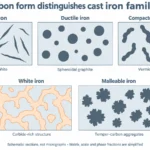
- Gray iron
- Ductile iron
- Malleable iron
- White iron
Gray iron offers excellent vibration damping, machinability, and wear resistance, which makes it common for machine bases, housings, engine components, and pump bodies.
Ductile iron contains graphite in nodular form, giving it much better tensile strength and toughness than conventional gray iron.
Cast iron is particularly associated with sand casting because the process accommodates large parts economically.
Its limitations include relatively high weight and, depending on the grade, lower corrosion resistance and ductility than many steels.
Carbon Steel for Strength and General Industrial Use
Carbon steel is one of the most versatile materials for structural and mechanical cast components.
Compared with cast iron, it generally provides better toughness, impact resistance, and weldability.
Low- and medium-carbon casting grades are used for:
- Valve bodies
- Pump components
- Machinery parts
- Heavy equipment
- Structural brackets
- Pressure-containing components
Carbon steel also responds to heat treatment, allowing mechanical properties to be adjusted after casting.
Common international cast grades include ASTM A216 WCB and WCC.
YTD produces carbon steel castings through investment casting for smaller precision components and supports larger sand-cast parts through its casting network.
Carbon steel is often a practical starting point when a component requires strength and toughness but does not need the corrosion resistance of stainless steel.
Alloy Steel for Higher Strength, Wear, or Heat Resistance
Alloy steels add elements such as chromium, molybdenum, nickel, manganese, or vanadium to improve properties beyond those of ordinary carbon steel.
Depending on the grade and heat treatment, alloy steel can provide:
- Higher tensile strength
- Better hardenability
- Improved wear resistance
- Greater fatigue strength
- Better performance at elevated or low temperatures
Common grades used in cast or cast-equivalent applications include 4130, 4140, 4340, and 8620-type materials, together with specification-specific cast steel grades.
Typical applications include gears, couplings, machinery components, mining equipment, structural parts, and highly loaded mechanical components.
Because heat treatment is often central to final performance, alloy selection and thermal processing should be considered together.
For more examples, see YTD’s alloy steel casting materials.
Stainless Steel for Corrosion-Resistant Castings
Stainless steel is a common choice when the component must combine strength with corrosion resistance.
Common cast stainless families include:
- Austenitic stainless steel
- Martensitic stainless steel
- Ferritic stainless steel
- Duplex stainless steel
- Precipitation-hardening stainless steel
CF8 and CF8M are among the most familiar austenitic casting grades and broadly correspond to the 304 and 316 material families.
But cast grades should not automatically be treated as identical to their wrought counterparts.
Casting specifications can have different chemical limits, heat treatments, and mechanical requirements.
Stainless steel works particularly well with investment casting because complex corrosion-resistant components such as valve bodies, impellers, fittings, marine hardware, and food-processing parts can be produced close to their final shape.
Our stainless steel casting page covers the major cast grades in more detail.
Aluminum for Lightweight Cast Parts
Aluminum is one of the most versatile metals for casting.
Its relatively low melting temperature and good fluidity allow it to be processed through several different casting methods.
Common casting families include:
- Al-Si alloys
- Al-Si-Mg alloys
- Al-Cu alloys
- Al-Mg alloys
A356 and A357 are widely used for sand, permanent-mold, and investment casting applications, while alloys such as A380 and ADC12 are closely associated with high-pressure die casting.
Aluminum’s main advantages include:
- Low density
- Good strength-to-weight ratio
- Good corrosion resistance
- Good machinability
- High thermal conductivity
- Ability to form complex integrated structures
The manufacturing process depends heavily on quantity and geometry.
Investment casting can be useful for complex lower-volume precision aluminum parts, sand casting for larger components, and die casting for high-volume thin-wall production.
YTD’s aluminum casting material page compares these routes and commonly used alloys.
Copper Alloys for Wear, Corrosion, and Conductivity
Copper itself can be cast, but industrial castings more commonly use copper alloys such as bronze and brass.
These materials are selected where properties such as wear resistance, corrosion resistance, low friction, or electrical and thermal conductivity are important.
Typical casting applications include:
- Bushings
- Bearings
- Marine hardware
- Pumps
- Valves
- Electrical components
- Decorative hardware
Bronze alloys are especially useful for bearing and wear applications.
Brass offers good machinability and corrosion resistance together with an attractive appearance.
Copper alloys can be processed using sand casting, investment casting, centrifugal casting, and other methods depending on geometry and grade.
Their relatively high material cost makes process selection and casting yield important when producing large components.
Zinc for High-Volume Precision Die Casting
Zinc has excellent fluidity and a relatively low melting temperature.
These characteristics make zinc particularly suitable for hot-chamber die casting.
Common families include:
- Zamak 3
- Zamak 5
- ZA alloys
Zinc die castings can reproduce:
- Thin walls
- Fine lettering
- Small ribs
- Detailed surface features
- Tight repeatable dimensions
It also allows long die life compared with higher-temperature die casting alloys.
Typical applications include hardware, connectors, housings, mechanisms, handles, and consumer products.
Zinc is therefore an excellent casting material when the component is relatively small and production volume is high.
It is much less relevant for large structural castings or high-temperature applications.
Magnesium for the Lightest Structural Castings
Magnesium is the lightest structural metal commonly used in large-scale casting.
It provides:
- Very low density
- Good machinability
- Good vibration damping
- Useful strength-to-weight ratio
Grades such as AZ91D, AM60B, and AM50A are commonly used in die casting.
Typical applications include:
- Automotive housings
- Electronics
- Lightweight brackets
- Structural enclosures
- Portable equipment
Magnesium’s low weight can provide advantages over aluminum where every gram matters.
However, corrosion protection, alloy selection, melt handling, and manufacturing safety require careful control.
For mass production, high-pressure die casting is one of the most important magnesium manufacturing routes.
Nickel and Cobalt Superalloys for Extreme Conditions
Nickel- and cobalt-based superalloys sit at the opposite end of the casting spectrum from low-cost metals such as cast iron.
They are selected when ordinary steels cannot reliably tolerate combinations of:
- High temperature
- Oxidation
- Corrosion
- Creep
- Heavy mechanical stress
Common examples include:
- Inconel 625
- Inconel 718
- Inconel 713C
- Hastelloy X
- Cast nickel superalloys such as K18
- Cobalt-based alloys such as Stellite
These materials are expensive and difficult to machine, which makes near-net-shape casting especially valuable.
Some high-performance alloys also contain reactive elements that require vacuum melting or tightly controlled casting conditions.
YTD uses investment casting and vacuum melting for suitable superalloy castings.
These materials are primarily used in turbines, aerospace systems, energy equipment, furnaces, chemical processing, and other severe-service applications.
What Makes a Metal Good for Casting?
A metal does not need only good mechanical properties.
It must also behave predictably while molten and during solidification.
Several material characteristics influence castability.
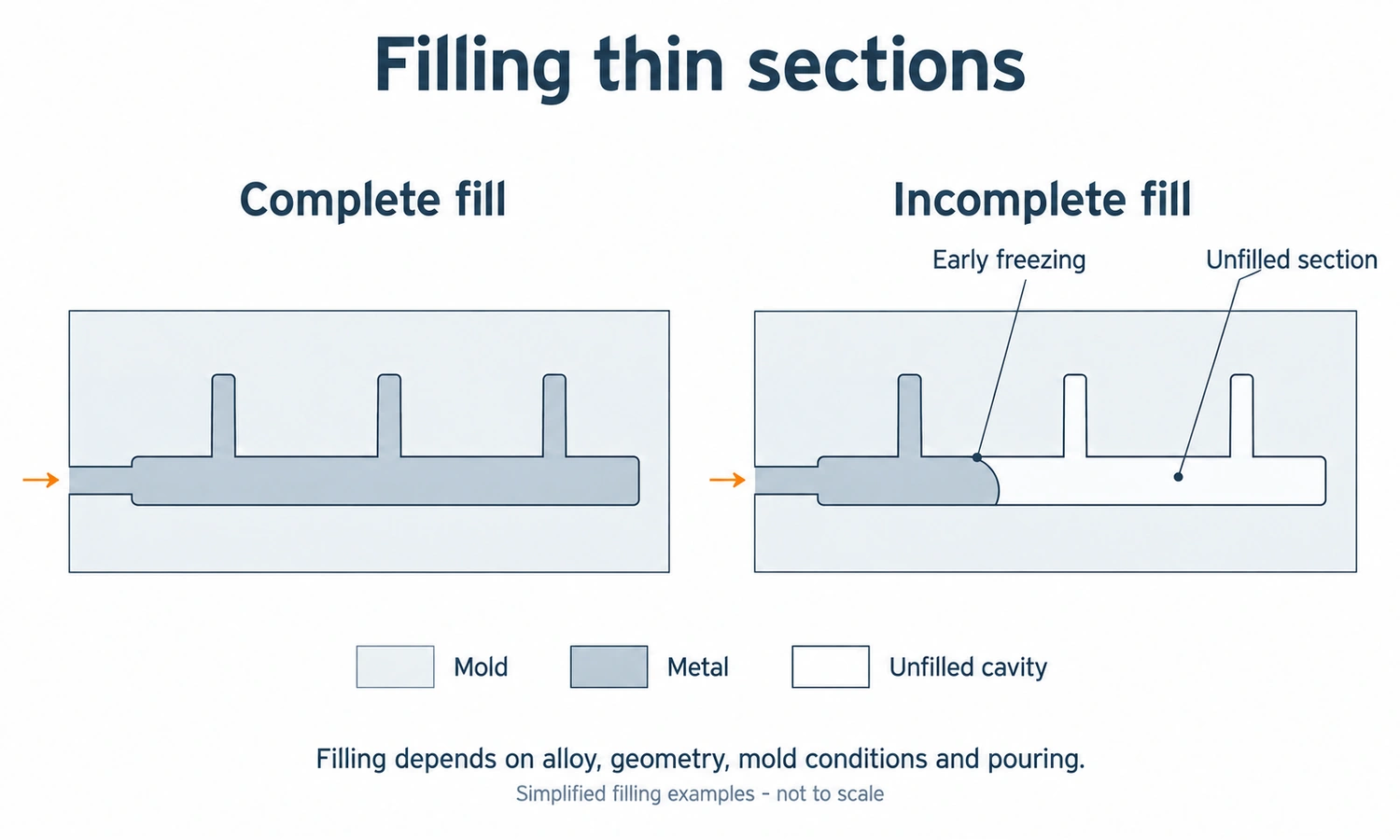
Fluidity
Fluidity describes how effectively molten metal can flow through a mold before it freezes.
Good fluidity helps fill:
- Thin sections
- Fine details
- Long flow paths
- Complex cavities
Aluminum-silicon alloys and cast iron, for example, are well known for good casting fluidity.
Melting and Pouring Temperature
Higher melting temperatures increase demands on furnaces, molds, tooling, refractory materials, and energy consumption.
This is one reason high-pressure die casting is dominated by relatively low-melting non-ferrous alloys rather than steel.
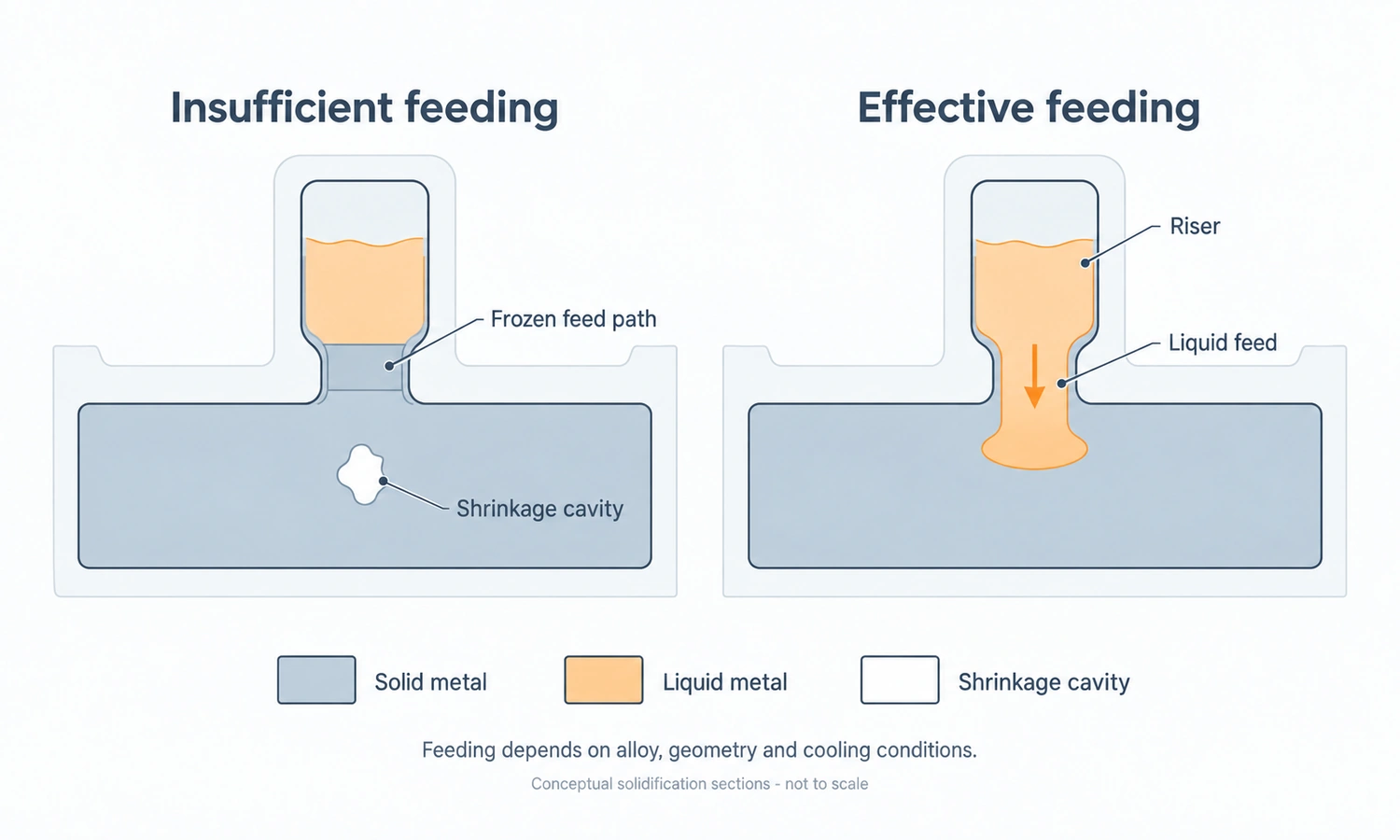
Solidification Shrinkage
Most metals contract as they cool from liquid to solid.
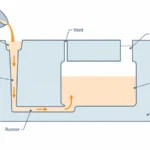
If the casting cannot receive enough additional molten metal during solidification, shrinkage cavities or internal porosity can develop.
Different alloys require different feeding and gating strategies.
Oxidation and Reactivity
Some molten metals react readily with oxygen, mold materials, or atmospheric gases.
Titanium and certain nickel-based superalloys, for example, require much stricter melting and mold control than ordinary cast iron.
Hot Cracking and Solidification Behavior
Some alloys are more sensitive to cracking while they are partially solidified.
Geometry, cooling rate, alloy chemistry, and mold design can all affect this risk.
This means a material that looks ideal on a mechanical-property chart may still require a much more demanding casting process.
Metal Choice Can Determine the Casting Process
Not every casting process is compatible with every metal.
This is one of the most important points when choosing a casting material.
Investment Casting
Investment casting supports one of the broadest alloy ranges.
Typical materials include:
- Carbon steel
- Alloy steel
- Stainless steel
- Aluminum
- Nickel-based superalloys
- Cobalt alloys
- Selected titanium alloys
It is especially useful when a complex shape must be produced from a material that is expensive or difficult to machine.
Sand Casting
Sand casting is also extremely flexible.
It is commonly used for:
- Cast iron
- Carbon steel
- Alloy steel
- Stainless steel
- Aluminum
- Copper alloys
Its major advantage is the ability to produce components ranging from small castings to extremely large industrial parts.
Die Casting
Die casting is much more material-specific.
Commercial high-pressure die casting is dominated by:
- Aluminum
- Zinc
- Magnesium
Selected copper alloys can also be processed by cold-chamber equipment.
The permanent steel die limits the practical use of very high-melting metals such as steel and nickel superalloys.
This is why material and manufacturing process should never be selected independently.
Casting Metal vs. Wrought Metal Grade
One common mistake is assuming that the grade used for bar, plate, or forging should automatically be used for casting.
Sometimes a similar cast grade exists, but that does not make the two specifications identical.
For example:
- Wrought 304 stainless steel broadly corresponds to cast CF8.
- Wrought 316 broadly corresponds to CF8M.
- Some aluminum alloys are designed mainly for casting, while others are primarily wrought products.
- Certain nickel superalloys are specifically developed as cast grades.
Casting alloys may adjust silicon, carbon, or other elements to improve fluidity, solidification, or foundry performance.
Therefore, when converting a machined or fabricated component to casting, the correct question is not:
“Can you cast this exact wrought grade?”
It is:
“Which cast specification provides the required performance for this component?”
How to Choose the Right Metal for Casting
Material selection should begin with what the part must do.
Start With Mechanical Requirements
Define whether the component needs:
- High tensile strength
- Impact toughness
- Wear resistance
- Fatigue resistance
- Hardness
- Vibration damping
A heavy machine base and a highly loaded mechanical arm have very different material priorities.
Consider the Environment
Ask whether the component is exposed to:
- Water
- Seawater
- Acids or chemicals
- Outdoor weather
- Food-processing environments
- High humidity
Corrosion requirements may shift the choice from carbon steel toward stainless steel, aluminum, bronze, or a higher-performance alloy.
Check the Operating Temperature
Ordinary aluminum, carbon steel, stainless steel, and superalloys operate in very different temperature ranges.
High-temperature service may require heat-resistant steel or nickel-based superalloys.
Decide Whether Weight Matters
If lightweight design is important, aluminum and magnesium become strong candidates.
If mass is not a concern, steel or cast iron may offer better economics or mechanical properties.
Consider Wear and Friction
Cast iron, alloy steel, bronze, and cobalt-based alloys can all be useful for wear applications, but they solve different levels of severity and cost.
Include the Casting Process and Quantity
Finally, ask how the material will be manufactured.
A zinc component planned for hundreds of thousands of pieces naturally points toward die casting.
A large cast-iron machine base points toward sand casting.
A complex stainless steel valve body may be well suited to investment casting.
The material, geometry, volume, and casting process should be evaluated together.
Common Casting Metals by Design Requirement
| Requirement | Materials to Consider |
|---|---|
| Low-cost heavy industrial component | Cast Iron, Carbon Steel |
| High strength and toughness | Carbon Steel, Alloy Steel |
| Corrosion resistance | Stainless Steel, Aluminum, Bronze, Nickel Alloys |
| Lightweight design | Aluminum, Magnesium |
| High-volume thin-wall parts | Aluminum, Zinc, Magnesium |
| Wear resistance | Cast Iron, Alloy Steel, Bronze, Cobalt Alloys |
| High-temperature service | Heat-Resistant Steel, Nickel / Cobalt Superalloys |
| Seawater or marine exposure | Stainless Steel, Bronze, Selected Nickel Alloys |
| Good vibration damping | Gray Iron, Magnesium |
| Extreme corrosion and heat | Nickel-Based Superalloys |
This table is a starting point rather than a material specification.
The exact grade still depends on load, temperature, corrosion medium, standards, heat treatment, geometry, and manufacturing route.
How YTD Selects Materials for Casting Projects
At YTD Foundry, material selection is considered together with the manufacturing process rather than as a separate decision.
Investment casting is our in-house core process and supports materials including stainless steel, carbon steel, alloy steel, aluminum, and selected high-temperature alloys.
For projects better suited to sand casting or die casting, we work through specialized foundry partners while managing the project and quality requirements.
If a customer already specifies a material, we review whether the grade is appropriate for casting and whether the specified process can produce the required geometry and properties.
If the material is still open, information about the operating environment, load, temperature, annual quantity, and critical dimensions helps narrow the options.
For projects already confirmed for lost-wax production, our investment casting materials guide provides a deeper comparison of materials specifically for that process.
Final Thoughts
Choosing a metal for casting is not simply a matter of comparing strength or material price.
The right choice must satisfy the component’s load, corrosion, temperature, weight, and wear requirements while remaining practical to melt, cast, heat treat, machine, and inspect.
If several materials appear suitable, compare them together with the casting process and finished-part cost. YTD Foundry can review your drawing, application, and production requirements to help narrow both the material and manufacturing route.
FAQs
What Is the Best Metal for Casting?
There is no single best casting metal. Cast iron is economical and highly castable, aluminum is lightweight and versatile, stainless steel provides corrosion resistance, and superalloys are designed for extreme environments. The best material depends on the component’s requirements.
What Is the Easiest Metal to Cast?
Low-melting metals such as zinc and many aluminum alloys are relatively easy to process compared with high-temperature steels and superalloys. In industrial sand foundries, cast iron is also considered highly castable because of its good fluidity.
Can Steel Be Cast?
Yes. Carbon steel, alloy steel, and stainless steel are all widely cast using processes such as investment casting and sand casting. Steel requires significantly higher melting and pouring temperatures than aluminum or zinc.
Can Any Metal Be Die Cast?
No. Commercial die casting primarily uses aluminum, zinc, and magnesium alloys, with selected copper alloys also possible. Very high-melting materials such as steel are generally unsuitable for conventional high-pressure die casting because of the permanent steel tooling.
Is Cast Metal Weaker Than Forged Metal?
Not automatically. Mechanical performance depends on material, heat treatment, casting quality, geometry, and loading conditions. Forging can offer advantages for certain fatigue- or toughness-critical parts, while castings are widely used successfully in demanding industrial applications.
Should I Choose the Metal or Casting Process First?
They should be evaluated together. Material requirements can eliminate certain casting processes, while geometry, quantity, and tooling economics can make one manufacturing route more practical than another.