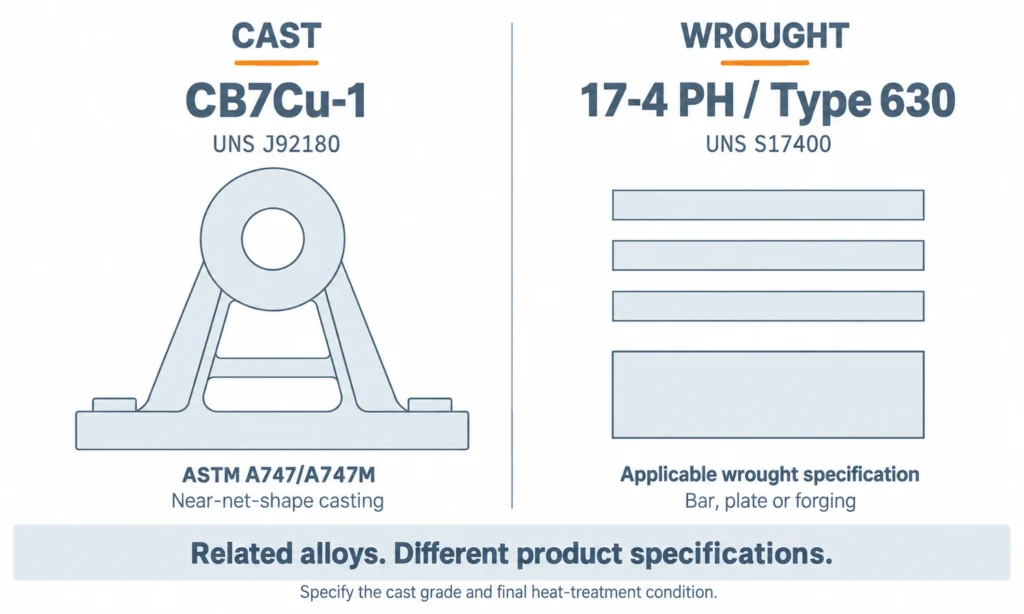
17-4 PH is one of the most familiar high-strength stainless steels, but investment castings should not simply be specified by copying a wrought 17-4 PH bar or plate grade.
For cast components, the relevant ASTM grade is CB7Cu-1, UNS J92180, covered by ASTM A747/A747M. Its chemistry is closely related to wrought 17-4 PH, but the casting specification, heat treatment, microstructure, and mechanical-property requirements are different.
For this alloy, the heat-treatment condition is just as important as the grade name.
CB7Cu-1 and 17-4 PH: What Is the Relationship?
17-4 PH is the familiar wrought designation associated with Type 630 / UNS S17400.
CB7Cu-1 is the corresponding precipitation-hardening stainless casting grade. ASTM A747/A747M-23 identifies:
- CB7Cu-1
- UNS J92180
- Type 17-4
within its specification for precipitation-hardening stainless steel castings. ASTM A747/A747M-23
The relationship is close, but the names should not be treated as interchangeable specifications.
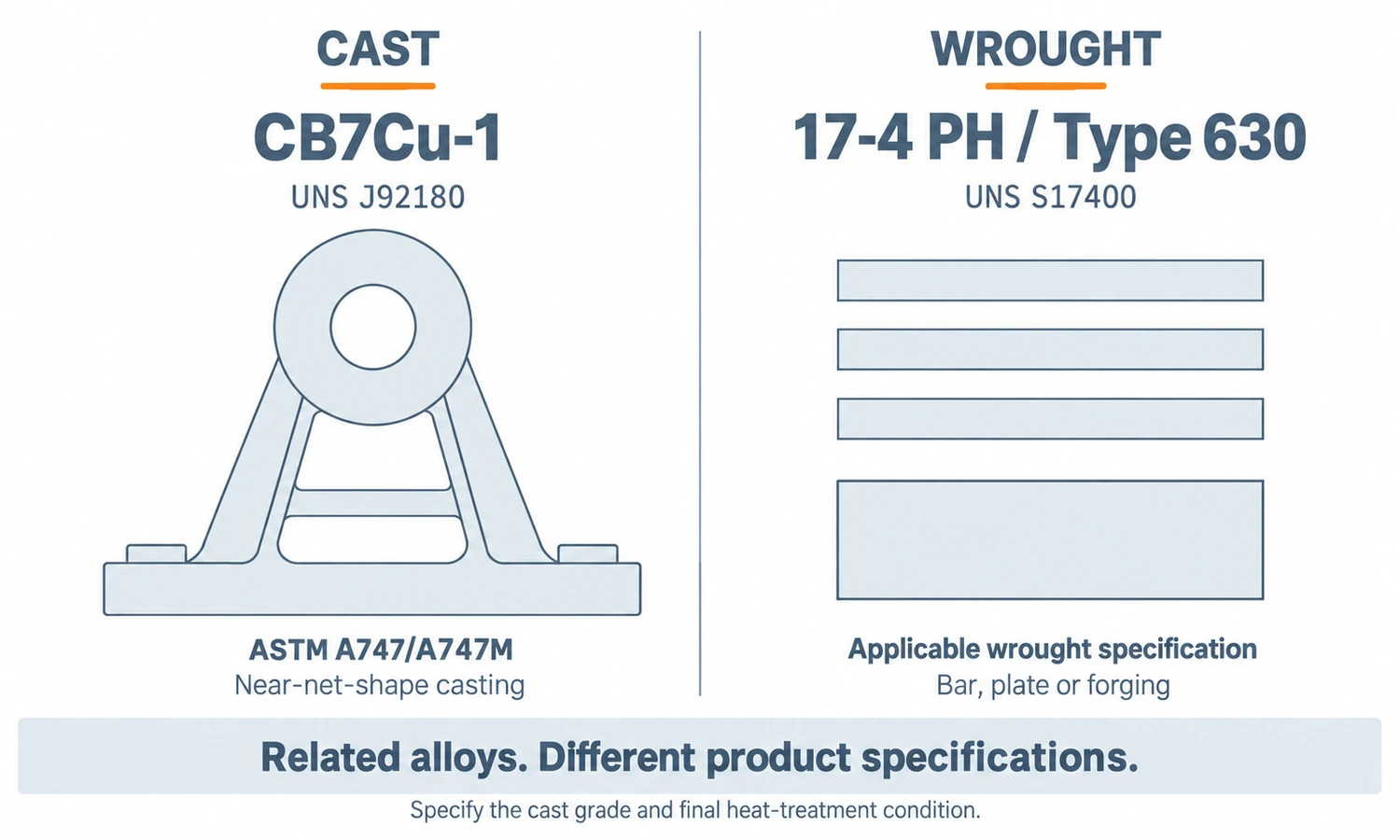
The Steel Founders’ Society of America lists wrought 17-4 PH as the corresponding alloy for CB7Cu-1, while explicitly warning that cast and wrought composition ranges are not identical and that buyers should use the cast alloy designation when identifying castings. SFSA Corrosion-Resistant Steel Casting Data
So a drawing for an investment casting is better specified as:
ASTM A747/A747M, Grade CB7Cu-1, required heat-treatment condition
rather than simply:
17-4 PH stainless steel
This is the same principle we discuss more broadly in our Cast Stainless Steel guide: cast and wrought grades can be related without being identical specifications.
CB7Cu-1 Chemical Composition
ASTM A747/A747M-23 defines CB7Cu-1 as an iron-chromium-nickel-copper precipitation-hardening stainless casting alloy.
The current composition limits include:
| Element | ASTM A747 CB7Cu-1 |
|---|---|
| Carbon | 0.07% max |
| Manganese | 0.70% max |
| Silicon | 1.00% max |
| Phosphorus | 0.035% max |
| Sulfur | 0.030% max |
| Chromium | 15.50–17.70% |
| Nickel | 3.60–4.60% |
| Copper | 2.50–3.20% |
| Niobium / Columbium | 0.15–0.35%* |
| Nitrogen | 0.05% max when specified |
*ASTM A747 includes a special note for H900 regarding the minimum niobium requirement. ASTM A747/A747M-23
Chromium provides the stainless corrosion-resistant base. Nickel supports the required phase balance and transformation behavior, while copper is central to the precipitation-hardening response.
The chemistry is deliberately controlled for a cast product, so it should not be replaced automatically with the chemistry limits from a wrought S17400 specification.
Why CB7Cu-1 Is Precipitation Hardened
CB7Cu-1 obtains its final strength through precipitation hardening rather than through the conventional quench-and-temper route used for many alloy steels.
The general sequence is:
casting → solution heat treatment → cooling → precipitation aging
After solution treatment, the material is in a condition that can still be machined relatively effectively.
A lower-temperature aging treatment then develops the final strength and hardness.
ASTM A747/A747M-23 specifically notes that castings can be machined in the solution heat-treated condition and then precipitation hardened to the required final properties with relatively little risk of cracking or distortion compared with more severe hardening routes. ASTM A747/A747M-23
This sequence is one reason CB7Cu-1 works well for precision investment castings that still require CNC finishing.
CB7Cu-1 Heat Treatment Conditions
ASTM A747/A747M-23 defines several precipitation-hardening conditions.
| Condition | Aging Temperature | Minimum Time | Cooling |
|---|---|---|---|
| H900 | 900°F / 480°C | 1.5 h | Air cool |
| H925 | 925°F / 495°C | 1.5 h | Air cool |
| H1025 | 1025°F / 550°C | 4 h | Air cool |
| H1075 | 1075°F / 580°C | 4 h | Air cool |
| H1100 | 1100°F / 595°C | 4 h | Air cool |
| H1150 | 1150°F / 620°C | 4 h | Air cool |
The standard also includes H1150M and H1150 double-aging routes for specific applications. ASTM A747/A747M-23
The number after the H therefore refers to the aging temperature in degrees Fahrenheit.
It is not simply a hardness grade.
Changing the aging temperature changes the microstructure and therefore the balance among strength, hardness, elongation, toughness, and stress-corrosion behavior.
Mechanical Properties of CB7Cu-1 by Heat Treatment
The heat-treatment condition creates a large change in mechanical performance.
ASTM A747/A747M-23 provides the following minimum values when the relevant supplementary mechanical-property requirements are specified:
| Condition | Min. Tensile Strength | Min. Yield Strength | Min. Elongation | Hardness Requirement |
|---|---|---|---|---|
| H900 | 1170 MPa / 170 ksi | 1000 MPa / 145 ksi | 5% | 375 HBW / 40 HRC |
| H925 | 1205 MPa / 175 ksi | 1035 MPa / 150 ksi | 5% | 375 HBW / 40 HRC |
| H1025 | 1035 MPa / 150 ksi | 965 MPa / 140 ksi | 9% | 311 HBW / 33 HRC |
| H1075 | 1000 MPa / 145 ksi | 795 MPa / 115 ksi | 9% | 277 HBW / 29 HRC |
| H1100 | 930 MPa / 135 ksi | 760 MPa / 110 ksi | 9% | 269 HBW / 28 HRC |
| H1150 | 860 MPa / 125 ksi | 670 MPa / 97 ksi | 10% | 269 HBW / 28 HRC |
ASTM A747/A747M-23
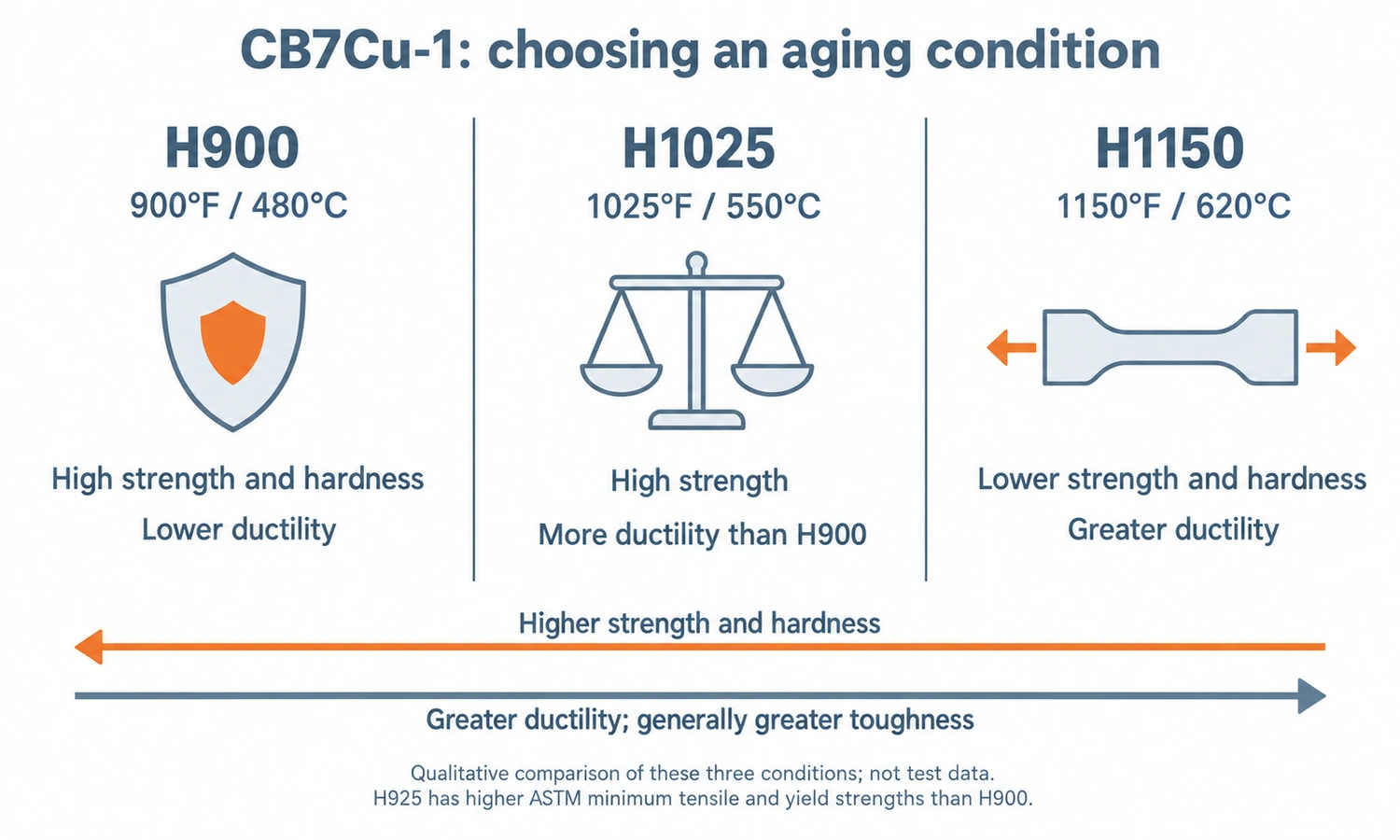
The overall trend is clear.
Lower aging temperatures produce the highest strength and hardness.
Higher aging temperatures reduce strength but improve ductility and generally move the alloy toward greater toughness.
H925 is slightly stronger than H900 in the ASTM minimum values, so the relationship is not perfectly monotonic at the lowest aging temperatures. The broader engineering tradeoff, however, remains strength versus ductility and toughness.
H900 vs. H1025 vs. H1150
Three conditions illustrate the selection logic particularly well.
H900: High Strength and Hardness
H900 provides very high strength and hardness.
The ASTM minimums are 1170 MPa tensile strength, 1000 MPa yield strength, and 40 HRC, with only 5% minimum elongation.
This condition makes sense where maximum strength, hardness, or wear resistance is more important than impact toughness or high ductility.
It should not be selected automatically just because it produces the highest hardness.
H1025: High Strength With More Ductility
H1025 lowers hardness to about 33 HRC minimum while increasing minimum elongation to 9%.
Yield strength remains high at 965 MPa.
For many mechanical components, this provides a more balanced combination of strength and ductility than H900.
H1150: Lower Strength, Greater Ductility
H1150 reduces the ASTM minimum tensile strength to 860 MPa and yield strength to 670 MPa, while minimum elongation increases to 10%.
The Steel Founders’ Society of America also reports substantially higher representative Charpy impact values as aging temperature rises from H900 toward H1150. SFSA CB7Cu Alloy Data
H1150 is therefore relevant when toughness, lower hardness, or resistance to certain stress-corrosion conditions matters more than maximum strength.
The application should determine the condition.
Solution Treatment Is Not the Final Service Condition
One important point in ASTM A747/A747M-23 is easy to miss:
CB7Cu-1 is not intended to be used in the solution heat-treated condition as its normal final service condition.
Solution treatment prepares the microstructure for later precipitation hardening.
The current ASTM standard allows castings to be ordered in the solution heat-treated condition where needed for manufacturing, but the final precipitation-hardening condition still needs to be defined for the intended material performance.
This makes a drawing note such as:
CB7Cu-1
incomplete for many projects.
A much more useful requirement is:
ASTM A747/A747M CB7Cu-1, H1025
or another specified aging condition.
The grade tells the foundry what alloy to cast.
The condition tells the foundry what final material state the component needs.
Machining Before Final Aging
CB7Cu-1 is particularly useful when a complex casting also needs precision-machined features.
The alloy can be machined after solution treatment, before final precipitation hardening.
That may include features such as:
- precision bores;
- sealing faces;
- bearing seats;
- threads;
- mounting surfaces.
The final aging treatment occurs at a much lower temperature than the original solution treatment, reducing the risk of severe dimensional movement after machining.
ASTM A747 specifically highlights this manufacturing sequence as an advantage of precipitation-hardenable stainless castings.

At YTD, both heat treatment and CNC machining are part of our in-house investment-casting workflow. For CB7Cu-1 projects, the machining sequence can therefore be planned together with the required final heat-treatment condition instead of treating casting and machining as separate operations.
Our Investment Casting Machining Allowance guide explains how raw casting geometry and machining stock are planned around this type of finished component.
Corrosion Resistance of CB7Cu-1
CB7Cu-1 combines high mechanical strength with useful stainless-steel corrosion resistance.
The SFSA alloy data describes CB7Cu as having corrosion resistance between the non-hardenable austenitic CF casting grades and the hardenable martensitic CA grades, with resistance to atmospheric corrosion and a range of aqueous environments. SFSA CB7Cu Alloy Data
That balance is important.
CB7Cu-1 is usually selected because the component needs much higher strength than a conventional 300-series-type cast stainless, while still retaining useful corrosion resistance.
It should not automatically replace CF8M or a duplex grade in aggressive chloride or chemical service.
Corrosion environment remains a separate material-selection requirement.
Our Cast Stainless Steel guide compares precipitation-hardening, austenitic, martensitic, and duplex cast stainless families in more detail.
Cast CB7Cu-1 vs. Wrought 17-4 PH
The difference between cast and wrought material is more than the grade name.
Wrought 17-4 PH begins as an ingot or other primary material and is subsequently rolled, forged, drawn, or otherwise mechanically worked.
An investment casting solidifies much closer to the final component geometry.
That difference changes the solidification structure, segregation behavior, and resulting microstructure.
NIST research describes CB7Cu-1 as the casting alloy analog to wrought 17-4 PH and specifically uses the casting heat-treatment route to address dendritic microstructure and segregation. NIST — 17-4 PH Post-Processing Heat Treatment
So wrought-property tables should not be copied directly onto a casting drawing.
If the component is cast, specify the cast grade and casting standard.
If it is machined from bar, plate, or forging, use the applicable wrought specification.
Why Investment Casting Works Well for CB7Cu-1
CB7Cu-1 is often chosen for components that need both complex geometry and high final strength.
Investment casting can form:
- ribs and bosses;
- curved surfaces;
- integrated mounting features;
- relatively thin sections;
- complex near-net-shape geometry.
The casting can then be heat treated and selectively machined where tighter dimensional control is required.
This is particularly useful when machining the entire component from wrought 17-4 PH stock would remove a large amount of material or require many setups.
Investment casting does not make the alloy stronger. The value comes from producing the geometry close to final shape while the subsequent heat treatment develops the required material properties.
For the broader process and material options, see our Stainless Steel Investment Casting guide and Investment Casting Materials Guide.
Typical Applications for CB7Cu-1 Castings
The combination of strength, hardness, corrosion resistance, and castability makes CB7Cu-1 useful in components such as:
- valve and pump parts;
- aerospace hardware;
- actuator components;
- chemical-processing equipment;
- marine and fluid-handling components;
- mechanical parts requiring high strength in a corrosion-resistant stainless alloy.
ASTM A747 covers these castings for applications requiring corrosion resistance and high strength at temperatures up to 600°F / 315°C. ASTM A747/A747M-23
The exact application still determines the required aging condition.
A hard wear-loaded component and a toughness-sensitive valve part may use the same CB7Cu-1 chemistry but should not automatically use the same heat treatment.
When to Choose CB7Cu-1
CB7Cu-1 becomes a strong candidate when three requirements appear together:
stainless corrosion resistance + high mechanical strength + geometry that benefits from casting
If corrosion resistance is the primary requirement and very high strength is unnecessary, an austenitic grade such as CF8 or CF8M may be simpler.
If severe chloride resistance dominates, a suitable duplex cast stainless may provide a better corrosion-strength balance.
If maximum hardness or wear resistance matters more than corrosion performance, a martensitic stainless or another alloy family may deserve comparison.
CB7Cu-1 earns its place when precipitation hardening provides the property combination the component actually needs.
Specifying 17-4 PH Investment Castings on a Drawing
For a production casting, avoid specifying only:
17-4 PH
A clearer requirement identifies:
- cast specification + cast grade + heat-treatment condition
For example:
- ASTM A747/A747M-23
- CB7Cu-1
- H1025
Additional requirements can then define machining, inspection, hardness or tensile verification, NDT, and surface finishing where needed.
ASTM A747 also allows supplementary requirements for hardness testing, tensile testing, magnetic particle inspection, radiography, liquid penetrant inspection, and other controls when the purchaser specifies them.
For investment castings ordered to ASTM material specifications, ASTM A957/A957M provides common requirements for steel and alloy investment castings. ASTM A957/A957M
The drawing should therefore describe the actual cast product rather than relying on a familiar wrought alloy nickname.
Final Thoughts
17-4 PH investment casting is best specified as CB7Cu-1 under ASTM A747, together with the required precipitation-hardening condition.
The alloy name alone does not define the final performance. H900, H1025, H1150, and the other aging conditions create very different combinations of strength, hardness, elongation, and toughness.
For design and purchasing, treat grade + heat-treatment condition as one material decision. That is the key to using CB7Cu-1 successfully in high-strength stainless investment castings.
FAQs
Is CB7Cu-1 the Same as 17-4 PH?
CB7Cu-1 is the cast Type 17-4 grade under ASTM A747, while wrought 17-4 PH is commonly UNS S17400 / Type 630 under wrought-product specifications. They are closely related but should not be treated as identical material specifications.
What Is the UNS Number for Cast 17-4 PH?
CB7Cu-1 is UNS J92180.
What Is the Strongest CB7Cu-1 Heat Treatment Condition?
Under ASTM A747/A747M-23 supplementary mechanical requirements, H925 has the highest listed minimum tensile and yield strengths: 1205 MPa tensile and 1035 MPa yield, while H900 carries the same minimum hardness requirement of 40 HRC.
What Is the Difference Between H900 and H1150?
H900 provides much higher strength and hardness with lower elongation. H1150 reduces strength and hardness while increasing ductility and generally improving toughness.
Can CB7Cu-1 Be Machined Before Aging?
Yes. ASTM A747 specifically allows machining in the solution heat-treated condition followed by precipitation hardening to the required final condition.
Is CB7Cu-1 Corrosion Resistant?
Yes. It combines useful stainless corrosion resistance with much higher strength than conventional austenitic cast stainless grades, but the specific environment still needs to be considered when selecting between CB7Cu-1, CF8M, duplex, or other stainless casting grades.