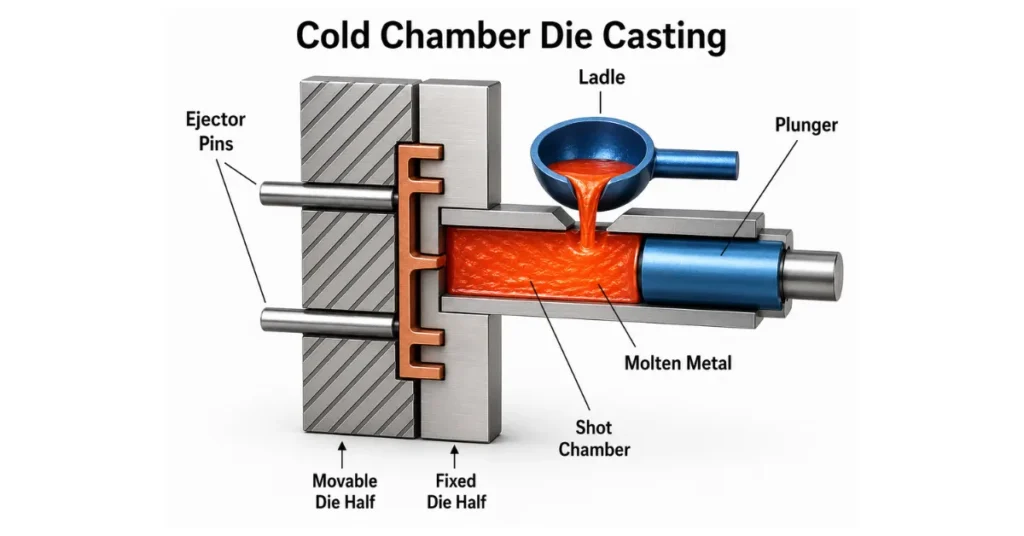
Cold chamber die casting is a high-pressure manufacturing process in which molten metal is prepared in a separate furnace and transferred into the machine’s shot sleeve for each casting cycle. A hydraulic plunger then forces the metal into a reusable steel die, where it solidifies into the required component.
The term “cold chamber” does not mean that cold metal is injected. It refers to the injection mechanism, which is not continuously immersed in molten metal. This arrangement allows the process to handle alloys that would damage or rapidly wear the submerged injection components used in a hot chamber machine.
Cold chamber equipment is widely associated with aluminum and is also used for selected magnesium, copper-based and high-aluminum zinc alloys. The exact material and machine combination must still be confirmed with the supplier. The North American Die Casting Association identifies these as the principal alloy categories used with the process.
As a form of die casting, the process can produce complex parts at repeat production volumes. However, metal transfer, air displacement, temperature loss, die design and injection control directly affect porosity, surface condition, dimensional stability and machining performance. Buyers should therefore evaluate more than production speed when deciding whether cold chamber die casting is suitable for a component.
How the Cold Chamber Die Casting Process Works
The cold chamber die casting process begins with molten alloy held in a separate furnace. For each cycle, a measured quantity of metal is transferred by ladle or automated dosing system into the machine’s horizontal shot sleeve.
Melting and Transferring the Alloy
The alloy must reach the shot sleeve at a controlled temperature and within a consistent transfer time. Excessive delay can increase temperature loss and premature solidification, while unstable dosing can change the amount of metal available to fill the die.
The shot quantity must be sufficient to fill the cavity, runners, overflows and the remaining biscuit at the end of the sleeve. Too little metal can cause incomplete filling, while excessive dosing increases waste and may disturb process stability.
Filling the Shot Sleeve and Injecting the Metal
After the metal enters the sleeve, the plunger initially moves forward at a controlled speed. This stage is intended to advance the melt while limiting excessive turbulence and air entrapment. The plunger then accelerates, forcing the alloy through the runner and gate system into the die cavity.
Once the cavity is filled, higher pressure is applied and maintained as the metal begins to solidify. This intensification stage helps feed areas affected by solidification shrinkage and supports dimensional consistency. However, pressure alone cannot correct poor gating, unsuitable wall transitions or trapped air.
Solidification, Ejection and Trimming
Cooling channels within the die remove heat until the casting can retain its shape. The die then opens, ejector pins release the part, and the runner, biscuit, overflows and flash are removed.
The completed casting may subsequently require machining, deburring, shot blasting, coating, leak testing or dimensional inspection. Stable results therefore depend on the complete process—from metal transfer and injection through cooling, trimming and secondary operations—not only on the pressure used to fill the die.
Which Metals Are Suitable for Cold Chamber Die Casting?
Cold chamber die casting is mainly used for alloys that melt at relatively high temperatures or would aggressively attack the submerged injection components of a hot chamber machine.
Aluminum is the most common material for this process. Its low density, corrosion resistance, strength-to-weight ratio and ability to form complex shapes make aluminum die casting suitable for automotive, electrical, industrial and consumer components. Common grades include A380, A360 and ADC12, although the correct alloy depends on strength, castability, corrosion exposure, machining and finishing requirements.
Selected magnesium alloys may also be processed in cold chamber machines, particularly for larger parts or applications where the machine configuration requires it. Copper-based alloys can be cast as well, but their higher temperatures create greater thermal stress on the die and injection system, which can increase tooling wear and production cost.
Some zinc alloys with relatively high aluminum content may also require cold chamber equipment. However, standard zinc die casting is more commonly associated with hot chamber machines.
Buyers should specify the exact alloy grade rather than requesting only “aluminum,” “magnesium” or “zinc.” Material selection affects machine type, die life, shrinkage, wall thickness, machining allowance, surface finishing and inspection requirements. The quotation should therefore confirm both the proposed alloy and the equipment used to process it.
Advantages, Limitations and Cost Drivers
Cold chamber die casting supports large-scale production of complex metal parts with consistent dimensions and relatively smooth surfaces. It can form thin walls, ribs, bosses, mounting features and other details in a single casting, which can reduce assembly work and secondary machining.
The process is particularly valuable for aluminum components where low weight, corrosion resistance and repeatable geometry are important. Reusable steel dies also make it suitable for programs with stable designs and sustained production demand.
However, cold chamber casting includes an additional metal-transfer step that is not required in hot chamber equipment. Each ladling or dosing cycle creates opportunities for temperature loss, oxide formation, inconsistent shot volume and air entrapment. Cycle times are therefore generally longer than those of comparable hot chamber production.
Tooling also represents a major upfront investment. Total project cost may include the die, slides, cores, trimming tools, fixtures, sample approval, machining and inspection equipment. High-temperature alloys can accelerate die wear, while complex undercuts, tight tolerances and deep machining requirements increase both tooling and production costs.
The final cost depends on annual and lifetime production volume, part weight, projected area, machine clamping force, cavity count, movable slides or cores, machining, finishing, inspection, leak testing and the expected life of the die. Tool maintenance and replacement responsibility should also be agreed before production begins.
Cold chamber die casting is most economical when demand is repeatable, the design is stable and the tooling investment can be distributed across a sufficiently large production program. Buyers should therefore compare total program cost rather than relying only on the quoted unit price.
Suitable Parts and DFM Requirements
Cold chamber die casting is best suited to components that combine repeat production demand with complex geometry, thin sections, mounting features or dimensional requirements that would be costly to create through machining alone. Typical applications include housings, covers, brackets, structural supports, heat-management components, motor parts and automotive assemblies.
Part suitability depends more on geometry and performance requirements than on the product category. Uniform wall thickness generally supports smoother metal flow, more predictable solidification and lower porosity risk. Sudden changes from thin to heavy sections can create hot spots, shrinkage and dimensional variation. Thick isolated areas should therefore be reduced, cored out or redesigned with ribs where possible.
Draft angles are required so the casting can release from the die without excessive force or surface damage. Undercuts, side holes and recessed features may require slides or moving cores, which increase die complexity, maintenance and cycle time. Designers should also allow suitable locations for gates, overflows, ejector pins and the parting line.
Tolerances should be assigned according to function rather than applied uniformly across the drawing. Sealing faces, bearing locations, threads and precision interfaces may require machining, while non-critical cast surfaces can often retain practical die-casting tolerances.
A DFM review before tooling approval should confirm wall thickness, draft, radii, machining allowances, critical dimensions, cosmetic areas and ejection requirements. Early correction is significantly less expensive than modifying a hardened production die after sample testing.
Quality Risks and Process Controls
Cold chamber die casting can produce repeatable parts, but the transfer of molten metal into the shot sleeve creates additional opportunities for air entrapment, oxide formation and temperature loss. These risks must be controlled through stable dosing, injection settings, die temperature, venting and cooling.
Porosity is one of the most important concerns. Gas porosity may develop when air becomes trapped during filling, while shrinkage porosity can form in heavy sections that are not adequately fed during solidification. These defects may remain hidden until the part is machined, leak tested or placed under load.
Oxide inclusions can also enter the casting when the molten metal surface is disturbed during transfer. Turbulent filling, inconsistent ladling or excessive delay between dosing and injection can increase this risk. The shot sleeve fill level and plunger-speed profile should therefore be controlled so that the metal advances without unnecessary turbulence before high-speed filling begins.
Cold shuts and incomplete filling may occur when the alloy loses too much heat before reaching thin or distant sections of the cavity. Flash can result from excessive pressure, poor die closure, parting-line damage or tooling wear. Dimensional variation may be linked to unstable die temperature, cooling imbalance or progressive wear of inserts and moving components.
The inspection plan should reflect the function of the part. Critical dimensions, sealing surfaces, threads, machining zones and cosmetic areas should be identified before tooling. Leak testing, X-ray inspection or other internal-defect testing should only be specified where the application justifies the additional cost.
Sample approval should include dimensional results, material certification, visual standards and any required functional testing. Buyers should also confirm how process changes and tooling repairs will be controlled after production begins.
Cold Chamber vs Hot Chamber Die Casting
The main difference between cold chamber and hot chamber die casting is the location of the molten metal and injection system. In cold chamber production, the alloy is melted in a separate furnace and transferred into the shot sleeve for every cycle. In hot chamber die casting, the injection mechanism remains connected to or immersed in the molten metal supply.
This distinction largely determines which alloys each process can handle. Cold chamber machines are commonly used for aluminum and other alloys that operate at higher temperatures or would damage a submerged injection system. Hot chamber machines are mainly associated with zinc and selected magnesium alloys.
Hot chamber equipment generally provides shorter cycles because it does not require a separate metal-transfer step. Cold chamber production takes longer, but it provides access to a wider range of higher-temperature alloys and is suitable for many larger aluminum components.
Neither process is automatically better. The correct choice depends first on alloy compatibility and then on part size, geometry, required properties, surface finish, production volume, machining and quality requirements. Buyers should therefore select the material and performance requirements before comparing machine speed or unit price.
What Buyers Should Include in the RFQ
A complete RFQ helps the supplier evaluate machine size, alloy suitability, tooling complexity, secondary operations and quality requirements before preparing a quotation. The buyer should provide both a 3D model and a controlled technical drawing so that geometry and dimensional requirements can be reviewed together.
The drawing should identify the exact alloy grade, annual quantity, expected program life, critical dimensions, tolerances, machining locations, threaded features, sealing surfaces and cosmetic areas. Any restrictions on gate marks, ejector-pin marks or parting-line locations should also be stated before the die layout is finalized.
Surface finishing requirements must be clearly defined because painting, powder coating, anodizing, conversion coating or polishing may require different controls over porosity, surface defects and handling. Where the part must hold pressure or contain fluids, the RFQ should specify the test medium, pressure, test duration and acceptable leakage level.
The quotation should separate tooling, samples, casting, machining, finishing, inspection, packaging and shipping costs. It should also confirm the proposed cavity count, expected die life, sample approval procedure, production lead time and responsibility for tool maintenance or replacement.
Where the design is still flexible, buyers should request a DFM review before authorizing tooling. Early review can identify unnecessary tolerances, difficult undercuts, heavy sections, unsuitable machining allowances and quality requirements that would otherwise increase cost or rejection risk.
Conclusion
Cold chamber die casting is a practical choice for repeat production of aluminum and other higher-temperature alloy components that require complex geometry, dimensional consistency and efficient large-scale manufacturing.
Its suitability depends on more than alloy selection. Metal transfer, shot control, die design, wall thickness, venting, machining and inspection requirements all influence cost and quality. Buyers should therefore provide complete technical data and request a DFM review before approving tooling.
A well-prepared RFQ allows the supplier to assess the correct alloy, machine size, cavity layout, secondary operations and quality controls, reducing the risk of costly changes after sample production.
FAQs
Why is it called cold chamber die casting?
The name refers to the injection system rather than the temperature of the metal. Molten alloy is transferred from a separate furnace into the shot sleeve for each cycle, so the injection mechanism is not continuously immersed in the melt.
Which metals are used in cold chamber die casting?
Aluminum is the most common material. Selected magnesium, copper-based and high-aluminum zinc alloys may also be processed, depending on the machine and production setup. Buyers should specify the exact alloy grade because material selection affects tooling, shrinkage, finishing, machining and expected die life.
Is cold chamber die casting more expensive than hot chamber casting?
Cold chamber production usually has a longer cycle because molten metal must be transferred into the shot sleeve. However, the final cost depends on part weight, machine size, cavity count, tooling complexity, alloy price, machining, finishing and inspection. The comparison should therefore be based on total program cost rather than cycle time alone.
Can cold chamber die castings be pressure-tight?
Pressure-tight parts are possible, but they require suitable geometry, controlled filling, effective venting and a clearly defined leak-test requirement. Heavy sections, deep machining and trapped air can increase porosity risk. Pressure, test medium, test duration and acceptable leakage should be specified before tooling begins.
Is cold chamber die casting suitable for prototypes?
Permanent steel tooling generally makes the process more suitable for repeat production than for early prototypes. Machining or another rapid manufacturing method may be more economical while the design is still changing. Cold chamber tooling becomes more attractive once geometry, material and expected production demand are sufficiently stable.