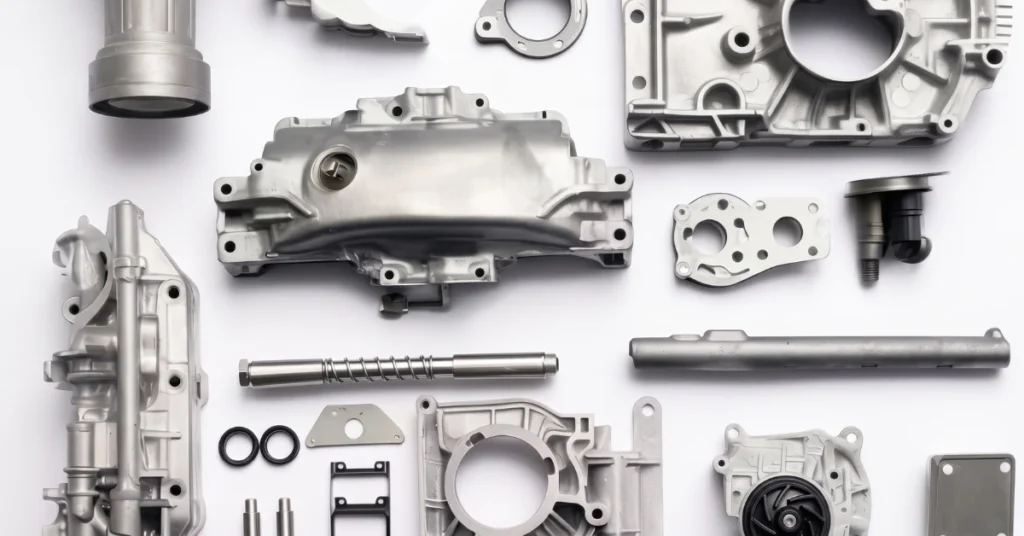
Aluminum die casting is used when a buyer needs a light, rigid metal component with repeatable dimensions and production volumes high enough to justify permanent tooling. Motor housings, electronic enclosures, heat sinks, lighting bodies, brackets, covers, and automotive components are common examples.
The process can form several functional features in one cycle, reducing later machining and assembly. Its success, however, depends on more than the casting price. Alloy choice, wall thickness, annual volume, porosity risk, finishing, and tool life all affect whether aluminum die casting is the right manufacturing route.
What Is Aluminum Die Casting?
Aluminum die casting is a permanent-mold process in which molten aluminum alloy is injected into a hardened steel die. The alloy fills the cavity, cools, and is ejected as a near-net-shape part. The same die is then reused for the next cycle.
Aluminum is normally processed in a cold-chamber machine. The metal is melted separately, transferred into a shot sleeve, and driven into the die at high speed and pressure. This is different from conventional hot-chamber production, where the injection system is immersed in the molten alloy.
This page focuses specifically on aluminum. The main die casting guide explains the wider process family, including zinc, magnesium, high-pressure, low-pressure, and gravity routes.
How the Aluminum Die Casting Process Works
The production cycle is fast, but the engineering work begins before metal enters the machine. The supplier first reviews the drawing, selects the alloy, establishes the parting line, and designs the cavity, runners, gates, vents, overflows, cooling channels, ejector system, and any moving slides.
During casting, the die closes and clamps. A measured quantity of molten aluminum enters the shot sleeve, and a plunger forces it into the cavity. After solidification, the die opens and ejector pins release the part. Runners, gates, flash, and overflow material are removed before the casting moves to inspection, machining, or finishing.
Process stability depends on metal cleanliness, die temperature, shot control, venting, and cooling balance. You can learn more about the die casting process if you want to know the production variables that you need to know while making an order.
Why Use Aluminum for Die Casting?
Aluminum combines low density with useful stiffness, corrosion resistance, thermal conductivity, and electrical conductivity. It also flows into complex cavities, making it practical to form ribs, bosses, fins, mounting points, and other features directly in the die.
For a buyer, the greatest value may come from part consolidation. A housing that previously required a machined body, separate brackets, heat-dissipation fins, and several fasteners may sometimes be redesigned as one casting. That can reduce component count, assembly time, handling, and inspection.
Aluminum is not the lightest die-casting material, nor does it match the strength of every wrought or forged alloy. Its advantage is the balance between component performance and repeat-production efficiency.
Common Aluminum Die Casting Alloys
Alloy selection affects filling, corrosion resistance, pressure tightness, wear, machining, finishing, and mechanical performance. The drawing should name the required grade or explain the functional requirements clearly enough for the foundry to recommend one.
| Alloy | Why it is considered | What the buyer should check |
| A380 | General-purpose balance of castability and performance | Corrosion, pressure tightness, machining, and finish |
| A360 | Often considered for corrosion resistance and pressure-related parts | Casting difficulty and project-specific mechanical needs |
| A413 | Good filling behavior for detailed or pressure-related castings | Strength, machining, and service load |
| A390 | Higher silicon content for wear-sensitive parts | Lower ductility and impact requirements |
| ADC12 | Common in Asian supply chains for general die cast parts | Exact composition standard and cross-reference to the buyer’s specification |
A380 is widely used for housings, covers, brackets, tools, and general industrial components. A360, A413, and A390 become more relevant when one property is more important than broad all-round performance. ADC12 is common in China and other Asian markets, but an apparent equivalent should not be accepted without confirming the chemical limits and required properties.
Specifications should refer to an applicable standard, such as those issued by ASTM International, while alloy designations can be checked through The Aluminum Association. The purchase order should also state whether certificates, chemical analysis, mechanical testing, or special traceability are required.
A356 often appears in general aluminum-casting discussions, but it is more commonly associated with gravity or low-pressure casting than conventional high-pressure die casting. This is why “cast aluminum” is not a complete material specification. For a comparison between aluminum, zinc, magnesium, and other die-casting metals check out die casting materials guide.
Aluminum Die Casting Applications
Aluminum die casting is most useful when the part benefits from integrated features and will be produced repeatedly. Automotive and mobility applications include motor housings, transmission-related covers, structural brackets, electronic-control housings, and thermal-management parts.
Electrical and electronic products use die cast aluminum for heat sinks, LED lighting bodies, telecommunications housings, power-electronics enclosures, and components requiring stiffness, heat transfer, grounding, or electromagnetic shielding.
Industrial machinery uses the process for pump covers, actuator housings, motor bodies, tool casings, and control-system components. It also appears in appliances, renewable-energy equipment, robotics, furniture hardware, and consumer products.
The quality plan changes with the application. A decorative lighting body may be driven by appearance, while a pump component may require leak testing and controlled machining around sealing surfaces.
Advantages of Aluminum Die Casting
The main advantage is the ability to produce complex parts repeatedly. Ribs, bosses, holes, fins, and mounting features can often be formed in the die, reducing machining and assembly.
Once the tool and production window are stable, dimensional consistency is generally good. Surface quality is also better than many sand-cast surfaces, so less preparation may be needed before painting or powder coating.
The process becomes economically attractive when the tooling cost can be spread across a stable volume. Part consolidation may add further savings by replacing several machined, stamped, or fabricated pieces with one casting.
Limitations and Trade-Offs
Tooling is the main barrier. A steel die requires design, machining, trials, correction, and maintenance. Aluminum die casting is therefore difficult to justify for very small orders or products that are still changing.
Late design revisions are expensive because they may require die welding, remachining, new inserts, or a replacement tool. A serious DFM review should therefore take place before tooling approval.
Porosity is another important limitation. Gas can become trapped during rapid filling, while shrinkage can form where sections cool unevenly. Small internal pores may be acceptable in a non-critical cover but serious in a pressure-tight housing, a deeply machined bore, or a part intended for welding or demanding heat treatment.
The process also uses cast aluminum alloys. When a component specifically needs the properties of wrought 6061 or 7075, CNC machining, forging, or extrusion may be more appropriate.
Design Decisions That Affect Cost and Quality
Uniform wall thickness is a useful starting point. Heavy sections next to thin walls cool unevenly and can increase shrinkage, distortion, and cycle time. Ribs often add stiffness more efficiently than increasing the full wall thickness.
Draft helps the part release from the die. Internal corners need suitable radii, while deep undercuts may require slides or other moving tool components. The parting line should avoid critical sealing faces, cosmetic zones, and tightly controlled dimensions where practical.
Machining should also be planned before the tool is built. Bearing seats, sealing faces, threads, and precision bores may need extra stock. Excessive machining adds cost and may expose porosity, so it should be limited to functional surfaces.
More detailed guidance on ribs, bosses, draft, gates, runners, wall thickness, and tolerances belongs in the future die casting design guide.
Common Defects and Quality Checks
Porosity receives the most attention, but other defects also matter. Cold shuts can form where metal streams meet without joining properly. Misruns occur when the alloy solidifies before the cavity fills. Flash may point to die wear or poor closure, while shrinkage often develops near heavy sections and unbalanced cooling zones.
Prevention begins with design and process control. Gating, venting, metal cleanliness, die temperature, shot settings, and cooling all contribute. Inspection can detect problems, but it cannot turn an unstable process into a reliable one.
The inspection plan should match the consequence of failure. A simple bracket may only need dimensional checks. A sealed housing may require leak testing and X-ray inspection. Critical projects may also require CMM reports, material analysis, coating checks, and documented process controls. These issues will be covered more fully in the die casting defects guide.
Aluminum Die Casting vs Other Processes
| Process | Consider it instead when… |
| Sand casting | Quantities are lower, parts are larger, or tooling investment must remain low |
| Investment casting | Steel, stainless steel, or high-temperature alloys are required with intricate geometry |
| CNC machining | Volume is low, design changes are expected, or wrought-material properties are essential |
| Plastic injection molding | Metal stiffness, heat transfer, shielding, and wear resistance are unnecessary |
| Zinc die casting | The component is small, highly detailed, and benefits from zinc’s surface quality and hot-chamber production |
The comparison should be based on the finished part and expected production life. A die casting may have a lower unit cost but a higher initial investment. A machined part may cost more per piece but avoid tooling and allow rapid revisions.
What Drives Aluminum Die Casting Cost?
Tool size and complexity usually dominate the initial investment. Slides, multiple cavities, complex ejection, tight tolerances, and difficult cooling requirements raise the tooling cost. Part size also determines machine capacity.
The unit price depends on alloy, casting weight, cycle time, cavity count, scrap rate, machining, finishing, inspection, packaging, and volume. A low casting price can become expensive if it excludes CNC work, coating, quality documents, or tool maintenance.
For a fair comparison, ask suppliers to separate tooling, sample approval, casting, machining, finishing, inspection, and logistics. Tool ownership and maintenance responsibility should also be stated clearly.
What to Include in an Aluminum Die Casting RFQ
A useful RFQ includes the 3D model, controlled 2D drawing, annual volume, batch size, required alloy, surface finish, critical tolerances, and machining or assembly work. It should identify cosmetic surfaces, sealing areas, leak-test requirements, and features linked to safety or performance.
The operating environment also matters. Temperature, corrosion, impact, pressure, grounding, heat dissipation, and contact with other metals can change the recommended alloy, coating, and inspection plan.
YTD Foundry can review these requirements before tooling to assess manufacturability and identify the decisions that have the greatest effect on cost and reliability.
Conclusion
Aluminum die casting is a strong option for repeat components that need low weight, complex geometry, dimensional consistency, and limited machining. Its economics improve with volume, but only when the alloy, part design, tool, and quality plan are developed together.
Before requesting quotations, define the part function, expected volume, critical dimensions, finishing, and inspection requirements. That gives the supplier enough information to recommend the right alloy and control the risks that matter most.
FAQs
Is aluminum die casting suitable for low-volume parts?
It can be used, but the tool must be justified. CNC machining, sand casting, or another process is usually more economical when quantities are low or the design is still changing.
What is the most common aluminum die casting alloy?
A380 is widely used as a general-purpose grade in North American specifications. The best alloy still depends on corrosion, pressure, wear, machining, and finishing needs.
Can aluminum die cast parts be anodized?
Yes, but appearance and consistency depend on alloy chemistry, silicon content, surface condition, and anodizing control. Cosmetic expectations should be agreed before production.
Can aluminum die castings be welded or heat treated?
Some alloys and process routes allow these operations, but porosity and alloy composition can limit the result. Declare welding or heat-treatment requirements during the RFQ.
How is porosity checked in aluminum die casting?
The method depends on the risk. Options include X-ray inspection, CT scanning, leak testing, sectioning, machining trials, and functional testing.