A356 is widely used for aluminum castings, from wheels to housings. Yet two parts labeled A356-T6 can perform differently. Understanding the alloy, the casting method, and the test conditions helps explain what this material offers—and what its name alone cannot tell you.
What Is A356 Aluminum?
A356 is a heat-treatable aluminum-silicon-magnesium casting alloy. It combines good mold-filling behavior with useful strength after heat treatment, making it a common candidate for lightweight cast components.
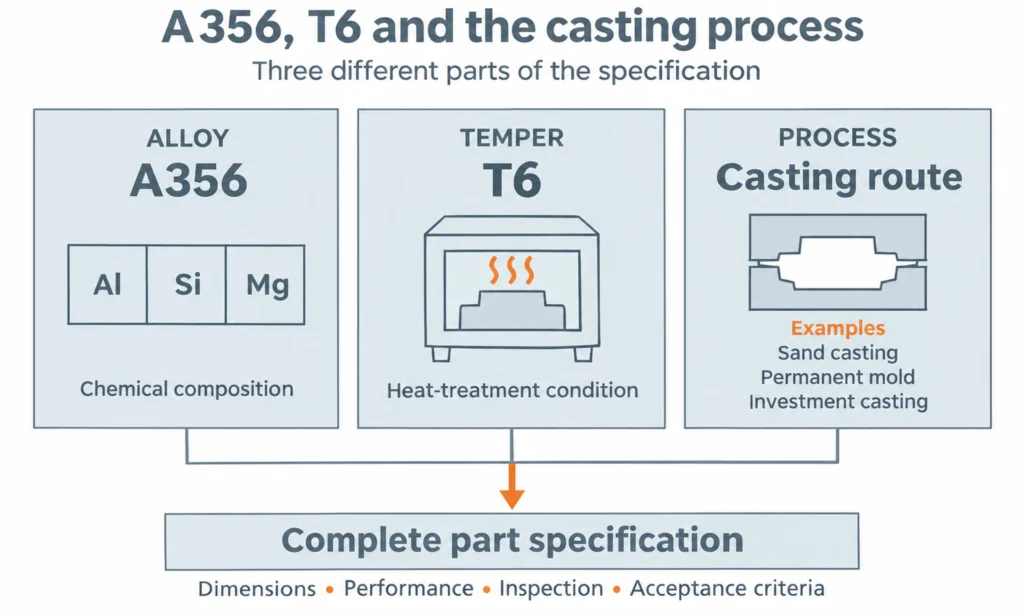
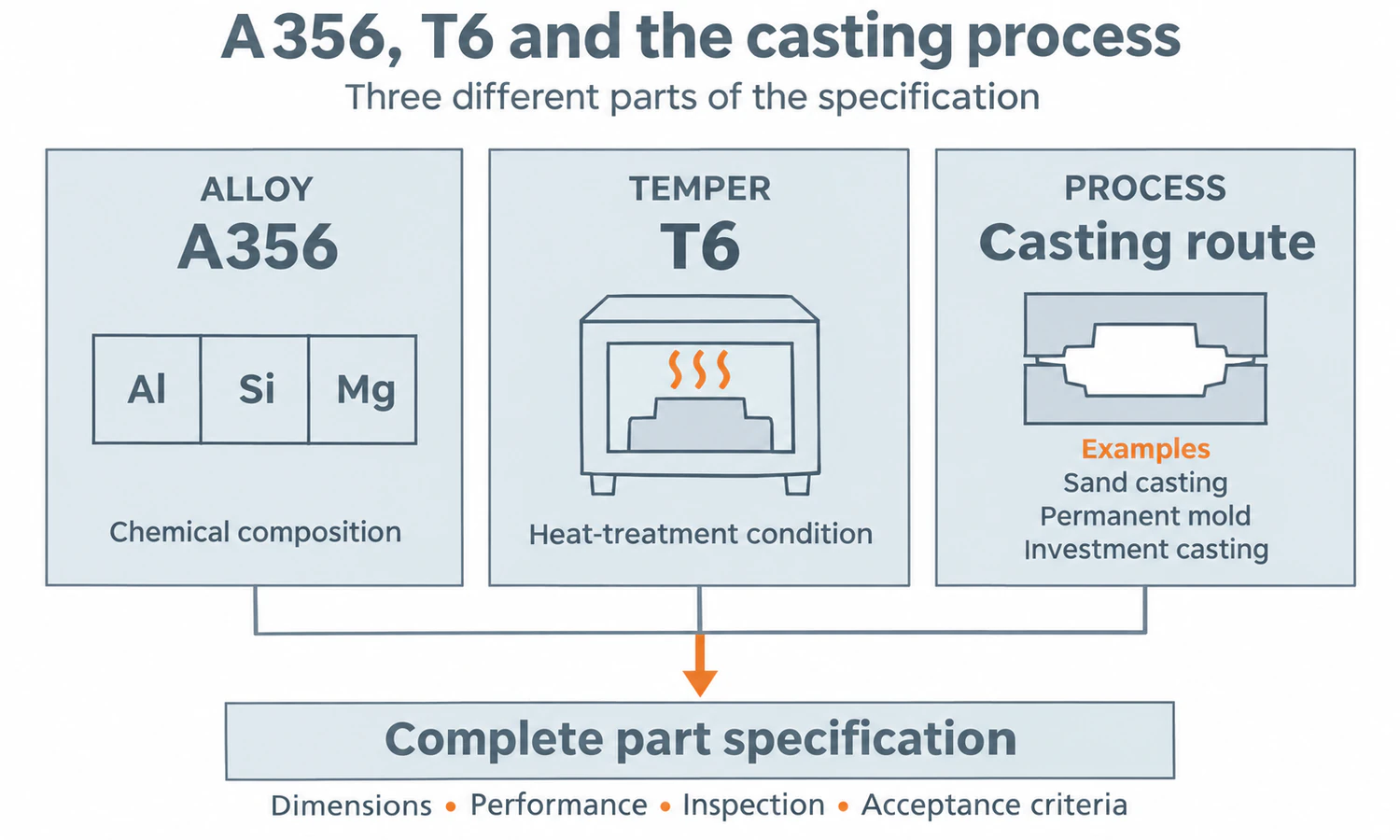
Three details describe different parts of the specification:
- A356 identifies the alloy chemistry.
- T6 identifies a heat-treatment condition.
- Sand casting, permanent mold casting, or another process identifies how the component is formed.
A356 is therefore a material choice, not the name of one casting process. A complete part specification connects all three details with the dimensions and performance the component needs.
A356.0 and A356.2
In the Aluminum Association system, A356.0 designates the casting alloy; A356.1 and A356.2 designate ingot compositions. Ingot is feedstock for remelting. These suffixes should not be read as progressively stronger finished-part grades.
The registered limits differ. For example, A356.0 permits up to 0.20% iron, while A356.2 permits up to 0.12%. The Aluminum Association’s August 2025 Pink Sheets provide the registered compositions and distinguish casting from ingot designations.
A356 Chemical Composition
The main alloying elements are silicon and magnesium. The following selected limits apply to A356.0 castings, expressed as percentage by mass:
| Element | Registered limit |
|---|---|
| Silicon | 6.5–7.5% |
| Magnesium | 0.25–0.45% |
| Iron | 0.20% maximum |
| Copper | 0.20% maximum |
| Manganese | 0.10% maximum |
| Zinc | 0.10% maximum |
| Titanium | 0.20% maximum |
| Aluminum | Remainder |
These are selected values from the Pink Sheets, not the complete chemistry specification. Trace-element limits and applicable purchase requirements still belong on the material documentation.
Silicon supports casting fluidity, while magnesium contributes to the alloy’s response to precipitation hardening. In practical terms, the chemistry helps produce the shape, and the subsequent treatment develops the required material condition. Neither step compensates for poor control of the other.
A356 Mechanical Properties
A356 has no single tensile-strength value. Temper, casting method, cooling conditions, and specimen location all affect the result.
Rio Tinto’s 2019 foundry-alloy guide gives the following typical values in its A356.2 section for cast test specimens:
| Condition | Casting method | Tensile strength | Yield strength, 0.2% offset | Elongation |
|---|---|---|---|---|
| F, as cast | Sand | 160 MPa / 23 ksi | 85 MPa / 12 ksi | 6% |
| F, as cast | Permanent mold | 185 MPa / 27 ksi | 90 MPa / 13 ksi | 8% |
| T6 | Sand | 275 MPa / 40 ksi | 205 MPa / 30 ksi | 6% |
| T6 | Permanent mold | 285 MPa / 41 ksi | 205 MPa / 30 ksi | 12% |
Source: Rio Tinto, Primary Aluminum Foundry Alloys, page 22. The guide identifies standard cast tensile specimens, approximately 12.5 mm in diameter, and elongation measured over approximately 50 mm. These are typical reference data, not guaranteed minimums for every location in a component.
How to Read a Property Table
Tensile strength describes the maximum stress reached during a tensile test. Yield strength indicates the onset of specified permanent deformation. Elongation describes how much the test specimen stretches before breaking.
Before comparing two published numbers, ask:
- Are both values for the same temper?
- Are they typical results or specified minimums?
- Were the specimens cast separately or removed from the component?
- Are the casting methods and test conditions comparable?
For example, a separately cast test bar and a specimen cut from a thick housing wall have different cooling histories. A satisfactory bar result does not, by itself, describe every section of that housing. This distinction is particularly important when fatigue, impact, or pressure containment drives the design.
What Does A356-T6 Mean?
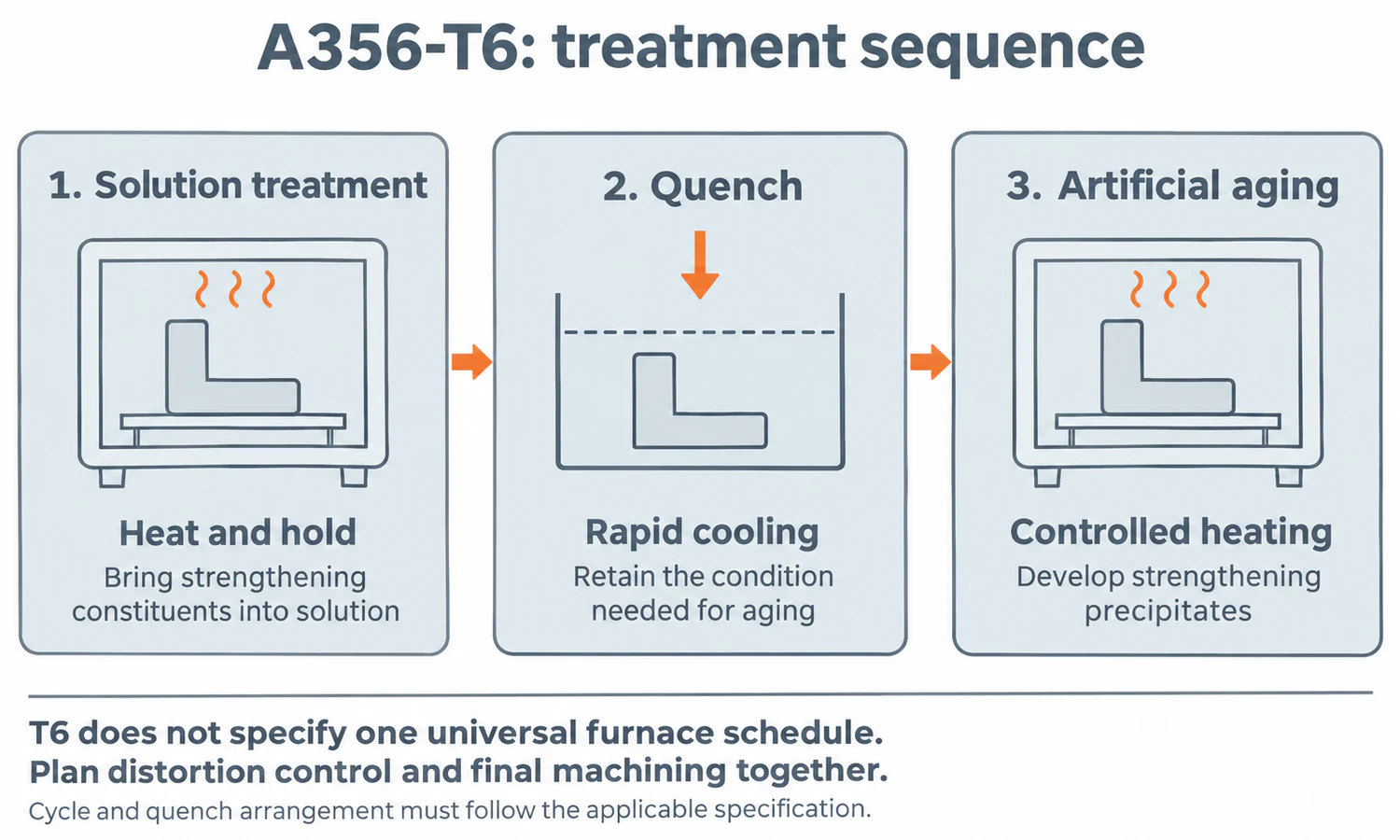
T6 means solution heat treated and artificially aged. For A356, the treatment sequence normally includes:
- Solution treatment: heating and holding to bring strengthening constituents into solution.
- Quenching: cooling rapidly enough to retain the condition needed for subsequent aging.
- Artificial aging: controlled heating that develops strengthening precipitates.
Bodycote’s aluminum solution-and-aging overview lists A356-T6 among common treated casting alloys and explains the relationship between treatment, properties, and distortion control.
T6 does not specify one universal furnace schedule. The applicable specification, section thickness, furnace loading, quench arrangement, and required properties determine the qualified cycle.
It also differs from other conditions:
| Condition | Basic meaning |
|---|---|
| F | As fabricated; for this discussion, the as-cast condition |
| T5 | Cooled from the casting process and artificially aged, without a separate solution treatment |
| T6 | Solution heat treated and artificially aged |
| T7 | Solution heat treated and stabilized or overaged |
Quenching can introduce distortion or residual stress, so heat treatment and final machining should be planned together. Our casting heat-treatment guide explains these conditions in more detail.
Casting Processes Used for A356
The process changes tooling cost, geometry options, cooling, surface finish, and the amount of machining needed. Choosing A356 does not settle those questions.
Sand Casting
Sand casting uses an expendable mold and can incorporate cores for internal passages. It is useful when geometry, size, design flexibility, or production quantity favors this route.
For an A356 housing, the foundry must consider how metal reaches thin sections and how heavier regions receive liquid feed metal during solidification. Local cooling and feeding influence the resulting structure and internal soundness. Our aluminum sand casting guide explains the mold, core, and feeding arrangements.
Permanent Mold and Low-Pressure Casting
Permanent mold casting uses a reusable metal mold. A356 is commonly associated with this route, including wheel and structural-component production.
Gravity and low-pressure filling are different ways to introduce metal into a mold. A request for “A356 die casting” should therefore identify whether it means gravity die casting, low-pressure casting, or high-pressure die casting. These processes do not share the same filling behavior or production assumptions.
Investment Casting
A356 can also be investment cast where detailed geometry makes the expendable-pattern route useful. As a concrete industry example, Shellcast’s investment casting material sheet lists A356-T6 alongside other aluminum casting alloys.
The alloy’s suitability does not establish a universal minimum wall thickness or tolerance. Those requirements still need review against the particular shape and foundry process.
High-Pressure Die Casting
A356 is not the usual starting point for conventional high-pressure die casting. A380 is a more familiar alloy for that route. NADCA’s process and material selection guide distinguishes A380, A356, and 6061 as representative alloys for different manufacturing processes.
Specialized casting routes can change the available options. The useful question is whether the proposed alloy-process combination can meet the finished part’s requirements, including any solution heat treatment, rather than whether all aluminum alloys can enter the same machine.
A356 vs. Other Aluminum Alloys
A356 vs. 356
A356 and 356 belong to the same general aluminum-silicon-magnesium family, but their impurity limits differ. St. Paul Foundry’s 356.0 data sheet lists an iron maximum of 0.60%, compared with 0.20% for A356.0.
Do not shorten an A356 requirement to “356” on an order. The prefix is part of the material designation, and both the alloy and temper should match the agreed specification.
A356 vs. A380
Consider A356 when the proposed sand or permanent-mold route and heat-treated properties suit the component. Consider A380 when conventional high-pressure die casting fits the geometry and production program.
Comparing only one tensile-strength number misses that manufacturing difference. Tooling, achievable shape, heat treatment, machining, and required integrity belong in the comparison too.
A356 vs. 6061
6061 is a wrought alloy commonly supplied as extrusions, plate, bar, or forgings. A356 is a casting alloy.
When replacing a machined 6061 component with an A356 casting, recheck the design against the selected casting properties and inspection requirements. The conversion is a change in material and manufacturing route, not just a way to remove less metal during machining.
European Grade References
For European sourcing, EN AC-42100, AlSi7Mg0.3, is a commonly associated reference. ACTech’s material list places it alongside A356.
Treat this as a cross-reference for comparison. Confirm chemistry, temper, casting method, mechanical requirements, and the governing standard before approving a substitution. A similar alloy name does not make two purchase specifications identical.
Applications, Machining, and Finishing
Typical A356 applications include wheels, brackets, aircraft fittings, impellers, and housings. These examples appear in St. Paul Foundry’s A356.0 technical data.
The common attraction is a lightweight cast shape with useful heat-treated properties. The application name alone does not establish suitability: a decorative housing and a fatigue-loaded bracket require different evidence.
A356 castings can be machined to produce bearing seats, sealing faces, threads, and accurate locating features. Define these surfaces early so the casting includes appropriate machining stock and usable datums.
The alloy is also weldable, but welding a T6 component requires consideration of the final material condition and inspection requirements. “Weldable” is not automatic permission to repair any location on a finished part.
For appearance, establish a sample finish before assuming A356 will match anodized wrought aluminum. St. Paul lists its anodized appearance as gray. Anodizing for protection and anodizing for a uniform decorative appearance are different purchasing expectations.
Porosity and Casting Quality
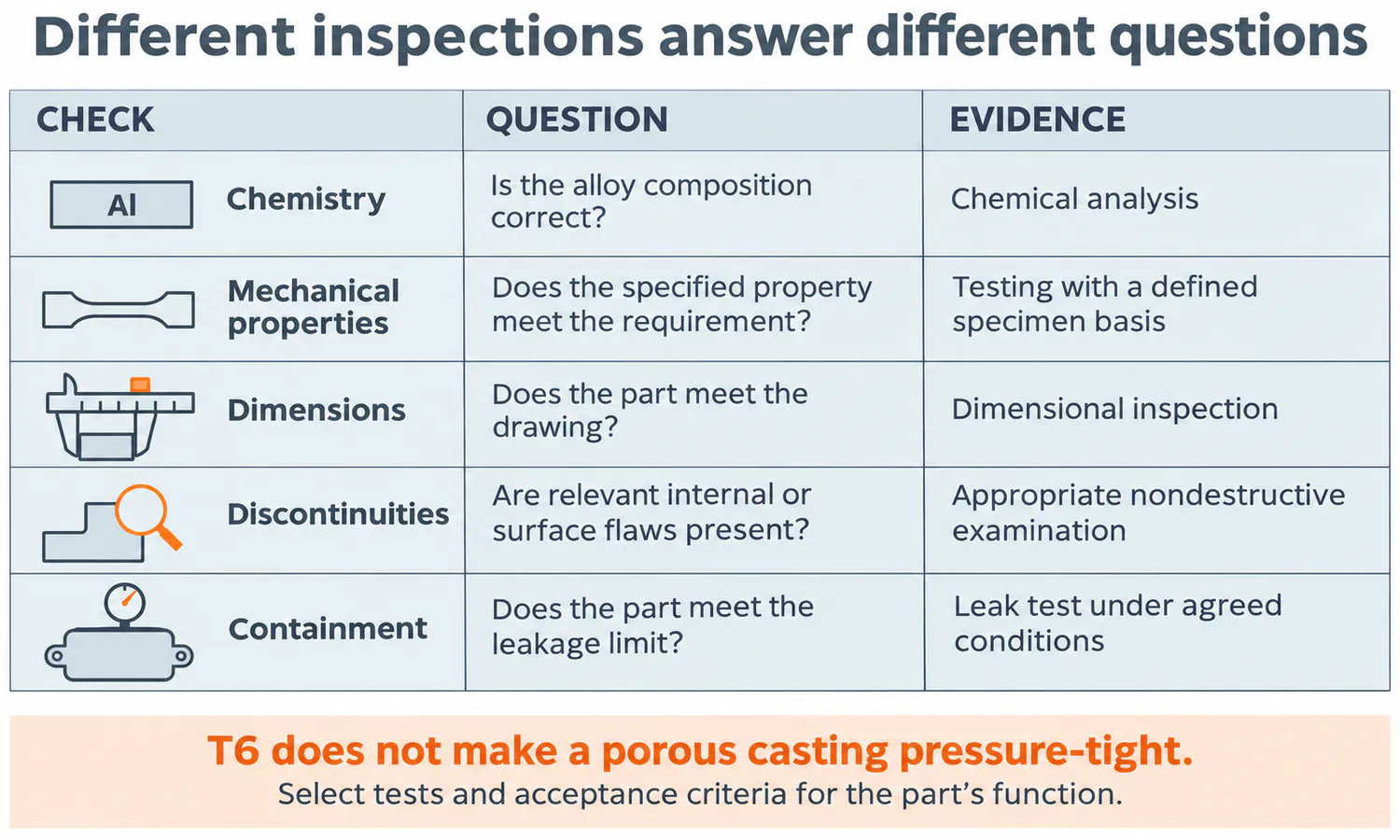
T6 heat treatment does not make a porous casting pressure-tight. Chemistry, heat treatment, and casting soundness answer different questions.
Gas pores, shrinkage, and oxide-related defects can occur in aluminum castings. A thick junction may need improved feeding; gas-related porosity calls for investigation of melt and process conditions. These mechanisms should not all be treated as a problem that more heat treatment will solve.
The inspection plan should follow the part’s function:
- Chemical analysis checks the alloy composition.
- Mechanical testing checks specified properties under defined conditions.
- Dimensional inspection checks fit and geometry.
- Appropriate nondestructive examination investigates relevant discontinuities.
- Leak testing checks containment under the agreed test conditions.
A machined pump housing illustrates the difference: a chemical certificate can confirm A356, while a leak test answers whether the finished housing contains fluid. Neither result substitutes for the other.
Specifying an A356 Casting
Start with the alloy, temper, casting route, and applicable specification. ASTM maintains separate standards for aluminum sand castings, B26/B26M, permanent mold castings, B108/B108M, and investment castings, B618/B618M.
Then identify what the finished part must meet:
- Required mechanical properties and the specimen basis for acceptance.
- Critical dimensions, datums, and surfaces requiring machining.
- Pressure, fatigue, temperature, or corrosion conditions relevant to service.
- Inspection methods and acceptance criteria for critical regions.
- Surface finish and any restrictions on welding or other repair.
This makes quotations easier to compare. Two suppliers may both offer A356-T6 while allowing different machining operations, testing, or acceptance requirements. Compare the complete delivered part and its documentation, rather than the alloy label or casting price alone.
Conclusion
A356 is a useful heat-treatable casting alloy for lightweight components. Select it together with the casting process, temper, and finished-part requirements. Read property data in context, distinguish ingot from casting designations, and verify the characteristics that matter to the actual application.
FAQs
What Is A356 Aluminum Used For?
Typical applications include wheels, brackets, aircraft fittings, impellers, and housings. The common attraction is a lightweight cast shape with useful heat-treated properties. The application name alone does not establish suitability—a decorative housing and a fatigue-loaded bracket require different evidence.
What Is the Difference Between A356.0 and A356.2?
A356.0 designates the casting alloy, while A356.1 and A356.2 designate ingot compositions for remelting. They are not progressively stronger finished-part grades. The registered limits differ—for example, A356.0 permits up to 0.20% iron while A356.2 permits up to 0.12%.
What Does A356-T6 Mean?
T6 means solution heat treated and artificially aged: the casting is solution treated, quenched, and then artificially aged to develop strengthening precipitates. T6 does not specify one universal furnace schedule—the applicable specification, section thickness, and required properties determine the qualified cycle.
How Strong Is A356-T6?
Typical published values for separately cast test bars are about 275 MPa tensile and 205 MPa yield for sand castings, and about 285 MPa tensile and 205 MPa yield for permanent mold castings. These are typical reference data, not guaranteed minimums for every location in a component.
Can A356 Be Die Cast?
A356 is not the usual starting point for conventional high-pressure die casting—A380 is more common for that route. A356 suits sand, permanent mold, low-pressure, and investment casting. When someone says “A356 die casting,” clarify whether they mean gravity die casting, low-pressure casting, or high-pressure die casting.
Is A356 the Same as 6061?
No. 6061 is a wrought alloy supplied as extrusions, plate, bar, or forgings, while A356 is a casting alloy. Converting a machined 6061 component to an A356 casting changes both the material and the manufacturing route, so the design should be rechecked against the selected casting properties.