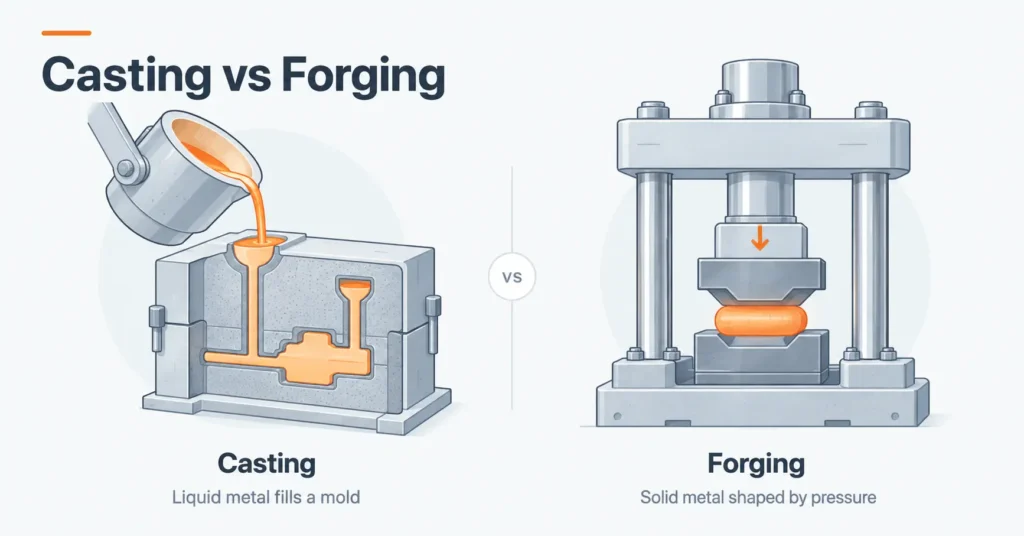
Casting shapes metal after it has been melted and poured into a mold. Forging shapes metal while it remains solid, using pressure from hammers, presses, upsetters, or rolling equipment. That difference changes how the metal flows, which shapes are practical, how properties develop, what defects must be controlled, and where the money is spent.
Neither process is automatically better. A forged shaft carrying a repeated load along one main direction presents a different problem from a valve body with an internal flow passage. The useful comparison begins with the finished part: its alloy, geometry, load, quantity, critical dimensions, inspection requirements, and the work still needed after forming.
What Is the Difference Between Casting and Forging?
The clearest distinction is the condition of the metal during shaping. In casting, liquid metal fills a cavity and develops its solid structure as it cools. In forging, a solid workpiece is squeezed or struck until it takes a new shape. Forging is commonly performed hot, although warm and cold forging are also established routes.
Both names cover families of processes. Sand casting, investment casting, die casting, permanent-mold casting, and centrifugal casting do not share one level of detail, tooling cost, or production speed. Open-die forging, closed-die forging, precision forging, upset forging, and rolled-ring forging also solve different shape and quantity problems. A comparison becomes reliable only when the actual sub-processes are named.
| What changes | Casting | Forging |
|---|---|---|
| Metal during shaping | Liquid metal fills a mold and solidifies. | Solid metal is plastically deformed under pressure. |
| Tool that defines the shape | A mold cavity, often made from a pattern or die; cores can form internal spaces. | Dies, hammers, presses, upsetters, or rolls move solid metal into shape. |
| Typical geometric advantage | Complex external forms and internal passages can be created near the final shape. | Efficient material flow and favorable grain direction can suit heavily loaded forms. |
| Main property question | How alloy, solidification, heat treatment, and defect control affect the part. | How alloy, deformation, grain flow, section size, and heat treatment affect the part. |
| Common extra work | Gate and riser removal, cleaning, heat treatment, and selected machining. | Flash trimming, scale removal, heat treatment, straightening, and machining. |
| Economic question | Which route reaches the accepted finished part at the lower total cost and acceptable risk? | |
How Does Casting Shape Metal?
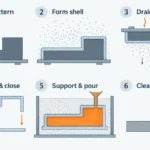
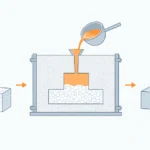
Metalcasting begins with a mold that contains the negative shape of the part. Molten metal enters the cavity, cools, and solidifies. Depending on the casting process, the mold may be expendable, as in sand or investment casting, or reusable for many cycles, as in permanent-mold and die casting. The American Foundry Society gives the same broad definition: high-temperature liquid metal is poured into a sand, metal, or ceramic mold to form a part.
A pattern or die forms the main external geometry. Separate cores can keep metal out of spaces that must remain hollow, creating ports, chambers, and curved passages that would be difficult to cut from solid stock. Once the casting is removed, gates and risers are cut away and the part can be cleaned, heat treated, machined, finished, and inspected.
The way the mold is made matters. Sand casting can cover a broad size range, investment casting can reproduce fine details and complex surfaces, and die casting uses a metal die and pressure for a different production environment. Treating all three as a single “casting capability” hides differences that may decide the part.
How Does Forging Shape Metal?
Forging starts with solid stock such as a billet, bar, ingot, or preform. The workpiece may be heated, placed between dies, and shaped through one or more pressing or hammering operations. The part may be reheated between stages, then trimmed, heat treated, straightened, descaled, machined, and inspected.
Open-die forging moves metal between relatively simple tools and is used for forms such as shafts, blocks, and large rings. Closed-die or impression-die forging pushes material into shaped die cavities. Upsetting increases a section by shortening the workpiece, while ring rolling expands a pierced blank into a seamless ring. The Forging Industry Association describes all of these as ways of pressing, pounding, squeezing, or rolling metal without melting it during the forging operation.
Solid metal does not flow into narrow cavities as freely as liquid metal. Forging geometry therefore has to let material move through the available dies and equipment without folds, laps, underfill, or harmful grain flow. Generous radii, draft, parting position, preform design, and successive deformation stages can be central to the result.
How Do Casting and Forging Affect Grain Structure?
A casting develops its structure while liquid metal nucleates and grows into solid grains. Cooling rate, section thickness, alloy chemistry, feeding, and heat treatment influence grain size, segregation, porosity, and the final properties. Different regions of a complex casting can cool at different rates, so “cast structure” is not one uniform condition.
Forging changes an existing solid structure through deformation. At suitable temperatures and reductions, deformation and recrystallization can refine grains and alter the shape and distribution of constituents. Flow lines tend to follow the direction in which the metal has moved. When that grain flow follows the principal load path, it can improve resistance to certain failures.
Directionality is an advantage only when it suits the part. Properties measured along the main grain flow may differ from transverse or axial properties. A forging specification or test report therefore needs to state where the test sample comes from and how it is oriented. A casting should not automatically be called perfectly isotropic either; geometry, solidification, inclusions, and local structure can still create direction-dependent behavior.
Is Forged Metal Always Stronger Than Cast Metal?
No. Forging often provides a strong route for parts under high or repeated loads, but “forged” is not a material grade or a guaranteed strength value. A valid comparison controls the alloy, heat treatment, section size, grain-flow direction, surface condition, defects, and the load the part will actually see.
Tensile strength is only one property. Yield strength, ductility, impact toughness, fatigue resistance, hardness, wear, corrosion, and behavior at temperature may matter more for a particular component. A crankshaft and a pump casing can fail in different ways even if both are made from iron-based alloys.
A University of Toledo crankshaft study found a fatigue advantage for a forged steel design over a ductile cast iron design in its specimen and component tests. That is useful evidence for the particular materials, crankshaft geometry, and loading in the study. Because the alloy families differed as well as the forming route, it is not a universal percentage difference between every casting and every forging.
The engineering question is whether the selected material and process meet the required properties with suitable verification. A casting that meets the drawing, material specification, heat-treatment condition, and acceptance criteria is not made inferior by its process name. A forging with unfavorable grain orientation, a lap, or inadequate heat treatment is not made safe by its process name either.
Which Process Handles Complex Shapes and Internal Passages Better?
Casting usually has the advantage as shape complexity rises. Liquid metal can fill a mold around ribs, bosses, curved walls, and changing sections. Cores can form internal passages and cavities as part of the initial shape. The result may combine features that a forging would need to machine, pierce, weld, or assemble.
The Steel Founders’ Society of America illustrates this with a 10-inch valve. Its comparison shows a steel forging route using either two forged halves joined by welding or a solid forging that is pierced and machined to create the internal channel. The casting route uses a mold and cores to establish the body and flow passage. This is a steel-valve example rather than a rule for every part, but it makes the geometric difference easy to see.
Forging is not limited to plain blocks. Closed dies can form detailed external features, and rolled-ring, upset, and precision forging can produce efficient near-net forms. The constraint is that solid metal and tooling still need a practical path to create the shape. Deep internal passages, undercuts, and enclosed cavities usually increase the amount of machining or assembly.
How Do Casting and Forging Compare in Part Size?
Casting is often chosen for very large, thick, or geometrically complex parts because liquid metal can fill a large mold without mechanically deforming the entire section. Large housings, valve bodies, machine structures, and equipment components are common examples.
That does not mean forged parts are necessarily small. The Forging Industry Association notes that large presses can apply 60,000 tons of force or more, and open-die facilities produce major shafts, rings, and structural components. The number gives a sense of industrial scale, not a universal equipment requirement or maximum part size.
For either route, the supplier’s actual equipment is decisive. A foundry must melt, pour, handle, clean, and heat treat the required mass. A forge must obtain suitable stock, create enough deformation with available force, handle the workpiece between stages, and heat treat it uniformly. Size, section thickness, alloy, and desired properties need to be evaluated together.
Which Process Gives Better Tolerances and Surface Finish?
There is no accurate answer at the level of “casting versus forging.” Investment casting, sand casting, and die casting produce different as-cast surfaces and dimensional capability. Open-die, conventional closed-die, and precision forging also leave different amounts of stock and variation.
Tooling condition, part size, alloy, thermal contraction, draft, parting lines, die wear, process control, and production quantity all affect the formed result. ISO 8062-3:2023 provides a framework for general dimensional and geometrical tolerances and machining allowance grades for castings, but it does not assign one tolerance to every casting process or guarantee a particular supplier’s result.
Machining changes the practical comparison. A cast or forged surface may be acceptable on a noncritical exterior while a bore, bearing seat, sealing face, or locating diameter must be machined. The useful question is how much material and access each route leaves for that work, and whether the final datum structure can be held consistently.
What Defects Can Occur in Castings and Forgings?
Both processes can produce discontinuities. Their mechanisms differ, and good process control reduces the risk, but neither process is automatically defect-free.
| Process | Possible discontinuities | What must be investigated |
|---|---|---|
| Casting | Gas porosity, shrinkage, inclusions, cold shuts, hot tears, or mold-related inclusions | Melt quality, mold and core condition, filling, feeding, solidification, heat treatment, and cleaning |
| Forging | Laps, folds, seams, bursts, cracks, die mismatch, or unfavorable grain structure | Starting stock, temperature, reduction, preform and die design, material flow, trimming, cooling, and heat treatment |
Forging deformation can close some internal voids and break up parts of an as-cast structure, but the result depends on the void’s position, temperature, local strain, stress state, and forging sequence. It does not prove that every original discontinuity has disappeared. Likewise, casting defect names describe failure modes to control, not conditions present in every casting.
How Should Castings and Forgings Be Inspected?
Inspection should follow the likely discontinuity, material, geometry, and consequence of failure. Visual and dimensional inspection answer different questions from chemical analysis, mechanical testing, or nondestructive examination.
Radiography is often used to examine castings for volumetric indications, although its sensitivity to planar cracks can depend strongly on their orientation to the radiation beam. Magnetic-particle inspection can reveal surface and near-surface discontinuities in ferromagnetic steel forgings. Ultrasonic testing is widely used for internal examination of heavy steel forgings. Liquid penetrant testing can reveal surface-breaking indications in suitable nonporous materials.
A test method does not set the acceptance limit by itself. ASTM A275/A275M, for example, describes magnetic-particle examination for steel forgings but does not supply a universal acceptance grade. ASTM A388/A388M requires the applicable ultrasonic quality level to be stated in the order. The drawing, material specification, purchase order, and service standard must define what is inspected, where, how extensively, and what result is acceptable.
Is Casting or Forging Cheaper?
Either process can be cheaper for the right part. Tooling, quantity, starting material, forming operations, heat treatment, machining, welding, inspection, finishing, reject risk, and lead time all contribute to the accepted finished-part cost.
Casting often becomes attractive when the mold can create complex geometry and reduce machining or assembly. A pattern and corebox may also be economical for modest quantities, depending on the casting route. The metal in gates and risers is not part of the finished component, although suitable returns may be remelted within the production system.
Forging can use material efficiently when a well-designed preform and die place metal close to a relatively simple final shape. Closed-die tooling may require a larger initial investment, but that investment can be distributed across repeat production. Flash, scale, trimming, stock removal, multiple heating stages, and die wear remain part of the calculation.
Comparing a rough casting quotation with a machined forging price gives a distorted answer. Both quotations should cover the same alloy, heat-treatment condition, final dimensions, testing, documentation, quantity, delivery scope, and expected design life. The lower forming price may not produce the lower finished-part cost.
Which Metals Can Be Cast or Forged?
Many metal families can use either route. Carbon steel, alloy steel, stainless steel, aluminum, copper alloys, titanium, and several nickel- or cobalt-based alloys all have cast and forged applications. The correct answer sits at the alloy-grade and condition level because melting behavior, hot workability, temperature window, section size, and heat treatment vary.
A broad metal name is therefore only a starting point. “Stainless steel” includes grades with very different castability, forgeability, corrosion behavior, and heat-treatment response. A material specification written for a casting may also differ from the nominally similar wrought or forged grade, so substitutions require an engineering review rather than a name match.
Why Is Gray Cast Iron Usually Cast Instead of Forged?
Ordinary gray iron contains graphite flakes that interrupt the metallic matrix and give the material relatively low tensile ductility. Under conventional forging deformation, it is more likely to crack than flow into a new shape, so gray iron parts are normally made by casting.
Ductile iron and malleable iron have different graphite forms and mechanical behavior from ordinary gray iron. Their names do not mean that commercial parts are normally made by forging them. “Cast iron cannot be forged” is a useful shorthand for common gray-iron practice, but it is too broad to serve as a rule for every iron composition and specialized process.
Can an Existing Casting Be Redesigned as a Forging?
Sometimes, but changing the process name on the drawing is not enough. A forging needs a practical material-flow path, grain orientation, radii, draft, parting arrangement, stock size, and machining plan. Features previously made by cores may need drilling, piercing, welding, or a new assembly.
The reverse change also requires redesign. A casting needs appropriate mold separation, pattern allowances, feeding, solidification control, core support, and machining stock. Some features can be combined or added more easily, but the foundry must still establish how the mold fills and how contraction is fed.
Process conversion is most useful before the design is fully locked. Comparing preliminary routes can reveal whether a change removes machining, combines parts, improves the load path, simplifies inspection, or merely moves cost from one operation to another.
When Should You Choose Casting or Forging?
Start with the requirement that is hardest to satisfy, then compare the complete routes.
- Consider casting first when complex external geometry, internal passages, large sections, or part consolidation could reduce machining and assembly.
- Consider forging first when a comparatively forgeable shape carries severe or repeated loads along a grain-flow direction that the process can create and verify.
- Compare both when either route can meet the specification. Use the same alloy basis, heat treatment, finished dimensions, quantity, inspection, documentation, and delivery scope.
A housing may favor casting because its flow passages can be molded near shape. A shaft or ring may favor forging because the deformation can follow the main load. Between those clear examples is a large overlap where supplier capability, redesign effort, and finished-part cost settle the question.
YTD Foundry provides custom investment casting, sand casting, and die casting, together with CNC machining, inspection, surface finishing, and finished-part delivery. For a new or replacement component, send the drawing, 3D model, physical sample, or available requirements. The review can then connect the geometry, material, quantity, critical features, and acceptance criteria to a defined casting and finishing route.