Some metals fill thin mold sections easily; others leave gaps, pores or cracks. Castability explains these differences, but it is more than how freely molten metal flows. Understanding it helps explain why an alloy works well in one casting and struggles in another.
What Is Castability?
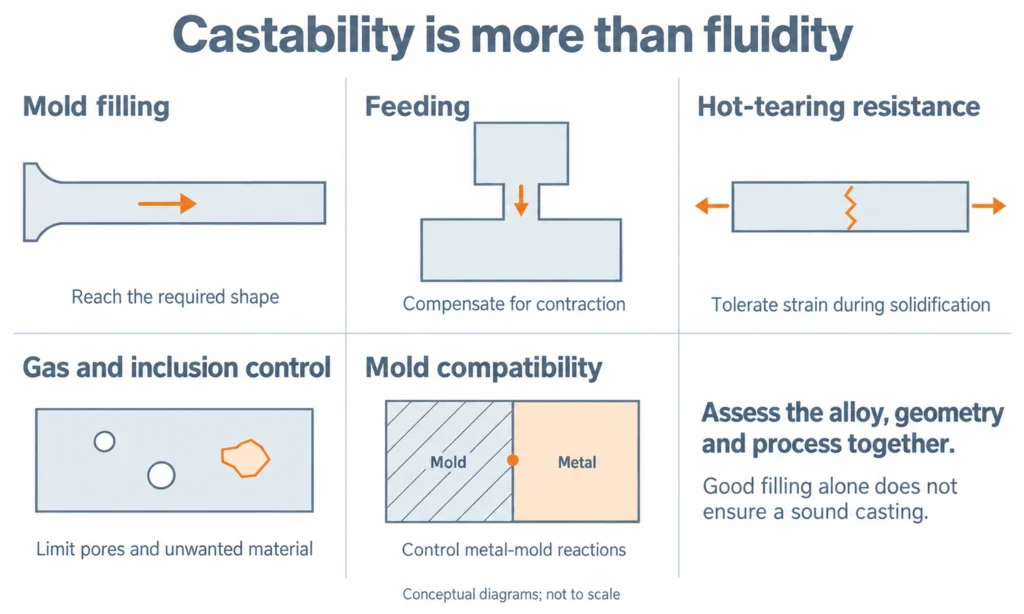
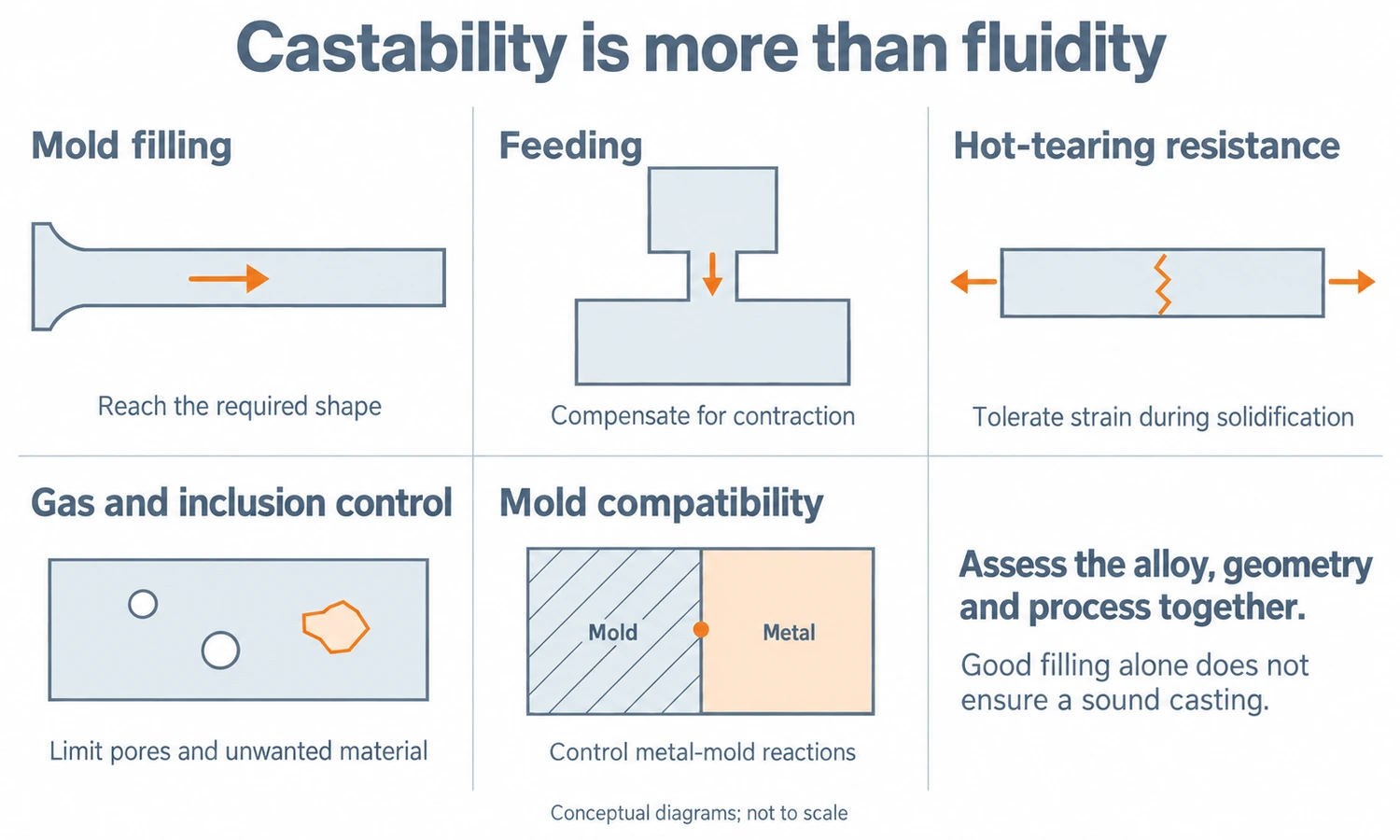
Castability is how readily a metal or alloy can be made into a sound casting with the required shape and properties. It includes filling the mold, compensating for contraction during solidification and avoiding unacceptable defects.
A metal that fills every corner but develops internal cavities has not demonstrated good overall castability. Neither has a metal that solidifies without cavities but cracks as the mold restrains its contraction.
Castability therefore describes several behaviors together. It is also affected by the casting process and part design. An alloy may suit a thick housing yet struggle with a long, thin rib made under the same conditions.
This differs from the strength, hardness or corrosion resistance of the finished part. Those properties describe performance in service; castability describes the difficulty of producing that part successfully.
Castability and Fluidity
Fluidity is one part of castability: it describes how far molten metal can flow under specified conditions before solidification stops it. It matters especially for thin walls, fine details and long distances from the metal inlet.
In foundry use, fluidity is not simply the opposite of viscosity. Viscosity describes resistance to flow. A casting fluidity test also captures the effects of cooling, crystal formation and the time available to fill a passage. Two melts with similar liquid viscosity can stop flowing at different distances as they freeze.
Di Sabatino and Arnberg’s review of aluminum-alloy fluidity discusses this distinction and the effects of composition, temperature and mold conditions. A long flow length is useful evidence about filling, but it does not establish resistance to shrinkage porosity or hot tearing.
The Main Elements of Castability
Several different problems can make a metal difficult to cast. Identifying which behavior is limiting the process is more useful than simply calling the alloy “poorly castable.”
| Element | What it describes | What can go wrong |
|---|---|---|
| Fluidity and mold filling | Reaching the required shape before flow stops | Unfilled sections or metal fronts that fail to join |
| Feeding during solidification | Supplying liquid metal to compensate for contraction | Shrinkage cavities or distributed shrinkage porosity |
| Resistance to hot tearing | Tolerating contraction while the casting is still weak | Cracks during the late stages of solidification |
| Gas and inclusion control | Limiting trapped gas and unwanted material in the casting | Gas pores, oxide films or other inclusions |
| Compatibility with the mold | Controlling reactions between the melt and mold materials | Surface damage, contamination or difficult mold release |
Solidification Shrinkage and Feeding
Most casting alloys need additional liquid metal as they solidify and contract. Feeding is the supply of that metal, often from a reservoir called a riser or feeder.
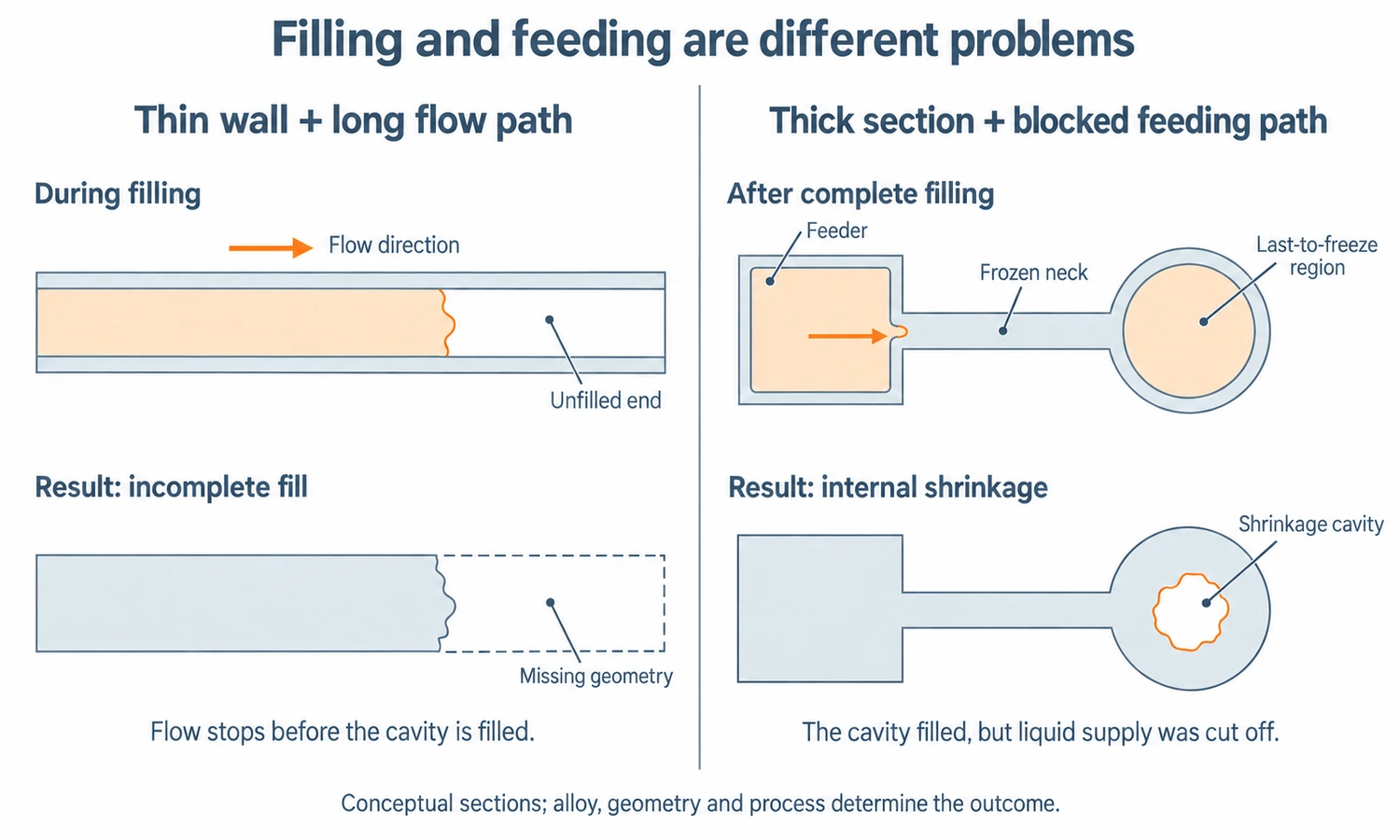
The important issue is whether liquid metal can still reach the region that needs it. A thick boss connected through a thin wall may remain liquid after the wall has frozen. If that frozen wall blocks its supply, a cavity can develop inside the boss even though the mold filled completely.
The SFSA Steel Castings Handbook explains this relationship between section thickness, solidification and feeding. It also shows why a thin section near the inlet may fill successfully while the same thickness farther away does not.
Making the pattern larger addresses a different problem: the dimensional contraction of the solid casting as it cools. A larger pattern does not, by itself, prevent an internal shrinkage cavity.
Hot Tearing
Hot tearing occurs when a partly solidified casting is pulled apart before it has enough strength to tolerate the strain. Mold restraint, local geometry and insufficient liquid feeding can contribute.
Think of a cooling casting that needs to contract around a rigid core. If a weak region cannot accommodate that movement, it may tear. Alloy composition matters because it changes how the metal develops strength and how long liquid remains between growing crystals.
Research on hot tearing in aluminum-zinc alloys examines the interaction of feeding and stress during solidification. This is why good fluidity alone cannot predict cracking resistance.
Gas, Oxides and Mold Reactions
A completely filled casting can still contain gas pores or inclusions. In aluminum casting, dissolved hydrogen can contribute to porosity, while disturbed metal flow can entrain oxide films.
These problems require different controls from shrinkage. Degassing addresses dissolved gas; suitable feeding addresses contraction; melt handling and filtration help manage inclusions. Foseco’s overview of casting defects distinguishes these mechanisms and their corresponding controls.
Chemical compatibility also matters. The mold or coating must tolerate the chosen alloy and pouring conditions. A material that reacts strongly with its mold may require a different mold system even when it fills well.
What Affects the Castability of Metals?
Alloy composition, temperature, heat transfer and geometry work together. Changing one can improve a particular result while making another problem harder to control.
Alloy Composition and Freezing Range
Many alloys solidify over a temperature interval rather than at one temperature. The liquidus is the temperature above which the alloy is fully liquid; below the solidus, it is fully solid. Between them, liquid and solid coexist.
That partly solid region affects both flow and feeding. Growing crystals can obstruct liquid movement before the casting is fully solid. Freezing range is therefore useful when assessing an alloy, but it cannot provide a complete castability ranking on its own.
Silicon illustrates how alloying changes casting behavior. In aluminum-silicon systems, suitable silicon additions can improve fluidity, lower the melting temperature and reduce solidification contraction. A University of Cambridge explanation of aluminum-silicon alloys gives the binary system’s eutectic temperature as 577°C—the temperature at which its eutectic liquid transforms into two solid phases together.
This does not mean adding more silicon always produces a better component. The final microstructure and required mechanical properties still matter. A readily cast alloy must also meet the part’s service requirements.
Metal and Mold Temperature
Higher metal temperature can provide more time for filling before freezing interrupts the flow. Superheat means the metal temperature above the alloy’s liquidus temperature, rather than simply its temperature above room temperature.
A hotter mold can also slow heat loss from the advancing metal. Conversely, rapid heat extraction can make thin sections freeze before they fill.
Increasing temperature is not a universal remedy. It changes the thermal conditions for the whole casting and can increase oxidation, gas-related problems or mold reactions. The practical aim is a controlled temperature range that achieves filling and sound solidification together.
Wall Thickness and Flow Distance
Thin sections lose heat quickly relative to the amount of metal they contain. Long flow paths give the metal more opportunity to cool before reaching the farthest feature.
This is why a minimum-wall figure without a part size, alloy and casting process is incomplete. A short thin feature close to a gate—the inlet into the casting—may be practical when a much longer feature of the same thickness is not.
Thick sections create another challenge: they may freeze last and need dedicated feeding. A design can therefore have both a difficult-to-fill thin rib and a shrinkage-prone thick junction. Solving only one does not establish good castability for the whole part.
Castability of Common Metal Families
Aluminum-silicon alloys, zinc casting alloys and many cast irons are widely used partly because of favorable casting behavior. Steel and other more demanding alloys are also cast successfully, but require a suitable process and design.
The following comparison describes tendencies, not a universal best-to-worst ranking.
| Metal family | Relevant casting behavior | Main point to check |
|---|---|---|
| Aluminum-silicon casting alloys | Useful mold-filling behavior; silicon changes freezing and contraction | Exact grade, melt quality, feeding and required properties |
| Zinc casting alloys | High fluidity supports fine details and thin sections | Die conditions, flow distance and the particular alloy |
| Gray cast iron | Graphite formation can offset some solidification contraction | Composition, section size and the solidification pattern |
| Ductile iron | Also benefits from graphite formation, but does not feed exactly like gray iron | Melt treatment, mold rigidity and shrinkage control |
| Carbon, alloy and stainless steels | Can form complex cast parts, with filling and feeding constraints | Thin-section flow distance, hot spots and alloy-specific process control |
| Copper-based casting alloys | Behavior varies substantially between brass and bronze families | Grade-specific fluidity and freezing range |
The International Zinc Association highlights the high fluidity of conventional zinc and ZA casting alloys. For iron, Röth’s explanation of shrinkage describes how graphite expansion can offset contraction, while also explaining why gray and ductile iron need different treatment.
For copper-based alloys, the St. Paul Foundry design guide separates alloys by their solidification behavior rather than treating every bronze or brass identically. The same principle applies across the table: evaluate an actual grade, not just a family name.
For a broader comparison of strength, corrosion resistance, weight and applications, see our guide to metals for casting.
How Is Castability Measured?
Different tests assess different aspects of castability. A result should identify the alloy, test geometry and process conditions before it is used for comparison.
Fluidity Tests
A spiral test measures the distance molten metal travels through a spiral-shaped channel before flow stops. Other tests use straight channels, suction tubes or thin plates.
Longer flow or more complete filling indicates better performance under those test conditions. To compare alloys fairly, the test must control relevant variables such as channel dimensions, mold temperature, metal temperature and filling pressure. A result from a heated pressure die is not directly interchangeable with one from a gravity-poured sand mold.
A Published Thin-Wall Test
A 2006 study of ZDC2 zinc alloy used a hot-chamber die-casting machine and 70 × 100 mm test plates, with thicknesses from 0.2 to 1.5 mm. Researchers assessed fluidity through the weight of metal filling the plates.
With one production lubricant condition, the 0.2 mm plate did not fill completely at any tested plunger speed. Changing to an undiluted oil-type lubricant enabled complete filling; the researchers linked this to reduced heat transfer at the metal-die interface. Read the published study abstract.
The useful conclusion is that the same alloy and wall thickness can produce different filling results when interface conditions change. The experiment does not establish a general 0.2 mm design limit or a lubricant recommendation for other processes.
Hot-Tearing Tests and Casting Trials
Hot-tearing tests use restrained shapes to compare cracking tendencies as alloys solidify. They answer a different question from a fluidity test: whether the developing solid structure can tolerate contraction under the test’s restraint conditions.
For a real component, trial castings and inspection check whether the combination of alloy, design and process meets the requirements. Casting simulation can help identify filling difficulties and isolated hot spots before trials, but its predictions still depend on suitable material data and process inputs.
How to Improve Castability
Start with the actual failure mode, then change the factor responsible for it. Raising the pouring temperature will not necessarily fix a feeding problem, and changing alloy will not automatically correct an unsuitable gate location.
| Observed problem | Useful areas to investigate |
|---|---|
| Thin section does not fill | Flow distance, gate position, metal and mold temperatures, filling conditions |
| Internal cavity in a thick region | Feeding path, local hot spot and solidification sequence |
| Crack near a restrained junction | Alloy susceptibility, contraction restraint, geometry and cooling pattern |
| Gas pores or inclusions | Melt quality, gas control, turbulence, filtration and mold conditions |
These are investigation starting points; similar-looking defects can have different causes. Our investment casting defects guide explains the common defect types in more detail.
At the design stage, smooth section transitions, practical flow paths and accessible feeding locations can make production more reliable. Where material selection is flexible, consider a suitable casting grade that meets the required service properties. Keep any chemistry changes within the agreed specification.
The most useful question is therefore specific: “Can this alloy fill and solidify soundly in this geometry using this process?” That gives the foundry something it can assess and test.
Conclusion
Castability combines mold filling, feeding, cracking resistance and defect control. Judge it for a specific alloy, geometry and casting process. Good fluidity helps, but a successful casting must also solidify soundly. Matching the material, design and process is more useful than relying on a general metal ranking.
FAQs
What Metal Is Easiest to Cast?
Gray iron, aluminum-silicon alloys, and zinc casting alloys are widely used partly because of favorable casting behavior. “Easiest” still depends on the geometry, process, and required properties: an alloy that fills well can still suffer shrinkage or hot tearing in the wrong design. Evaluate a specific grade for the specific part rather than ranking families in general.
Is Fluidity the Same as Castability?
No. Fluidity describes how far molten metal flows before solidification stops it. Castability also includes feeding during contraction, hot-tearing resistance, gas and inclusion control, and mold compatibility. A metal with excellent fluidity can still make a poor casting.
Does Castability Affect Casting Cost?
Yes. Poor castability can require more gating and feeding metal, higher pouring temperatures, extra inspection, or more rework, all of which raise cost. Better filling and feeding behavior can reduce scrap and simplify the process. Cost also depends on the alloy price, tooling, and production quantity.
Can a Difficult-to-Cast Alloy Still Be Used?
Often, yes, if the design and process are adjusted. More demanding steels are routinely cast with suitable gating, risering, temperature control, and mold materials. The question is whether the alloy can fill and solidify soundly in the specific geometry with the specific process.
Why Do Aluminum-Silicon Alloys Cast Well?
Silicon additions improve fluidity, lower the melting temperature, and reduce solidification contraction in aluminum casting alloys. The exact silicon content, melt quality, and the part’s mechanical requirements still determine the final result—adding more silicon is not automatically better.
How Is Castability Tested?
Common tests include spiral or channel fluidity tests for flow distance, restrained shapes for hot-tearing tendency, and trial castings for the complete alloy-design-process combination. Each test measures a different aspect, so results should state the alloy, geometry, and process conditions.