Die casting is one of the most widely used processes for producing repeat metal parts with detailed geometry, good surface quality, and stable dimensions. It is common in automotive components, electrical housings, lighting parts, industrial equipment, hardware, appliances, and many other products where a part must be made consistently at scale.
The process is often described as fast and economical. That is true only when the part design, material, tooling cost, and production quantity are aligned. A simple bracket made in a small batch may be better machined or fabricated. A detailed aluminum housing required in thousands of units may be an ideal die casting. The purpose of this guide is to explain where die casting fits, how it works, and what a buyer should check before selecting it.
What Is Die Casting?
Die casting is a permanent-mold metal casting process. Molten metal is introduced into a reusable steel die, where it takes the shape of the cavity, cools, and is ejected as a near-net-shape part.
The important distinction is that the mold is reused. In sand casting, a mold is normally broken after each casting. In die casting, a hardened tool is used repeatedly, allowing the same component to be produced many times with a consistent shape and surface.
Most die cast parts are made from non-ferrous alloys. Aluminum, zinc, magnesium, and copper-based alloys are the usual choices because they can be processed in the equipment without creating excessive wear on the die. Steel and stainless steel are generally not conventional die-casting materials because their much higher pouring temperatures require different manufacturing routes.
Die casting is particularly useful where a product needs integrated features. Ribs, bosses, mounting holes, internal cavities, heat-dissipation fins, cosmetic surfaces, and certain threads can often be formed directly in the die. This can reduce secondary machining and may allow several fabricated parts to be redesigned as one casting.
How Does the Die Casting Process Work?
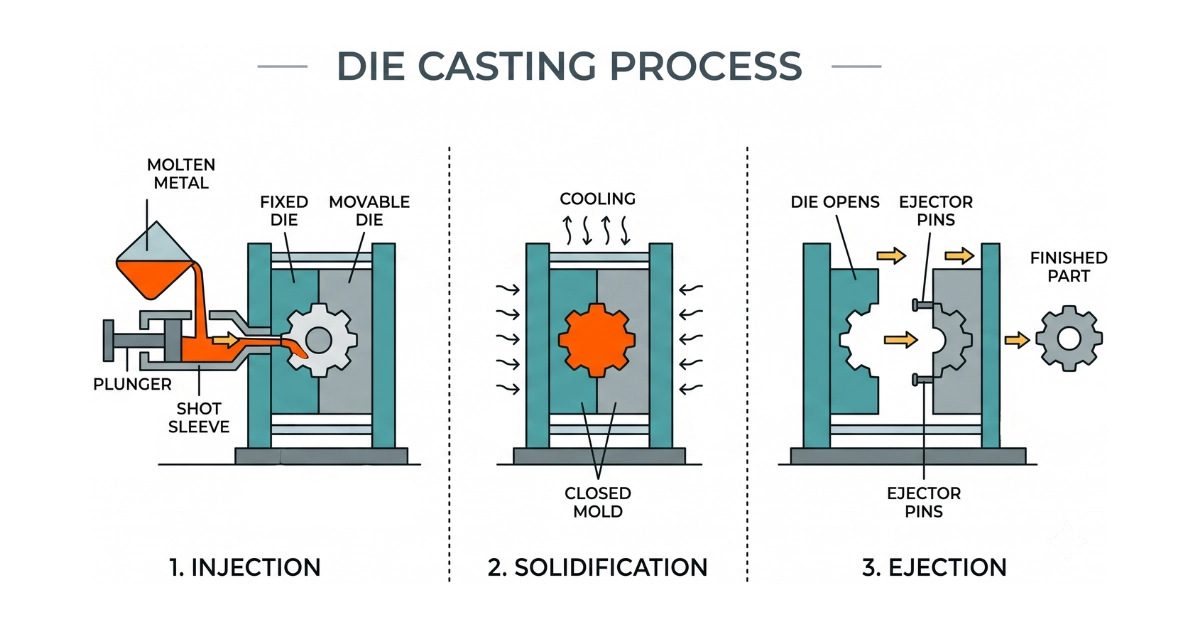
The die casting process begins before metal is melted. The first major decision is tooling design. The die must account for the parting line, wall thickness, draft angles, runners, gates, vents, cooling channels, ejector pins, and any slides or cores required for side openings or undercuts.
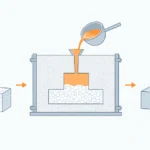
Once the die is prepared, it is mounted on the casting machine and brought to a controlled operating temperature. Molten alloy is then introduced into the machine’s injection system. The metal enters the die cavity, solidifies against the cooled steel surfaces, and is pushed out when the die opens.
The ejected part is not always the final product. It normally includes excess material from gates, runners, and overflow areas. This material is trimmed away. Depending on the drawing, the casting may then be machined, tapped, deburred, polished, coated, plated, leak tested, or inspected.
The process works best when the part design supports stable metal flow and controlled cooling. A difficult design can still be cast, but it may need more complex tooling, greater machining allowance, longer cycle time, or tighter process control. You can learn about the die casting process in more detail.
Types of Die Casting
Die casting is not one single process. Several production routes exist, and each is suited to different alloys, part sizes, quality requirements, and production volumes.
High Pressure Die Casting
High pressure die casting is the most common type. Molten alloy is forced into the die cavity at high speed and pressure. It is widely used for aluminum, zinc, and magnesium components that need detailed shapes, thin sections, repeatable dimensions, and fast production cycles.
This method is usually selected for medium- to high-volume production. Typical parts include housings, covers, structural brackets, lighting bodies, motor components, electronic enclosures, and automotive parts.
High pressure die casting can create complex parts efficiently, but it also requires careful control of venting, gating, die temperature, and fill conditions. Fast filling helps the alloy reach detailed areas before it solidifies, but poor air removal can increase the risk of porosity.
Hot Chamber Die Casting
Hot chamber die casting uses an injection system that works directly with the molten alloy. This arrangement allows short cycles and is generally used for lower-melting materials, especially zinc.
Zinc die casting is often chosen for small, detailed components where surface quality and dimensional repeatability matter. Hardware, locks, fittings, handles, decorative components, electrical parts, and plated products are common examples.
The main advantage of the hot chamber route is production speed. Its limitation is material range. It is not normally the preferred route for aluminum because aluminum’s processing temperature and chemistry place greater demands on the submerged equipment.
Cold Chamber Die Casting
Cold chamber die casting is commonly used for aluminum, magnesium, and some copper-based alloys. In this method, molten metal is melted in a separate furnace and transferred into the shot chamber before each casting cycle.
Aluminum die casting is usually performed by the cold chamber method. It is widely used where low weight, thermal conductivity, corrosion resistance, and structural performance are important. The transfer step makes the cycle different from hot chamber production, but it allows the process to handle alloys that would be unsuitable for a submerged injection system.
Low Pressure and Gravity Die Casting
Low pressure and gravity die casting fill the mold more slowly than high pressure die casting. They are not always substitutes for high pressure die casting. They are chosen when the part needs a different filling pattern, thicker sections, specific integrity requirements, or a production route that places less emphasis on the shortest possible cycle time.
The correct method should be selected after reviewing the alloy, geometry, production volume, functional requirements, and post-processing needs. Choosing a process only because it appears cheaper at the start can create higher costs later through machining, quality problems, or unsuitable tooling.
Die Casting Materials
Material selection should begin with the function of the finished part. The alloy must match the required strength, weight, corrosion resistance, thermal behavior, surface finish, electrical performance, and production economics.
| Material | Common Uses | Why Buyers Choose It | Main Consideration |
| Aluminum | Housings, heat sinks, structural parts, covers | Low weight, thermal performance, corrosion resistance | Requires proper control for pressure-tight or deeply machined parts |
| Zinc | Hardware, small housings, fittings, plated parts | Fine detail, good finish, strong dimensional repeatability | Heavier than aluminum |
| Magnesium | Weight-sensitive components | Very low density and good strength-to-weight potential | Requires specialised capability and corrosion planning |
| Copper-based alloys | Wear-resistant or conductive parts | Strength, conductivity, and wear resistance | Higher processing and tooling demands |
Aluminum Die Casting
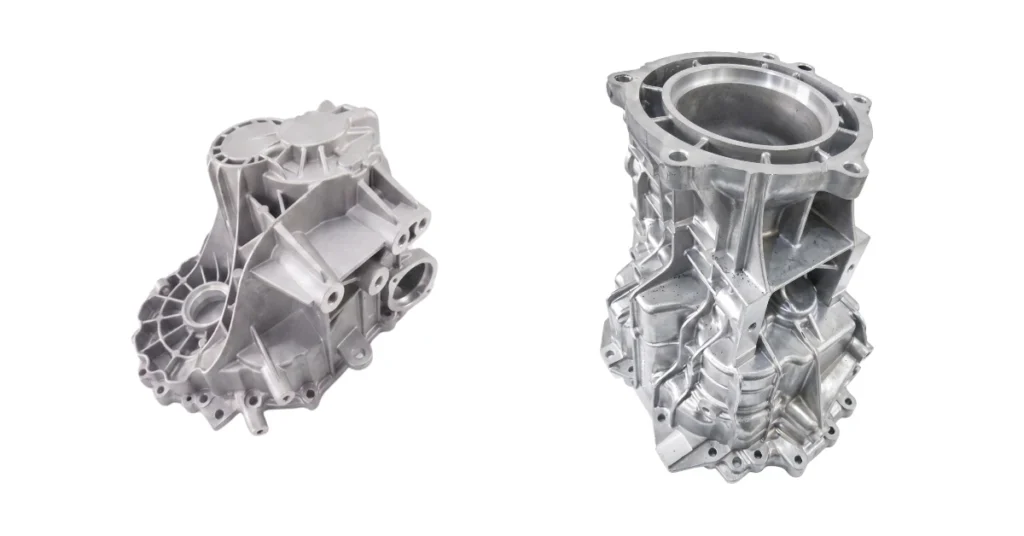
Aluminum is one of the most important die-casting materials. It is commonly used in motor housings, lighting bodies, gearbox covers, pump components, electronic enclosures, heat sinks, and automotive parts.
Buyers often request “aluminum die casting” without defining the alloy or functional requirement. That can lead to an incomplete quotation. A better RFQ explains whether the priority is pressure tightness, corrosion resistance, thermal transfer, machinability, surface treatment, weight reduction, or structural performance.
Material requirements should be aligned with the relevant ASTM standards and agreed with the supplier before tooling begins. If you want to learn more about alloy selection, production considerations, and common applications in more detail check out aluminum die casting page.
Zinc Die Casting
Zinc is useful for smaller components that need detailed geometry, thin features, threads, smooth surfaces, or plating. It can produce parts with strong dimensional consistency and is widely used for hardware, fittings, electrical parts, locks, handles, and decorative components.
Zinc is usually not selected where the lowest possible part weight is the main priority. In those cases, aluminum or magnesium may be more appropriate. However, for compact and detailed components, zinc can be a highly practical choice.
Magnesium and Other Alloys
Magnesium is attractive where weight reduction is critical. It may be considered for transportation, electronics, and equipment where lower mass can improve handling or performance. However, its use should be based on confirmed casting capability, finishing requirements, corrosion exposure, and the real service environment.
Copper-based alloys can also be die cast for specialist applications requiring conductivity, wear resistance, or higher strength. They generally demand more from the tooling and process, so they should be selected only where their performance benefit justifies the added complexity.
Die Casting Applications
Die casting is used across many industries because it can combine complex geometry with repeat production. The part itself may look simple, but its function often drives the process decision.
In automotive manufacturing, die casting is used for housings, brackets, transmission-related components, covers, structural parts, and thermal-management applications. The value is not only the ability to produce metal parts at volume. It is also the opportunity to integrate multiple features into one component and reduce assembly work.
In electrical and electronic products, die cast aluminum is often used for enclosures, heat sinks, lighting housings, and parts that require thermal conductivity or electromagnetic shielding. A plastic enclosure may be lighter and cheaper in some products, but a metal casting may be necessary where heat, stiffness, grounding, durability, or environmental exposure are important.
Industrial equipment also uses die cast parts for pump covers, motor bodies, machine housings, power-tool components, fittings, and actuator parts. In these applications, the key questions are usually pressure tightness, corrosion resistance, mechanical load, machining requirements, and surface protection.
Hardware, consumer appliances, lighting, furniture fittings, locks, and hand tools often use zinc die casting because it supports small detailed parts with a good surface finish.
Advantages of Die Casting
The main advantage of die casting is repeatability. Once a die has been developed and validated, it can produce a large number of similar parts with stable dimensions and consistent appearance.
Die casting can reduce machining because many features are formed directly in the die. This can lower total manufacturing effort, particularly where a part has ribs, bosses, mounting points, openings, cosmetic surfaces, or integrated functional details.
The process can also support part consolidation. A fabricated assembly with several pieces, fasteners, and welds may sometimes be redesigned as one casting. This can reduce assembly time, simplify quality control, and improve consistency.
Surface quality is another advantage. Die cast parts usually require less finishing than sand cast parts, although the final requirement still depends on the alloy, tooling condition, cosmetic standard, and any coating or plating process.
For parts produced in stable volumes, die casting can provide a competitive unit cost because the tooling investment is spread across many pieces. This is why it is common in automotive, electronics, appliance, lighting, and industrial product programs.
Limitations of Die Casting
The biggest limitation is the initial tooling cost. A die must be designed, manufactured, tested, and refined before production begins. This makes die casting less suitable for one-off parts, very small quantities, or designs that are likely to change frequently.
The process is also not ideal for every material. Conventional die casting is mainly used for non-ferrous alloys. A buyer requiring steel, stainless steel, or very high-temperature alloys may need investment casting, sand casting, forging, fabrication, or machining instead.
Part design matters greatly. Large changes in wall thickness can increase shrinkage risk. Deep undercuts may require slides or complex die actions. Tight tolerances on every dimension can increase tooling cost and may add unnecessary machining. A good design does not demand maximum precision everywhere. It applies precision only where the assembly needs it.
Porosity is another important limitation. It may result from trapped gas or shrinkage during solidification. In a non-critical bracket, small internal porosity may have little effect. In a pressure-tight housing or a part with deep machining, it can become a major issue. This is why die casting should be assessed together with the intended inspection method and functional requirement.
Die Casting Design and Quality Control
The most effective cost reduction happens before the tool is built. A manufacturing review should examine wall thickness, ribs, bosses, draft, parting-line position, undercuts, machining allowance, material selection, and critical tolerances.
Draft is necessary because the casting must release from the die without damaging surfaces. Ribs can increase stiffness without making the full part thicker. Corners should be designed with appropriate radii rather than sharp transitions. Parting lines should avoid critical sealing areas, visible cosmetic surfaces, and tight assembly features where possible.
Quality control should match the part’s use. A cosmetic cover may need visual inspection and dimensional checks. A pump housing may require leak testing. A structural or safety-related component may need stronger material verification and inspection controls. Depending on the requirement, this may include CMM inspection, X-ray examination, material analysis, pressure testing, or functional testing.
General tolerance and casting guidance can be reviewed through resources from the North American Die Casting Association and ISO. The final acceptance criteria should always be defined on the drawing and agreed before production starts. You need to be clear about the die casting defects in order to avoid the mistakes while ordering.
Die Casting Compared With Other Manufacturing Methods
Die casting is often compared with injection molding because both rely on reusable tools and repeat production. Injection molding is usually suitable where plastic performance, electrical insulation, low weight, or chemical resistance is needed. Die casting becomes more attractive where the part requires metal stiffness, heat transfer, EMI shielding, wear resistance, or long-term structural durability.
Compared with sand casting, die casting generally provides better repeatability and surface finish for suitable part sizes and production volumes. Sand casting may be better for very large parts, lower quantities, or materials that are not practical for die casting.
Compared with investment casting, die casting is usually more suited to high-volume non-ferrous parts. Investment casting can be more appropriate for complex steel, stainless steel, and high-temperature alloy components where tooling economics and material requirements differ.
These comparisons should be treated as design decisions rather than fixed rules. The right method depends on the component, not only the keyword used in the RFQ.
What Buyers Should Include in a Die Casting RFQ
A complete RFQ gives the supplier enough information to recommend the correct process and prepare a realistic quotation. It should include a 3D CAD model, a 2D drawing with critical dimensions and tolerances, expected annual volume, material or functional requirement, surface-finish expectation, machining details, and any testing or documentation needs.
It also helps to explain how the part will be used. A pressure-bearing cover, a cosmetic enclosure, and a structural bracket may all be die cast, but they require different design, inspection, and quality-control decisions.
YTD Foundry can use this information to review whether die casting is suitable before tooling is released. This keeps the discussion focused on manufacturability, performance, and total cost rather than only the initial unit price.
Conclusion
Die casting is a strong manufacturing option for repeat non-ferrous metal parts that need detailed geometry, stable dimensions, good surface quality, and efficient production after tooling is established.
The process works best when it is selected early, before the part design and tool cost are fixed. Buyers should evaluate material choice, production volume, wall thickness, machining needs, inspection requirements, and functional performance together. That approach makes it easier to choose the right casting route and avoid expensive changes after tooling begins.
FAQs
Is die casting suitable for low-volume production?
It can be, but the tooling cost must be justified by the expected quantity and long-term demand. For a very small batch or a design likely to change, machining, sand casting, or investment casting may be more practical.
Can die cast parts be machined?
Yes. Machining is commonly used for threads, sealing faces, bearing bores, and dimensions that need more precision than the casting process can provide economically.
What is the difference between hot chamber and cold chamber die casting?
Hot chamber machines are normally used with lower-melting alloys such as zinc. Cold chamber machines are commonly used for aluminum, magnesium, and some copper-based alloys because the metal is transferred from a separate furnace.
What causes porosity in die casting?
Porosity can result from trapped gas or shrinkage during solidification. It is controlled through part design, die venting, gating, process settings, cooling, and inspection matched to the part’s function.
Is die casting stronger than CNC machining?
Not automatically. Strength depends on the alloy, geometry, loading, porosity level, heat treatment, and manufacturing route. CNC machining from wrought material and die casting serve different production and performance needs.