Silica-sol casting and water-glass casting, as compared here, are both investment casting processes that use expendable patterns and ceramic shells. The distinction is the shell’s binding system. Water-glass investment casting should not be confused with sodium-silicate-bonded sand casting, which uses the same broad family of binder in a different mold-making process.
Silica-sol routes are often considered when as-cast surface quality and dimensional control have significant value. Water-glass investment casting is often considered when a lower-cost shell process can meet the component’s requirements. Neither description establishes the result for a particular part.
The useful choice depends on how the complete shell system performs, what finishing remains, and the cost of delivering acceptable components.
The Binder Holds the Shell’s Refractory Materials Together
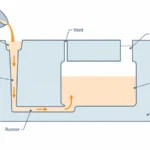
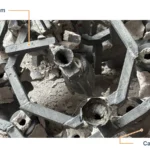
Both routes build a ceramic shell around an expendable pattern and its metal-delivery channels. The pattern is coated, the shell is built up and hardened, and the pattern is removed before metal enters the cavity. After casting, the shell is broken away.
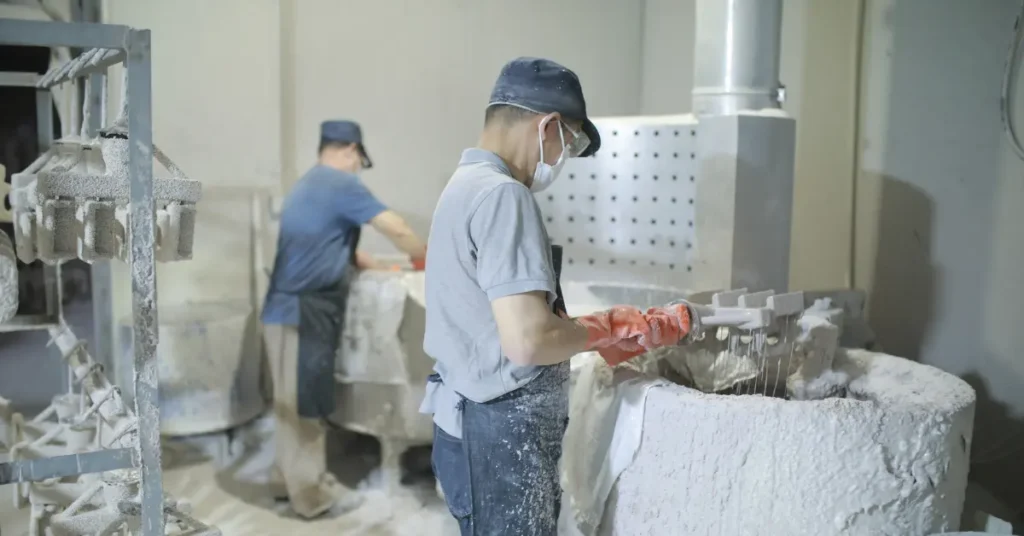
The materials used to build that shell have different roles. The binder is the liquid binding medium. Fine ceramic powder, called refractory flour, is mixed with it to form a slurry, often with additional ingredients that control coating behavior. After dipping and draining, coarser refractory grains called stucco are applied to the wet coating. Repeating the coating sequence builds the shell.
The Investment Casting Institute’s shell-building guidance distinguishes these materials and the roles of the shell layers:
- Face coats reproduce the pattern detail and form the surface that will contact the metal.
- Backup coats add the thickness and strength needed for subsequent processing and pouring.
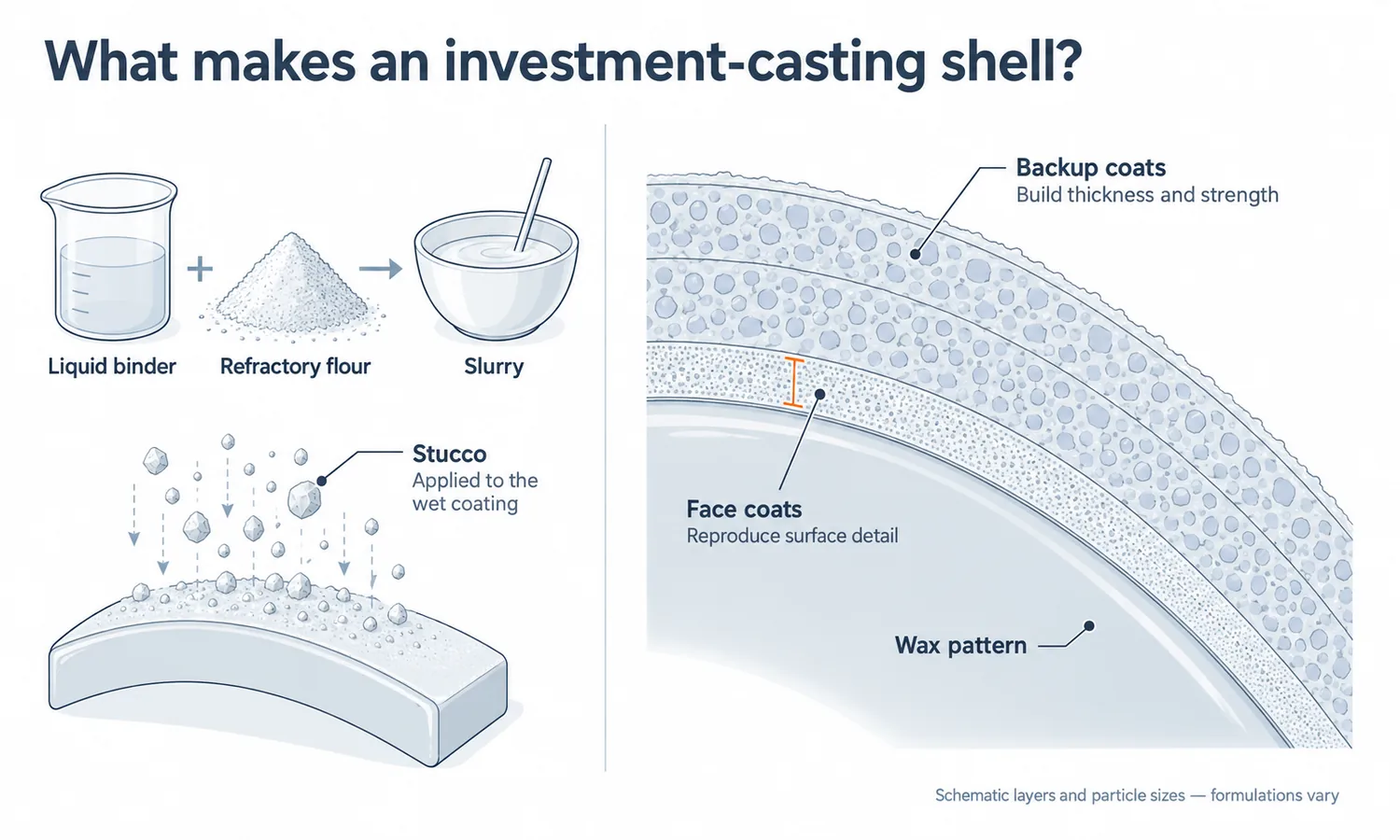
These layers can use different formulations. A silica-sol shell is not necessarily made entirely from silica, and the binder name does not require zircon, quartz, or any other single refractory. The choice of flour and stucco matters alongside the binder.
This is why two foundries using the same binder family can produce different results: they may be making substantially different shells.
Drying and Chemical Hardening Change How the Shell Develops Strength
The two binders contain silicon and oxygen, but they are different materials.
Silica sol is colloidal silica: very small, discrete particles of amorphous silica dispersed in water. Water glass, in this investment-casting comparison, generally means an aqueous sodium-silicate solution. Commercial water-glass grades vary in their silica-to-alkali ratio and solids content, rather than sharing one fixed composition. The OxyChem Sodium Silicates Handbook explains these product differences.
Their different forms lead to different ways of developing a usable shell.
Silica-Sol Shells Need Controlled Water Removal
As water leaves a silica-sol coating, the particles move closer together and form a connected gel structure. This gives the unfired shell strength. Subsequent firing develops the ceramic bond needed for later stages.
Drying therefore does more than make a surface feel dry. The coating must lose enough water in the places where it needs to build strength. A sheltered recess can dry differently from an open surface, even on the same pattern assembly.
Temperature, humidity, airflow, geometry, and the shell formulation all influence the drying time. The ICI’s technical discussion of slurry formulation and drying treats these as interacting factors. Silica-sol shell production can use controlled air and formulation adjustments; it is not defined by one fixed period of natural air drying.
Water-Glass Shells Need Hardener and Moisture Control
Water-glass investment shells commonly use a chemical hardener to develop the bond. Different hardeners and application methods are used, so the actual hardening route needs to be identified.
Chemical setting can shorten the time needed to build strength between coats. It can also introduce hardener control, penetration, draining, rinsing, and drying requirements. A shell that has chemically hardened is not automatically ready for dewaxing or pouring.
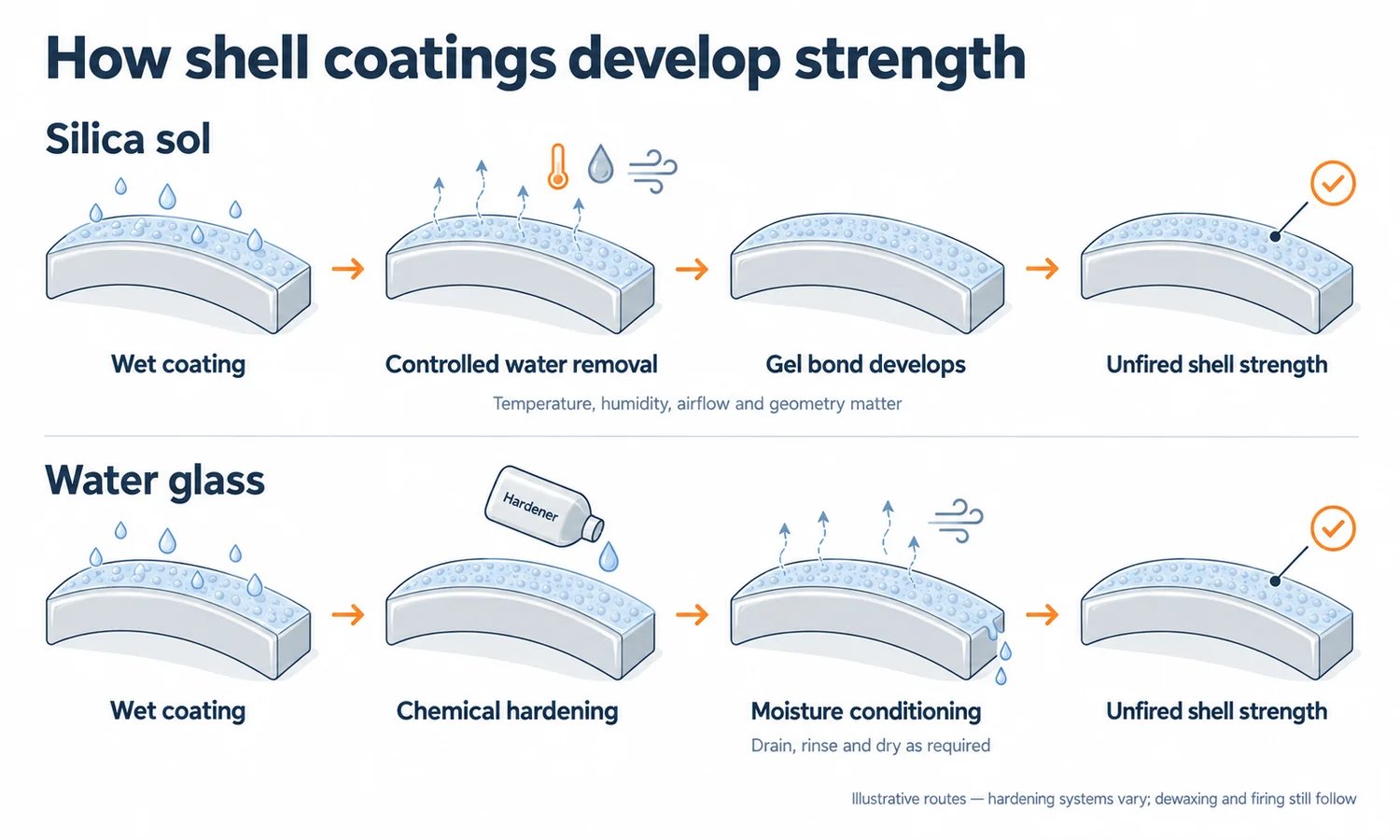
The practical comparison is therefore the time needed to produce a shell in the required condition. Comparing only a drying interval on one line with a chemical-setting interval on another can leave out necessary operations.
The Shell Must Withstand Dewaxing and Pouring
Once the shell has formed, it must preserve the pattern’s shape through several different loads. It needs strength for handling, resistance to damage during pattern removal, and sufficient stability at casting temperature.
Those are different performance requirements. A shell that is strong at room temperature may behave differently after firing or while exposed to hot metal. “Stronger shell” is useful only when the test condition and the production stage are clear.
The shell also needs suitable permeability so gas can escape, and it must be removable after the casting has solidified. Research on shell porosity, permeability, and strength shows why these properties must be balanced. Maximizing density or one strength measurement does not necessarily improve the whole process.
Finning illustrates how shell behavior reaches the finished casting. A crack can allow metal to enter a space that was not part of the intended cavity, leaving a thin projection on the part. The ICI’s finning guidance identifies shell cracking during shell building, drying, or dewaxing among the relevant mechanisms.
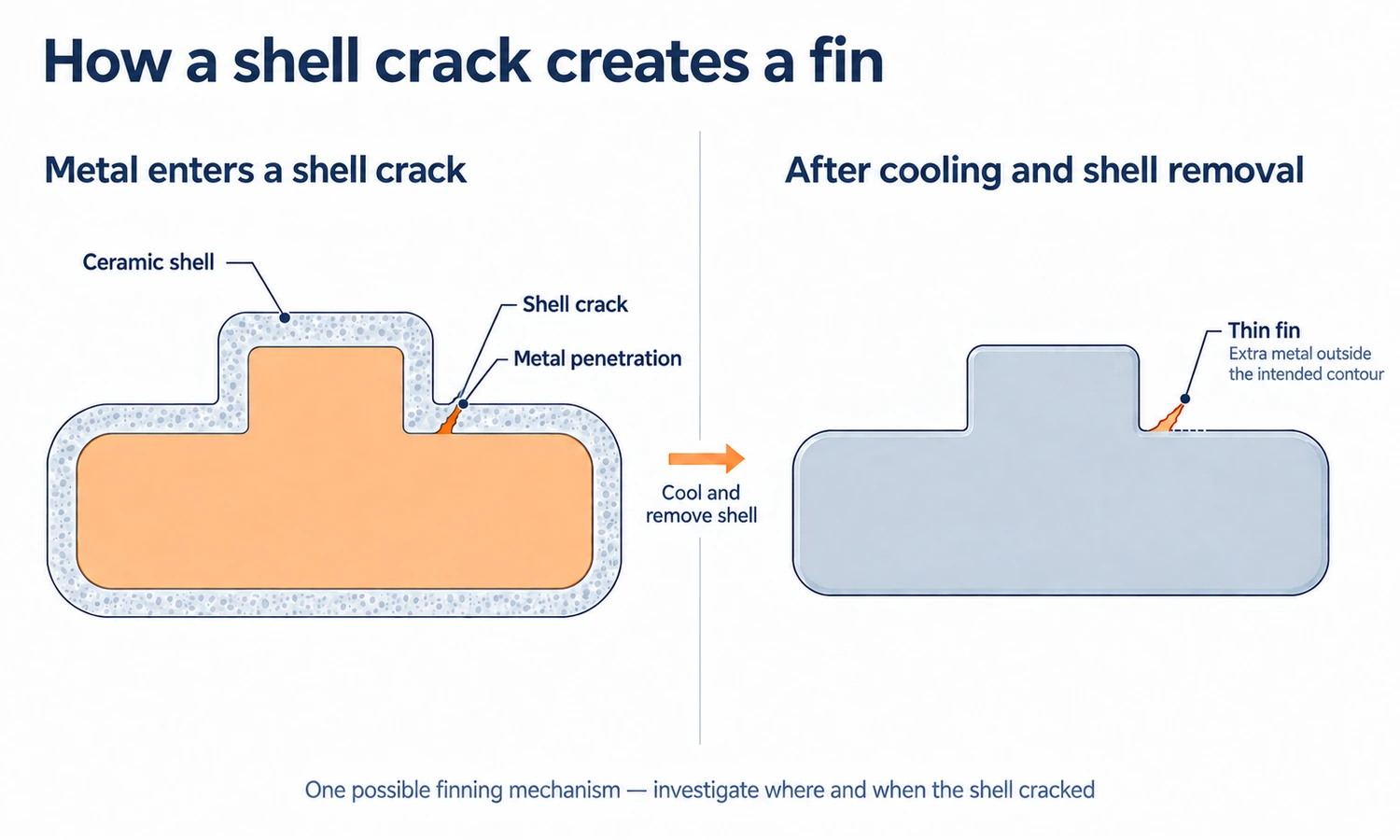
Such a defect calls for evidence about where and when the shell failed. Drying, shell strength, pattern removal, and pressure relief may all need investigation. The binder label alone does not identify the cause, nor does it establish how frequently the problem will occur.
For a purchaser, consistent control through these stages matters more than an isolated claim about shell strength.
Better As-Cast Results Matter When They Reduce Finishing
Foundry comparisons commonly associate silica-sol investment casting with finer as-cast surfaces and tighter dimensional control, and water-glass investment casting with lower-cost production and less refined as-cast results. These are broad descriptions of the processes offered by suppliers. Their quoted roughness and tolerance ranges differ, so they should not be treated as fixed capabilities attached to the binder names.
There is a practical reason to look beyond those labels. The surface is first defined by the pattern, then reproduced by the face coat and affected by contact with the metal. Pattern condition, refractory particle size, slurry flow and drainage, coating defects, alloy reactions, and shell removal can all influence it.
Dimensions also develop through the tooling, pattern, shell, casting contraction, heat treatment, and finishing. A more stable shell can help preserve geometry, but it cannot correct every error introduced elsewhere.
Consider a lever with an external profile and lettering that will remain as cast, plus a pivot bore that will be machined. Better reproduction of the profile and lettering may reduce grinding or other surface work. The pivot bore still needs the planned machining operation.
That example separates three requirements that should remain distinct:
- The dimensions and surfaces accepted as cast or after specified cleaning.
- The machining allowance left to absorb casting variation and permit full cleanup.
- The finished dimensions and surface condition required after machining.
A finer exterior has value when it meets a functional or appearance requirement, removes work, or improves consistency. It has less economic value when an alternative casting already meets those requirements and the remaining machining is unchanged.
Specify surface measurements with their parameter, units, location, and condition. Ra, RMS, and Rz are different measures; an as-cast value and a value after grinding or blasting may describe different deliverables. Likewise, ISO 8062-3:2023 provides casting-tolerance and machining-allowance frameworks, not automatic grades for the two binder families.
Finishing and Rejection Rates Can Change the Cost Advantage
Water-glass routes are often offered on the basis of lower shell-material or production cost. A silica-sol proposal may involve higher material expenditure or more investment in controlled drying. Those differences need to be compared with the work and losses elsewhere in the route.
Return to the lever. If a silica-sol process reduces repeated grinding of the profile while still producing a consistent machining blank, the saving can offset a higher casting price. If the proposed water-glass route already meets the accepted profile and surface requirements, paying more for a finer finish may add little value.
The comparison must include the complete shell materials, hardening or drying operations, casting acceptance rates, shell removal, finishing, heat treatment, and inspection. Tooling and development also matter, particularly when a route change requires new allowances, trials, or process qualification.
A lower price for liquid binder is therefore only one input. Use the cost per accepted finished component at the same material, drawing, quantity, and inspection requirements.
Delivery needs a separate check. Shell-making time contributes to the schedule, but tooling, first-article work, melting, heat treatment, machining, inspection, and capacity also affect delivery. Faster chemical hardening does not establish a fixed lead-time advantage for a complete order.
When to Choose Silica Sol, Water Glass, or Further Trials
Start by confirming that the proposed shell and refractory system suits the alloy and geometry. Binder names do not set the maximum part weight, minimum wall, or complete alloy range. Coating access, drying, shell stability, metal flow, cleaning, and the available equipment still determine whether the part is practical.
Once those conditions are established, the choice can be narrowed:
- Favor a silica-sol proposal when demonstrated surface reproduction or dimensional control helps meet an important requirement, reduces finishing, or improves the consistency of the accepted part enough to justify its total cost.
- Consider a water-glass proposal when the qualified process meets the same finished-part and material requirements at a lower total cost. Judge the supplied component, including necessary cleanup and machining.
- Obtain further evidence when a critical feature or a claimed cost saving is unproven. Comparable production results, a targeted trial, and an agreed inspection plan can resolve the uncertainty.
For either route, shell selection supports casting quality; it does not independently determine the metal’s tensile strength, fatigue performance, or corrosion resistance. The material specification, melting, solidification, heat treatment, and acceptance testing remain part of the decision.
Silica-Sol Investment Casting with YTD Foundry
YTD Foundry provides custom silica-sol investment castings from drawings or physical samples, with tooling, casting, CNC finishing, inspection, and surface finishing organized around the component.
For a silica-sol process review, provide the required alloy, geometry, quantities, and the surfaces or dimensions that determine acceptance. Identifying which features will remain as cast and which will be machined helps establish where the casting process must deliver precision and where subsequent finishing will complete the part.
FAQs
Can Silica Sol and Water Glass Be Used in the Same Shell?
Yes. Documented composite systems include silica-sol face coats with water-glass backup coats, as well as other combined formulations. A published study of compound coatings records the use of both binder families in investment casting.
For a composite proposal, establish which binder and refractory are used in the face and backup layers. The word “composite” does not describe one standard recipe or a guaranteed result.
Does the Binder Determine the Wax Grade or Dewaxing Method?
No. Suppliers sometimes associate silica-sol casting with one wax-temperature category and water-glass casting with another, but these pairings do not define the binder systems.
Wax selection, pattern manufacture, and dewaxing depend on the actual process. Hot-water, steam, and flash-fire methods should not be assigned solely from the binder name. The pattern, shell, equipment, and removal path need to work together.
Is Silica-Sol Casting Automatically More Environmentally Friendly?
Both binders in this comparison are water-based. Their use of water does not account for energy consumption, emissions from pattern removal, refractory dust, cleaning, and other waste streams across the casting process.
Water-glass impacts depend partly on the hardener. A documented ammonium-chloride hardening route generates ammonia and salt-containing liquid; those conditions should not be assigned to every hardener system.
An environmental comparison needs the actual materials, energy use, recovery, emissions, and waste treatment for each proposed route. “Water-based” alone is not a complete assessment.