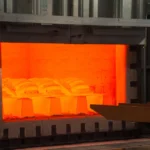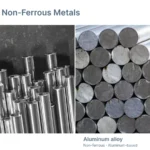
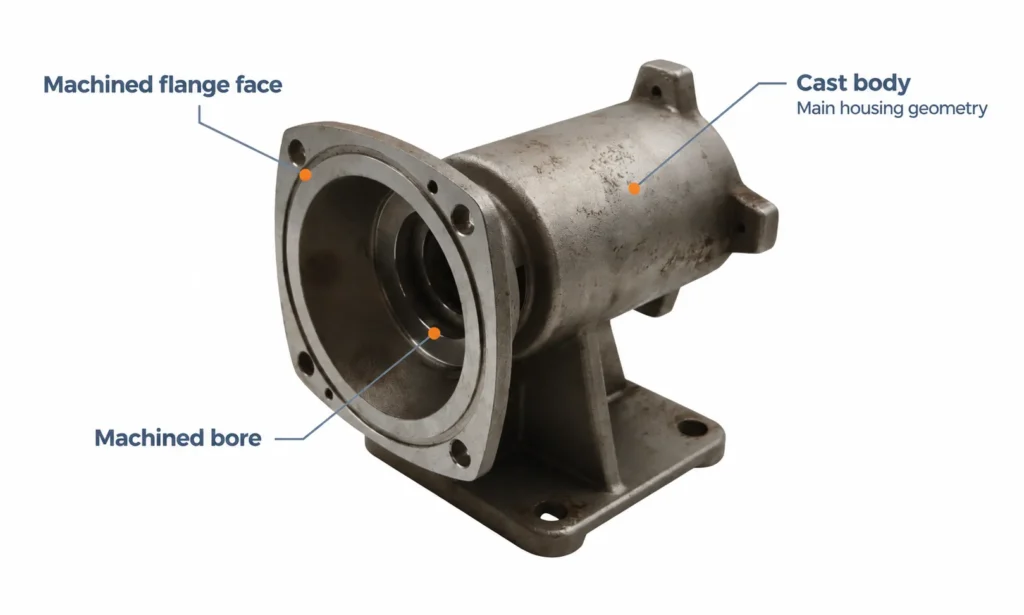
Casting and machining create metal parts in almost opposite ways.
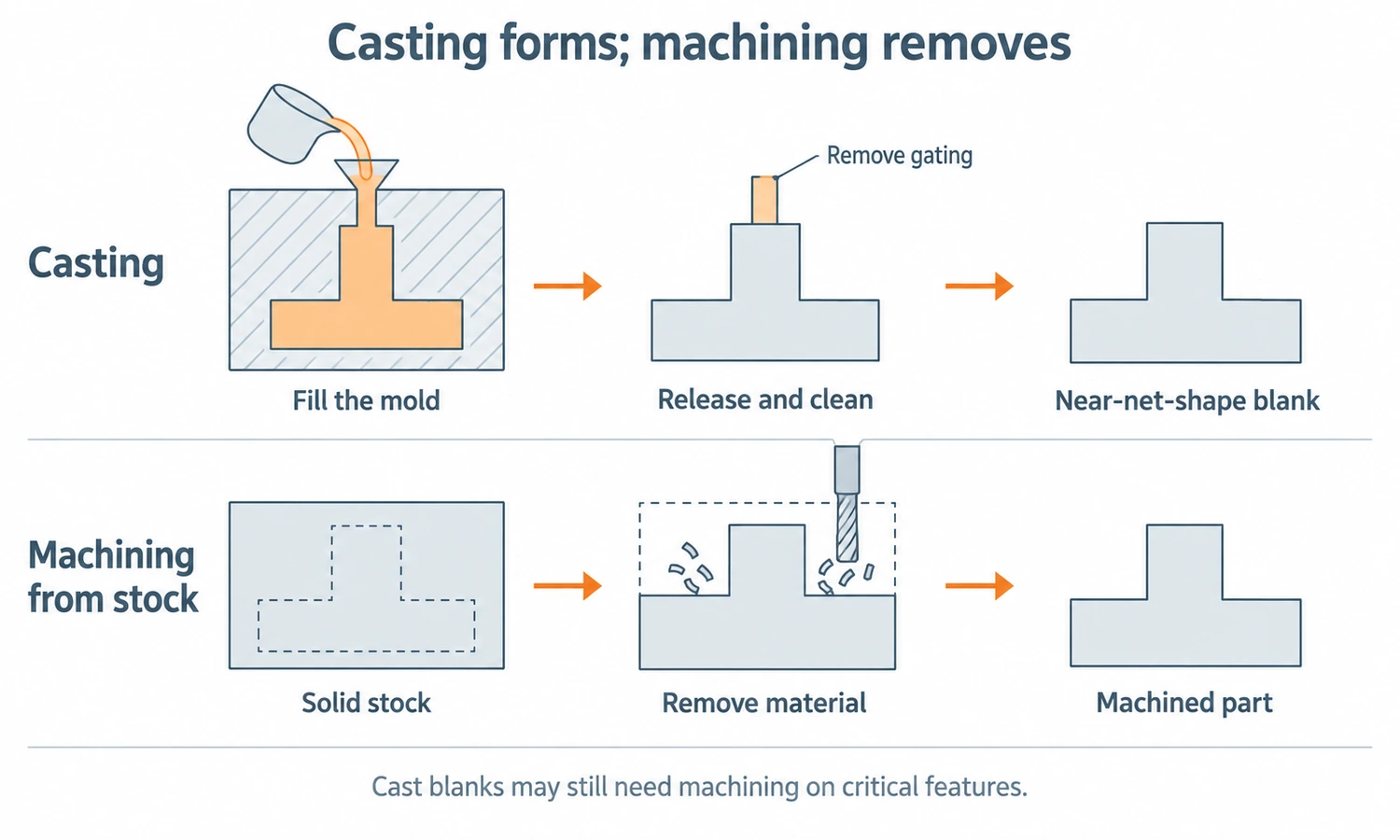
Casting uses a mold to form much of the component geometry from molten metal. Machining starts with solid stock and removes material until the required shape remains.
That difference affects geometry, tolerance, material use, tooling, lead time, and production cost.
But many production parts are not made by choosing only one process. A common strategy is to cast the geometry that is expensive to machine, then CNC machine the features that need precision.
This guide explains when each approach makes sense and how to compare them for a real component.
Casting vs Machining: Quick Comparison
| Factor | Casting | CNC Machining From Stock |
|---|---|---|
| Basic Method | Molten metal takes the shape of a mold | Cutting tools remove material from solid stock |
| Tooling | Usually requires patterns or casting tooling | Usually little dedicated tooling beyond fixtures |
| Complex 3D Geometry | Strong advantage | Limited by tool access and machining time |
| Internal Cavities | Can be formed with suitable cores or casting methods | Often difficult or impossible to machine directly |
| Tight Tolerances | Critical features often machined afterward | Strong advantage |
| Surface Finish | Depends on casting process | Generally better directly from machining |
| Material Utilization | Near-net shape can reduce material removal | Chips may represent substantial material loss |
| Design Changes | Tooling may need modification | CAD/CAM changes are relatively easy |
| Low Quantity | Tooling may be difficult to justify | Often attractive |
| Repeated Production | Can become highly economical | Machining time remains in every part |
| Best Use | Form complex bulk geometry | Create precise accessible features |
This comparison is only a starting point because casting is not one single process.
Sand casting, investment casting, and die casting have very different tooling costs, tolerances, surface quality, and production economics.
How Casting and CNC Machining Create Metal Parts
The most important difference is where the final shape comes from.
Casting Forms Geometry With a Mold
A casting mold contains a negative version of the component.
Molten metal fills the cavity, solidifies, and becomes the basic part shape.
This is efficient for geometry such as:
- Curved surfaces
- Ribs
- Bosses
- Irregular contours
- Internal cavities
- Flow passages
- Shapes with a large difference between overall size and actual metal volume
Once the mold is developed, much of this geometry can be reproduced in every casting.
CNC Machining Creates Geometry Through Tool Access
Machining starts with bar, plate, billet, forging, or another solid workpiece.
A cutting tool must physically reach each feature.
This works extremely well for:
- Flat surfaces
- Holes
- Bores
- Threads
- Slots
- Pockets
- Turning profiles
- Precision mating features
Machining becomes less efficient when the required shape is difficult to reach or when most of the starting block must be removed.
A useful first question is therefore:
Is the part difficult to form with a mold, or expensive to reach with a cutting tool?
How Sand Casting, Investment Casting, and Die Casting Compare With Machining
Statements such as “casting needs tooling” or “casting is cheaper at volume” are too broad unless the casting process is identified.
Sand Casting vs. Machining
Sand casting is often useful for large parts and shapes that would require very large machining stock.
A pump housing is a typical example.
Machining it entirely from solid material may require:
- A very large billet
- Heavy rough machining
- Long machine time
- Extensive material removal
- Difficult internal-cavity machining
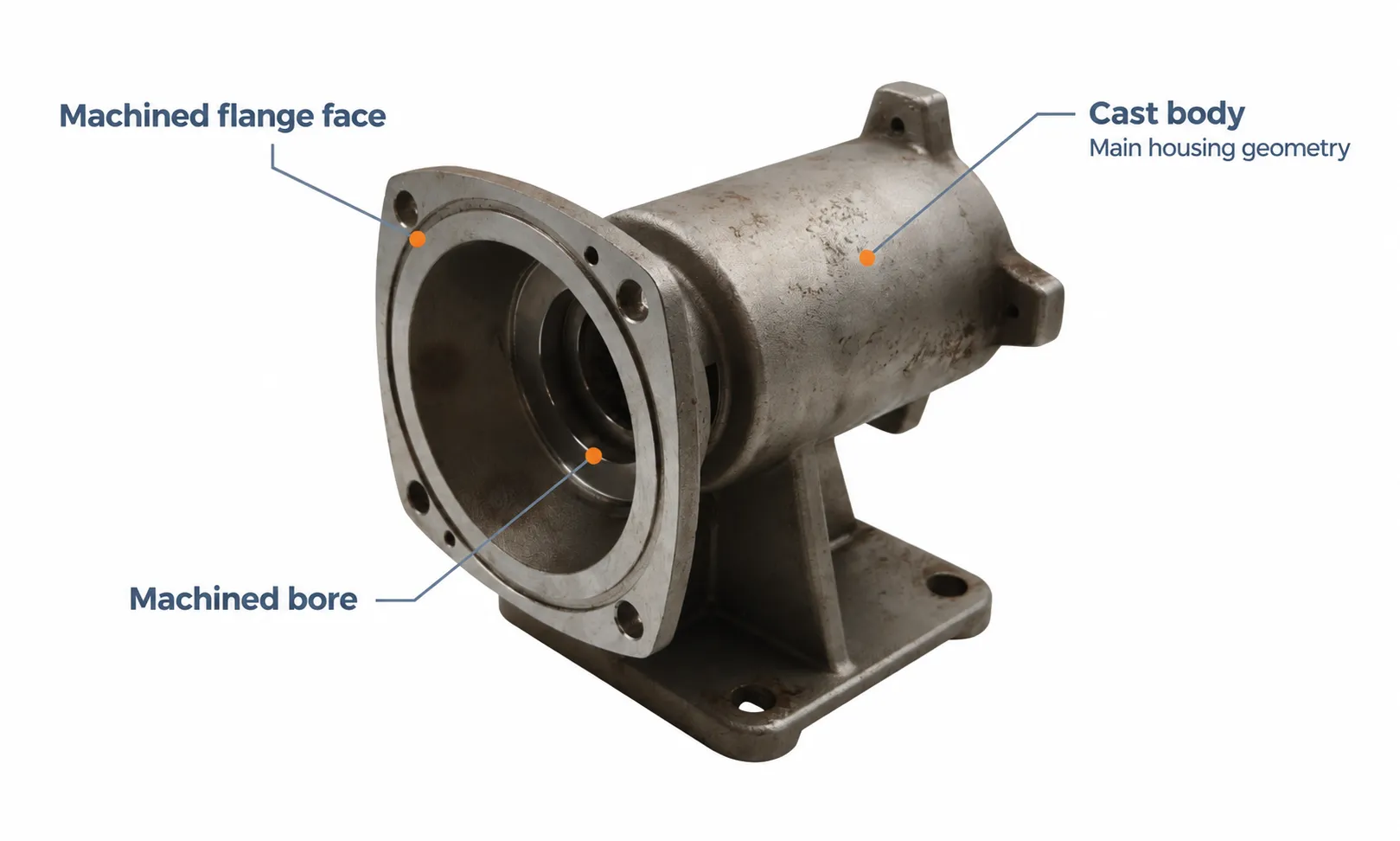
Sand casting can form the main body and internal volume first, leaving only bores, sealing surfaces, mounting faces, and other functional features for machining.
Investment Casting vs. Machining
Investment casting is especially useful for small and medium-size parts with complicated geometry.
Curved surfaces, ribs, bosses, integrated features, and difficult contours can be produced close to final shape.
This can reduce:
- Rough-machining time
- Number of setups
- Tool reach problems
- Separate fabricated pieces
- Material waste
YTD’s detailed guide to CNC machining vs investment casting covers this narrower process comparison.
Die Casting vs. Machining
Die casting changes the economics again.
Permanent tooling is expensive, but once production is stable, large quantities of aluminum, zinc, or magnesium components can be produced quickly.
For a high-volume stable design, machining every part from billet may leave far more production time in every unit than die casting.
This is why the phrase “casting vs machining” should always be followed by another question:
Which casting process?
Complex Shapes, Internal Cavities, and Tool Access
Geometry is one of the strongest reasons to consider casting.
Imagine two parts with the same finished weight.
The first is a rectangular block with several holes.
The second is a hollow housing containing:
- Curved walls
- Internal passages
- Ribs
- Bosses
- Mounting pads
- Features on several sides
The first may be easy to machine from stock.
The second may require:
- A much larger starting billet
- Several machining setups
- Long-reach tooling
- Heavy roughing
- Difficult internal access
- Fabrication or welding where machining cannot reach
Casting moves much of this complexity into the mold.
That means geometry often matters more than finished weight alone.
A small but complicated component may benefit from casting more than a much heavier but simple block-shaped part.
Dimensional Tolerance and Surface Finish: Casting vs. Machining
CNC machining has the stronger advantage when tight tolerances or fine functional surfaces dominate the design.
Machining is particularly effective for:
- Precision bores
- Bearing seats
- Threads
- Closely controlled flatness
- Hole positions
- Sealing surfaces
- Sliding or fitted interfaces
Casting can produce good dimensional control, especially with processes such as investment casting and die casting, but it normally does not make sense to force every surface to meet machining-level tolerance.
If most of the component is simple and almost every feature needs precision, machining from stock may be the more direct route.
If only a limited number of features need precision, casting the basic shape and machining those areas afterward is often more efficient.
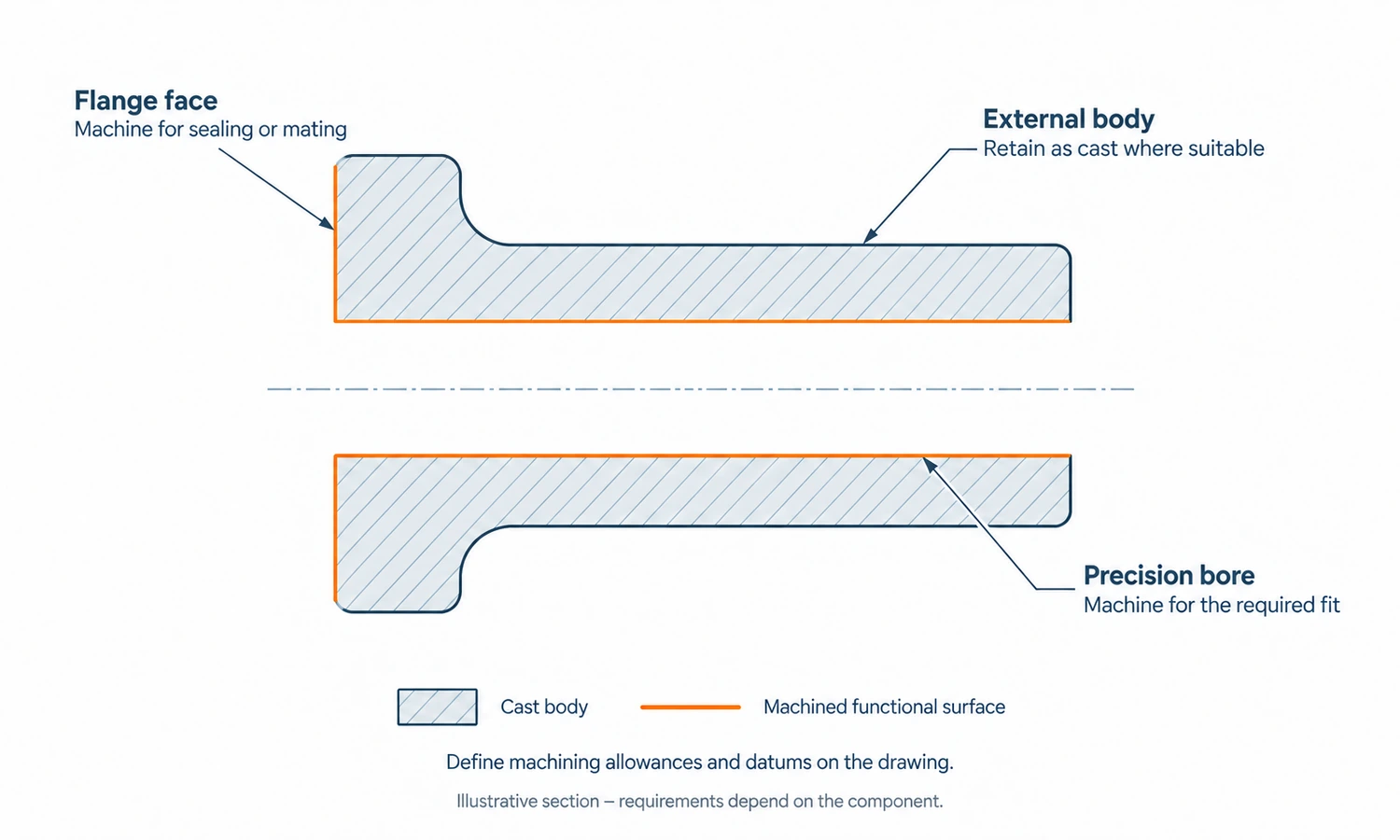
As-Cast Surfaces, Machined Features, and Machining Allowances
Most production castings do not need the same tolerance everywhere.
Consider a valve body.
Its external contour may only need normal casting tolerance.
But the following may require machining:
- Stem bore
- Flange face
- Seal seat
- Threaded connection
- Mating datum
This is why good casting drawings distinguish between:
- As-cast surfaces
- Machined surfaces
- Critical dimensions
- Reference datums
- Machining allowances
The objective is not to make the entire component as precise as possible.
It is to apply precision where it affects function.
YTD’s in-house CNC machining capability is used this way on cast components: the casting creates the basic geometry, and CNC finishing completes the critical features.
Material Utilization and Machining Waste
Machining is subtractive.
If a finished component weighs 3 kg but requires a 12 kg billet, most of the purchased material becomes chips.
Scrap metal can often be recycled, but recycling does not recover:
- Original material purchase cost
- Machine hours
- Cutting-tool wear
- Coolant
- Electricity
- Handling
- Production capacity
This becomes increasingly important with expensive alloys such as:
- Stainless steel
- Nickel alloys
- Cobalt alloys
- High-alloy steels
Near-net-shape casting can reduce the difference between starting material and finished-part weight.
However, this advantage depends on geometry.
If the finished component already looks very similar to standard bar, plate, tube, or readily available billet, machining may use material efficiently enough that casting adds no real benefit.
Upfront Tooling Cost vs. Per-Part Machining Cost
Casting and machining distribute cost differently.
Casting Places More Cost Before Production
Casting may require:
- Pattern or mold design
- Tool manufacturing
- Gating and runner design
- Simulation or process engineering
- Sample production
- Validation
This creates a higher initial commitment.
Machining Keeps More Cost Inside Every Part
Machining can often begin with relatively little dedicated tooling.
But every unit still consumes:
- Machine time
- Cutting tools
- Workholding
- Setup time
- Raw stock
- Inspection time
This creates the basic economic tradeoff:
Casting often has higher fixed cost but lower repeated geometry-creation cost.
Machining often has lower fixed tooling cost but keeps more processing cost in every part.
How Part Complexity and Production Volume Affect the Break-Even Point
There is no universal quantity where casting automatically becomes cheaper than machining.
A simple cylindrical part may remain economical to machine even at high volume.
A complex housing may justify casting at a much lower quantity because every machined unit requires extensive material removal and several setups.
The break-even point depends on:
- Casting process
- Tooling cost
- Machining cycle time
- Starting material
- Part complexity
- Annual volume
- Lifetime volume
- Design stability
This means quantity changes the answer, but geometry determines how quickly the economics change.
A rule such as:
“Machine below 100 pieces and cast above 100 pieces”
is not reliable enough for engineering decisions.
Prototypes, Design Changes, and Production Tooling
Machining has an important advantage while a design is still changing.
If an engineer moves a hole, removes a pocket, or changes an external profile, the CAD and machining program may be updated without rebuilding a casting tool.
Casting changes can be more expensive.
Depending on the process, an engineering change may require:
- Tool modification
- New inserts
- Pattern changes
- Gating changes
- New simulation
- Additional samples
This is why machining is often attractive for:
- Prototypes
- Engineering validation
- Pilot production
- Designs that are not yet stable
A common product-development path is:
Machine prototypes → validate the design → cast the production geometry → machine critical features
Changing the manufacturing process as the product matures is often the most economical choice.
Part Consolidation: Replacing Multi-Part Assemblies With Castings
Casting can create value even when machining time is not the main problem.
A fabricated assembly may contain:
- Main body
- Brackets
- Mounting bosses
- Curved connectors
- Welded joints
- Fasteners
A casting may allow several of these features to become one component.
That can reduce:
- Part count
- Welding
- Fasteners
- Assembly labor
- Alignment errors
- Inspection points
- Supply-chain complexity
This is one reason investment casting design sometimes begins by asking whether an existing machined or welded assembly can be redesigned as a single cast part.
Cast vs. Wrought Material Strength: Why Machining Is Not the Main Difference
A common question is:
Are machined parts stronger than cast parts?
The comparison is incomplete.
Machining does not create the metallurgy of the starting material.
A machined part may start as:
- Rolled plate
- Bar stock
- Forging
- Extrusion
- A casting
What people often mean is:
cast material vs. wrought or forged material that is later machined.
Wrought and forged materials can offer advantages in some fatigue, toughness, or highly loaded applications because mechanical working changes the material structure.
Cast components have their own considerations, including:
- Solidification structure
- Porosity
- Inclusions
- Heat treatment
- Section thickness
But final mechanical performance depends on much more than the word “cast.”
Important factors include:
- Alloy
- Heat treatment
- Manufacturing quality
- Geometry
- Surface condition
- Loading direction
Material form and machining method should therefore be specified separately.
Casting + CNC Machining as a Combined Manufacturing Process
Casting and machining are often presented as competitors.
In practice, they are frequently complementary.
A pump impeller is a good example.
Casting can form:
- Curved blades
- Hub geometry
- Flow surfaces
Machining can then finish:
- Shaft bore
- Keyway
- Mounting surface
- Balancing-related features
Machining the entire impeller from solid could make the flow geometry extremely expensive.
Casting the shaft interface directly to final precision could be unnecessarily difficult.
The efficient route is:
Cast the complex shape. Machine the functional precision.
This combination is central to YTD’s one-stop investment-casting workflow.
How to Choose Between Casting and Machining
A useful decision starts with the drawing.
1. Compare the Finished Shape With Available Stock
Does the part already resemble bar, plate, tube, or billet?
Machining may be straightforward.
Does it contain hollow regions, curved walls, ribs, bosses, or large empty volumes inside the overall envelope?
Casting becomes more attractive.
2. Mark Every Critical Dimension
Separate features requiring true machining precision from those that can remain as cast.
Do not apply the tightest tolerance on the drawing to the entire component automatically.
3. Estimate Material Removal
Compare the finished weight and geometry with the stock required for machining.
Large amounts of removed material—especially expensive alloy—strengthen the casting case.
4. Check Quantity and Design Stability
Small quantities and changing designs generally favor machining.
Stable repeated production improves the economics of casting tooling.
5. Choose the Appropriate Casting Process
If casting looks promising, decide whether the geometry and volume favor:
- Sand casting
- Investment casting
- Die casting
- Another casting route
6. Compare Finished-Part Cost
Include:
- Material
- Tooling
- Casting
- CNC machining
- Finishing
- Inspection
- Scrap and rework
The cheaper raw blank is not necessarily the cheaper production component.
Casting vs. Machining Selection Guide
| Project Requirement | Route to Evaluate First |
|---|---|
| One-off prototype | CNC Machining |
| Design still changing | CNC Machining |
| Simple geometry from standard stock | CNC Machining |
| Tight tolerance across most of the part | CNC Machining |
| Large internal cavity | Casting |
| Complex curved geometry | Casting |
| Extensive removal of expensive material | Casting |
| Large industrial housing | Sand Casting + CNC |
| Complex stainless steel part | Investment Casting + CNC |
| High-volume aluminum or zinc part | Die Casting + selective machining |
| Complex body with a few precision surfaces | Casting + CNC |
| Multi-part assembly that may be consolidated | Evaluate Casting |
This is only a screening guide.
The actual decision should come from the finished drawing, required volume, and complete manufacturing route.
How YTD Evaluates Casting and Machining Projects
YTD Foundry does not assume that every metal component should be cast.
Investment casting is our core in-house casting process. We also provide tooling design and manufacture, CNC machining, heat treatment, inspection, reverse engineering, and standard post-processing within the same production workflow.
Projects better suited to sand casting or die casting can be coordinated through specialized partner foundries.
When reviewing a drawing, the useful question is not:
Can this part be cast?
It is:
Which geometry should be cast, which features should be machined, and does casting improve the total manufacturing route?
For suitable investment-casting projects, casting simulation and DFM can also be used during tooling development to evaluate filling, solidification, gating, and manufacturing risk before production tooling is finalized.
If a simple component is better made directly from bar or billet, casting may only add unnecessary cost.
If a complex component would require excessive machining from solid, near-net-shape casting followed by targeted CNC finishing can provide a more efficient route.
Final Thoughts
Casting and machining solve different parts of the manufacturing problem.
Machining is strongest when precision, flexibility, and accessible geometry dominate. Casting becomes valuable when a mold can create complex geometry more efficiently than cutting it from solid material.
For many production components, the most practical answer is both: cast the shape that is expensive to machine, then machine the features that need precision.
FAQs
Is Casting Cheaper Than Machining?
Not automatically. Casting requires tooling and process development, while machining retains cutting time and material removal in every part. Casting tends to become more attractive when repeated production, complex geometry, or high material removal makes machining expensive.
Is Machining More Accurate Than Casting?
CNC machining generally provides tighter dimensional and surface control. Casting can produce near-net geometry efficiently, with critical features subsequently machined when tighter tolerances are required.
Is Casting Better for High-Volume Production?
Often, but not always. Die casting, investment casting, and sand casting have very different tooling and production economics. Simple parts can remain economical to machine at high volume, especially with automation.
Can Cast Parts Be CNC Machined?
Yes. Many industrial castings are intentionally designed with machining allowances so bores, threads, sealing surfaces, bearing seats, and mounting faces can be finished after casting.
Are Machined Parts Stronger Than Cast Parts?
Not simply because they are machined. Mechanical properties depend on the starting material form, alloy, heat treatment, casting soundness, geometry, and loading. A machined part made from wrought or forged stock may have different properties from a casting of a related alloy.
Should I Cast a Prototype Before Production?
Not necessarily. Machining can be a faster and more flexible route during early development. Once the design is stable, casting can be evaluated for production if geometry, material use, and quantity justify tooling.