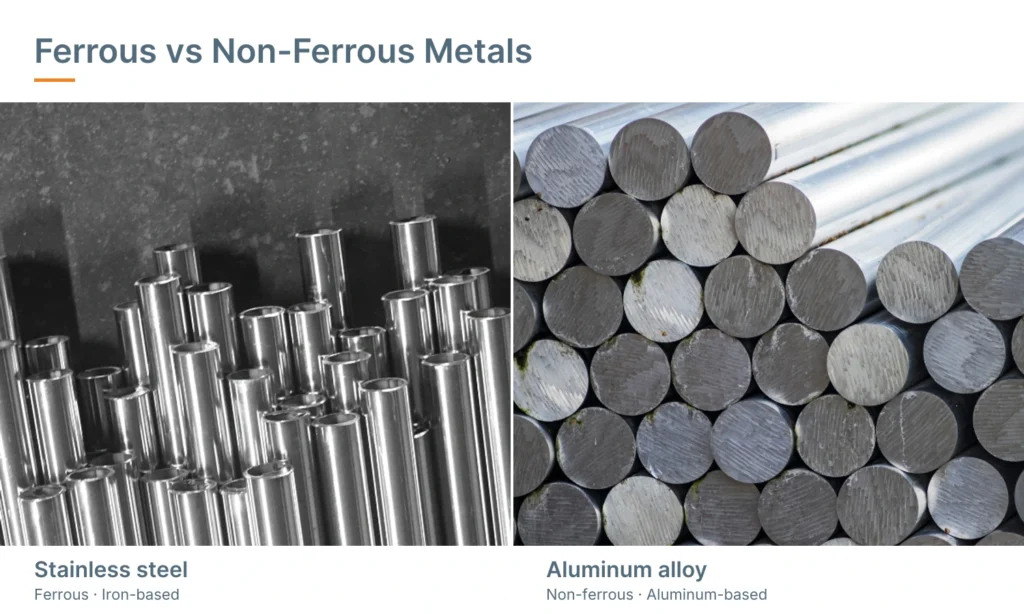
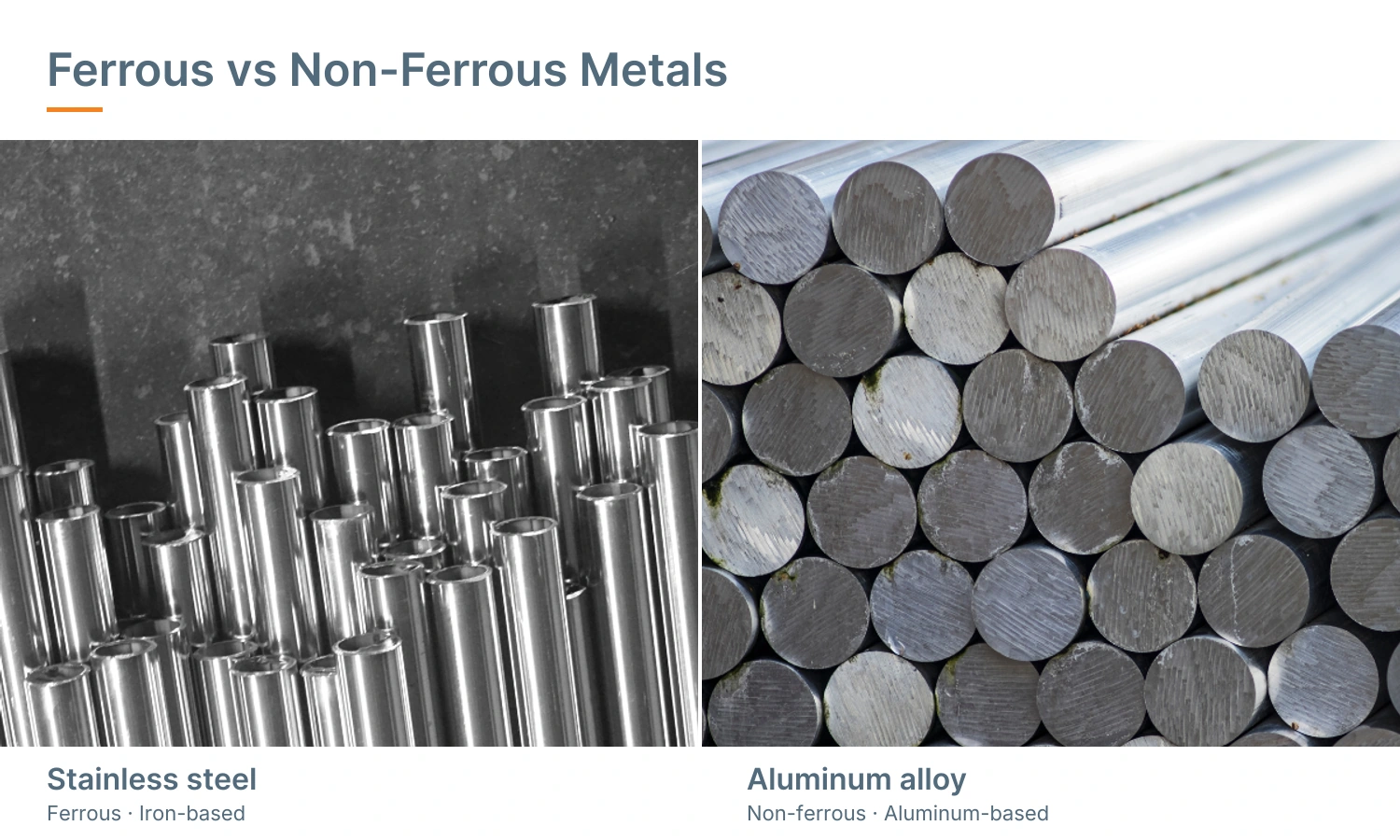
Ferrous and non-ferrous are two broad ways of classifying metals.
The basic difference is simple: ferrous metals are iron-based, while non-ferrous metals are based primarily on elements other than iron.
What that means for an actual component is less simple.
Iron content can influence weight, corrosion behavior, magnetism, cost, strength, conductivity, and manufacturing options—but none of those properties follows one universal rule.
This guide explains the real differences, common exceptions, typical materials, and how to choose between them for an engineering project.
Ferrous vs Non-Ferrous Metals: Quick Comparison
| Factor | Ferrous Metals | Non-Ferrous Metals |
|---|---|---|
| Base Element | Primarily iron | Primarily an element other than iron |
| Common Examples | Carbon steel, alloy steel, stainless steel, cast iron | Aluminum, copper, brass, bronze, zinc, magnesium, titanium, nickel alloys |
| Density | Often relatively high | Varies widely; aluminum and magnesium are light, nickel alloys are not |
| Corrosion Resistance | Varies from poor to excellent | Often good, but strongly alloy-dependent |
| Magnetism | Many are magnetic, but not all | Usually non-magnetic, with important exceptions |
| Electrical Conductivity | Generally lower than copper and aluminum | Copper and aluminum are major conductive materials |
| Cost | Many common steels and irons are economical | Can range from inexpensive zinc to costly titanium and superalloys |
| Typical Strength | Wide range from soft iron to very high-strength steels | Also ranges widely depending on alloy |
| Casting Processes | Investment casting, sand casting and others | Investment, sand, die casting and other processes |
The important word throughout this table is varies.
Knowing whether a metal is ferrous or non-ferrous helps narrow material families, but it does not tell you everything about how that metal will perform.
What Does Ferrous Metal Mean?
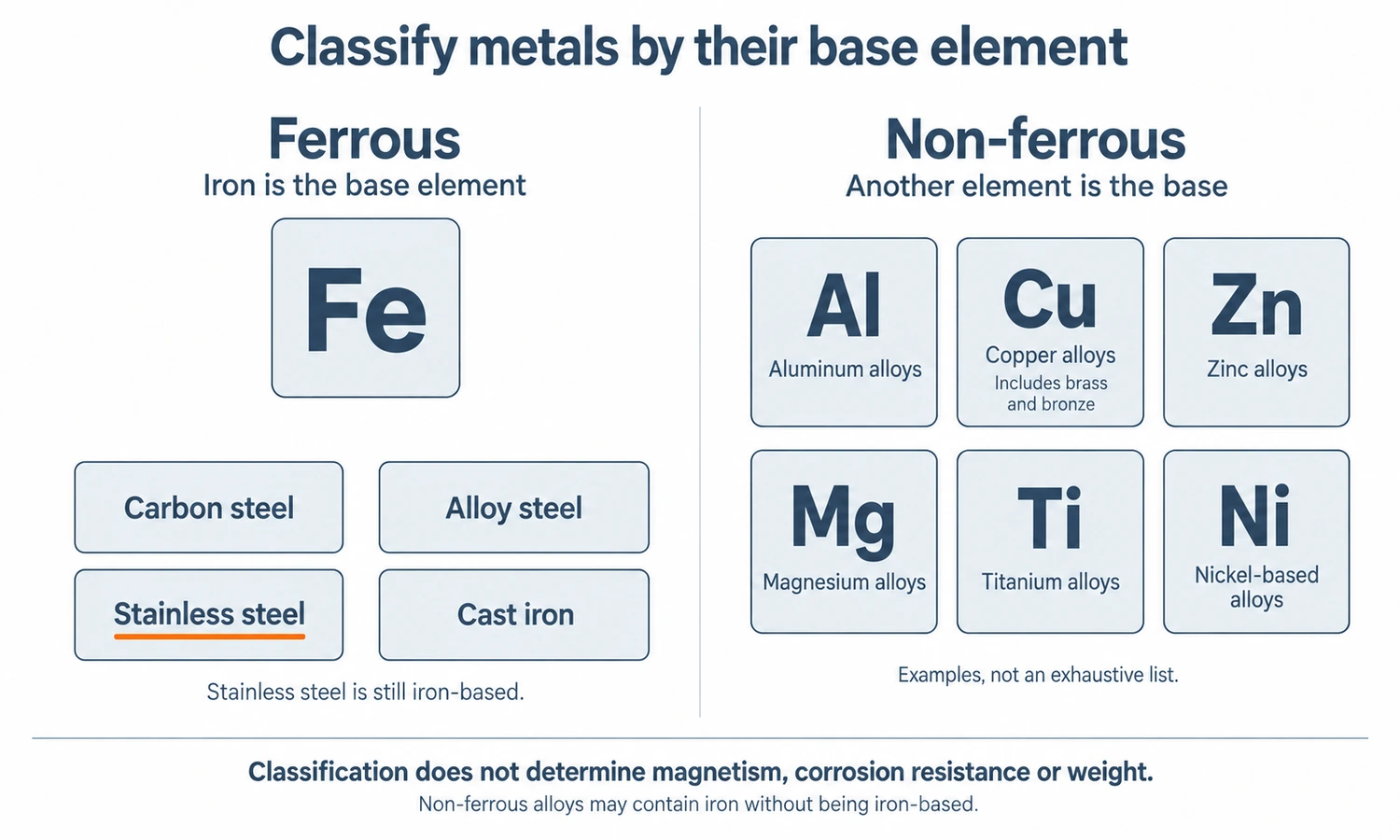
A ferrous metal is a metal or alloy in which iron is the primary base element.
The word comes from ferrum, the Latin word for iron and the origin of the chemical symbol Fe.
Common ferrous materials include:
- Carbon steel
- Low-alloy steel
- Tool steel
- Stainless steel
- Cast iron
- Ductile iron
This definition is more useful than saying:
“Ferrous metal contains iron.”
Many non-ferrous alloys can contain small amounts of iron as an alloying addition or impurity.
What matters is whether the material is fundamentally iron-based.
For example, stainless steel may contain significant chromium, nickel, molybdenum, and other elements, but iron remains its base metal.
Stainless steel is therefore still ferrous.
What Does Non-Ferrous Metal Mean?
A non-ferrous metal is based primarily on an element other than iron.
Major families include:
- Aluminum alloys
- Copper alloys
- Zinc alloys
- Magnesium alloys
- Titanium alloys
- Nickel alloys
- Cobalt alloys
- Lead and tin alloys
These materials do not share one common set of properties.
That is one of the biggest problems with treating “non-ferrous” as if it were a performance description.
Aluminum is lightweight.
Copper is heavy and highly conductive.
Titanium combines relatively low density with high strength.
Nickel-based superalloys can be dense, expensive, difficult to machine, and extremely strong at elevated temperatures.
All of them are non-ferrous.
So non-ferrous tells you what the base metal is not—it does not tell you exactly what the material can do.
Common Ferrous Metals
Carbon Steel
Carbon steel is iron alloyed primarily with carbon, with smaller amounts of other elements depending on the grade.
It is widely used because it can provide a useful balance of:
- Strength
- Toughness
- Weldability
- Machinability
- Cost
Low-carbon steels are generally easier to form and weld, while increasing carbon content can increase hardness and strength at the expense of ductility and weldability.
For cast components, carbon steels are common in valves, pumps, structural parts, machinery, and pressure-containing equipment.
Alloy Steel
Alloy steels contain additions such as chromium, nickel, molybdenum, manganese, or vanadium to obtain properties beyond those of ordinary carbon steel.
Depending on the grade and heat treatment, they may offer:
- Higher strength
- Better wear resistance
- Improved hardenability
- Better fatigue performance
- Improved high- or low-temperature behavior
They remain ferrous because iron is still the base element.
Stainless Steel
Stainless steel is one of the most important exceptions to the idea that “ferrous metals rust easily.”
It is iron-based, but sufficient chromium allows a protective passive surface layer to form.
Depending on the grade, stainless steel can provide excellent corrosion resistance while retaining useful strength and heat resistance.
Austenitic, martensitic, ferritic, duplex, and precipitation-hardening stainless steels all belong to the ferrous family.
Cast Iron
Cast iron contains higher carbon levels than conventional steel and is designed around casting rather than wrought processing.
Common types include:
- Gray iron
- Ductile iron
- White iron
- Malleable iron
Gray iron is valued for vibration damping and machinability.
Ductile iron offers much greater ductility and impact strength.
Cast iron is widely used for machine bases, housings, pumps, automotive components, and other heavy industrial parts.
Common Non-Ferrous Metals
Aluminum
Aluminum is one of the most widely used non-ferrous engineering metals.
Its major advantages include:
- Low density
- Good corrosion resistance
- Good thermal conductivity
- Useful strength-to-weight ratio
- Good castability in suitable alloys
Aluminum can be investment cast, sand cast, permanent-mold cast, or die cast depending on alloy, geometry, and production quantity.
It is common in automotive, aerospace, electronics, machinery, and lightweight structural applications.
Copper and Copper Alloys
Copper is particularly important for electrical and thermal conductivity.
Alloys such as brass and bronze shift the balance toward properties including:
- Strength
- Wear resistance
- Machinability
- Corrosion resistance
- Bearing performance
Copper alloys appear in electrical equipment, marine hardware, valves, pumps, bushings, bearings, and plumbing systems.
Zinc
Zinc has a relatively low melting temperature and excellent fluidity.
This makes zinc alloys especially useful for high-volume die casting of parts containing:
- Thin sections
- Fine details
- Lettering
- Small mechanical features
Zinc itself also plays an important role in corrosion protection through galvanizing.
Magnesium
Magnesium is the lightest commonly used structural metal.
It is attractive where weight reduction is critical and is widely used in die-cast housings and lightweight structural components.
Its low density does not mean it is simply a “lighter aluminum.”
Magnesium alloys have their own corrosion, strength, manufacturing, and handling considerations.
Titanium
Titanium combines relatively low density with high specific strength and excellent corrosion resistance in many environments.
It is widely associated with:
- Aerospace
- Chemical processing
- Medical applications
- High-performance equipment
Its processing cost is much higher than ordinary steel or aluminum, and molten titanium requires careful control because of its high chemical reactivity.
Nickel-Based Alloys
Nickel alloys show why “non-ferrous = lightweight” is not a useful rule.
Many nickel-based alloys are dense.
Their value instead comes from properties such as:
- High-temperature strength
- Oxidation resistance
- Severe corrosion resistance
- Creep resistance
Grades such as Inconel 625 and 718 are used where more conventional steels begin to reach their practical limits.
Magnetism in Ferrous and Non-Ferrous Metals
A magnet is often suggested as the easiest way to distinguish ferrous from non-ferrous metals.
It can be useful.
It is not a definitive test.
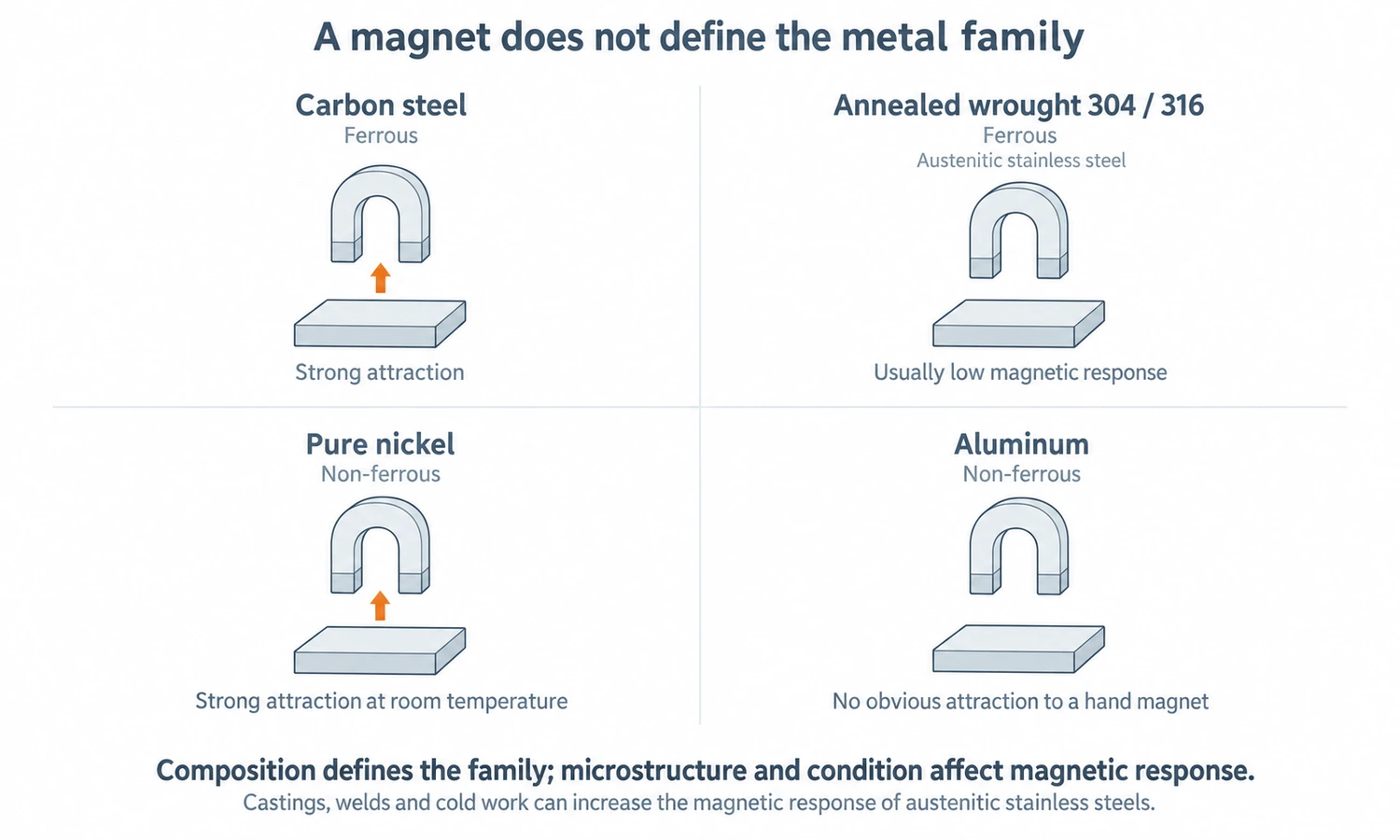
Carbon steel and many cast irons are strongly magnetic.
Ferritic and martensitic stainless steels are also magnetic.
But many austenitic stainless steels—such as common 304- and 316-type materials—can have relatively low magnetic response in their normal condition.
Casting, cold working, welding, or microstructural changes can further alter magnetic behavior.
On the other side, nickel itself is ferromagnetic, even though nickel-based materials are classified as non-ferrous.
Therefore:
Magnetism can help identify an unknown metal, but it does not define whether the material is ferrous or non-ferrous.
Chemical composition does.
Corrosion and Rust Resistance: Ferrous vs Non-Ferrous Metals
Iron is susceptible to oxidation, which is why ordinary carbon steel can develop the familiar reddish-brown corrosion product called rust.
But this does not mean every ferrous alloy has poor corrosion resistance.
Stainless steel is the clearest example.
By adding sufficient chromium—and, in some grades, nickel, molybdenum, nitrogen, and other elements—engineers can create iron-based alloys capable of performing in water, food-processing, marine, chemical, and other corrosive environments.
Likewise, saying:
“Non-ferrous metals do not corrode”
would also be wrong.
Aluminum, copper, zinc, magnesium, nickel, and titanium all interact with their environments.
Some form highly protective oxide films.
Others can experience pitting, galvanic corrosion, dezincification, stress-corrosion cracking, or other forms of attack under particular conditions.
The useful distinction is:
Corrosion behavior depends on the exact alloy and environment—not simply whether iron is present.
Density and Weight
Weight is another common shortcut.
It works reasonably well when comparing steel with aluminum or magnesium.
It fails when applied to the entire non-ferrous category.
Approximate density relationships illustrate the problem:
- Magnesium is very light.
- Aluminum is much lighter than steel.
- Titanium is lighter than steel but significantly heavier than aluminum.
- Copper is relatively heavy.
- Nickel alloys can have densities comparable to or greater than many steels.
So if lightweight design is the requirement, the decision should be:
steel vs aluminum vs magnesium vs titanium
not simply:
ferrous vs non-ferrous
The broad classification helps organize materials, but actual design requires comparing specific alloys.
Mechanical Properties
Ferrous materials are often described as “stronger.”
Again, that is only a rough generalization.
Many structural steels provide excellent strength at relatively low cost, which is why they dominate buildings, machinery, vehicles, and heavy equipment.
But strength varies enormously inside both material groups.
Examples include:
- Soft low-carbon steel
- Hardened tool steel
- Gray cast iron
- High-strength aluminum
- Titanium alloy
- Precipitation-hardened nickel superalloy
These materials cannot be ranked meaningfully simply from the words ferrous and non-ferrous.
Strength also has several meanings:
- Yield strength
- Tensile strength
- Hardness
- Impact toughness
- Fatigue strength
- Creep strength
A material that is excellent in one category may not be the best in another.
Electrical and Thermal Conductivity: Steel vs. Copper and Aluminum
Conductivity is one area where specific non-ferrous materials have a clear industrial advantage.
Copper is one of the most important electrical conductor materials.
Aluminum is also widely used for electrical transmission where lower weight matters.
These properties make non-ferrous metals essential for:
- Electrical wiring
- Busbars
- Motors
- Electronics
- Heat exchangers
- Thermal-management components
Steel is electrically conductive, but it generally cannot compete with copper or aluminum where conductivity is the main design objective.
Again, the useful comparison is between specific materials, not every member of one category.
Material Cost and Availability
Ferrous metals are often cheaper, and there is a good reason for that generalization.
Carbon steel and cast iron are produced at enormous global scale from widely available raw materials.
But cost comparisons quickly become more complicated.
Stainless steel costs more than ordinary carbon steel.
Tool steels and specialty alloy steels can be expensive.
Among non-ferrous metals:
- Some aluminum and zinc alloys are relatively economical.
- Copper can be significantly more expensive.
- Titanium and nickel superalloys can be dramatically more expensive.
Material price is also only one part of component cost.
A cheaper metal that requires:
- More machining
- Additional corrosion protection
- More frequent replacement
- Greater component weight
may not produce the lowest total cost.
Ferrous vs. Non-Ferrous Metals for Casting
For a foundry, the distinction matters because alloy family affects melting temperature, mold material, furnace choice, shrinkage, fluidity, oxidation, heat treatment, and casting-process compatibility.
Ferrous Casting Metals
Common ferrous casting materials include:
- Cast iron
- Carbon steel
- Alloy steel
- Stainless steel
Investment casting and sand casting are important processes for these materials.
For example, complex precision stainless or carbon-steel components can be produced through investment casting, while larger iron and steel parts are often better suited to sand casting.
Non-Ferrous Casting Metals
Common non-ferrous casting materials include:
- Aluminum
- Zinc
- Magnesium
- Copper alloys
- Titanium
- Nickel- and cobalt-based alloys
The casting process varies dramatically between them.
Aluminum can be sand cast, investment cast, permanent-mold cast, or die cast.
Zinc and magnesium are strongly associated with high-pressure die casting.
Nickel-based superalloys may require investment casting and vacuum melting.
Titanium requires highly controlled mold and melting conditions.
This is why ferrous vs non-ferrous is only the first level of casting-material selection.
The next step is choosing the actual alloy and manufacturing process.
Which Casting Processes Work With Ferrous and Non-Ferrous Metals?
Partly—but the exact alloy matters more.
High-pressure die casting is dominated by relatively low-melting non-ferrous alloys such as aluminum, zinc, and magnesium.
Reusable steel dies make conventional HPDC unsuitable for ordinary steel and stainless steel.
Investment casting has a much broader material range and can process both ferrous and non-ferrous alloys.
Sand casting is similarly flexible and can handle cast iron, steel, aluminum, copper alloys, and many other materials.
So the decision is not:
Ferrous = one casting process
Non-ferrous = another casting process
Instead:
Alloy + geometry + size + quantity + properties → casting process
That is the more useful engineering sequence.
How to Choose Between Ferrous and Non-Ferrous Metals
Do not begin with the category.
Begin with what the component has to do.
Strength and Structural Load
If the project requires high stiffness and strength at economical cost, carbon or alloy steel is often a logical starting point.
If strength-to-weight ratio matters more, aluminum or titanium may enter the comparison.
Corrosion Environment
For ordinary indoor structural service, carbon steel may be adequate.
For water, chemicals, food processing, or marine environments, materials such as stainless steel, aluminum, bronze, titanium, or nickel alloys may be more appropriate.
The actual medium and temperature matter.
Weight
If mass reduction is a major objective, compare aluminum, magnesium, and titanium directly with the relevant steel alternative.
Temperature
High-temperature applications may require heat-resistant ferrous alloys or nickel/cobalt superalloys depending on service severity.
Conductivity
Electrical or thermal conductivity quickly pushes material selection toward copper or aluminum families.
Wear and Friction
Cast iron, hardened alloy steel, bronze, and cobalt alloys all offer useful wear properties in very different applications.
Manufacturing Route
Finally, the material must be practical to cast, machine, weld, forge, or form into the required geometry.
A material with excellent theoretical properties is not useful if its manufacturing route makes the part impractical or unnecessarily expensive.
How YTD Approaches Ferrous and Non-Ferrous Casting Projects
YTD Foundry works with both ferrous and non-ferrous casting materials.
Investment casting is our in-house core process and supports materials including carbon steel, alloy steel, stainless steel, aluminum, and selected high-performance alloys.
For suitable superalloys, vacuum melting is available as part of the investment-casting workflow.
Projects better suited to large sand castings or high-volume die-cast non-ferrous parts are handled through specialized partner foundries.
The useful starting question is therefore not simply:
“Do you cast ferrous or non-ferrous metals?”
It is:
What alloy gives the component the required performance, and which casting process can manufacture that alloy and geometry efficiently?
That allows material and manufacturing decisions to be considered together rather than treating one broad metal category as automatically better than the other.
Final Thoughts
Ferrous and non-ferrous are useful ways to organize metals, but they are only the beginning of material selection.
Ferrous metals are iron-based; non-ferrous metals are based primarily on other elements. Beyond that, properties such as magnetism, corrosion resistance, weight, strength, and cost depend on the specific alloy.
For engineering decisions, move quickly from the broad category to the actual material grade—and then evaluate that material together with the manufacturing process.
FAQs
What Is the Main Difference Between Ferrous and Non-Ferrous Metals?
Ferrous metals are based primarily on iron. Non-ferrous metals are based primarily on elements other than iron, such as aluminum, copper, magnesium, titanium, zinc, or nickel.
Is Stainless Steel Ferrous or Non-Ferrous?
Stainless steel is ferrous because iron is its base metal. Chromium, nickel, molybdenum, and other alloying elements can provide corrosion resistance and other properties, but they do not change its basic classification as an iron-based alloy.
Are All Ferrous Metals Magnetic?
No. Many ferrous metals are magnetic, including carbon steel and many cast irons, but some iron-based alloys—particularly many austenitic stainless steels—can have relatively low magnetic response.
Are All Non-Ferrous Metals Non-Magnetic?
No. Non-ferrous refers to the base-metal classification, not magnetic behavior. Nickel is one example of a non-ferrous metal that can be ferromagnetic.
Do All Ferrous Metals Rust?
No. Ordinary iron and carbon steels are susceptible to rust, but stainless steels are ferrous alloys specifically designed for much greater corrosion resistance.
Are Non-Ferrous Metals Better for Casting?
Not inherently. Both ferrous and non-ferrous alloys are widely cast. The best material depends on strength, corrosion, temperature, weight, geometry, quantity, and casting-process requirements.