
Both processes use disposable molds, and both can produce detailed metal parts. Yet shell molding and investment casting make those molds differently. Understanding that difference helps explain which process suits a part’s geometry, accuracy, production quantity, and finished cost.
What Is the Difference Between Shell Molding and Investment Casting?
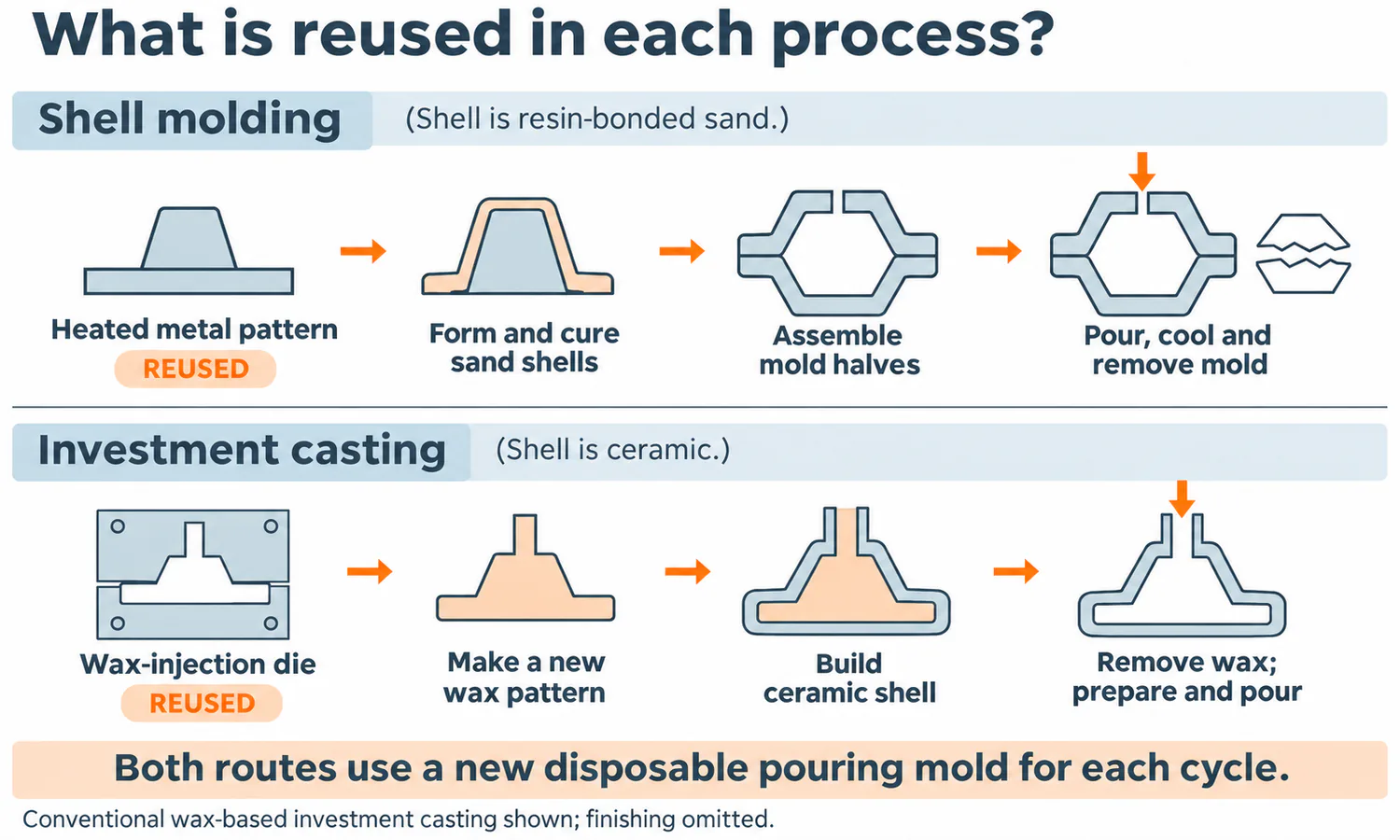
Shell molding forms resin-bonded sand shells against a reusable heated metal pattern. Investment casting builds a refractory mold around a disposable pattern, usually wax, which is removed before pouring.
In this comparison, shell molding means the resin-coated sand process, also called the Croning process. It does not mean ceramic shell investment casting. The word “shell” describes the mold’s construction in both cases, but the pattern materials and mold-making methods differ.
Shell molding is a type of sand casting. However, its rigid shells and metal tooling make it a more specific comparison with investment casting than conventional green sand. Our shell molding vs sand casting guide covers that separate comparison.
How Shell Molding Works
Fine resin-coated sand contacts a heated metal pattern. Heat bonds a layer of sand to the pattern’s shape; excess loose sand is removed, and further curing gives the shell strength. The shell is released from the tool and joined to its matching half, with cores added where needed.
Metal is poured into the assembled mold. After cooling, the sand shell is broken away, and the casting is cleaned and finished. The metal pattern remains available to make more molds. The Open University’s resin shell casting description explains this tooling-and-curing sequence.
How Investment Casting Works
Wax patterns are normally produced in reusable dies and assembled onto a tree. Repeated coating, application of refractory grains, and drying build a ceramic shell around them. The wax is removed, and the shell is prepared for pouring.
After solidification, the ceramic is removed and the individual parts are cut from the metal tree. The Investment Casting Institute’s process guide illustrates these stages.
The important distinction is what gets reused. Shell molding reuses the metal pattern directly. Conventional investment casting reuses the wax-injection die, but needs a new wax pattern and a new pouring shell for each cycle. Neither process pours successive batches into the same finished mold.
Shell Molding vs Investment Casting: Comparison Table
| Factor | Shell molding | Investment casting |
|---|---|---|
| Mold material | Resin-bonded sand | Refractory investment; commonly a ceramic shell in industrial production |
| Pattern | Reusable heated metal pattern | Expendable pattern, usually wax |
| Mold construction | Usually assembled shell halves | Shell built around the pattern assembly |
| Shape constraints | Pattern withdrawal, mold joint, and core arrangement matter | Sacrificial patterns allow greater geometric freedom; pattern tooling still needs planning |
| Fine detail | Good detail and dimensional repeatability | Generally favored for finer detail and intricate features |
| Accuracy and finish | Can leave many surfaces usable as cast | Often reduces additional finishing on demanding features |
| Repeated production | Reusable tooling supports efficient repeat mold making | Repeated pattern production and shell building remain part of each cycle |
| Cost decision | Tooling investment can pay off across repeat orders | Added processing may pay off through less machining or part consolidation |
These are selection tendencies. A particular drawing may be practical with either method, and both can require machining for final fits.
Part Geometry, Draft, and Internal Passages
Investment casting usually offers more freedom when the shape is difficult to release from a rigid pattern. Shell molding remains a strong option when its mold halves and cores can produce the required shape efficiently.
Draft and Parting Lines
In shell molding, each cured shell must come away from the metal pattern without damage. Draft—a slight taper in the withdrawal direction—helps release it. The joint between the assembled halves also affects the casting: mismatch at that joint can change the relationship between features on opposite sides.
Investment casting removes its wax pattern rather than pulling it intact from the ceramic mold. This avoids that particular withdrawal constraint. However, an injected wax pattern must first be released from its die, so split tooling, removable inserts, or another pattern-making method may still be needed.
A continuous ceramic shell also avoids the assembled sand-mold joint. It does not guarantee a completely unmarked surface. The ICI defect atlas distinguishes wax parting-line indications from fins created when metal enters a cracked shell.

Thin Walls and Cores
Small ribs, curved features, and closely spaced details often favor investment casting. But “shell molding cannot make thin walls” is too broad. Filling distance, alloy, gating, mold conditions, and local geometry determine whether a thin section fills successfully.
For a documented example, the Steel Founders’ Society of America’s rotor-disc study selected shell molding because it met the component’s requirements for detail, surface finish, and thin sections. The study compared shell molding with green sand; it demonstrates shell molding’s capability, not a universal advantage over investment casting.
Both routes can use cores to create internal spaces. A curved passage is therefore not an automatic reason to choose investment casting. Core positioning, support, removal, and inspection may matter more than the outer shape. Our shell mold casting guide explains how the external shell and internal core perform different jobs.
Dimensional Accuracy and Surface Finish
Investment casting generally has the advantage for fine detail and tighter as-cast dimensions. Shell molding can nevertheless provide enough accuracy for many components, especially where selected surfaces will be machined afterward.
How Should Tolerance Figures Be Compared?
Compare the same feature, size, material, and delivery condition. A tolerance across a mold joint is different from a dimension contained within one mold half. A machined bore is different again.
As a concrete reference, the Open University’s 2017 teaching material describes achievable limits of ±0.25 mm for small shell castings up to 100 mm in size. This is a contextual capability example, not a guarantee for every feature, alloy, or supplier.
Likewise, a broad investment-casting tolerance range cannot establish whether a specific long arm, thin wall, or hole position will meet a drawing. Our investment casting tolerance guide explains why geometry and the condition in which a part is measured matter.
For selection, identify which dimensions actually need to be cast accurately. If both routes require machining the same bearing bore, the comparison should include how each casting can be located and machined, rather than only its advertised general tolerance.
Does a Smoother Casting Need Less Machining?
Sometimes. Better as-cast texture can reduce finishing, but smoothness does not establish flatness, alignment, or sealing performance.
A housing may retain its outer cast surface while its mounting face and bore require machining. Investment casting becomes more valuable if it also produces several difficult features close enough to final shape to avoid additional operations. If both alternatives need the same machining, its smoother exterior may contribute little to the functional result.
When comparing surface data, also check the measurement. Ra and RMS roughness values are different parameters; numbers labeled differently should not be treated as directly interchangeable.
Materials and Part Size
There is substantial overlap in the alloys available through the two processes. Shell molding is used for cast iron, steels, and suitable nonferrous alloys. Investment casting also serves a broad alloy range, with many applications in steels, stainless steels, and specialist alloys.
The material alone often does not decide the process. A steel component may be feasible by either route. The foundry still needs suitable melting, molding, heat-treatment, and inspection arrangements for the specified grade and application.
Nor does a better surface finish automatically mean greater strength. Strength and toughness depend on the specified material condition and casting integrity, not simply on whether sand or ceramic formed the mold.
Both processes commonly serve small and medium components, but fixed maximum-weight tables can be misleading. Shell handling and backing constrain resin-shell work; pattern handling, shell building, and pouring capacity constrain investment casting. Check the proposed foundry’s capability for the actual geometry rather than treating an internet weight limit as a process rule.
Tooling Cost, Production Volume, and Lead Time
Shell molding often becomes attractive for stable, repeated production. Its metal tooling represents an initial commitment, but it avoids producing and removing a wax pattern for every mold cavity.
Investment casting adds pattern-making and shell-building work. Eagle Group’s process comparison identifies this recurring labor as a reason investment casting can cost more despite a lower initial tooling cost in some projects. That tooling relationship is not universal: die complexity, cores, cavity count, and production arrangements change it.
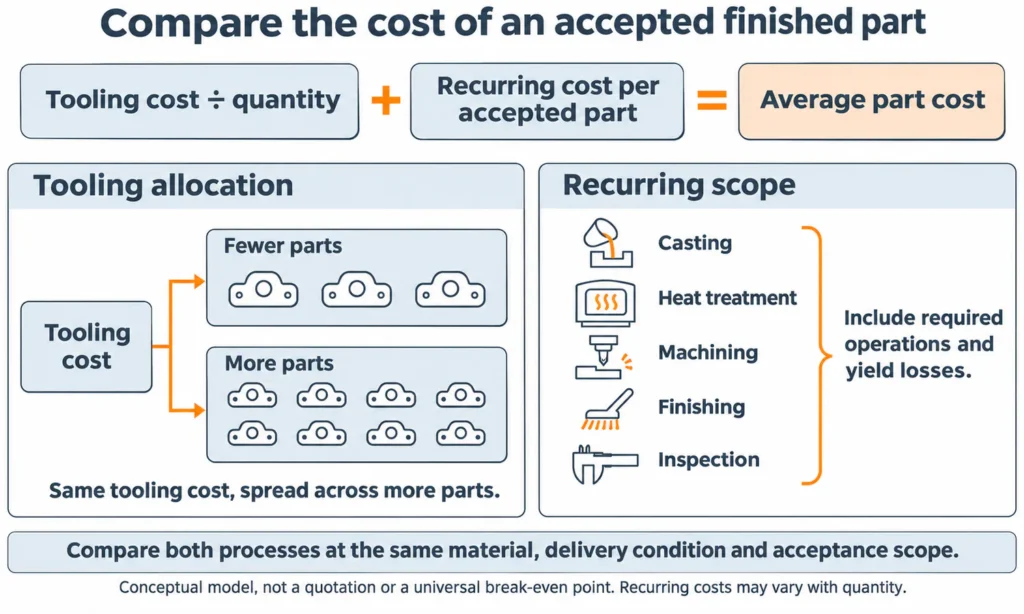
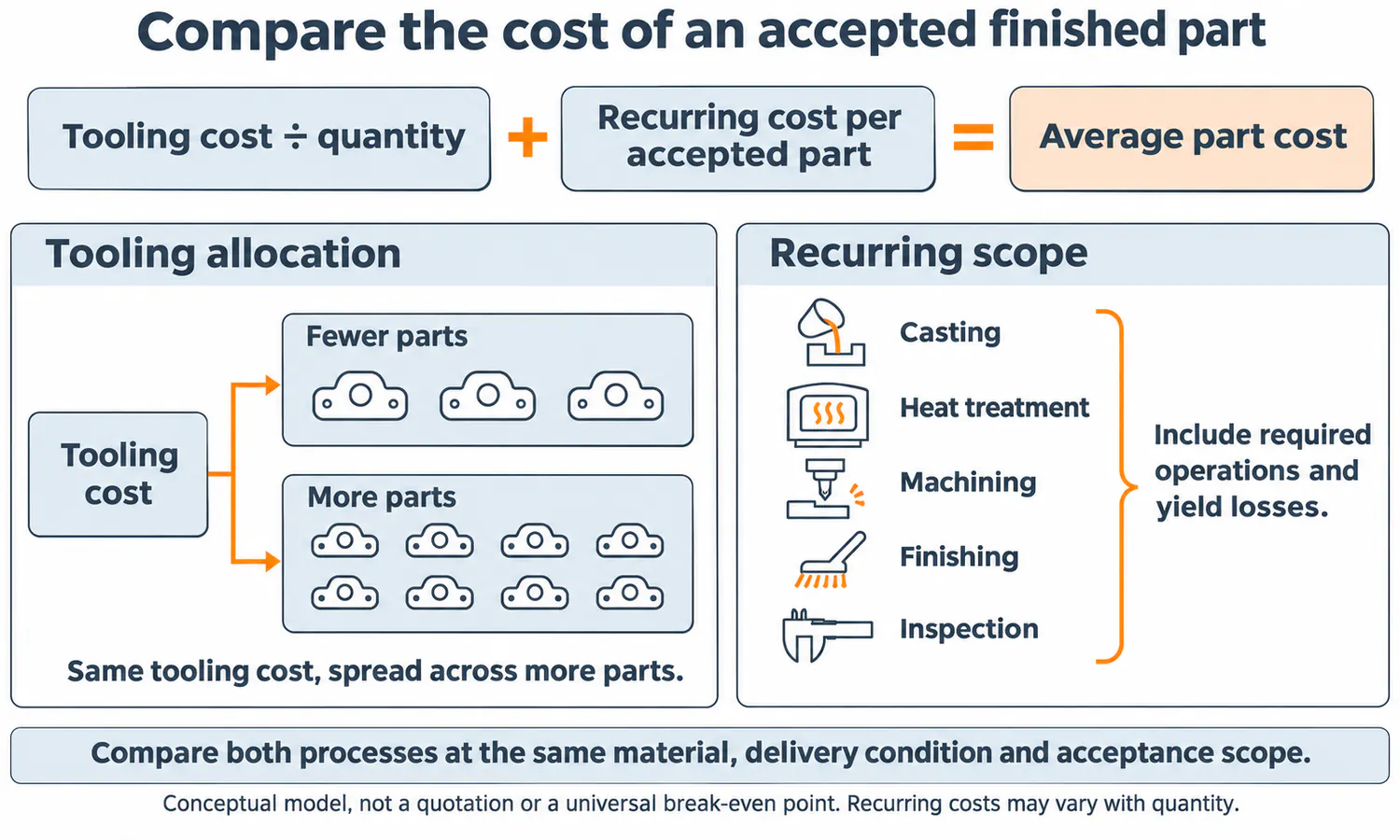
Compare the cost of an accepted finished part:
Average part cost = tooling cost ÷ quantity + recurring cost per accepted part.
Recurring cost should include casting, required heat treatment, machining, finishing, and inspection. Include the financial effect of yield losses where relevant to the quotation.
A Simple Cost Example
The following figures are hypothetical, not supplier quotations. Assume the same material, finished requirements, and acceptance scope, with constant recurring costs over the quantities shown.
| Cost input | Shell molding | Investment casting |
|---|---|---|
| Initial tooling | $12,000 | $6,000 |
| Recurring cost per accepted part | $18 | $24 |
| Average at 500 parts | $42 | $36 |
| Average at 2,000 parts | $24 | $27 |
With these assumptions, the costs are equal at 1,000 parts: the $6,000 tooling difference is offset by a $6 saving per part. Both average $30 at that quantity.
This is a way to compare quotations, not a universal production threshold. If investment casting eliminates enough machining to have the lower recurring cost, the result changes. Real quotations may also have quantity breaks and additional tooling charges.
Which Process Is Faster?
Shell molding avoids the repeated ceramic coating, drying, and dewaxing stages of conventional investment casting. That can favor production throughput once tooling is ready. However, mold-making speed and delivery lead time are different measures.
New tooling, sample approval, furnace schedules, heat treatment, machining, and inspection can govern the delivery date. Investment casting is also used for repeated production, so “low volume only” is an inaccurate limit. Compare the initial sample schedule and repeat-order schedule separately.
How to Choose Between the Processes
Start with the requirements that could eliminate a process, then compare the remaining routes on finished cost.
- Evaluate shell molding first when the shape has a practical parting arrangement, the design is stable, and repeat orders can support metal tooling. It is particularly worth comparing when its as-cast quality is sufficient and both routes would need similar final machining.
- Evaluate investment casting first when fine detail, difficult external geometry, or reduced machining provides a clear benefit. It is also worth considering when a more complex casting could replace several separately manufactured pieces.
- Compare both when either can produce the geometry and required material condition. Ask what remains to be machined, how critical dimensions will be verified, and what the quoted delivery condition includes.
At YTD Foundry, our core manufacturing capability is silica sol investment casting, supported by in-house machining. Sand casting and die casting are provided through a partner network. For a process comparison, the useful starting information is the drawing, alloy, expected quantities, and features that must meet their requirements without machining.
Conclusion
Shell molding suits repeatable parts that benefit from rigid sand shells and reusable tooling. Investment casting offers more freedom for intricate geometry and fine detail. Choose by the features each process can deliver, the work still required afterward, and the total cost of an accepted part.
FAQs
Is Shell Molding the Same as Investment Casting?
No. Shell molding forms resin-bonded sand shells against a reusable heated metal pattern. Investment casting builds a refractory mold around a disposable pattern, usually wax, which is removed before pouring. “Shell” describes the mold’s construction in both cases, but the pattern materials and mold-making methods differ.
Which Process Is More Accurate?
Investment casting generally has the advantage for fine detail and tighter as-cast dimensions, but shell molding provides enough accuracy for many components. Compare the same feature, size, material, and delivery condition—a dimension across a mold joint is not the same as one within a single mold half.
Which Process Costs More?
It depends on the project. Shell molding often carries higher initial tooling cost but lower recurring cost per part; investment casting can have lower tooling but more pattern and shell work per cycle. In the worked example, the two routes broke even at 1,000 parts. If investment casting eliminates enough machining, the balance changes.
Can Shell Molding Produce Thin Walls?
Yes. Saying shell molding cannot make thin walls is too broad. Filling distance, alloy, gating, mold conditions, and local geometry determine whether a thin section fills successfully. Investment casting is often favored for fine detail, but that is not the same as a hard wall-thickness limit.
Can Both Processes Use Cores?
Yes. Both routes can use cores to create internal spaces, so a curved passage is not an automatic reason to choose investment casting. Core positioning, support, removal, and inspection can matter more than the outer shape.
Which Process Is Better for High-Volume Production?
Shell molding becomes attractive for stable, repeated production because its reusable metal tooling supports efficient repeat mold making. Investment casting is also used for repeated production—”low volume only” is an inaccurate limit. Compare the first-article schedule and repeat-order schedule separately.


