1. Quick Answer
Investment casting, also known as lost wax casting or precision casting, is a manufacturing process used to produce highly accurate metal components with excellent surface finish and complex geometries.
The process creates a disposable wax pattern, builds a ceramic shell around it, removes the wax, and then pours molten metal into the resulting cavity. Because the mold accurately reproduces every detail of the wax pattern, investment casting can manufacture intricate parts with minimal machining and excellent dimensional consistency.
Today, investment casting is widely used in aerospace, automotive, medical, marine, industrial machinery, energy, and defense industries where precision and performance are critical.
2. Why Investment Casting Matters
Every manufacturing process has strengths and limitations.
- Machining offers excellent precision but often wastes significant amounts of material.
- Sand casting can produce large parts economically but struggles with fine detail and tight tolerances.
- Die casting provides excellent productivity but is limited to certain alloys and usually requires high production volumes to justify tooling costs.
Investment casting occupies a unique position between these manufacturing methods. It combines exceptional design freedom, excellent dimensional accuracy, broad material compatibility, and near-net-shape production into a single process. For engineers and procurement teams, this often means fewer assemblies, less machining, lower material waste, and simplified supply chains.
3. What Is Investment Casting?
Investment casting is a highly versatile precision metal manufacturing process with roots dating back thousands of years. It relies on a relatively simple yet highly effective principle: using a disposable pattern to create a perfect, seamless mold.
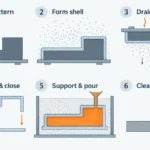
The process begins by injecting liquid wax into a precision-machined metal die to create a “pattern,” which is an exact replica of the desired final metal part. Once the wax pattern solidifies, it is coated—or “invested”—with a specialized refractory ceramic material. This coating is built up layer by layer until a thick, robust shell is formed.
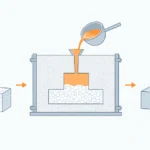
After the ceramic shell dries, the entire assembly is heated. This causes the internal wax to melt and drain away, leaving behind a completely hollow ceramic mold. Molten metal is then poured directly into this cavity. Once the metal cools and solidifies, the ceramic shell is broken off to reveal the final metal component.
Because of this unique methodology, investment casting is frequently referred to by two other names in the manufacturing industry:
- Lost Wax Casting: This historical term highlights the defining step of the process where the original wax pattern is melted, burned out, and permanently “lost” to create the mold cavity.
- Precision Casting: This term is favored in modern industrial applications because the liquid ceramic slurry perfectly conforms to the wax pattern. This results in metal parts that feature exceptional dimensional accuracy, fine details, and near-net shapes that require little to no secondary machining.
Whether casting delicate surgical instruments or robust heavy machinery components, investment casting provides a level of detail and structural integrity that few other processes can match.
4. How Investment Casting Works
Investment casting follows a carefully controlled sequence of manufacturing steps to ensure high precision and consistency.
- Wax Pattern Injection: Liquid wax is injected into a precision metal die to create a replica of the final component.
- Tree Assembly: Multiple wax patterns are attached to a central runner system, forming a “wax tree” for efficient batch production.
- Ceramic Shell Building: The wax assembly is repeatedly dipped into a ceramic slurry and coated with refractory sand. Typically, six to eight layers are required to build sufficient thickness.
- Dewaxing: The shell is heated inside a steam autoclave to melt and safely remove the wax without cracking the mold.
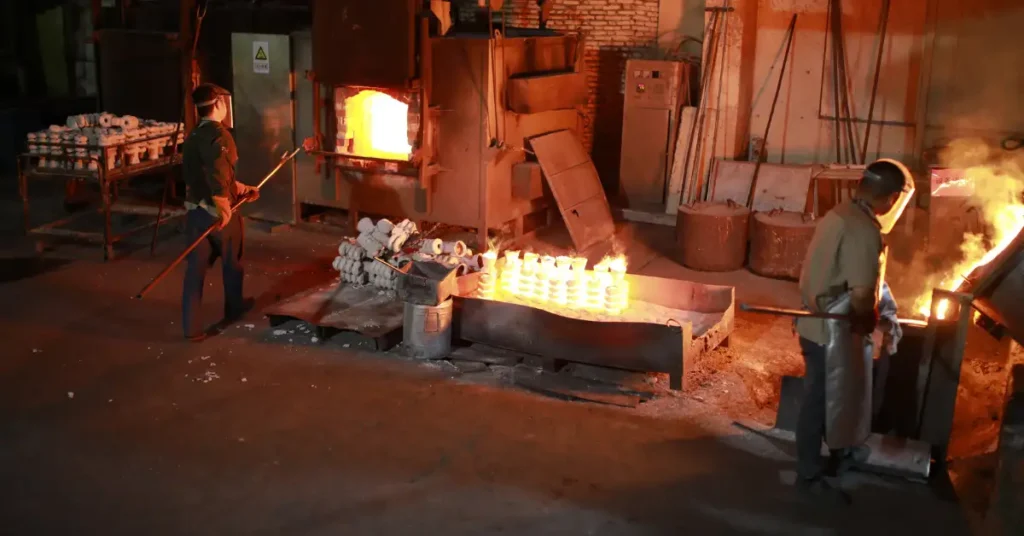
- Shell Firing: The empty ceramic mold is fired at approximately 1000°C to achieve maximum structural strength and thermal stability.
- Pouring: Molten metal is poured into the preheated ceramic shell, filling every detail of the cavity.
- Knockout: After the metal has completely cooled and solidified, the ceramic shell is broken away using vibration, water jetting, or sandblasting.
- Finishing: Individual parts are cut from the gating system and undergo necessary finishing operations such as CNC machining, heat treatment, polishing, or surface coating.
Typical Production Cycle
One of the most common questions buyers ask is: How long does investment casting take?
The shell-building stage accounts for the majority of production time because each ceramic layer must fully dry naturally before the next layer is applied. A complete production cycle generally follows this timeline:
| Stage | Typical Duration |
| Tooling | 2–6 Weeks |
| Wax Pattern Production | 1–3 Days |
| Shell Building | 6–12 Days |
| Dewax & Firing | 1–2 Days |
| Casting & Cooling | 1–3 Days |
| Finishing | 1–5 Days |
5. Modern Innovations: 3D Printing & Rapid Prototyping
Traditionally, the first step of investment casting relies on an expensive aluminum or steel mold to inject the wax patterns. While this is highly economical for mass production, it often creates a barrier for low-volume orders or prototype testing.
Today, the integration of 3D Printing (Additive Manufacturing) has revolutionized the investment casting process:
- Tool-Less Casting: Instead of machining a metal die, the initial pattern is 3D printed directly using castable wax or SLA (Stereolithography) photopolymer resins.
- Rapid Iteration: Engineers can test multiple design iterations in actual cast metal within days, rather than waiting weeks for hard tooling.
- Economical Low-Volume Production:3D printed patterns eliminate upfront tooling costs entirely, making it possible to produce a single custom part or a micro-batch of highly complex components economically.
6. Investment Casting Capabilities
Understanding process capabilities is critical when evaluating manufacturing feasibility for your specific project.
Materials
Investment casting supports an exceptionally broad range of metals, allowing engineers to prioritize performance characteristics over manufacturability constraints.
- Ferrous Alloys: Stainless Steel, Carbon Steel, Alloy Steel, Tool Steel.
- Non-Ferrous Alloys: Aluminum Alloys, Brass, Bronze, Copper Alloys.
- High-Performance Alloys: Titanium, Inconel, Hastelloy, Cobalt Alloys.
Typical Part Weight
Investment castings may range from a few grams to over 100 kg. However, the most economical and common weight range is typically below 50 kg.
Dimensional Tolerances
Typical investment casting tolerances comply with ISO 8062 CT4–CT6. This tight tolerance range significantly reduces or even eliminates secondary machining requirements.
Surface Finish
Because the ceramic perfectly mirrors the smooth wax, the surface finish is excellent right out of the mold.
| Process | Typical Surface Finish |
| Silica Sol Process | Ra 1.6–3.2 μm |
| Water Glass Process | Ra 6.3–12.5 μm |
7. Design Guidelines for Investment Casting
Successful castings begin with proper design. Understanding a few key design principles can significantly reduce production costs, minimize defects, and improve overall part quality.
Maintain Uniform Wall Thickness
Sudden thickness transitions create uneven cooling rates and increase the risk of shrinkage defects or warping. Whenever possible, maintain consistent wall thickness throughout the entire design.
| Design Condition | Recommendation |
| Minimum Thickness | 0.5–1.5 mm |
| Preferred Thickness | 2–5 mm |
| Heavy Sections | > 10 mm |
Avoid Sharp Corners
Sharp corners create stress concentrations and localized hot spots during metal solidification. Generous internal radii improve metal flow and drastically reduce defect risks. A recommended internal radius is generally 0.75–3 mm.
Design Castable Holes
While investment casting captures great detail, very small or deep blind holes may require secondary machining. A practical design rule for castable holes is: Hole Diameter ≥ 1.5 × Wall Thickness.
Minimize Large Flat Areas
Large unsupported flat surfaces may distort during cooling. Adding ribs, gussets, and structural features can improve dimensional stability and maintain flatness.
Consolidate Multiple Components
One of the greatest advantages of investment casting is the ability to combine multiple fabricated components into a single casting. This eliminates the need for welding, fasteners, assembly labor, and potential fluid leak paths.
8. Common Casting Defects & How to Prevent Them
Even with the most precise methods, metal casting is a complex metallurgical process. However, a highly capable foundry will prevent these issues before the first pour occurs. Here are three common defects and how engineering expertise solves them:
- Shrinkage Porosity: These are tiny cavities that form when the metal shrinks as it cools and solidifies.
- The Prevention: We utilize advanced Mold Flow Simulation software during the design phase to optimize the gating and feeding system, ensuring that molten metal continues to feed the casting as it cools, pushing shrinkage into the disposable runner system rather than the part.
- Sand/Ceramic Inclusions: This occurs when small pieces of the ceramic shell break off and become trapped in the molten metal.
- The Prevention: Utilizing high-quality silica sol binders and strictly controlling the environmental humidity and drying time in the shell-building room ensures maximum mold strength.
- Dimensional Distortion: Thin-walled or large flat parts may warp out of tolerance as the metal contracts.
- The Prevention: In addition to adding structural ribs during design, specialized cooling fixtures and post-casting heat treatments are used to relieve internal stresses and restore perfect dimensional accuracy.
9. Advantages of Investment Casting
- Complex Geometries: Capable of producing intricate shapes, undercuts, and internal cavities that would be difficult or impossible using machining alone.
- Excellent Surface Finish: Smooth as-cast surfaces reduce the need for extensive post-polishing and finishing.
- Tight Tolerances: Near-net-shape production minimizes material waste and secondary CNC machining.
- Wide Material Selection: Almost any castable alloy can be utilized, from standard carbon steel to extreme-temperature superalloys.
- Reduced Assembly: Multiple parts can often be integrated into one continuous, unified casting, strengthening the final product.
10. Limitations of Investment Casting
- Tooling Investment: Initial tooling (wax mold) costs are higher than standard sand casting patterns.
- Longer Production Cycles: The ceramic shell manufacturing process requires significant curing time.
- Size Limitations: Extremely large or massive components may be more cost-effective to produce via sand casting.
- Not Always Ideal for Simple Parts: Very simple, bulky geometries without intricate details may be cheaper to machine directly from stock metal.
11. What Affects Investment Casting Cost?
Cost is influenced by multiple interconnected factors throughout the process.
- Tooling Cost: The complexity of the part directly affects tooling expense. Key factors include part size, the number of cavities in the die, the presence of undercuts, and the need for soluble or ceramic cores.
- Material Cost: Material selection often has the greatest impact on total part cost. The general cost hierarchy typically follows: Carbon Steel → Stainless Steel → Titanium → Nickel Superalloys.
- Production Volume: Higher production volumes distribute the initial tooling costs across more parts, significantly lowering the per-piece pricing.
- Machining Requirements: Additional CNC operations increase costs. Designing the part for near-net-shape production from the beginning can substantially reduce machining expenses.
- Secondary Operations: Additional services such as heat treatment, specialized surface finishing, plating/coating, and non-destructive inspection (NDI) will increase total project costs.
12. When Is Investment Casting Most Economical?
Investment casting becomes highly competitive and cost-effective when:
- The required part geometry is highly complex.
- Expensive or extensive CNC machining can be significantly reduced.
- Production volume is medium to high, easily absorbing tooling costs.
- Multiple individual components can be consolidated into a single cast part.
13. Investment Casting vs Other Manufacturing Processes
| Factor | Investment Casting | Sand Casting | Die Casting | CNC Machining |
| Accuracy | High (CT4-CT6) | Moderate (CT8-CT12) | High (CT4-CT6) | Very High |
| Surface Finish | Excellent | Rough | Excellent | Excellent |
| Complexity | Very High | Moderate | High | High |
| Material Options | Very Wide | Wide | Limited | Extremely Wide |
| Production Volume | Medium–High | Low–High | High | Low–Medium |
Investment Casting vs Sand Casting
Choose investment casting when tight precision, smooth surface finish, and complex internal geometry are important. Choose sand casting for very large, heavy, or lower-cost structural components.
Investment Casting vs Die Casting
Choose investment casting when you need flexibility in high-performance alloys (like steel or titanium) and complex geometry. Choose die casting for very high-volume production of lower-melting-point alloys (like zinc or aluminum).
Investment Casting vs CNC Machining
Investment casting reduces raw material waste and machining time for highly complex geometries. CNC machining remains superior for single prototypes or when ultra-tight tolerances (e.g., ±0.005mm) are mandatory across the entire part.
14. Common Applications
- Aerospace: Turbine blades, structural brackets, and engine housings demanding superalloys and high heat resistance.
- Medical: Orthopedic implants (hips, knees) and surgical instruments requiring flawless surface finish and biocompatible metals.
- Automotive: Turbocharger components, exhaust manifolds, and transmission parts needing thin-wall, lightweight designs.
- Marine: Propellers, pump components, and hardware exposed to highly corrosive seawater environments.
- Industrial Machinery: Impellers, complex valve bodies, and pump housings that require smooth internal fluid passages.
- Energy & Oil & Gas: Burner nozzles, hot gas path components, and rugged downhole drilling tools.
15. Quality Control & Testing Standards (QA/QC)
For critical components—especially in aerospace, medical, and high-pressure fluid systems—the manufacturing process is only as good as the testing that validates it. A premium investment casting project is backed by rigorous Quality Control and Non-Destructive Testing (NDT):
- Chemical Analysis (Spectrometer): Guarantees the raw material melt matches the exact alloy specifications before pouring.
- X-Ray/Radiographic Inspection: Looks deep inside the solid metal part to detect any hidden internal shrinkage or porosity.
- Magnetic Particle (MPI) & Dye Penetrant (DPI) Inspection: Identifies microscopic surface and near-surface cracks that are invisible to the naked eye.
- Coordinate Measuring Machine (CMM): Scans the finished part to ensure all critical dimensions and geometric tolerances (GD&T) perfectly match the CAD model.
16. How to Choose an Investment Casting Supplier
Selecting the right supplier is as important as selecting the right process. Look for a partner who offers comprehensive, end-to-end capabilities.
- Engineering Support: Ensure the supplier can provide a thorough Design for Manufacturability (DFM) review to optimize your part before tooling begins.
- Tooling Capability: Check if they design and manufacture precision wax tooling in-house to ensure quality control and faster lead times.
- Material Traceability: Verify that the supplier can provide rigorous documentation, including Material Certificates, Chemical Analysis Reports, and Positive Material Identification (PMI) verification.
- Inspection Equipment: A reliable foundry should possess modern testing equipment, such as Coordinate Measuring Machines (CMM), spectrometers, X-ray inspection, and hardness testers.
- Secondary Services: Working with a supplier who offers in-house CNC machining, heat treatment, and surface finishing saves time and eliminates supply chain headaches.
- Global Manufacturing Experience: If you are sourcing internationally, ensure they have proven experience managing complex projects, logistics, and global exports. A fully integrated supplier significantly simplifies project management.
17. Conclusion
Investment casting is one of the most versatile and capable metal manufacturing processes available today. It offers exceptional geometric freedom, excellent dimensional accuracy, broad material compatibility, and the unique ability to reduce costly machining and assembly requirements.
Whether you are designing critical aerospace components, intricate industrial machinery, lightweight automotive parts, or custom-engineered fluid handling products, understanding the capabilities, limitations, and economics of investment casting will help you select the exact right manufacturing solution for your project. By partnering with a qualified and fully integrated supplier, you can leverage this ancient process to meet the most demanding modern engineering challenges.
FAQs
How much does investment casting cost?
The cost varies heavily based on part size, geometric complexity, material, and production volume. While the initial tooling and per-part costs may be higher than sand casting, investment casting often proves more economical overall by drastically reducing or eliminating expensive secondary CNC machining and assembly labor.
What is the typical lead time?
Generally, designing and manufacturing the initial tooling takes 2 to 6 weeks. Once tooling is approved, a standard mass-production run typically takes 10 to 21 days from wax injection to final casting, depending on finishing requirements.
Can aluminum be investment cast?
Yes. While investment casting is famous for high-temperature alloys, it is widely and successfully used to cast aluminum, particularly for aerospace and automotive parts where complex internal cooling channels and a high strength-to-weight ratio are required.
Can investment casting replace machining?
In many cases, yes. Because it produces near-net-shape parts with tolerances of CT4-CT6, investment casting can eliminate rough machining and significantly reduce finishing machining. You may only need minor CNC work for highly critical mating surfaces or precise threading.
What tolerance can be achieved?
Standard precision investment casting typically achieves ISO 8062-3 CT4 to CT6 tolerances, depending on the material and specific part geometry.
What is the minimum wall thickness?
Using the silica sol process, the minimum wall thickness can routinely reach 1.5 mm. For highly optimized, specific designs, wall thicknesses can sometimes be cast as thin as 0.5 mm to 1.0 mm.
What is a core in investment casting?
A core is a pre-formed ceramic or soluble insert placed inside the wax mold to create hollow internal cavities or complex internal fluid channels that cannot be formed by the outer shell alone. The core is chemically dissolved or shaken out after the metal solidifies.
What’s the best-suited metal for investment casting?
Stainless steel and carbon steel are the most popular and cost-effective. However, there is no single “best” metal; this process accommodates almost any alloy, including brass, bronze, titanium, and superalloys like Inconel.
Can I cast heat-resistant metals with investment casting?
Absolutely. Because the ceramic shell is fired at around 1000°C and can withstand pouring temperatures well over 1,500°C, investment casting is the premier manufacturing method for heat-resistant superalloys.
Why do you need to assemble the wax pattern into a wax tree?
Assembling individual wax patterns onto a central runner (the “tree”) allows multiple parts to share the same pouring gate. This enables the foundry to coat, dry, and pour dozens of parts simultaneously, maximizing batch production efficiency.
What’s the weight range of a single investment casting part?
It typically ranges from a few grams up to 50 kg for the best balance of cost and precision. Heavier parts can be cast, but they often become more economical to produce using sand casting methods.
How do you make sure the initial mold is correct and precise?
Reputable foundries use multi-axis CNC machines to cut the initial aluminum or steel wax dies, ensuring tolerances within ±0.01mm. Before mass production, a Coordinate Measuring Machine (CMM) is used to strictly verify the dimensions of the first article samples.
Do you provide post-casting CNC machining and surface treatments?
Quality foundries act as one-stop shops, providing comprehensive secondary services including precision CNC machining, heat treatment, polishing, sandblasting, and plating to deliver a ready-to-use component.