Hot chamber and cold chamber die casting are both high-pressure processes that inject molten metal into a reusable steel die. The difference is how the molten metal reaches the injection system. In a hot chamber machine, the injection mechanism sits in the molten metal. In a cold chamber machine, metal is melted separately and transferred into the shot sleeve for every cycle. That difference determines which alloys can be used and then affects production speed, part size, process control, die life, and cost.
Hot Chamber vs Cold Chamber Die Casting: Quick Comparison
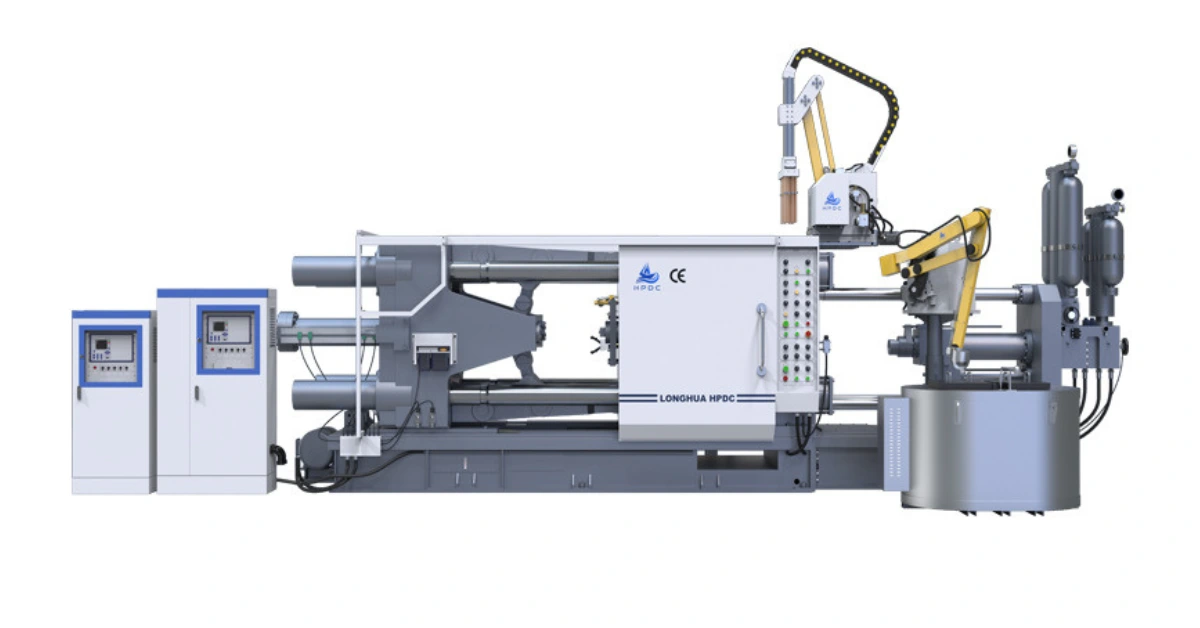
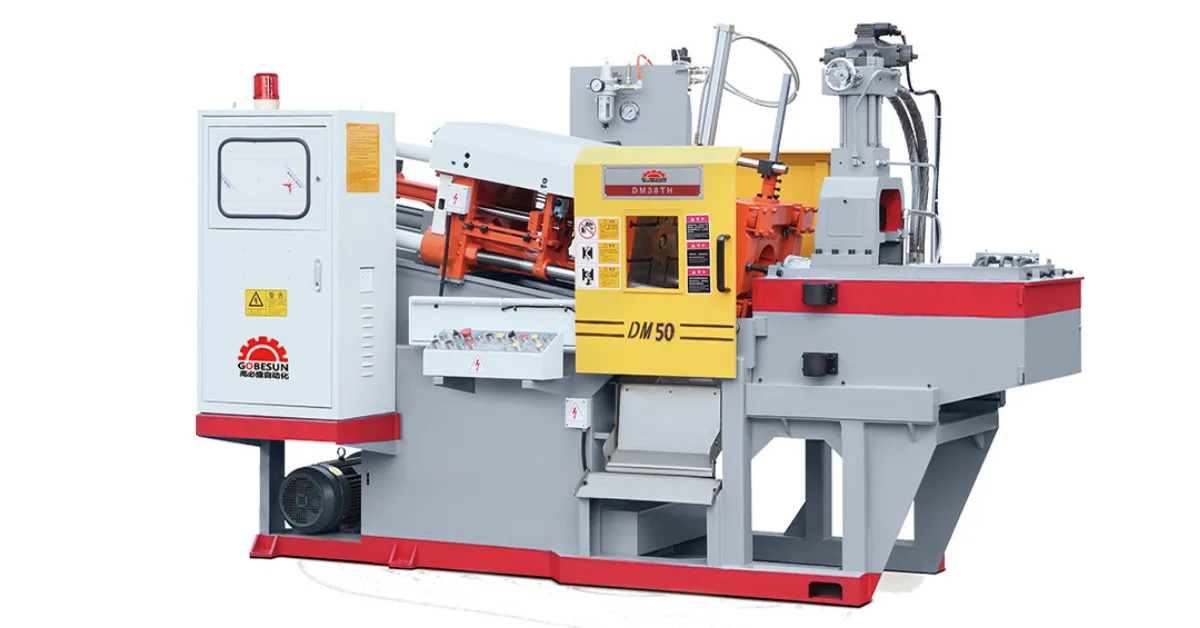
| Factor | Hot Chamber Die Casting | Cold Chamber Die Casting |
|---|---|---|
| Injection system | Connected to / immersed in molten metal | Separate from melting furnace |
| Metal transfer before each shot | No separate ladling step | Metal transferred into shot sleeve |
| Common alloys | Zinc, selected magnesium, lead, tin | Aluminum, selected magnesium, copper alloys, high-aluminum zinc alloys |
| Production rate | Generally faster | Generally slower because of metal transfer |
| Main alloy limitation | Melt must not rapidly attack submerged injection components | Handles alloys unsuitable for submerged hot-chamber equipment |
| Typical industrial use | High-volume zinc and selected magnesium parts | Aluminum die casting and larger non-ferrous components |
| YTD network part-weight reference | 0.02–5 kg | 0.1–20 kg |
| YTD network max-size reference | Up to about 300 mm | Up to about 800 mm |
| YTD network min-wall reference | About 0.5 mm | About 0.8 mm |
| YTD network tolerance reference | About ±0.05 mm | About ±0.10 mm |
The dimensional and size figures above describe YTD’s current die-casting partner network, not universal limits for every hot- or cold-chamber machine.
Hot Chamber and Cold Chamber Refer to the Injection System
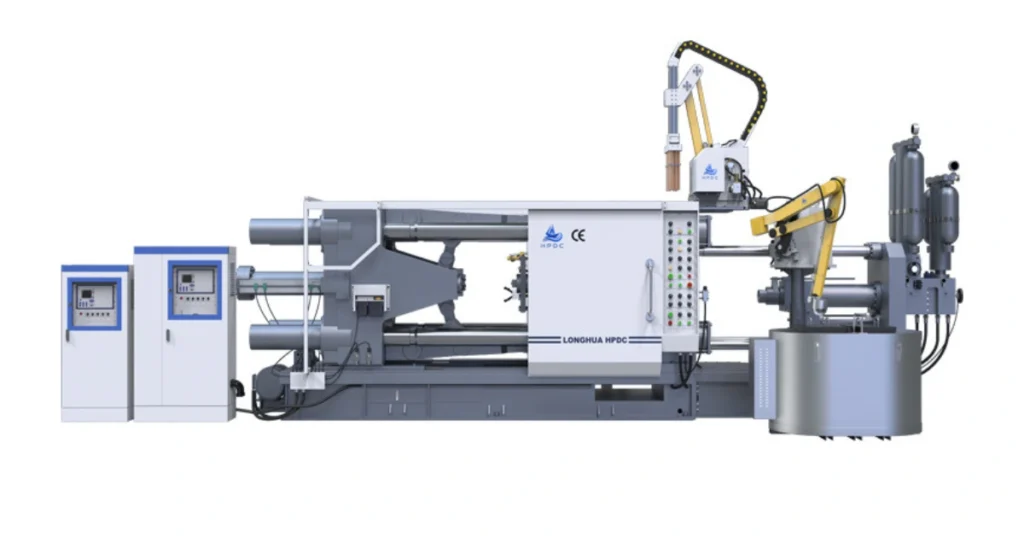
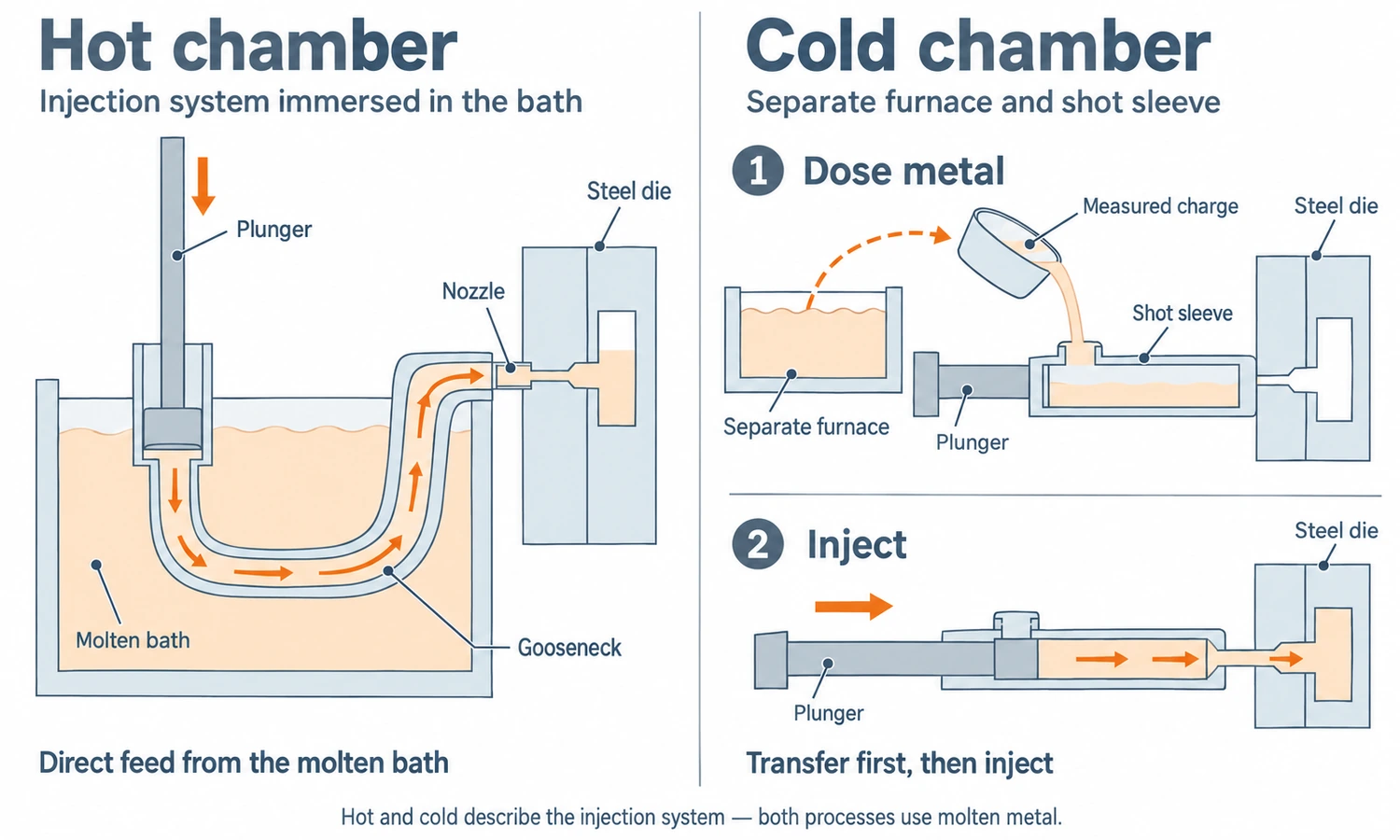
The words hot and cold do not describe whether molten metal is hot or cold. Both processes inject liquid metal at casting temperature. They describe the relationship between the injection mechanism and the molten-metal supply. In a hot chamber machine, the injection system is partly submerged in the furnace. A plunger forces metal through a gooseneck and nozzle directly into the die. In a cold chamber machine, the alloy is melted in a separate furnace. A measured quantity is transferred into a shot sleeve, and a hydraulic plunger pushes that metal into the die. The North American Die Casting Association uses this same distinction in its die-casting process definitions. (NADCA) The rest of the comparison follows from this machine architecture.
Alloy Selection for Hot Chamber and Cold Chamber Die Casting
Material is normally the first—and often decisive—filter.
Hot Chamber Alloys
Hot chamber equipment is best suited to alloys with relatively low melting temperatures that do not rapidly attack the submerged injection components. Zinc is the dominant example. Selected magnesium alloys can also run on hot chamber equipment, while lead and tin are technically compatible for applications where those materials are still used. NADCA specifically identifies zinc, lead, tin, and some magnesium alloys as hot-chamber materials. (NADCA) Zinc works particularly well because it combines good fluidity with fine-detail capability and a relatively low casting temperature.
Cold Chamber Alloys
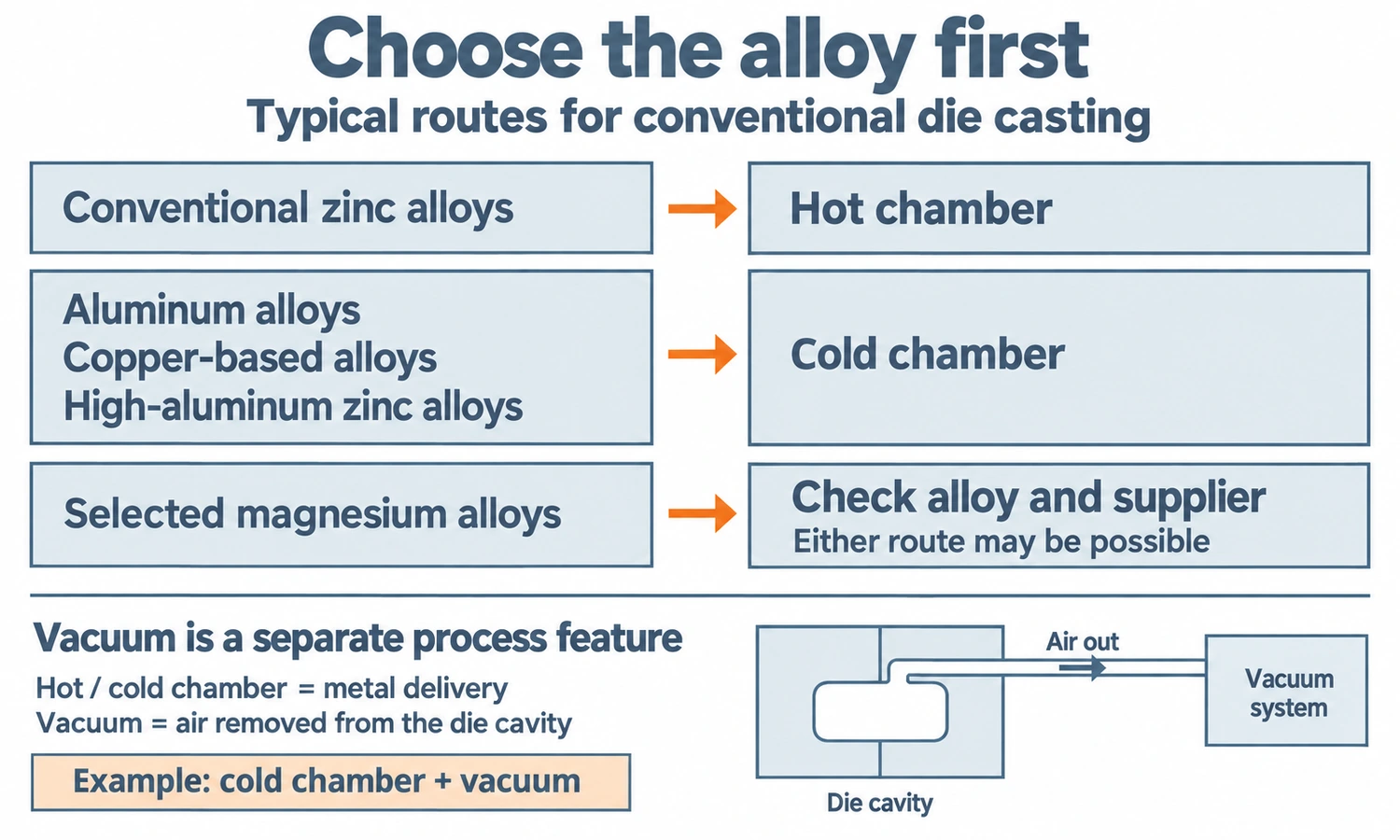
Cold chamber equipment keeps the injection mechanism out of continuous contact with the molten bath, making it suitable for alloys that would be difficult to run through a conventional submerged hot-chamber system. Aluminum is the most important cold-chamber material. Copper-based alloys, selected magnesium alloys, and high-aluminum zinc alloys can also use this process. This is why aluminum die casting normally means cold chamber die casting, while high-volume zinc die casting normally points toward hot chamber equipment. Magnesium sits between the two: the exact alloy and machine configuration determine which system is used. For a detailed explanation of each route separately, see our Hot Chamber Die Casting guide and Cold Chamber Die Casting guide.
Why Aluminum Normally Uses Cold Chamber Die Casting
Conventional hot chamber equipment keeps the gooseneck, injection cylinder, and related metal-delivery components in contact with the molten alloy. That arrangement works well with zinc, but molten aluminum is much more aggressive toward conventional iron-based submerged components. Cold chamber equipment avoids prolonged immersion. Aluminum is melted outside the machine and transferred into the shot sleeve only when a casting cycle begins. That extra transfer step makes the cycle slower, but it allows aluminum to be die cast without continuously exposing the injection system to the molten bath. Specialized hot-chamber aluminum systems exist, but they are not the standard industrial route. For normal process selection, aluminum should be treated as a cold chamber material.
Metal Transfer and Production Cycle Time
Hot chamber machines eliminate one complete operation from each cycle: transferring molten metal from a separate furnace into the shot sleeve. After a casting is ejected and the die is ready again, the immersed injection system can receive the next charge directly from the molten bath. Cold chamber machines need an additional dosing or ladling step before every shot. NADCA therefore describes hot chamber production rates as generally higher than cold chamber production rates. (NADCA) This does not mean injection speed alone determines the cycle. Cooling and solidification often consume a large share of total cycle time, especially as casting size and wall thickness increase. But for similar compatible parts, removing the repeated metal-transfer stage gives hot chamber production an important efficiency advantage. That is one reason high-volume zinc components are so strongly associated with hot chamber machines.
Part Size, Wall Thickness, and Machine Capacity
Hot chamber does not automatically mean “small parts,” and cold chamber does not inherently mean “large parts.” Actual capacity depends on shot size, die dimensions, projected area, clamping force, alloy, and machine design. In YTD’s current partner network, however, the process ranges illustrate the typical production difference. Our hot chamber partners currently support parts from approximately 0.02 to 5 kg, with maximum dimensions around 300 mm and minimum wall sections around 0.5 mm. Cold chamber capability extends to approximately 0.1 to 20 kg, maximum dimensions around 800 mm, and minimum wall sections around 0.8 mm. Those ranges partly reflect the parts and alloys each machine family commonly serves. Zinc hot chamber casting is especially effective for smaller, detailed parts, while aluminum cold chamber equipment is widely used for larger housings and structural components. Machine capacity still needs to be checked against the actual drawing rather than inferred from the process name.
Dimensional Accuracy and Thin-Wall Capability
Both processes use reusable precision steel dies, so both can provide good dimensional repeatability and fine as-cast detail. The machine type itself does not create a simple universal rule that hot chamber is always more accurate than cold chamber. Alloy, part size, die condition, thermal control, projected area, cavity layout, and the dimensions being measured all matter. Within YTD’s current network, hot chamber parts are referenced around ±0.05 mm, while cold chamber and vacuum die casting are referenced around ±0.10 mm. Hot chamber minimum wall thickness is about 0.5 mm, compared with about 0.8 mm for the current cold chamber range. These numbers are useful capability references, but the drawing still has to be reviewed feature by feature. For formal die-casting tolerance design, the current NADCA Product Specification Standards provide separate standard and precision tolerance guidance rather than one tolerance for every die casting. NADCA Product Specification Standards for Die Castings
Process Control Differences During Metal Delivery
Hot and cold chamber machines share many of the same downstream controls—die temperature, fill speed, venting, pressure, cooling, and ejection—but the metal reaches the injection system differently.
Hot Chamber Metal Delivery
Because the injection system is connected directly to the molten bath, there is no repeated open transfer between furnace and shot sleeve. This reduces temperature loss between furnace and injection and removes one opportunity for variation in ladled shot volume. The tradeoff is that the injection system remains exposed to the molten alloy, which is why alloy compatibility is so restrictive.
Cold Chamber Metal Delivery
Cold chamber production adds a transfer step. Molten metal is dosed into the shot sleeve for each cycle before the plunger advances. That creates additional control points: transfer time, shot volume, temperature loss, oxide formation, and the amount of air present in the sleeve before injection. Our dedicated cold chamber guide discusses these issues in more detail. Cold Chamber Die Casting: Process, Materials and Buyer Guide This does not make cold chamber castings inherently lower quality. It simply means the metal-delivery stage has more variables to control.
Die Construction and Tool Life
Hot and cold chamber processes both use reusable steel dies with cavities, runners, gates, vents, cooling, and ejector systems. The major difference in tooling life comes less from the words hot chamber and cold chamber than from the alloy being cast. Zinc runs at much lower temperatures than aluminum and places less thermal stress on the die. Aluminum cold chamber dies operate under more severe thermal cycling, so heat checking, soldering, erosion, and thermal-fatigue control become more important. The die casting process still rewards large production volumes because the permanent steel tool spreads its cost over repeated shots. NADCA notes that suitable dies can produce hundreds of thousands of identical castings before additional tooling is required. (NADCA) Tool life for a real project should therefore be discussed together with the alloy, cavity count, die steel, cooling design, maintenance plan, and expected lifetime quantity.
Hot Chamber vs Cold Chamber Production Cost
Hot chamber production often has a lower conversion cost for a compatible part because the machine cycles quickly and does not need to ladle or dose metal into a separate shot sleeve for every casting. That advantage is strongest in stable, high-volume zinc programs. Cold chamber production accepts the additional metal-transfer step because it gives access to aluminum and other alloys that cannot normally use the submerged hot-chamber injection system. The comparison should not stop at machine cycle time. Zinc and aluminum differ in density, raw-material cost, wall-thickness capability, mechanical properties, finishing, and part weight. A zinc component produced very quickly can still be more expensive than an aluminum design if substantially more metal is required. Likewise, switching a part from aluminum to zinc simply to use a faster hot chamber machine can change its weight and performance. The correct economic comparison uses the same functional component, not just machine cost per hour.
Hot Chamber vs Cold Chamber: Material Usually Decides First
When the alloy is already specified, the machine choice is often straightforward.
| Specified Alloy / Requirement | Process to Evaluate First |
|---|---|
| Conventional zinc die-casting alloy | Hot chamber |
| Aluminum die-casting alloy | Cold chamber |
| Selected magnesium alloy | Check alloy and supplier; either process may be possible |
| Copper-based die-casting alloy | Cold chamber |
| High-aluminum zinc alloy | Cold chamber |
| Very small, detailed zinc part at high volume | Hot chamber |
| Larger aluminum housing | Cold chamber |
If the material has not yet been selected, the order should be reversed. First choose the alloy that gives the part the required weight, strength, corrosion behavior, operating temperature, plating or finishing performance, and cost. Then select the machine architecture that can process that alloy efficiently. Choosing hot or cold chamber first and then forcing the material to fit the machine puts the manufacturing decision in the wrong order.
Hot Chamber, Cold Chamber, and Vacuum Die Casting
Vacuum die casting is not a third alternative at the same classification level. Hot chamber vs cold chamber describes how molten metal reaches the injection mechanism. Vacuum die casting describes how air is removed from the die cavity before or during filling. NADCA defines high-vacuum die casting as a high-integrity process in which the sealed cavity is evacuated to reduce trapped gas. Its public guidance cites cavity vacuum below 50 mbar for high-vacuum die casting. (NADCA) In aluminum production, high-vacuum die casting is typically built around a cold-chamber system because aluminum itself already dictates the cold-chamber metal-delivery route. So a project may be both: cold chamber + high vacuum There is no contradiction between the two terms.
How We Select Hot and Cold Chamber Die Casting at YTD
Die casting projects at YTD are produced through specialized partner foundries rather than our in-house investment-casting line. When we review a die-casting project, the alloy usually narrows the machine choice first. A high-volume zinc component normally moves toward hot chamber production. An aluminum housing moves toward cold chamber, while structural aluminum parts with stricter porosity requirements may require evaluation of a vacuum die-casting route. Our current partner network supports hot chamber, cold chamber, and vacuum die casting, together with tooling, machining, finishing, and inspection. YTD Die Casting Service The process choice is based on the drawing and material rather than treating hot chamber as simply the “faster” option or cold chamber as the “stronger” one.
Final Thoughts
Hot chamber and cold chamber die casting differ mainly in how molten metal reaches the injection system. That difference makes alloy selection the first decision: zinc usually favors hot chamber equipment, while aluminum normally requires cold chamber casting. From there, cycle speed, part size, wall thickness, die life, and cost refine the choice. For most projects, choosing the correct alloy first makes the hot-versus-cold chamber decision much simpler.
FAQs
What Is the Main Difference Between Hot Chamber and Cold Chamber Die Casting?
Hot chamber machines keep the injection mechanism connected to or immersed in molten metal. Cold chamber machines melt the alloy separately and transfer a measured charge into the shot sleeve for each cycle.
Is Hot Chamber Die Casting Faster?
Generally, yes. It eliminates the separate metal-transfer step required by cold chamber production. Cooling time, part size, cavity count, and automation still affect the complete cycle.
Why Is Aluminum Cold Chamber Die Cast?
Molten aluminum is not well suited to continuous contact with conventional submerged iron-based hot-chamber injection components. Cold chamber equipment keeps the melting furnace separate and exposes the shot system to molten aluminum only during each cycle.
Can Magnesium Use Both Hot and Cold Chamber Machines?
Yes, selected magnesium alloys can use either process. The exact alloy, component, machine configuration, and supplier capability determine the appropriate route.
Is Zinc Always Hot Chamber Die Cast?
Most conventional zinc die casting uses hot chamber equipment, but some high-aluminum zinc alloys are processed by cold chamber machines. NADCA specifically includes high-aluminum zinc alloys among cold-chamber materials. (NADCA)
Is Vacuum Die Casting Hot Chamber or Cold Chamber?
Vacuum describes cavity evacuation, not the location of the injection mechanism. High-vacuum aluminum die casting is typically a cold-chamber process because aluminum already requires cold-chamber metal delivery.