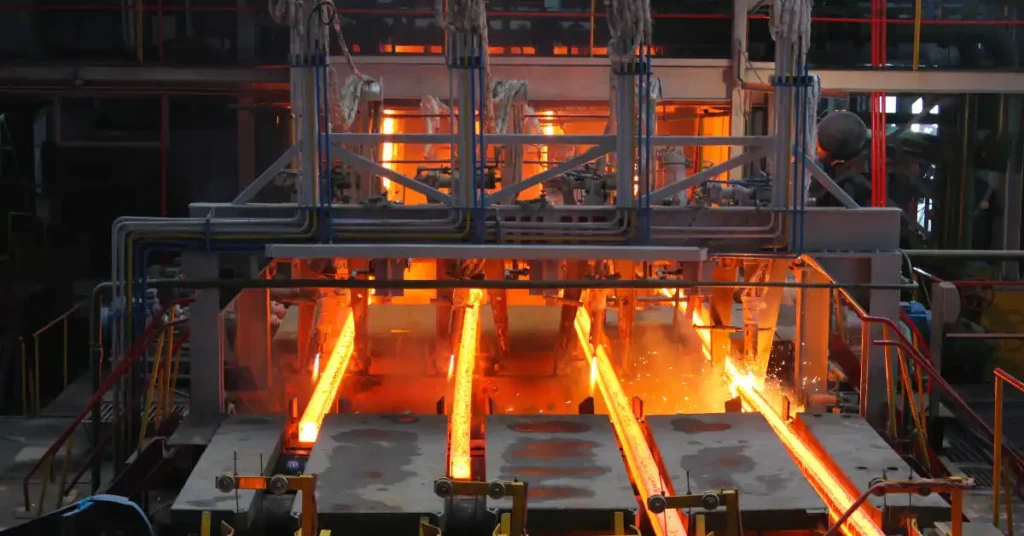
Continuous casting turns molten metal into a continuously moving solid strand with a constant cross-section.
Instead of pouring one mold at a time, the process keeps metal flowing through a water-cooled mold while the strand is withdrawn, cooled, and eventually cut into slabs, blooms, billets, or other semi-finished shapes.
That distinction is important: continuous casting normally makes material for later rolling or forming, not individual complex components.
This guide explains how the process works, what each part of the caster does, what products it makes, and why continuous casting dominates modern primary steel production.
What Is Continuous Casting?
Continuous casting, also called strand casting, is a manufacturing process in which molten metal is continuously solidified into a long shape with an essentially constant cross-section.
In steel production, the output is typically:
- Slab
- Bloom
- Billet
- Round
- Beam blank
- Thin slab
These are usually semi-finished products.
They continue to rolling mills or other downstream operations, where they become plate, sheet, bar, wire rod, structural sections, pipe feedstock, and other commercial products.
This is the first major difference between continuous casting and processes such as investment casting.
Investment casting tries to create a component close to its final geometry.
Continuous casting tries to produce metal stock continuously and efficiently for later processing.
ASM describes the process as a way to bypass conventional ingot casting and produce material in a form that can move more directly into finishing mills. ASM Digital Library
What Does a Continuous Casting Machine Produce?
The product shape is one of the easiest ways to understand a continuous caster.
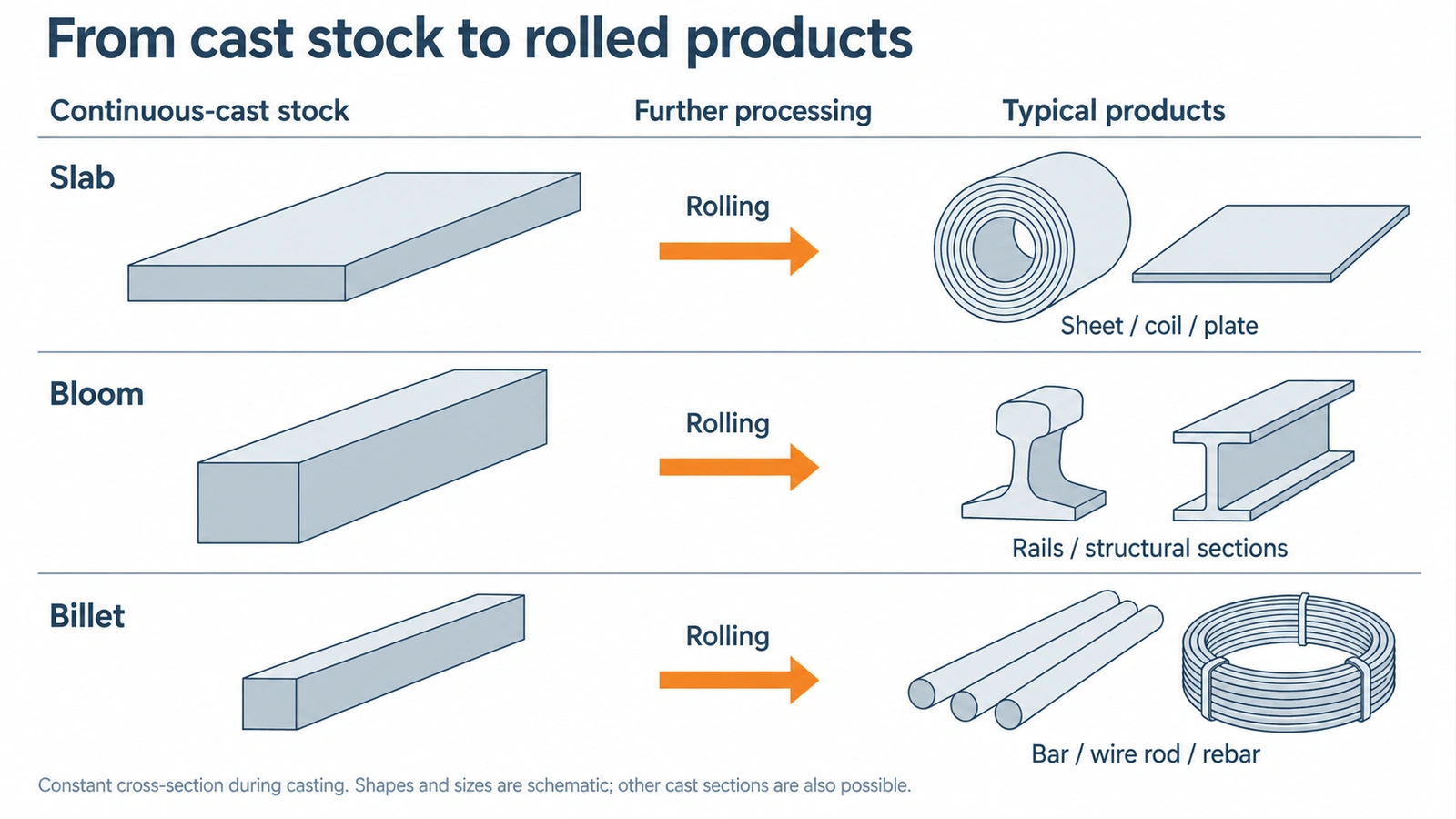
Slabs
Slabs are wide, relatively flat rectangular sections.
They are mainly rolled into:
- Steel plate
- Hot-rolled sheet
- Cold-rolled sheet
- Strip
If you look at automotive body sheet, appliance steel, or structural plate, the manufacturing route often starts with a continuously cast slab.
Blooms
Blooms have a larger square or rectangular cross-section than billets.
They are commonly used as feedstock for:
- Structural sections
- Rails
- Heavy bars
- Seamless-pipe routes
Billets
Billets are smaller square or rectangular sections.
They are typically rolled into:
- Bar
- Wire rod
- Rebar
- Smaller structural sections
Other Continuous-Cast Shapes
Depending on the plant, continuous casters can also produce:
- Rounds
- Beam blanks
- Thin slabs
- Specialty non-ferrous sections
The common feature is not the exact shape.
It is that the cross-section remains essentially constant while the strand is produced continuously.
How the Continuous Casting Process Works
The easiest way to understand the process is to follow the metal from liquid to solid.
A conventional steel caster contains several connected zones:
Ladle → Tundish → Mold → Secondary Cooling → Rolls/Straightening → Cutting
Each solves a different problem.
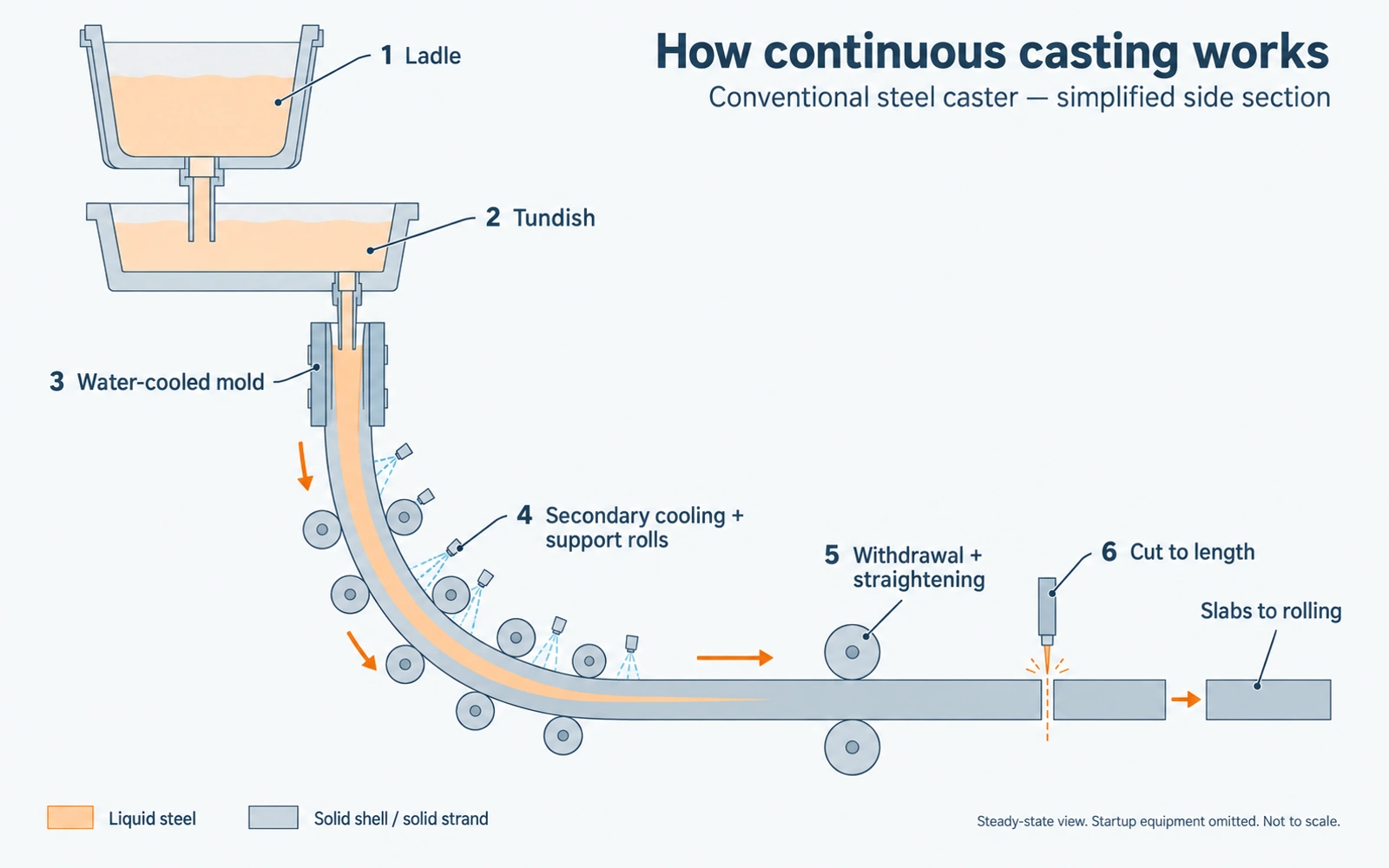
1. The Ladle Brings Molten Metal to the Caster
The process begins with molten metal prepared upstream in the steelmaking or melting operation.
For steel, the ladle does more than transport liquid metal.
Before casting, the melt may already have undergone operations to control:
- Chemical composition
- Temperature
- Deoxidation
- Inclusion content
- Dissolved gases
Once ready, the ladle is positioned above the casting machine.
The objective from this point is to maintain a controlled supply of metal without interrupting the casting strand.
2. The Tundish Controls Flow Into the Mold
The ladle normally does not pour directly into the final casting mold.
Metal first enters a vessel called the tundish.
The tundish acts as a buffer between the ladle and the molds.
This has several practical benefits:
- It stabilizes metal flow.
- It allows one ladle to be changed for another without immediately stopping the strand.
- It distributes metal when a machine has multiple casting strands.
- It can help manage inclusions and temperature before metal enters the mold.
This makes the tundish much more than a simple funnel.
It helps turn batch steelmaking into a continuous casting operation.
3. Solidification Begins in a Water-Cooled Mold
Molten metal flows from the tundish into a water-cooled mold, usually through a controlled nozzle system.
For steel casting, the mold is commonly copper or copper-alloy because high thermal conductivity is needed to remove heat rapidly.
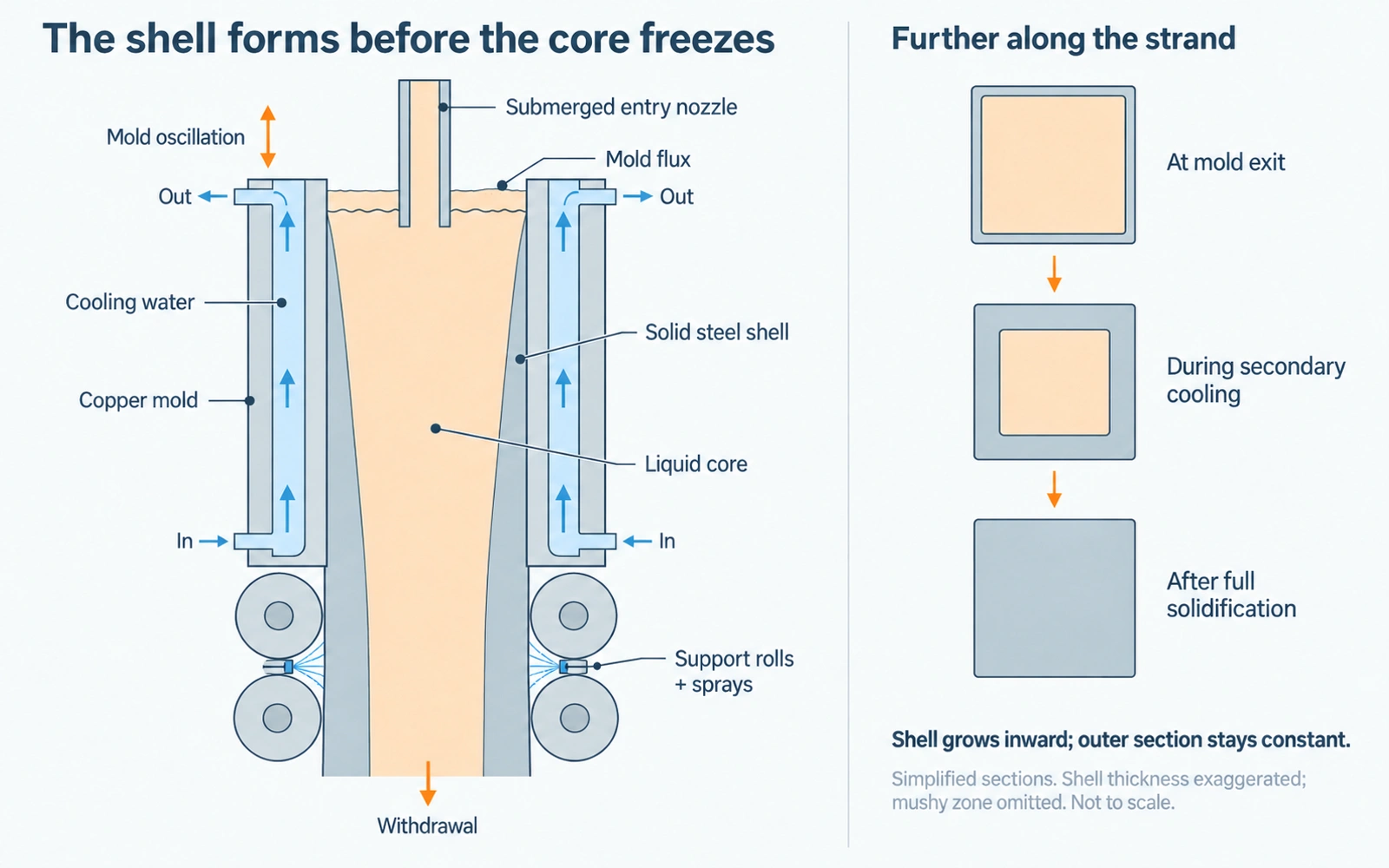
The important point is that the strand does not become completely solid inside the mold.
Only its outer layer freezes first.
This creates a solid shell surrounding a still-liquid core.
ScienceDirect’s process description notes that this partially solidified shell must be strong enough to contain the liquid interior as it leaves the mold. 科学直通车
This is one of the defining engineering challenges of continuous casting.
The strand must leave the mold early enough for continuous production, but the shell must already be strong enough not to rupture.
4. Mold Oscillation and Flux Help the Strand Move
If hot steel simply froze against a stationary copper mold, it could stick.
Continuous casters therefore use additional control systems.
The mold typically oscillates vertically.
A mold-flux system can also provide lubrication between the solidifying shell and mold while helping manage heat transfer and protecting the molten-metal surface.
These details may seem secondary, but the mold region is where the initial surface of the product forms.
Problems here can later appear as:
- Surface cracks
- Oscillation marks
- Entrapped slag
- Other surface defects
The first few moments of solidification therefore have a strong influence on downstream product quality.
5. Secondary Cooling Solidifies the Strand
When the strand exits the mold, the outside is solid but the center can still contain molten metal.
The strand then passes through a secondary cooling zone.
Water sprays or water-air systems remove additional heat while rolls support the strand.
The rolls are essential because the shell is still relatively thin.
Pressure from the liquid core can push the hot shell outward if support is inadequate.
As cooling continues, the solidification front moves toward the center until the strand becomes fully solid.
This distance is sometimes described as the caster’s metallurgical length.
6. Rolls Guide, Bend, and Straighten the Strand
Continuous casters are not always completely vertical.
Many steel casters use a curved path so the machine does not need an extremely tall building.
The strand may therefore:
- Travel vertically downward.
- Follow a curved roll segment.
- Be gradually straightened.
- Continue horizontally toward cutting equipment.
The support and alignment of these rolls matter.
Incorrect roll position or insufficient support can contribute to bulging, cracking, and internal quality problems while the strand is still partly solid. 科学直通车
7. The Continuous Strand Is Cut to Length
Once the metal is sufficiently solid, it no longer needs to remain one endless strand.
Torches, shears, or other cutting systems divide it into manageable lengths.
A continuous slab may therefore become a series of individual slabs only after the continuous solidification process has taken place.
These pieces are then sent downstream for reheating, rolling, direct rolling, storage, or additional processing.
Why Continuous Casting Replaced Ingot Casting
Before continuous casting became dominant in steelmaking, molten steel was commonly poured into individual ingot molds.
After solidification, those ingots had to be stripped, reheated, and heavily rolled to convert them into slabs, blooms, or billets.
Continuous casting removes several of those intermediate steps.
ASM highlights improvements in yield, surface condition, and internal quality compared with older ingot-based production routes. ASM Digital Library
The main advantages come from the fact that material moves through one continuous production route rather than repeatedly stopping and restarting.
Advantages of Continuous Casting
Higher Material Yield
Individual ingots often require removal of material associated with shrinkage cavities, ends, and other non-useful regions.
Continuous casting can reduce these losses.
More of the molten metal becomes usable downstream product.
High Production Rate
Once stable casting conditions are established, metal can flow continuously for long production sequences.
This makes the process extremely productive for steel mills and other high-volume primary-metal operations.
More Consistent Product
A stable continuous process can provide relatively uniform:
- Cross-section
- Temperature history
- Surface condition
- Internal structure
This is particularly valuable when the strand feeds a rolling operation.
Fewer Intermediate Steps
Continuous casting can eliminate or reduce the need for:
- Individual ingot molds
- Ingot stripping
- Soaking
- Primary breakdown rolling
This simplifies the production route between molten steel and rolling feedstock.
Lower Unit Cost at Large Scale
A continuous caster requires major capital investment.
But once running at industrial scale, it can process enormous quantities of material efficiently.
Engineering LibreTexts identifies high production volume, high yield, and low unit cost as major advantages of the process. Engineering LibreTexts
Limitations of Continuous Casting
Continuous casting is highly efficient, but it is also highly specialized.
Very High Equipment Investment
A continuous caster is not a simple foundry machine.
A complete system may require:
- Ladle handling
- Tundish equipment
- Water-cooled molds
- Roll segments
- Spray cooling
- Hydraulic systems
- Straightening equipment
- Cutting systems
- Extensive automation and process control
This makes it practical for large-scale metal production rather than small custom batches.
Limited Product Geometry
Continuous casting is excellent at producing a constant cross-section.
That is also its major geometric limitation.
It cannot directly produce a complex pump housing, valve body, impeller, bracket, or turbine component.
Those products require another forming or manufacturing process.
Process Changes Can Be Expensive
A continuous caster is optimized around specific:
- Section sizes
- Alloy ranges
- Production rates
- Downstream mills
Changing the system for a completely different product is much less flexible than changing a mold in a conventional foundry.
Common Continuous Casting Defects
Continuous casting does not eliminate casting defects.
It creates its own set of quality challenges because solidification occurs while the strand is moving.
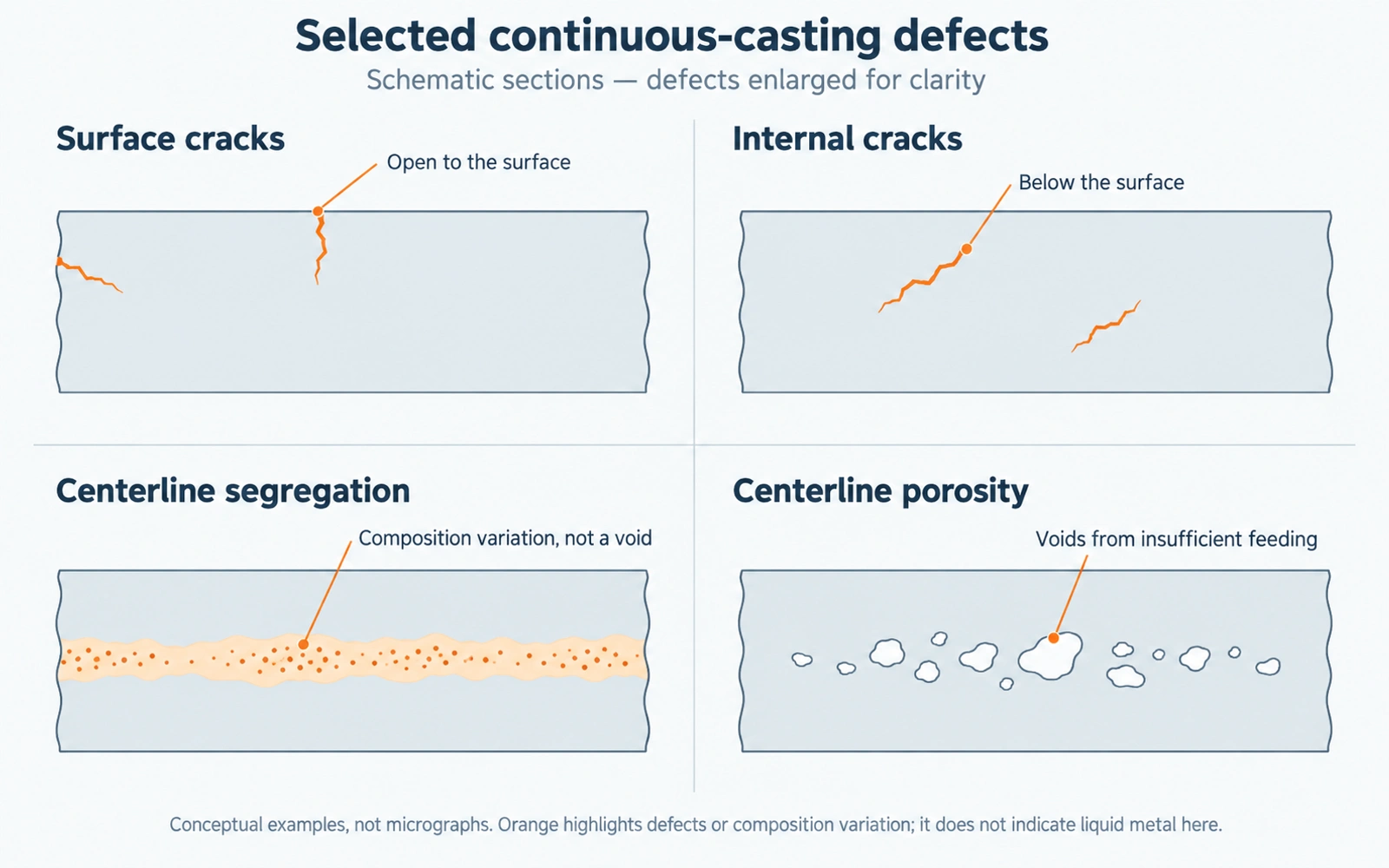
Surface Cracks
Thermal stress, mold behavior, steel composition, or mechanical strain can create longitudinal or transverse surface cracks.
Because the strand is later rolled, small casting defects can sometimes propagate or remain visible in downstream products.
Internal Cracks
Internal cracking can develop while the center of the strand is still hot or partially solid.
Roll misalignment, bulging, thermal stress, or excessive mechanical strain can contribute.
Centerline Segregation
As metal solidifies, alloying elements do not always remain perfectly uniform between the solid and liquid phases.
The final liquid near the center can become chemically different from the metal that solidified earlier.
This can produce centerline segregation.
Control of solidification, cooling, strand support, and stirring helps manage the problem.
Porosity and Centerline Cavities
Shrinkage during final solidification can leave internal voids or porosity if the center region does not feed correctly.
Inclusions
Nonmetallic inclusions can enter the strand from the melt, tundish, refractory system, or mold flux.
Flow control and steel cleanliness are therefore important before and during casting.
Breakout
A breakout is one of the most serious operational failures.
It occurs when the partially solidified shell ruptures and molten metal escapes from the strand.
The shell must therefore be thick enough and sufficiently supported as it leaves the mold.
Continuous casting quality is fundamentally a balance among metal flow, heat removal, solidification, and mechanical support.
Continuous Casting vs. Ingot Casting
The basic difference is continuity.
| Factor | Continuous Casting | Ingot Casting |
|---|---|---|
| Production | Continuous strand | Separate molds |
| Typical Output | Slab, bloom, billet | Individual ingot |
| Downstream Processing | Can move relatively directly to rolling | Usually requires more breakdown processing |
| Yield | Generally higher | More cropping and ingot-related losses |
| Productivity | Very high | Lower |
| Flexibility for Small Batches | Low | Greater |
| Equipment Investment | Very high | Lower |
Ingot casting still has specialized uses, particularly where very large individual sections, unusual compositions, or certain specialty-production routes make continuous casting unsuitable.
But for high-volume commercial steel production, continuous casting has largely replaced the older ingot route. Sail
Continuous Casting vs. Investment, Sand, and Die Casting
The word casting causes a lot of unnecessary confusion here.
All four processes solidify molten metal, but they are solving different manufacturing problems.
| Process | Typical Goal |
|---|---|
| Continuous Casting | Produce long semi-finished metal stock |
| Investment Casting | Produce complex near-net-shape components |
| Sand Casting | Produce individual components over a very wide size range |
| Die Casting | Produce high-volume repeat non-ferrous parts |
Continuous Casting
Think:
slab, bloom, billet, bar feedstock
The geometry stays constant along the length.
Investment Casting
Think:
valve component, impeller, turbine part, structural bracket
The goal is to reproduce an individual component close to its final shape.
YTD’s investment casting process shows how wax patterns and ceramic shells are used for this type of manufacturing.
Sand Casting
Sand casting also makes discrete individual components rather than an endless strand.
It is particularly useful for large industrial shapes and broad alloy selection.
Die Casting
Die casting repeatedly produces individual parts in a reusable metal die, typically from aluminum, zinc, or magnesium alloys.
So asking:
“Is continuous casting better than investment casting?”
usually starts from the wrong premise.
They rarely compete for the same component.
One supplies metal stock; the other produces shaped parts.
Is Continuous Casting Only Used for Steel?
No.
Steel is by far the most familiar industrial example, but the principle can also be applied to non-ferrous metals.
Continuous casting is used for products based on materials such as:
- Aluminum
- Copper and copper alloys
- Other metals suited to continuous-section production
Non-ferrous continuous casting may use horizontal, vertical, or other machine arrangements depending on the alloy and product.
The exact equipment differs from a large steel slab caster, but the underlying concept remains:
molten metal enters continuously, a solid shell forms against a cooled mold, and solid material is withdrawn continuously.
What Happens After Continuous Casting?
Continuous casting is normally not the final manufacturing step.
Its output becomes feedstock for another process.
A slab may become:
slab → hot rolling → coil/plate → additional processing
A billet may become:
billet → rolling → bar/wire rod
A bloom may become:
bloom → rolling → structural section/rail
This explains why continuous casting belongs more naturally to steelmaking and primary-metal production than to custom component foundries.
The caster sits between liquid-metal production and downstream deformation processing.
When Is Continuous Casting the Right Process?
Continuous casting makes sense when all of the following are broadly true:
- Production volume is extremely high.
- The product has a constant cross-section.
- The output will normally undergo further processing.
- Material yield and production rate matter greatly.
- Major equipment investment can be justified.
It does not normally make sense when the requirement is:
- A complex individual component
- Many changing cross-sections
- Small production quantities
- Frequent design changes
- Near-final component geometry directly from the mold
For those requirements, a conventional component casting process is more appropriate.
Does YTD Foundry Provide Continuous Casting?
YTD Foundry focuses on custom-shaped metal components, with investment casting as our core in-house process.
Continuous casting belongs to a different part of the metals supply chain.
For example, a steel mill may continuously cast steel into billet or slab. That material can later become bar, sheet, or other raw material used by downstream manufacturers.
If your requirement is an individual cast component rather than semi-finished metal stock, the more relevant processes are typically investment casting, sand casting, or die casting depending on the material, geometry, size, and production quantity.
This distinction helps avoid choosing a casting process simply because the processes share the word “casting.”
Final Thoughts
Continuous casting is best understood as a bridge between molten metal and downstream rolling.
Its strength is not complex part geometry, but the ability to turn enormous quantities of liquid metal into uniform slabs, blooms, billets, and other continuous sections with high yield and productivity.
For custom-shaped components, other casting processes are normally more appropriate. The first question should therefore be whether you need metal stock for further processing or a finished-shaped casting.
FAQs
What Is Continuous Casting Used For?
Continuous casting is mainly used to turn molten metal into long semi-finished products with a constant cross-section, such as slabs, blooms, billets, and rounds. These products normally continue to rolling or other downstream processing.
What Is a Tundish in Continuous Casting?
A tundish is an intermediate vessel between the ladle and the casting mold. It helps regulate and distribute molten-metal flow and allows continuous operation during ladle changes.
Why Is the Continuous Casting Mold Water-Cooled?
The mold must remove heat rapidly enough to create a solid outer shell around the still-liquid interior of the strand. That shell allows the strand to leave the mold and continue through secondary cooling.
What Is the Difference Between a Billet, Bloom, and Slab?
They are different semi-finished continuous-cast cross-sections. Slabs are wide and flat, billets are relatively small square or rectangular sections, and blooms are larger square or rectangular sections used for heavier downstream products.
What Is a Continuous Casting Breakout?
A breakout occurs when the solidifying shell ruptures and liquid metal escapes from the strand. It is a serious process failure related to shell formation, heat transfer, mold operation, or strand support.
Is Continuous Casting the Same as Investment Casting?
No. Continuous casting produces long metal stock with a constant cross-section, while investment casting produces individual complex components using expendable ceramic molds.