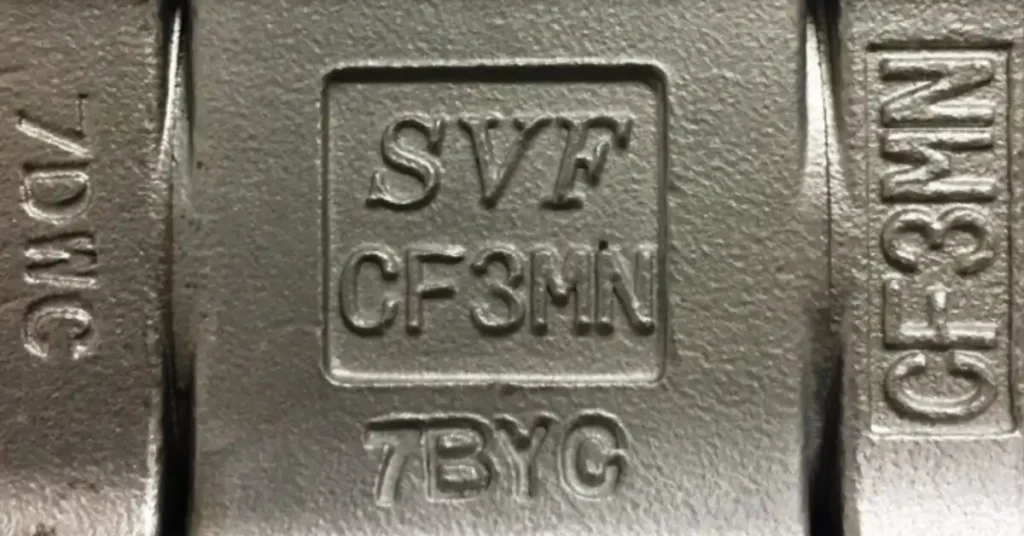
CF3MN is an austenitic stainless steel casting grade specified under ASTM A351 (for pressure-containing parts) and ASTM A743 (for general corrosion service). It serves as the official cast counterpart to wrought 316LN stainless steel.
Importantly, CF3MN is a casting only grade, and we believe this is what makes it truly valuable for demanding applications.
What Does “CF3MN” Mean?
The designation CF3MN follows the ACI (Alloy Casting Institute) standard nomenclature, and here is our quick breakdown of what each character means:
- C stands for corrosion-resistant, identifying CF3MN material as part of the family of stainless steel castings designed for service in corrosive environments.
- F denotes a chromium-nickel-molybdenum austenitic steel, whose face-centered cubic microstructure provides excellent toughness and ductility.
- 3 means ultra-low carbon at ≤0.03%—the level that ensures good weldability and resistance to intergranular corrosion after welding.
- M signals molybdenum (2.0–3.0%), an element that significantly improves resistance to pitting and crevice corrosion, especially in chloride media.
- N represents nitrogen (0.10–0.20%), added to boost yield strength through solid-solution strengthening while preserving corrosion resistance—a significant advantage that gives CF3MN an edge in demanding applications.
In short, CF3MN material is a casting alloy engineered for applications that demand strength, corrosion resistance, and weldability in one.
Chemical Composition & Mechanical Properties of CF3MN Stainless Steel
CF3MN Chemical Composition
Here you can see the exact composition that gives CF3MN its properties—so you know what to expect in service.
| Element | Content (%) |
| Carbon (C) | ≤ 0.03 |
| Chromium (Cr) | 17.0 – 21.0 |
| Nickel (Ni) | 9.0 – 13.0 |
| Molybdenum (Mo) | 2.0 – 3.0 |
| Nitrogen (N) | 0.10 – 0.20 |
| Manganese (Mn) | ≤ 1.50 |
| Silicon (Si) | ≤ 1.50 |
| Phosphorus (P) | ≤ 0.04 |
| Sulfur (S) | ≤ 0.04 |
| Iron (Fe) | Balance |
CF3MN Mechanical Properties
These values tell you how CF3MN will perform under load and impact.
| Property | Value |
| Tensile Strength (min) | ≥ 515 MPa (75 ksi) |
| Yield Strength (min) | ≥ 255 MPa (37 ksi) |
| Elongation (min) | ≥ 35% |
| Hardness (Brinell) | 150-200 HBW |
CF3MN Equivalent Grades
Use this table when you need to cross reference CF3MN with other standards.
| Standard | Equivalent |
| ASTM (Cast) | A351/A743 CF3MN |
| UNS (Cast) | J92804 |
| UNS (Wrought) | S31653 |
| Wrought Equivalent | 316LN |
| DIN (Germany) | 1.4429 |
| EN (Europe) | X2CrNiMoN17-13-3 |
| JIS (Japan) | SUS316LN |
Engineering Grade Comparisons
CF3MN vs CF3M
CF3M lacks nitrogen, so its strength and corrosion resistance are limited. CF3MN adds nitrogen to give you higher strength and better protection against corrosion. For us, this means you get a more durable material that lasts longer in harsh conditions.
CF3MN vs CF3
CF3 is a basic grade without molybdenum or nitrogen. It works for simple applications, but it won’t protect your equipment from chlorides. CF3MN gives you the molybdenum and nitrogen you need for real corrosion resistance. We recommend CF3MN when reliability matters.
CF3MN vs 316LN
CF3MN is the casting version of 316LN. For cast parts like pump bodies and valves, we recommend CF3MN because it is engineered specifically for foundry production. For plates, bars, or tubing, 316LN is the right choice. We supply both forms, so you get exactly what your project requires.
Key Applications of CF3MN Castings
For your reference, the following are the industries and specific parts where our long-term clients choose CF3MN castings.
Pump & Valve Industry
When you need pump and valve components that must withstand corrosive media while maintaining mechanical integrity, we recommend CF3MN.
- Pump bodies, pump casings, volutes, and backplates
- Impellers, diffusers, and wear rings
- Valve bodies, bonnets, bonnet extensions, and trim components
Marine & Seawater Handling
When equipment is regularly exposed to seawater or brackish water, CF3MN’s molybdenum and nitrogen content gives you the pitting resistance you need.
- Seawater pump bodies and impellers
- Desalination plant components
- Marine hardware, offshore platform equipment
Chemical & Petrochemical Processing
When we work with customers in chemical processing, CF3MN is the grade we recommend for service in aggressive media where lower grades would fail prematurely.
- Reactor components, vessel internals
- Chemical pump casings, valve bodies
- Piping system components
Food & Pharmaceutical Processing
For food and pharmaceutical applications, we supply CF3MN castings when you need both corrosion resistance and cleanability for product purity.
- Processing equipment housings
- Sanitary valve bodies and pump components
Nuclear & Power Generation
CF3MN is also specified for nuclear service applications requiring a combination of strength and corrosion resistance.
- Uranium extraction and isotope separation equipment components
Our Specialty: Custom CF3MN Casting & Quality Control
Casting CF3MN requires metallurgical precision far beyond standard stainless steels. Here is how YTD Casting ensures defect-free CF3MN components:
Precise Nitrogen & Carbon Control
We maintain nitrogen at 0.10–0.20% and carbon below 0.03% through strict furnace practice. Using AOD/induction refining with nitrided ferro-alloys and controlled resin-sand binder systems, we prevent outgassing and carbon pickup—so you get consistent chemistry in every casting.
Solution Annealing & Quenching
Every CF3MN casting we produce undergoes full solution annealing at 1010–1150°C, followed by rapid water quenching. This dissolves chromium nitrides and carbides completely, giving you maximum pitting resistance, excellent low-temperature toughness, and a fully non-magnetic austenitic structure you can rely on.
Full Quality Assurance & NDT
We verify every heat with optical emission spectrometry (OES) to confirm exact N, Mo, and C levels. We perform tensile, yield, and elongation testing per ASTM A351/A743 standards.
Non-destructive testing—including PT, RT, and hydrostatic pressure testing—is available on request, so you get the documentation your project requires.
Conclusion
CF3MN’s unique composition gives it great strength and corrosion resistance, but it also requires extra care in casting. We know this grade well and control every step of the process to deliver sound, reliable parts. Send your drawing or requirements, and we will get back to you with a review and a firm quote.
FAQs
Is CF3MN magnetic?
No, it is essentially non-magnetic in the annealed condition. Some slight magnetism may appear after cold working.
Is CF3MN difficult to machine?
Yes, it work-hardens quickly. You’ll need sharp tooling, proper feeds and speeds, and adequate cooling to get good results.
What welding filler metal should be used for CF3MN?
Use nitrogen-bearing filler metals like E316LN or E316LMn to preserve CF3MN’s strength and pitting resistance. E316L may be used for non-critical repairs, but it reduces nitrogen.
What is the maximum section thickness for CF3MN castings?
Castings can be produced from about 4.8 mm upward. Heavier sections need more careful foundry practice to avoid defects.
Does CF3MN require heat treatment after casting?
Yes, solution annealing at 1010–1150°C followed by rapid cooling is standard practice for this grade.
What is the difference between CF3MN and CD3MN?
They belong to different metallurgical families. CF3MN (ASTM A351) is a 100% austenitic stainless steel (316LN cast equivalent). CD3MN (ASTM A890 Grade 4A) is a duplex stainless steel (2205 cast equivalent) with a 50/50 ferrite-austenite microstructure.
Is CF3MN more expensive than CF3M?
Generally yes, but the added nitrogen and tighter process control often pay off with longer service life in aggressive environments.