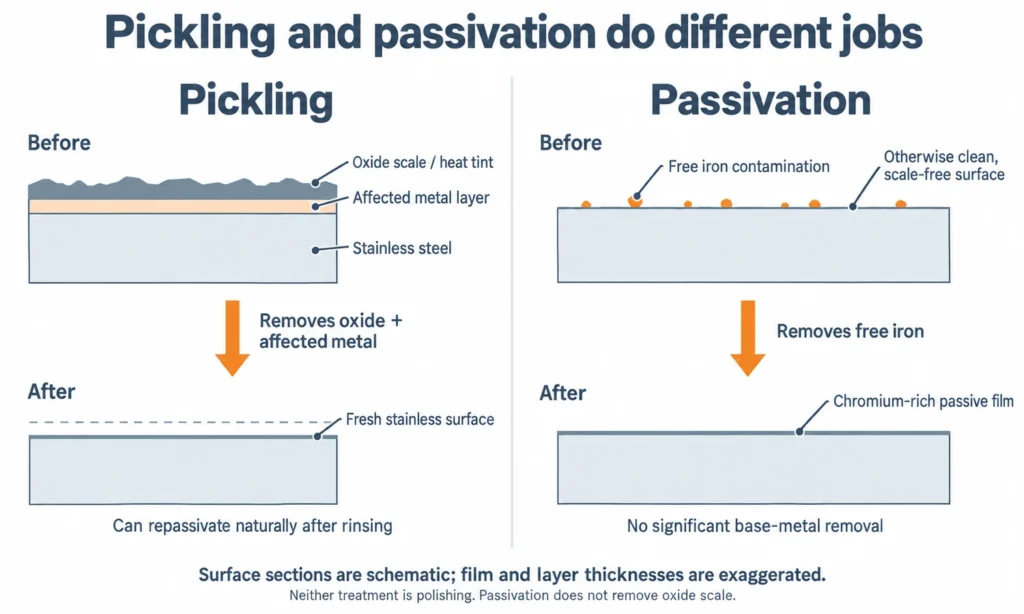
Pickling and passivation are both chemical surface treatments used on stainless steel, but they solve different problems.
Pickling removes oxide scale, heat tint, contamination, and a thin layer of affected metal. Passivation is a milder treatment used on an already clean stainless-steel surface to remove free iron and promote a stable chromium-rich passive film.
For stainless steel castings, the choice depends on what happened to the surface during casting, heat treatment, machining, blasting, welding, and handling.
Pickling vs Passivation: Quick Comparison
| Factor | Pickling | Passivation |
|---|---|---|
| Main purpose | Remove scale, heat tint, contamination, and affected surface metal | Remove free iron and improve the passive surface condition |
| Removes base metal? | Yes, in a controlled amount | Should not significantly attack the stainless steel |
| Removes oxide scale? | Yes | No |
| Removes heat tint? | Yes | No |
| Removes free iron contamination? | Yes | Yes, when the surface is otherwise clean |
| Typical effect on appearance | Can dull or matt the surface | Usually little visible change |
| Common use on castings | After heat treatment, welding, or when oxide scale must be removed | After machining, grinding, blasting, or final cleaning where free iron is a concern |
| Common standards | ASTM A380/A380M | ASTM A380/A380M, ASTM A967/A967M |
ASTM A380/A380M covers cleaning, descaling, pickling, and passivation of stainless steel parts, while ASTM A967/A967M focuses specifically on chemical passivation treatments.
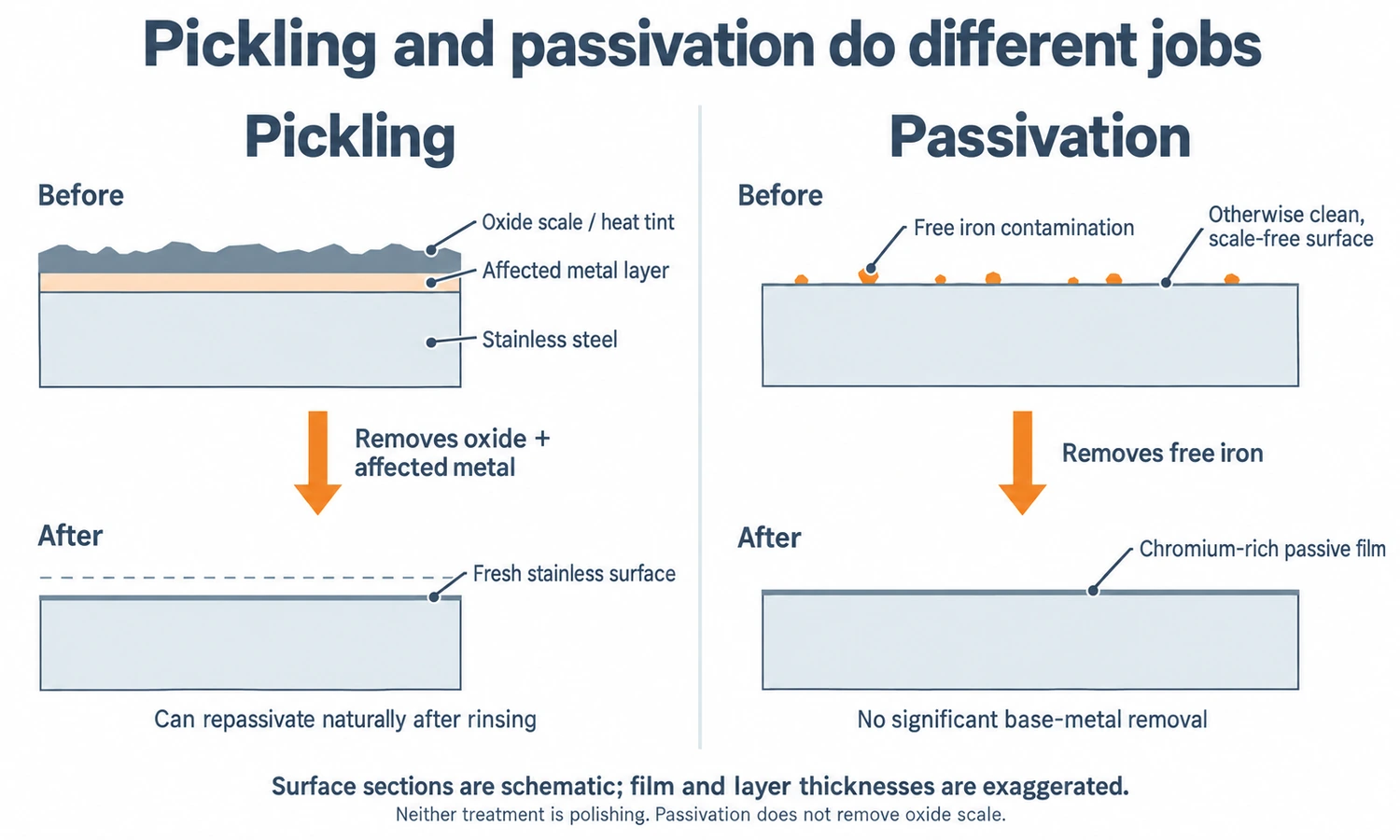
Why Stainless Steel Needs a Clean Passive Surface
Stainless steel resists corrosion because chromium in the alloy forms a very thin chromium-rich oxide film when a clean surface is exposed to oxygen.
This film forms naturally. Stainless steel does not need a thick coating added on top to become “stainless.”
Problems appear when manufacturing leaves the surface covered by oxide scale, heat tint, embedded iron, grinding contamination, or other material that interferes with the passive surface.
Worldstainless describes stainless steel as self-passivating once a clean surface is exposed to oxygen.
For a stainless steel casting, the surface can go through several operations before shipment:
casting → heat treatment → blasting → machining → polishing or finishing → final cleaning
Each stage can leave a different surface condition.
That is why pickling and passivation should be selected by the actual contamination or oxide present rather than automatically specified together.
For stainless casting grades such as CF8, CF8M, CF3, and CF3M, see our cast stainless steel material guide. Cast Stainless Steel guide
Pickling Stainless Steel Castings: Scale, Heat Tint, and Metal Removal
Pickling is the more aggressive of the two treatments.
It chemically removes material from the stainless-steel surface, including high-temperature oxides and the metal directly beneath them.
This matters because high-temperature oxidation does more than discolor stainless steel.
During welding or other high-temperature exposure, chromium is preferentially involved in oxide formation. The metal immediately beneath visible heat tint can therefore become depleted in chromium compared with the unaffected bulk material, reducing local corrosion resistance.
Worldstainless‘ guide to pickling and passivation specifically explains this relationship between heat tint, chromium depletion, and reduced corrosion resistance.
Pickling removes both the visible oxide and the affected surface layer underneath it, exposing fully alloyed stainless steel again.
The Australian Stainless Steel Development Association describes conventional stainless pickling in the same way: high-temperature scale and the adjacent chromium-depleted layer are chemically removed. (ASSDA pickling and passivation article)
Why Stainless Steel Castings May Need Pickling After Heat Treatment
Cast stainless steel often undergoes heat treatment before final machining or finishing.
For many austenitic casting grades, solution treatment is part of achieving the required material condition. Other stainless families can use different heat-treatment routes.
Heating the casting in an oxidizing atmosphere can leave oxide scale or discoloration on the surface.
That surface is different from the clean stainless steel underneath it.
Mechanical blasting can remove loose oxide and improve appearance, but where the requirement is to chemically remove scale and the affected surface layer, pickling is the more direct treatment.
This is one reason pickling often appears as a post-heat-treatment option for stainless steel castings.
The heat treatment itself and the subsequent surface cleaning should still be treated as separate operations. Our heat-treatment guide covers the metallurgical side in more detail. Heat Treatment for Castings
Passivation Stainless Steel Castings: Free Iron and Passive Film
Passivation starts from a different surface condition.
The stainless steel should already be free from heavy oxide scale and other material that blocks the treatment from reaching the metal surface.
Chemical passivation is typically used to remove free iron or other exogenous metallic contamination and promote a good passive surface.
ASTM A380/A380M specifically distinguishes passivation from descaling. It notes that passivation does not mean oxide-scale removal and that descaling or pickling may be necessary before passivation can be effective.
ASTM A967/A967M defines several chemical passivation routes, including nitric-acid and citric-acid treatments, together with methods for confirming that the resulting surface is free from unacceptable iron contamination.
Passivation is therefore not a substitute for pickling when the casting is covered by heavy scale or heat tint.
Why Machining and Blasting Can Create a Need for Passivation
A stainless casting can have correct alloy chemistry and heat treatment but still develop surface contamination during later manufacturing.
Machining, grinding, fixtures, work tables, handling equipment, or abrasive media that have also contacted carbon steel can transfer small amounts of iron to the stainless surface.
Those particles are not stainless steel.
When exposed to moisture, they can rust and create localized staining that may be mistaken for the stainless casting itself corroding.
Passivation is commonly used to remove this type of free iron contamination from an otherwise clean surface.
This is particularly relevant after CNC machining, where cutting tools, fixtures, and handling introduce another manufacturing environment after casting.
The same consideration applies to abrasive cleaning. Media and equipment used on carbon steel should not be assumed to be contamination-free for stainless work.
Our general surface-finishing page shows pickling and passivation among the specialized treatments available for stainless steel and selected superalloy castings through our qualified finishing network. YTD Surface Finishing Services
Pickling Removes Metal; Passivation Usually Does Not
This difference has practical consequences for cast components.
Pickling is a controlled chemical etching process. Nickel Institute guidance describes pickling as an aggressive process that removes a thin layer of stainless steel together with foreign material and oxide. In one stainless fabrication guide, the removed layer is described as typically less than 0.025 mm.
That amount is small for many cast surfaces, but it is not zero.
For a precision-machined sealing surface, bore, thread, or tightly controlled dimensional feature, chemical treatment should therefore be considered as part of the finishing sequence rather than added casually after final machining.
Passivation is different.
A correctly selected passivation treatment should clean the stainless surface without significant etching, pitting, or frosting. ASTM A967/A967M specifically requires the passivated surface to remain chemically clean without those forms of visible attack.
So if preserving finished dimensions and appearance is important and there is no scale to remove, passivation is usually the less aggressive operation.
Surface Appearance After Pickling and Passivation
Pickling can visibly change the surface.
Because metal is removed chemically, a previously bright or mechanically polished surface may become duller or more uniformly matt.
ASSDA specifically notes that pickling can change or dull the visual brightness of stainless steel. (ASSDA pickling and passivation article)
Passivation normally has much less effect on appearance.
Its purpose is not to smooth the surface or remove machining marks. A properly passivated component can look almost the same before and after treatment.
This distinction is useful when finishing stainless steel castings:
Pickling is not polishing. Passivation is not polishing either.
If the requirement is a smoother or brighter surface, processes such as mechanical polishing or electropolishing address a different problem.
Our investment-casting surface-finish guide compares these finishing methods in more detail. How to Improve Investment Casting Surface Finish
When Pickling and Passivation Are Used Together
The phrase pickling and passivation is common enough that it can sound like one inseparable process.
They are still two different operations.
Consider a stainless steel casting that has been heat treated, machined, and prepared for corrosive service.
The surface may first need pickling to remove high-temperature oxide and any chromium-depleted surface layer.
After pickling and thorough rinsing, the newly exposed stainless surface can naturally repassivate when it encounters oxygen.
For many applications, that may be sufficient.
The British Stainless Steel Association notes that freshly pickled stainless steel will normally passivate naturally after the acid is washed away, so an additional chemical passivation treatment is not automatically required. (BSSA passivation article)
A separate passivation treatment may still be specified when the customer standard requires it, when free-iron contamination must be controlled carefully, or when the service environment justifies additional surface preparation.
The correct sequence is therefore determined by the surface condition and specification—not by a rule that every pickled component must always be passivated afterward.
When Passivation Alone Is Enough
Passivation is appropriate when the stainless surface is already clean and free from scale but may contain free iron or needs a specified chemical passivation treatment.
A machined CF8M casting is a good example.
If solution treatment and scale removal occurred earlier in the process and the finished component is now clean but has gone through machining and handling, passivation may be all that is needed before shipment.
Pickling at this stage would remove additional base metal without solving a problem that actually requires aggressive descaling.
Similarly, a polished stainless casting with no heat tint or scale should not automatically be pickled simply because corrosion resistance matters.
The surface condition determines the treatment.
When Pickling Is Needed Before Passivation
Passivation cannot effectively clean through heavy oxide scale.
If heat treatment, welding, or another high-temperature operation has left visible scale or heat tint, that layer needs to be removed first.
ASTM A380/A380M makes this sequence explicit: materials should be precleaned, scale should be removed through suitable descaling or pickling, and passivation can then be used where specified.
Typical conditions that point toward pickling include:
- high-temperature oxide after heat treatment;
- visible welding heat tint;
- surface scale that mechanical cleaning has not adequately removed;
- embedded ferrous contamination combined with oxide;
- a customer specification explicitly requiring a pickled finish.
Once that layer has been removed, the requirement for separate passivation can be evaluated.
Cleaning Comes Before Both Pickling and Passivation
Neither treatment should be expected to remove grease, oil, cutting fluid, or general dirt efficiently.
Worldstainless and ASSDA both note that stainless surfaces may require detergent, alkaline cleaning, or another suitable precleaning process before acid treatment.
This is particularly relevant to finished castings because they may have passed through CNC machining, grinding, polishing, inspection, and handling before chemical finishing.
Acid treatment works on the metal surface.
Oil or grease that blocks access to that surface reduces treatment consistency.
The practical sequence therefore often begins with:
degreasing / cleaning → descaling or pickling if required → rinsing → passivation if specified → final rinsing and drying

The exact process still needs to match the alloy, surface condition, and applicable standard.
Pickling and Passivation Standards for Stainless Steel Parts
Two ASTM documents are especially relevant.
ASTM A380/A380M
ASTM A380/A380M — Standard Practice for Cleaning, Descaling, Pickling, and Passivation of Stainless Steel Parts, Equipment, and Systems
This is the broader surface-preparation document.
It covers cleaning, descaling, acid pickling, passivation, rinsing, contamination control, and methods for evaluating cleanliness.
ASTM A967/A967M
ASTM A967/A967M — Standard Specification for Chemical Passivation Treatments for Stainless Steel Parts
This standard focuses on chemical passivation and includes nitric-acid, citric-acid, and other defined treatment routes together with tests used to verify treatment effectiveness.
A drawing note that says only:
PASSIVATE
may therefore be incomplete if the project requires a specific ASTM treatment or verification test.
Likewise:
PICKLE AND PASSIVATE
does not tell the supplier why each operation is required or what final surface condition needs to be verified.
For critical work, specifying the relevant standard and acceptance requirements is clearer.
Pickling vs Passivation for Stainless Steel Castings: Selection Guide
| Surface Condition | Treatment to Evaluate |
|---|---|
| Heavy heat-treatment oxide or scale | Pickling |
| Welding heat tint | Pickling |
| Clean machined surface with possible free iron | Passivation |
| Stainless surface contaminated by carbon-steel tooling | Passivation after appropriate cleaning |
| Scale plus free-iron contamination | Pickling first; passivation if required afterward |
| Clean surface with no scale and no specified passivation requirement | Natural repassivation may be sufficient |
| Need smoother or brighter finish | Consider polishing or electropolishing instead |
| Customer drawing calls out ASTM A967 | Passivation to the specified treatment / verification requirements |
| Customer specification requires descaling under ASTM A380 | Pickling or another approved descaling method |
This selection starts with what is actually on the surface.
The treatment name should follow the condition, not the other way around.

Pickling and Passivation in YTD Stainless Steel Casting Projects
Stainless steel—particularly cast grades such as CF8, CF8M, and CF3—is one of the main material families in our investment-casting work. YTD Stainless Steel Casting
Our core in-house workflow includes investment casting, heat treatment, CNC machining, blasting, polishing, and inspection.
Pickling and passivation are specialized chemical surface treatments, so when a stainless casting requires them we coordinate the work through qualified finishing partners rather than presenting these processes as in-house operations.
The required finish is reviewed together with the rest of the manufacturing route.
A heat-treated casting with oxide scale may need descaling or pickling before later finishing. A fully machined stainless component may instead need passivation to address free-iron contamination while preserving the finished geometry.
Separating those two situations prevents unnecessary processing and keeps the chemical finish tied to the actual surface condition.
Final Thoughts
Pickling and passivation protect stainless steel in different ways because they start with different surface problems.
Pickling removes scale, heat tint, and affected surface metal. Passivation works on an already clean surface, removing free iron and promoting a stable passive condition.
For stainless steel castings, the correct choice follows the manufacturing history: heat treatment and welding may create a need for pickling, while machining and handling often make passivation more relevant. Neither treatment should be specified automatically without first understanding the surface.
FAQs
Is Pickling the Same as Passivation?
No. Pickling removes oxide scale and a thin layer of stainless steel. Passivation is a milder chemical treatment used on a clean surface to remove free iron and promote a stable passive film.
Does Stainless Steel Need Passivation After Pickling?
Not always. A clean freshly pickled stainless surface normally repassivates naturally when exposed to oxygen. Additional chemical passivation may still be required by the customer specification or service condition.
Can Passivation Remove Heat Tint?
No. Passivation is not a descaling process. Visible heat tint and the chromium-depleted layer beneath it normally require pickling or another suitable removal method.
Does Pickling Change Stainless Steel Dimensions?
Pickling removes a controlled layer of metal, so it can affect dimensions if treatment is excessive or the feature is very tightly controlled. Nickel Institute guidance describes typical removal in fabrication pickling as less than about 0.025 mm, although actual removal depends on the process and surface condition.
Does Passivation Improve Surface Finish?
Not in the same way as polishing or electropolishing. Passivation normally causes little visible change and is intended to improve surface cleanliness and passive-film condition rather than smooth machining marks or casting texture.
Which Standard Covers Stainless Steel Passivation?
ASTM A967/A967M specifically covers chemical passivation treatments for stainless steel parts. ASTM A380/A380M provides broader guidance for cleaning, descaling, pickling, and passivation.