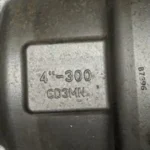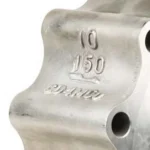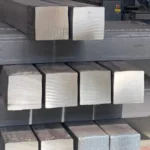
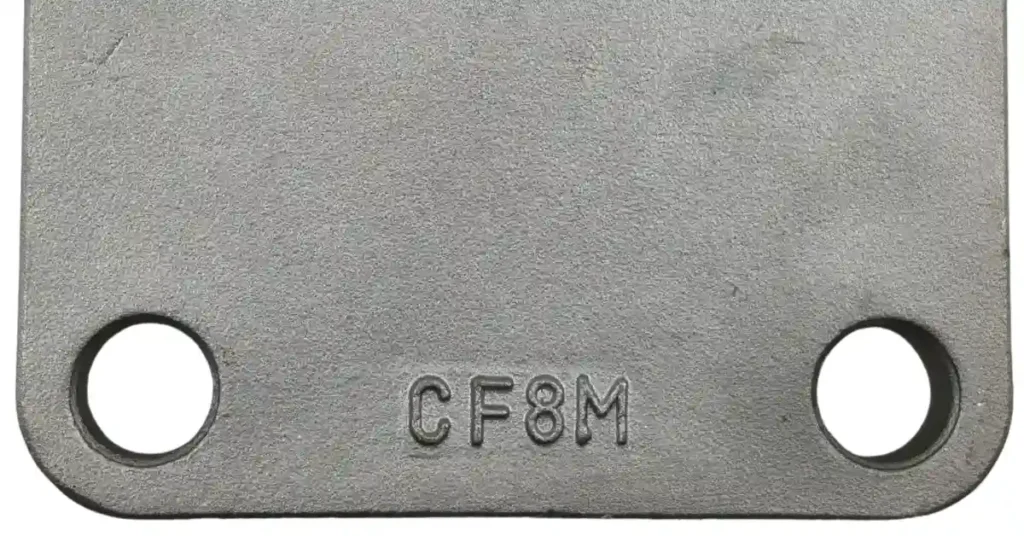
CF8M is an austenitic stainless steel casting grade produced in accordance with the ASTM A351 standard, and you can think of it as the cast counterpart to 316 stainless steel.
What distinguishes CF8M is its rare combination of excellent castability and superior corrosion resistance—attributes seldom achieved together in a single casting alloy.
What Does “CF8M” Mean?
- C means corrosion-resistant, it indicates the alloy is intended for corrosion-resistant service.
- F represents the alloy’s position on the iron-chromium-nickel (Fe-Cr-Ni) ternary diagram.
- 8 indicates the maximum carbon content is 0.08% (8 × 0.01%).
- M denotes the presence of molybdenum (Mo), which enhances resistance to pitting and crevice corrosion in chloride-bearing environments.
CF8M vs. 316 vs. CF8 vs. CF3M: What’s the Real Difference?
CF8M vs. 316
Chemically, CF8M and 316 are almost the same—both are Cr-Ni-Mo alloys. The real difference is how they are made.
- 316 is wrought: rolled or forged into bar, sheet, or plate. It is a machining material.
- CF8M is cast: molten metal poured into a mold. It is a shaping material.
During casting, CF8M picks up 5–20% delta(δ) ferrite to prevent cracking. That makes it slightly magnetic. Wrought 316 is not.
If you need a complex part, starting from 316 means machining away most of the metal. CF8M gives you the same corrosion resistance, but in one near-net shape, with less waste and lower cost.
CF8M vs. CF8
Both CF8 and CF8M are cast grades—the cast equivalents of 304 and 316, respectively. The difference is molybdenum. CF8 has none—fine for fresh water and mild service. CF8M contains 2–3% Mo, which acts like a shield against chlorides.
In seawater, salt spray, or chemical environments, CF8M resists pitting and corrosion where ordinary cast grades cannot. That single element makes it the reliable choice for your cast components in aggressive service.
CF8M vs. CF3M
CF8M max carbon is 0.08%; CF3M is 0.03% (cast 316L). The difference shows up during welding. Heat from welding (450–850°C) can cause carbon to form chromium carbides in CF8M, which reduces corrosion resistance along the weld.
If your casting part needs extensive welding and you cannot solution anneal afterward, choose CF3M. If welding is minimal or you can heat-treat, CF8M offers slightly higher strength and better value for the same performance.
Chemical Composition & Material Properties
Chemical Composition
The numbers behind the performance—here is what CF8M is made of.
| Element | Weight(%) |
| Carbon (C) | ≤ 0.08 |
| Manganese (Mn) | ≤ 1.5 |
| Silicon (Si) | ≤ 1.5 |
| Phosphorus (P) | ≤ 0.04 |
| Sulfur (S) | ≤ 0.04 |
| Chromium (Cr) | 18.0-21.0 |
| Nickel (Ni) | 9.0-12.0 |
| Molybdenum (Mo) | 2.0-3.0 |
| Iron (Fe) | Balance |
Material Properties
Here are the key properties of CF8M castings:
| Properties | Value |
| Tensile Strength (min) | 485MPa(70 ksi) |
| Yield Strength (min) | 205 MPa (30 ksi) |
| Elongation (min) | 30% |
| Hardness (Brinell) | 130-180 |
| Melting Range | 1370-1400℃ |
| Density | 7.98g/cm³ |
| Linear Shrinkage (Cast) | 1.8-2.2% |
CF8M Equivalent Material
Not all drawings call out CF8M by name. If your drawing references a different standard, use this table to match it to CF8M:
| Standard | Grade |
| ASTM(Cast) | A351 CF8M SS |
| UNS | J92900 |
| Wrought Equivalent | AISI 316 |
| DIN(Germany) | 1.4408 |
| JIS(Japan) | SCS14A |
| BS(Britain) | 316C12 |
Why Use CF8M for Your Custom Parts?
Advantages of Casting CF8M
CF8M is not just strong and corrosion-resistant—it is also a casting-friendly alloy. Here is why it works so well in the foundry:
- Excellent fluidity: CF8M flows easily into thin sections and complex cavities, so intricate internal passages fill cleanly without cold shuts or misruns.
- Controlled solidification: The solidification range of CF8M is narrow, which reduces segregation and promotes uniform mechanical properties throughout the casting.
- Good machinability: Once solution annealed, CF8M cuts cleanly and predictably—so your castings move through post-machining without excessive tool wear or scrap.
- Forgiving heat treatment: 1040°C minimum solution annealing temperature is easy to achieve consistently across different section thicknesses.
- Process versatility: Whether you need the fine detail of investment casting or the size capacity of sand casting, CF8M adapts—no single method required.
Casting Processes for CF8M Stainless Steel
At YTD Casting, we offer both investment and sand casting—and we match the process to your custom parts based on size, tolerance, and quantity.
Investment Casting(Silica Sol Casting)
For parts that demand tight tolerances and smooth surface finishes—small-to-medium valve trim, impellers, fittings. The silica sol shell produces fine detail and minimizes post-cast machining, which is especially valuable when working with CF8M’s good machinability.
Sand Casting
For larger components—pump casings, heavy valve bodies, structural parts—where size outweighs surface finish requirements. Sand casting gives you the same material integrity at lower tooling costs and shorter lead times for large pieces, and CF8M’s forgiving heat treatment ensures consistent properties even in heavy sections.
Common Applications of CF8M Castings
CF8M castings serve a wide range of industries where corrosion resistance and reliability are non-negotiable. Regardless of which casting method you choose, here are the most common applications:
Valves & Fittings
- Ball valves, check valves, gate valves, pipe fittings…
- CF8M resists pitting in chlorinated and acidic media, while castability allows complex internal flow paths.
Pumps & Impellers
- Pump casings, impellers, diffusers…
- CF8M withstands erosion-corrosion from slurries and abrasive fluids, and casts readily into hydrodynamic shapes.
Marine & Offshore
- Seawater pumps, deck hardware, subsea components…
- The molybdenum content of CF8M provides the chloride resistance needed for prolonged saltwater exposure.
Chemical Processing
- Reactor fittings, heat exchanger components, process piping…
- CF8M handles organic acids, caustic streams, and moderate sulfuric acid environments.
Food & Pharmaceutical
- Hygienic fittings, sanitary valves…
- The passive surface is easy to clean and resists corrosion from cleaning agents and product residues.
How We Control CF8M Casting Quality
Knowing where CF8M is used is one thing. Making sure it performs there is another. Here is how we ensure every CF8M casting meets your expectations.
- Chemical composition control: We verify each melt with an optical emission spectrometer before pouring—keeping Cr, Ni, and Mo locked within ASTM A351 limits.
- Solution annealing: Every CF8M casting is heated to 1040°C minimum and water-quenched, which dissolves chromium carbides and restores full corrosion resistance.
- Ferrite control: We monitor 5–20% delta ferrite—enough to prevent cracking, low enough to preserve corrosion resistance.
- Non-destructive testing (NDT): We use radiography (RT) to detect internal porosity and cracks, and penetrant testing (PT) to find surface defects—so no flawed casting leaves our shop.
Conclusion
CF8M offers a rare combination of castability and corrosion resistance—which is why it is specified for demanding applications. But material alone is not enough. At YTD Casting, we deliver more than the alloy—we deliver reliability. When you are ready for your next custom casting, we are ready to help.
FAQs
Is CF8M magnetic?
Yes, slightly. Casting introduces 5–20% ferrite, which is magnetic.
Can CF8M be welded?
Yes. Use low heat input and 316L filler metal to avoid sensitization and preserve corrosion resistance.
What does the "M" in CF8M stand for?
Molybdenum. It enhances resistance to pitting and crevice corrosion in chloride environments.
Is CF8M the same as 316 stainless steel?
Chemically similar, but CF8M is cast; 316 is wrought (rolled or forged).
Does CF8M rust?
It is highly corrosion-resistant, but not 100% rust-proof—it can still develop rust under extreme conditions.
What is the difference between CF8M and CF3M?
CF3M has lower carbon (≤0.03% vs. 0.08%), making it more weld-resistant to sensitization.
What is the service temperature range for CF8M?
-254°C to 538°C. It performs well in both cryogenic and high-temperature environments.
What is the difference between CF8M and CF8?
CF8 (cast 304) has no molybdenum; CF8M (cast 316) contains 2–3% Mo for superior chloride resistance.