High pressure die casting, commonly called HPDC, is one of the fastest and most repeatable die casting methods for producing complex metal parts in large quantities. The process injects molten metal into a hardened steel die at high speed and pressure, making it possible to form thin walls, detailed features, smooth surfaces, and consistent dimensions within short production cycles.
For buyers, however, selecting HPDC requires more than comparing unit prices. Part geometry, alloy selection, tooling investment, annual demand, machining requirements, and acceptable porosity must be considered together. Poor decisions at the design or tooling stage can increase scrap, leakage risk, secondary machining, and total production cost.
This guide explains how high pressure die casting works, where it provides the most value, which design and quality issues matter, and what buyers should evaluate before requesting a quote.
What Is High Pressure Die Casting?
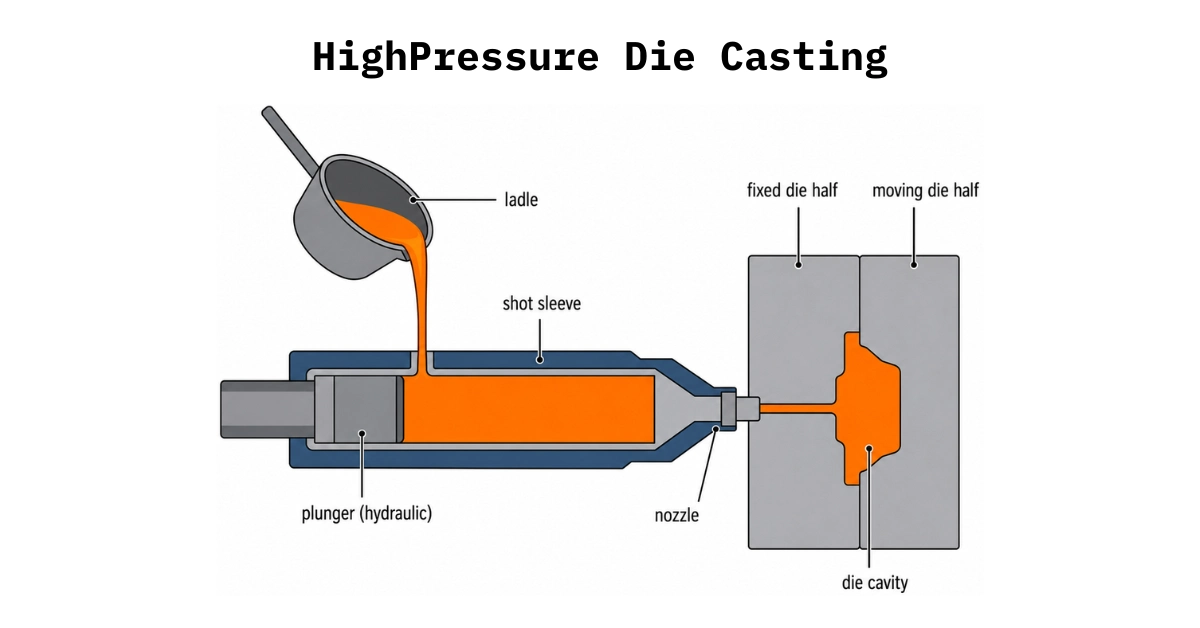
High pressure die casting is a manufacturing process in which molten non-ferrous metal is injected into a reusable steel die at high speed and pressure. The metal fills the die cavity, solidifies under pressure, and is then ejected as a near-net-shape component. HPDC is mainly used for aluminum, zinc, and magnesium parts that require consistent dimensions, thin walls, detailed features, and high production volumes.
The speed of injection is critical because the molten metal must reach every part of the cavity before it begins to solidify. The applied pressure helps the metal reproduce fine die details and supports dimensional consistency during solidification. However, excessive speed or poorly controlled flow can trap air and create porosity.
This makes HPDC more than a machine-driven process. Casting quality also depends on alloy condition, die temperature, gating, venting, cooling, and process control. Buyers should therefore assess both the supplier’s equipment and its ability to control the complete die casting process.
How Does the High Pressure Die Casting Process Work?
The high pressure die casting process follows a controlled cycle in which die preparation, metal injection, cooling, and part removal must remain consistent from one shot to the next.
Die Preparation and Clamping
The steel die is cleaned, lubricated, and brought to the required operating temperature before its two halves are closed. The machine then applies enough clamping force to keep the die shut during injection. Insufficient clamping force can allow molten metal to escape along the parting line and create excessive flash.
Molten Metal Injection
A measured quantity of molten metal enters the injection system and is forced through the runner and gate into the die cavity. The initial movement is controlled to reduce air entrapment, followed by a faster injection stage that fills thin sections before the metal starts to solidify. Injection speed, metal temperature, gate design, and venting must be balanced to avoid incomplete filling or internal porosity.
Intensification and Solidification
After the cavity fills, additional pressure is applied while the casting cools. This intensification stage helps reproduce fine die features and reduces some solidification shrinkage. Cooling channels inside the die control heat removal, cycle time, and dimensional stability.
Ejection, Trimming, and Finishing
Once the part is strong enough to retain its shape, the die opens and ejector pins remove the casting. Runners, gates, flash, and overflows are trimmed away. The part may then require CNC machining, deburring, leak testing, surface finishing, or dimensional inspection, depending on its functional requirements.
Hot Chamber vs Cold Chamber High Pressure Die Casting
High pressure die casting machines use either a hot chamber or cold chamber injection system. Buyers need to understand the difference because the machine type affects alloy compatibility, part size, cycle time, tooling requirements, and production cost. The North American Die Casting Association also identifies hot chamber and cold chamber casting as established variations of the die casting process.
Hot Chamber HPDC
In hot chamber die casting, the injection mechanism remains connected to a furnace containing molten metal. Metal is drawn into the injection system and forced directly into the die, resulting in short transfer times and fast production cycles.
This process is commonly used for zinc and selected magnesium alloys because they melt at relatively low temperatures and are less aggressive toward the submerged injection components. It is often the practical choice for small or medium-sized components requiring thin walls, detailed features, and very high production quantities.
Cold Chamber HPDC
In cold chamber die casting, molten metal is held in a separate furnace and transferred into the shot sleeve for each cycle. A plunger then injects it into the die. This process is normally used for aluminum alloys because molten aluminum can damage the submerged components used in hot chamber machines.
Cold chamber cycles are generally longer, but the process supports larger components and alloys with higher processing temperatures. When requesting a quotation, buyers should identify the required alloy, annual quantity, part weight, wall thickness, mechanical requirements, and critical dimensions. The supplier can then confirm whether hot chamber die casting or cold chamber die casting is suitable and whether the available machine has adequate shot capacity and clamping force.
Selecting a machine only because it offers the lowest quoted cycle cost can create quality problems if it is poorly matched to the alloy or projected casting area. Alloy performance and part requirements should therefore determine the process, not the machine that happens to be available.
Materials Used in High Pressure Die Casting
Material selection affects part weight, strength, corrosion resistance, thermal performance, surface finish, machining cost, and the type of HPDC machine required. Buyers should therefore select the alloy according to service conditions rather than choosing the lowest material price.
Aluminum Alloys
Aluminum is the most widely used material for cold chamber HPDC. It offers a useful balance of low weight, strength, corrosion resistance, thermal conductivity, and dimensional stability. Aluminum alloys are commonly selected for automotive housings, electronic enclosures, heat-management components, brackets, and industrial parts.
When ordering aluminum die casting, buyers should specify operating temperature, load conditions, corrosion exposure, sealing requirements, and any surfaces requiring machining. These factors influence the alloy grade and acceptable porosity level.
Zinc Alloys
Zinc alloys provide excellent fluidity, allowing very thin walls, fine details, and small features to be cast with high repeatability. They also support fast hot chamber production cycles and can produce surfaces suitable for plating or decorative finishing.
Zinc is practical for smaller components where detail, dimensional accuracy, and surface appearance matter more than minimum weight.
Magnesium Alloys
Magnesium offers the lowest density of the three common HPDC materials and is suitable for lightweight housings, structural covers, and portable equipment. It also provides good machinability and electromagnetic shielding.
However, alloy availability, corrosion protection, tooling experience, and finishing requirements should be confirmed before sourcing. The best choice depends on the complete performance requirement, not weight alone.
Advantages and Limitations of High Pressure Die Casting
High pressure die casting can reduce unit cost and secondary processing when the part design, alloy, tooling, and production volume are well matched. Buyers should assess its benefits together with its technical and commercial limitations before committing to tooling.
Production Speed and Repeatability
HPDC uses reusable steel dies and short automated cycles, making it suitable for medium- and high-volume production. Once the process is stabilized, it can deliver consistent dimensions, surface quality, and part weight across large batches.
This repeatability is important when ordering components for automated assembly, interchangeable products, or long-term supply programs. However, buyers should confirm that the supplier controls die temperature, injection parameters, alloy condition, and dimensional inspection throughout production rather than relying only on initial samples.
Thin Walls and Complex Geometries
The rapid injection of molten metal allows HPDC to form thin walls, ribs, bosses, mounting features, lettering, and complex external shapes in a single casting. Combining several features can reduce assembly work, machining, and the number of separate components.
During the die casting design review, buyers should ask whether wall thicknesses are realistic, whether sharp transitions can be softened, and whether features can be cast directly without increasing defect risk.
Tooling Cost, Volume, and Porosity Limitations
HPDC dies require a significant upfront investment, so the process is generally more economical when tooling cost can be spread across sufficient production volume. Low annual quantities, frequent design changes, or uncertain demand may make gravity casting, sand casting, or machining more practical.
Gas entrapment and solidification shrinkage can also create internal porosity. This may affect pressure-tight parts, heavily machined areas, welding, and some heat-treatment requirements. Buyers should identify leak-tight surfaces, structural zones, machining depths, and inspection criteria before tooling is approved. Where porosity is a critical risk, the supplier may recommend improved venting, vacuum assistance, local pressure control, leak testing, or a different casting process.
Common HPDC Defects and Quality Controls
HPDC defects often originate from the interaction between metal temperature, injection speed, die design, venting, cooling, and alloy condition. Buyers should define which defects are unacceptable for the intended application before tooling approval because a cosmetic enclosure, a machined housing, and a pressure-tight component require different inspection standards.
Gas and Shrinkage Porosity
Gas porosity forms when air or gases become trapped during cavity filling, while shrinkage porosity develops when solidifying metal is not adequately fed. Both may remain hidden until machining exposes cavities or leak testing identifies a failure.
This risk is especially important when ordering hydraulic housings, pump components, sealed enclosures, or parts with deeply machined surfaces. The drawing and RFQ should identify pressure-tight areas, machining depths, sealing faces, and any restrictions on impregnation. The supplier can then assess whether improved venting, vacuum assistance, local cooling, or another process is required.
Filling and Die-Related Defects
Cold shuts occur when separate metal flows meet without fully bonding, while short fills develop when the metal solidifies before the cavity is completely filled. Flow marks may affect appearance, and excessive flash can indicate parting-line wear, poor die closure, or inadequate clamping force. Soldering occurs when molten metal adheres to the die surface, causing rough areas and increasing maintenance requirements.
Buyers should not judge these problems only from photographs. Their importance depends on whether the affected area is visible, machined, loaded, coated, or used for sealing.
Process Monitoring and Inspection
A capable supplier should control shot parameters, metal and die temperatures, cooling time, lubrication, alloy composition, and die condition throughout production. Inspection may include dimensional measurement, visual checks, X-ray examination, leak testing, chemical analysis, and mechanical testing, depending on the part’s risk.
The purchase specification should define critical dimensions, sampling frequency, defect acceptance criteria, inspection records, and required reports. Clear requirements reduce disputes and prevent unsuitable parts from reaching assembly.
Design Guidelines for High Pressure Die Cast Parts
Design choices made before tooling directly affect filling, porosity, die life, machining cost, and rejection rates. Buyers should therefore request a DFM review before approving the die.
Wall thickness should remain reasonably uniform, with gradual transitions between thin and thick areas. Heavy bosses should be cored or supported with ribs to reduce shrinkage, while draft angles and radii help the part eject cleanly and improve metal flow.
The buyer should identify sealing faces, cosmetic surfaces, critical dimensions, machining depths, and restricted ejector-mark locations. The supplier can then position gates, vents, overflows, and machining allowances around these requirements. ISO 8062-3:2023 may be used when agreeing casting tolerances and machining allowances, but the drawing should still define the required tolerance class, datums, and inspection method.
Conclusion
High pressure die casting is a strong option for complex, repeatable metal parts when production volume can justify permanent tooling. Its success depends on selecting the right alloy, matching the part to the machine, controlling porosity, and defining machining and inspection requirements before tooling begins.
A useful RFQ should include the 3D model, technical drawing, alloy, annual quantity, critical dimensions, surface requirements, operating conditions, and required inspection records. This allows the foundry to identify risks early and recommend the most economical production route.
YTD Foundry can review your design, tooling requirements, machining needs, and quality expectations before production. Submit your drawings for a DFM review and quotation.
FAQs
Is high pressure die casting suitable for low-volume production?
HPDC is generally most economical for medium- or high-volume orders because the initial steel die requires a substantial investment. For prototypes, uncertain demand, or short production runs, CNC machining, sand casting, or gravity die casting may offer a lower total cost. Buyers should compare tooling cost, expected lifetime demand, unit price, and future design changes rather than evaluating the quoted part price alone.
Can high pressure die cast parts be pressure-tight?
They can be, but pressure tightness should not be assumed. Gas or shrinkage porosity may become a leakage path, particularly after machining. Buyers should identify sealing faces, test pressure, acceptable leakage rate, machining depth, and inspection method in the RFQ. Vacuum assistance, optimized venting, leak testing, or impregnation may be required for demanding applications.
What is the difference between high pressure and low pressure die casting?
HPDC injects metal rapidly and is normally preferred for thin, complex parts produced in large quantities. Low pressure die casting fills the die more gradually, offers lower production rates, and may be preferred where lower gas entrapment or different mechanical requirements are more important than cycle speed. The correct choice depends on part geometry, quality requirements, production volume, and allowable tooling cost.