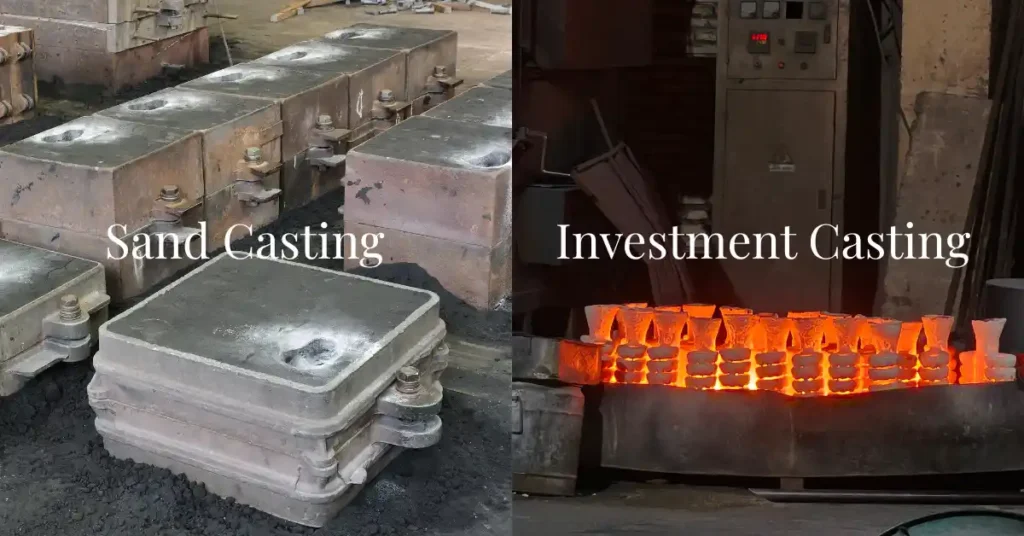
Sand casting shapes molten metal in a sand mold. Investment casting usually shapes it in a ceramic shell built around a wax pattern. That difference in mold making explains much of the choice: sand casting offers a wide size range and can be economical for relatively simple shapes, while investment casting usually reproduces finer detail, smoother surfaces, and more accurate dimensions before machining.
For a particular part, the useful question is how much those differences matter. A large housing with only a few surfaces to machine presents a different problem from a small component covered in thin ribs and curved features. To understand why, start with how each process creates the empty space that the metal will fill.
How Sand Casting and Investment Casting Work
The Sand Casting Process
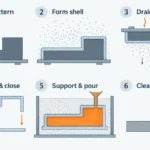
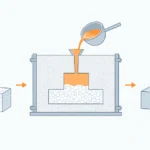
In conventional sand casting, a pattern is a physical model of the shape to be cast. Prepared sand is packed around it, often in two mold halves. The pattern is withdrawn, leaving its shape in the sand. The halves are brought together, and molten metal enters through prepared channels.
Once the metal has solidified, the sand mold is broken apart to release the casting. The pattern can be used to make another mold, but the mold that received the metal has served its purpose. Recovering and reusing the sand does not preserve the original cavity.
The need to remove the pattern affects the design. Surfaces along the withdrawal direction often need a slight taper, called draft, so the pattern comes out without damaging the sand. Where the mold halves meet, the casting may show a line or a small mismatch.
The Investment Casting Process
Investment casting, often called lost-wax casting, takes a different route. Wax is usually injected into a metal die to make a pattern. Several wax patterns can be attached to a common wax stem, forming a branching assembly called a tree.
The assembly is coated with a liquid ceramic mixture and heat-resistant grains. Coating and drying are repeated until a strong shell surrounds it. The wax is removed, and the shell is fired and prepared for pouring. Metal fills the space left by the stem and flows into the individual part cavities. After solidification, the ceramic is broken away and the castings are cut from the metal stem. The Investment Casting Institute illustrates this sequence in its process guide.
The wax pattern is sacrificed, so it does not have to be pulled out of the ceramic shell intact. This gives more freedom in the shape of the casting. The metal die used to produce wax patterns can be reused; each wax pattern and pouring shell must be made again.
Sand Casting vs Investment Casting: Comparison Table
The table below describes general tendencies. Sand casting includes several molding methods, so the exact comparison depends on which one is being considered.
| What matters | Sand casting | Investment casting |
|---|---|---|
| Fine detail and thin sections | Capability varies with the molding method; conventional routes generally favor less delicate features. | Usually better suited to small details and thin, intricate features. |
| Surface and dimensions before machining | Usually a coarser surface and wider dimensional variation; results vary by molding method. | Generally smoother surfaces and tighter dimensional control. |
| Part size | A broad range, including very large and heavy castings. | Commonly small to medium parts; larger work needs suitable facilities. |
| Initial tooling | A simple pattern can keep initial cost low; complex cores change the picture. | A wax-injection die adds initial cost; printed patterns offer another route. |
| Work after casting | Machining may provide the final accuracy on selected surfaces. | More features may be usable as cast, but precision surfaces can still need machining. |
| Production quantity | Can serve one-off work through high-volume production. | Can serve small runs through repeat production, using different pattern and production arrangements. |
For example, green sand uses a moist clay-bonded mixture, while no-bake sand hardens with a chemical binder. Shell molding uses resin-coated sand cured against a heated pattern. These differences affect surface quality, dimensional consistency, and tooling cost. The Steel Founders’ Society of America’s dimensional guide compares these steel-casting routes separately. Its comparison is a useful reminder that “sand cast” does not describe one fixed level of precision.
Shell molding also needs a distinction here: its resin-bonded sand shell is different from the ceramic shell formed around a wax pattern in investment casting.
Shape Complexity, Surface Finish, and Dimensional Accuracy
Complex Shapes and Thin Walls
Small lettering, narrow ribs, and curved features show why investment casting is attractive. The ceramic shell can reproduce the wax pattern closely, and the shell is preheated before pouring to help the metal fill the cavity. This is useful when the desired shape would otherwise need considerable cutting or grinding after casting.
For a sense of thickness, SFSA’s steel-casting design guidance suggests about 6 mm as a minimum section thickness for conventional steel-casting techniques and describes 1.5 mm walls as common in investment castings. These are references for steel-casting design; the achievable wall thickness still depends on the particular part and process.
Thin walls have to fill before the metal freezes. A short, thin feature near the metal entry may fill successfully while a long wall of the same thickness does not. Alloy choice and pouring conditions also change the result.
Investment casting can avoid some draft needed to withdraw a pattern from sand. However, the wax pattern still has to be made and released from its tooling. That earlier step may require a split die, removable pieces, or a different pattern-making approach.
A continuous ceramic shell also avoids the joint between conventional sand-mold halves. It does not guarantee a completely unmarked casting: excess wax at a die joint can leave a corresponding mark in the metal if it is not removed. The ICI’s defect atlas distinguishes these wax parting-line indications from fins caused by a cracked shell.
Internal Cavities and Cores
A hollow casting needs a way to keep metal out of the space that should remain hollow. In sand casting, a separate sand core can occupy that space. Metal solidifies around the core, which is removed afterward to reveal the passage.
Investment casting can also use cores. Ceramic cores can remain during pouring and be removed afterward. Soluble cores serve an earlier purpose: they help form a hollow wax pattern and are dissolved before the ceramic shell is built.
For either route, the passage must be manufacturable and cleanable. A long, narrow cavity raises questions about supporting the core, keeping it in position, and removing it. “Complex internal geometry” is therefore a reason to examine the core design, rather than an automatic reason to rule out sand casting.
Surface Finish, Tolerances, and Machining
As cast describes the shape and dimensions produced by casting, before machining brings selected features to their final size. Investment casting generally gets closer to the intended finished shape, which is why it is often described as a near-net-shape process.
A conventional sand-cast surface often has a more noticeable granular texture. Investment casting generally produces a finer surface, which can reduce the work needed to achieve the desired appearance. But texture and dimensional accuracy are different: a face can feel smooth and still need machining to make it flat enough to meet another component.
Dimensional tolerance is the permitted variation from a specified size. It needs to suit the feature being measured. A small hole and the overall length of a large housing do not share one meaningful “process tolerance,” and alloy, shape, and production control affect what can be achieved.
Consider a housing with a round opening for a shaft. Its outside may work perfectly well with a cast surface, while the opening needs machining so the shaft fits correctly. Either casting process could supply the housing. The important comparison is what each leaves the machine shop to do.
If investment casting allows several surfaces to remain as cast, its extra mold-making work may pay for itself. If both versions still need essentially the same machining, that advantage may be smaller. A smoother-looking casting alone does not establish the final fit.
Part Size, Weight, and Alloy Options
Sand casting is a common starting point for large, heavy components because sand molds can accommodate a very broad range of sizes. It also makes small parts. Investment casting is more commonly associated with smaller, detailed components, although specialist foundries produce much larger work.
The American MetalCasting Consortium’s process overview gives a sense of scale: it describes 50,000 lb pit-molded iron castings, about 22.7 metric tonnes, and notes investment castings above 500 lb, about 227 kg, at specialist foundries. These are size references for different applications, rather than maximum weights for the two processes.
A foundry needs to handle the pattern, mold, molten metal, and finished casting at the required size. Its equipment and experience determine the practical limit.
Material names do not divide the processes neatly either. Both have applications in ferrous alloys, which are iron-based, and nonferrous alloys. Aluminum and stainless steel, for example, are not exclusive to one route.
The useful question is whether a particular foundry can produce the required alloy in the intended shape and condition. An alloy being castable by a process does not mean every foundry using that process can supply it.
Tooling Costs and Cost per Finished Part
For a relatively simple part, sand casting often begins with a cost advantage. A straightforward pattern can be economical, and a conventional sand mold may involve less preparation than a layered ceramic shell. That advantage can shrink when the part needs complicated cores, extensive finishing, or substantial machining.
Investment casting adds work in wax production, assembly, coating, drying, and shell removal. Its economic benefit comes when that work produces features that would be expensive to create later.
Imagine two possible designs. A bulky cover needs a flat mounting face and drilled holes, but its other surfaces are uncritical. Finer casting detail may contribute little. A smaller component has several curved features that are difficult to reach with cutting tools. Reproducing those features during casting could remove a substantial manufacturing problem.
The comparison should reach the same endpoint: an acceptable, finished part. Include tooling spread over the expected quantity, the casting itself, machining and finishing, required heat treatment, inspection, and losses from rejected parts. Comparing a rough casting with a fully machined component tells you little about which route is cheaper.
A case in the ICI’s cost-reduction paper makes the effect of machining more concrete. An Inconel impeller was changed from machining out of solid stock to investment casting, with a reported 45% reduction in unit cost. The saving was measured against machining from solid, so it is not a sand-versus-investment cost comparison. It illustrates how avoiding substantial material removal can change the economics of a particular part.
How Production Volume Affects Cost per Part
Tooling paid for once becomes a smaller cost per part as more acceptable parts are made. But that does not create a fixed quantity above which investment casting always wins. Green-sand molding can support high production rates, while investment casting can produce multiple parts on each tree.
Small batches are also possible with both. Printed wax or other suitable expendable patterns can avoid a conventional wax-injection die. Printed sand molds and cores can bypass corresponding pattern or core-box tooling. Those alternatives exchange some tooling investment for the recurring cost of printing, so they deserve comparison when the design is changing or only a few parts are needed.
Production Lead Time
Investment casting’s repeated coating and drying stages take time. An established sand-molding operation may prepare molds more quickly, especially when its tooling is already available.
For a new part, however, tooling preparation, sample approval, production scheduling, and finishing can matter more than mold-making speed alone. A printed pattern might shorten development while leaving the later casting stages intact. Distinguish the time to obtain the first acceptable samples from the delivery time for repeat orders.
Casting Strength, Defects, and Quality Testing
Greater dimensional precision does not automatically mean greater strength. The alloy, the way the metal solidifies, and any heat treatment affect the material’s properties. Defects can also matter even when the casting looks smooth and measures correctly.
For example, as steel solidifies and contracts, it needs a supply of liquid metal to compensate. If that supply is cut off too early, a cavity can remain inside. Choosing investment casting does not remove the need to control this behavior. SFSA explains the relationship in its steel-casting design guidance.
Different checks answer different questions. Dimensional inspection checks size and shape. Suitable surface inspections can reveal cracks, while radiography or ultrasound can investigate internal discontinuities. Mechanical tests assess specified material properties. SFSA’s casting specifications guide treats these as distinct requirements. The methods, areas checked, and acceptance criteria should follow the part’s use.
When to Choose Sand Casting or Investment Casting
Start by identifying what the part must do and which features make it difficult to manufacture.
- Consider sand casting first when the part is large, the overall shape is relatively straightforward, and selected surfaces can be machined to provide the required fit. Check the specific sand-molding route before judging its precision or cost.
- Consider investment casting first when fine details, thin features, or difficult curves would otherwise require substantial machining or assembly work. Establish which surfaces can actually remain as cast.
- Compare both when either can meet the design. Use the same alloy, finished dimensions, quantity, inspection requirements, and delivery scope so the comparison answers the same question.
A part can contain reasons to favor both processes. A large body may suggest sand casting, while a small internal feature creates a difficult core or machining problem. Working through that particular feature is more useful than choosing from size alone.
The mold-making method explains each process’s strengths. The final choice comes from how those strengths help produce the required part, and how much work remains afterward.
FAQs
Can you switch an existing part from sand casting to investment casting?
Sometimes, especially if finer cast detail could reduce machining or simplify the part. The conversion needs a fresh review of tooling, shrinkage allowances, wall sections, and surfaces that still require machining. Existing sand-casting tooling does not simply become investment-casting tooling. Samples should confirm the required dimensions and performance before the new route is approved.