Sourcing investment casting in China can give buyers access to tooling, casting, machining, heat treatment, finishing, and inspection within one supply chain. But two suppliers using the same words—“investment casting manufacturer”—may offer very different processes and levels of control.
The useful comparison is not China versus another country in the abstract. It is whether a particular foundry can make your alloy, geometry, tolerances, and finished part consistently at a sensible total cost.
What Buyers Usually Mean by “Investment Casting in China”
Someone searching for investment casting in China is usually past the stage of asking what lost-wax casting is.
They are more likely to be comparing suppliers, checking whether China is suitable for a new project, or trying to understand why several Chinese quotations look very different.
That changes what matters.
The basic investment casting process is only part of the decision. Buyers also need to understand who makes the tooling, which shell process is used, whether the foundry has experience with the specified alloy, where machining and heat treatment happen, and how the final part will be inspected.
The Investment Casting Institute maintains a searchable global foundry directory that can be filtered by location, alloy, casting method, and services. China appears alongside other major casting regions, but even within one country, foundry capabilities vary substantially.
A country is therefore only the first filter. The actual manufacturing route matters much more.
Direct Foundry, Manufacturer, or Trading Company: Know Who Will Make the Parts
Chinese investment casting suppliers do not all operate in the same way.
Some companies operate their own wax room, shell line, melting equipment, and finishing operations. Others manage projects through one or more partner factories. Some are mainly commercial or sourcing organizations.
Any of these models can work if responsibilities are clear.
Problems start when the buyer assumes a process is in-house when it is not, or when several suppliers are involved but nobody has clear responsibility for the finished part.
For an investment casting project, we would want to know who actually controls the steps that matter most: tooling, wax pattern production, shell building, melting and pouring, heat treatment, CNC machining, inspection, and any special surface treatment.
Outsourcing itself is not the issue. Many specialist processes are sensibly handled by qualified partners.
The important point is visibility.
If a part fails a dimensional requirement after heat treatment and machining, the customer should not have to discover for the first time that three separate factories were involved and nobody owns the complete process.
Silica Sol and Water Glass Investment Casting Can Produce Very Different Quotations
One difference buyers encounter frequently in China is silica sol versus water glass investment casting.
Both are lost-wax processes, but they are not simply two names for the same shell system.
Water glass casting has traditionally been used for cost-sensitive steel castings where the finest surface finish and tightest investment-casting accuracy are not required.
Silica sol investment casting is generally the stronger option when a part needs better surface quality, finer detail, tighter dimensional consistency, or more demanding materials.
This can explain a quotation gap that otherwise looks difficult to understand.
If one supplier has quoted a water glass process and another has quoted silica sol, the two prices are not necessarily based on an equivalent production route.
At YTD, our core in-house process is silica sol investment casting. We use it for the type of precision components where customers are choosing investment casting specifically for near-net geometry, surface quality, and material flexibility.
We explain the process differences in more detail in our guide to silica sol vs. water glass casting.
Verify the Exact Alloy, Not Just the Material Family
A supplier saying it casts “stainless steel” tells you very little about whether it can make your part.
CF8M, CA6NM, duplex stainless steel, and precipitation-hardening stainless grades all fall under the stainless label, but they do not have the same melting, solidification, heat-treatment, or mechanical-property requirements.
The same applies to alloy steel and nickel-based superalloys.
When we review a new project, the exact casting grade matters much more than a broad description such as stainless, steel, or nickel alloy.
The drawing should identify the required grade and, where applicable, the governing ASTM, EN, GB, AMS, or customer specification.
From there, the foundry can determine the appropriate melting route, heat treatment, chemistry control, and testing.
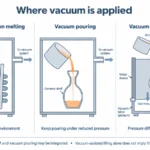
For high-performance alloys, another question becomes important: does the material need to be melted under vacuum?
Certain nickel-, cobalt-, and iron-based superalloys benefit from or require much tighter atmospheric control than ordinary air-melt steels. A supplier that regularly pours conventional stainless steel does not automatically have the same capability for these alloys.
Our Investment Casting Materials Guide goes deeper into how alloy choice affects the casting route.
Part Weight Alone Does Not Tell You Whether a Foundry Can Make the Casting
Foundry websites often publish maximum casting weights.
Those numbers are useful, but customers should not treat them as unconditional part limits.
A compact 20 kg component is a very different casting problem from a long, thin 20 kg component with isolated heavy sections and difficult feeding.
The foundry also has to pour more than the finished part weight.
The sprue, gates, runners, and feeding system all consume molten metal. For small parts grouped on a tree, this non-product metal may even outweigh the castings themselves. For a large part poured individually, the casting can make up most of the total pour.
That is why furnace capacity, pour weight, and finished casting weight are different numbers.
Geometry, wall thickness, tree layout, feeding, shell handling, and available pouring equipment all affect the practical limit.
We normally need the 3D model before we can judge a large or difficult investment casting properly. A capability table can tell you whether a project is broadly in range; the drawing tells us whether it is actually castable.
A Good China Investment Casting Quote Should Cover the Same Finished Part
A common sourcing mistake is comparing quotations that do not include the same manufacturing scope.
One supplier may quote a raw casting after cut-off.
Another may include heat treatment and machining.
A third may include machining, passivation, dimensional reports, special packaging, and delivery terms.
The unit prices may be very different even though none of the suppliers has actually quoted the same product.
Before comparing price, make sure the suppliers are working from the same:
- drawing and revision;
- material grade;
- annual and order quantity;
- tooling scope;
- heat-treatment condition;
- machining requirements;
- inspection requirements;
- surface treatment;
- delivery condition.
This is one place where a checklist is useful because every missing item can change the quotation materially.
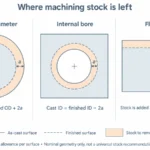
For many of our projects, the most practical route is to cast the complex near-net geometry first and then CNC machine only the bores, threads, sealing surfaces, datums, or mating features that truly require machining-level precision.
That makes more sense than comparing raw casting prices if the customer ultimately needs a finished component ready for assembly.
Tooling and First Articles Matter More Than the Lowest Mold Price
Investment casting quality begins before metal is poured.
The wax tool determines the starting geometry of every production pattern, so tooling decisions affect dimensional consistency throughout the program.
A low tooling price is attractive, but it matters less if the tool repeatedly produces distorted wax patterns, excessive flash, difficult ejection, or dimensions that require repeated correction later.
Before tooling starts, the foundry should review shrinkage, parting structure, machining allowance, wax removal, cores, gating, and other manufacturing issues.
For suitable difficult parts, casting simulation can also be used to examine filling and solidification before the process is finalized.
The next important stage is the first article.
A first casting tells us much more than the CAD model alone. It shows how the real combination of tooling, wax, ceramic shell, alloy, heat treatment, and machining behaves.
If dimensions need adjustment, this is the right time to make those changes—not after several hundred production pieces have been cast.
For a new supplier or a demanding component, first-article approval is one of the simplest ways to reduce sourcing risk.
ISO 9001 Is Useful, but the Casting Still Needs Its Own Inspection Plan
Quality certification is worth checking, but it should not replace part-specific evidence.
ISO itself makes this clear: ISO 9001 certification relates to the supplier’s quality-management system and should not be treated as a declaration that an individual product conforms to its specification. ISO’s guidance on ISO 9001 in the supply chain makes that distinction explicitly.
For a casting project, inspection needs to match the drawing and application.
A typical project may require chemistry verification, dimensional inspection, hardness, mechanical testing, penetrant testing, radiography, pressure testing, or other checks. Not every part needs all of them.
The point is to agree on what must be demonstrated before production begins.
Traceability matters too.
If the casting is supplied with a material certificate, the supplier should be able to connect that certificate to the actual heat or production lot from which the parts were made.
A certificate without that link is much less useful.
Factory Visits and Video Audits Should Follow the Actual Production Route
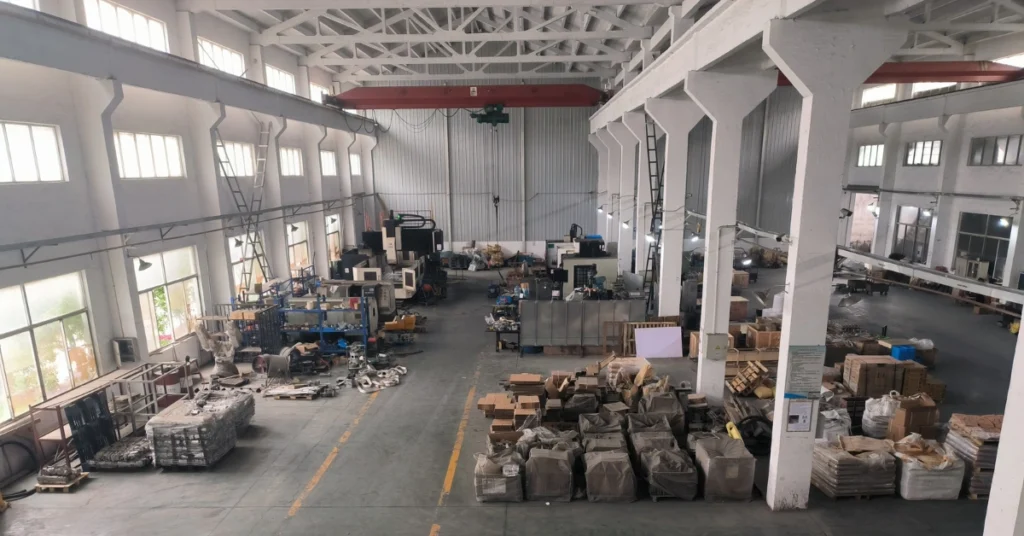
A factory visit can be valuable, but walking through a workshop and counting machines does not tell you very much on its own.
For an investment casting project, follow the part.
Look at where the wax patterns are made. See how they are inspected and assembled. Understand how ceramic shells are built and dried. Identify the furnaces that will melt the specified alloy. Then follow the route through cut-off, heat treatment, machining, and inspection.
This is also a useful way to separate genuine process capability from a capability list assembled from several unrelated partner factories.
If some operations are outsourced, ask where they go and how quality is controlled.
The objective is not to demand that everything happen under one roof.
It is to understand the real production chain before there is a quality problem.
When Sourcing Investment Castings From China Makes Sense
China can be particularly attractive when a component needs several manufacturing operations after casting.
A stainless steel housing, for example, may need tooling, casting, heat treatment, CNC machining, passivation, inspection, and export packaging.
Coordinating these operations through one responsible supplier can be easier than buying a raw casting and moving it through several separate vendors.
Repeated production also makes the effort spent on tooling development, first articles, and supplier qualification more worthwhile.
China is less automatically attractive for every project.
If only a few simple pieces are required urgently, tooling and international shipping can outweigh any manufacturing advantage. If the drawing is changing every few weeks, investing in production tooling may be premature regardless of country.
The better comparison is total project cost and effort: tooling, unit price, secondary operations, quality control, freight, lead time, and the amount of supplier management required.
A lower casting price does not always produce a lower finished-part cost.
What We Need to Quote an Investment Casting Project
The better the RFQ, the more useful the quotation.
For most new parts, we prefer to receive both a 3D model and a 2D drawing.
The 3D model tells us what the component looks like. The drawing tells us what actually matters: material, critical tolerances, datums, heat treatment, surface requirements, inspection notes, and which dimensions will be machined.
Expected quantity also matters because tooling and production decisions change between a prototype program and stable repeated production.
If you only have an existing component, reverse engineering can be used to create the geometry before tooling begins.
What we do not need is a drawing covered in unnecessarily tight tolerances simply because the designer was unsure what investment casting can hold.
If a dimension can remain as cast, it often should. Where machining is necessary, we can build that into the casting and tooling strategy from the beginning.
How We Handle Investment Casting Projects at YTD
Investment casting is our core in-house casting process.
A new project usually begins with the drawing. We review the alloy, geometry, wall thickness, tolerances, machining requirements, expected quantity, and any areas that may create filling or solidification problems.
From there, tooling, wax patterns, tree assembly, silica-sol shell building, casting, heat treatment, CNC machining, and inspection can be planned as one manufacturing route rather than as isolated purchasing steps.
For suitable alloys, we also have vacuum-melting capability. For difficult geometries, casting simulation can be used during tooling and process development to study filling, solidification, hot spots, and gating before the production route is finalized.
Standard blasting, polishing, and post-processing can be handled within our normal workflow. When a project needs a specialized surface treatment outside our core in-house processes, we coordinate it through a qualified partner and keep responsibility for the finished requirement clear.
We take the same approach to process selection. If a drawing is better suited to sand casting or die casting rather than investment casting, those projects can be supported through specialized partner foundries instead of forcing the component into our in-house process.
For us, “one-stop” should not mean pretending every manufacturing process happens inside the same building. It means giving the customer one clear production route and one accountable point of responsibility.
Final Thoughts
Sourcing investment casting in China works best when the supplier is evaluated as a manufacturing partner rather than simply as a low-cost source.
Start with the alloy, geometry, tolerances, and finished condition of the part. Then understand who controls tooling, casting, machining, heat treatment, and inspection.
A clear production route, good first-article validation, and transparent responsibility usually matter more than the lowest number on the quotation.
FAQs
Is Investment Casting Cheaper in China?
It can be, but there is no reliable percentage. Alloy, geometry, tooling, production volume, machining, heat treatment, inspection, freight, and delivery terms all affect the result. Compare finished conforming parts rather than raw casting prices.
How Can I Tell Whether a Chinese Investment Casting Supplier Is a Real Foundry?
Ask where wax injection, shell building, melting, and pouring take place. A factory visit, video audit, or detailed process review can confirm whether the production route matches what was described in the quotation.
What Is the Difference Between Silica Sol and Water Glass Casting in China?
Both are investment casting processes, but they use different shell systems and normally serve different cost and quality requirements. Silica sol is generally preferred for finer surface quality, dimensional consistency, and more demanding precision castings.
Should CNC Machining Be Done by the Foundry?
It does not have to be, but integrated casting and machining can make it easier to control machining allowance, datums, heat-treatment sequence, and final inspection. This is especially useful for castings with only a few critical precision features.
Is ISO 9001 Enough to Approve a Foundry?
No. It is useful evidence of a quality-management system, but the casting still needs project-specific acceptance criteria, inspection, material records, and any required testing.
Should I Approve Samples Before Production?
For new tooling, yes. First-article inspection allows both sides to confirm dimensions, material condition, machining, and other requirements before full production begins.