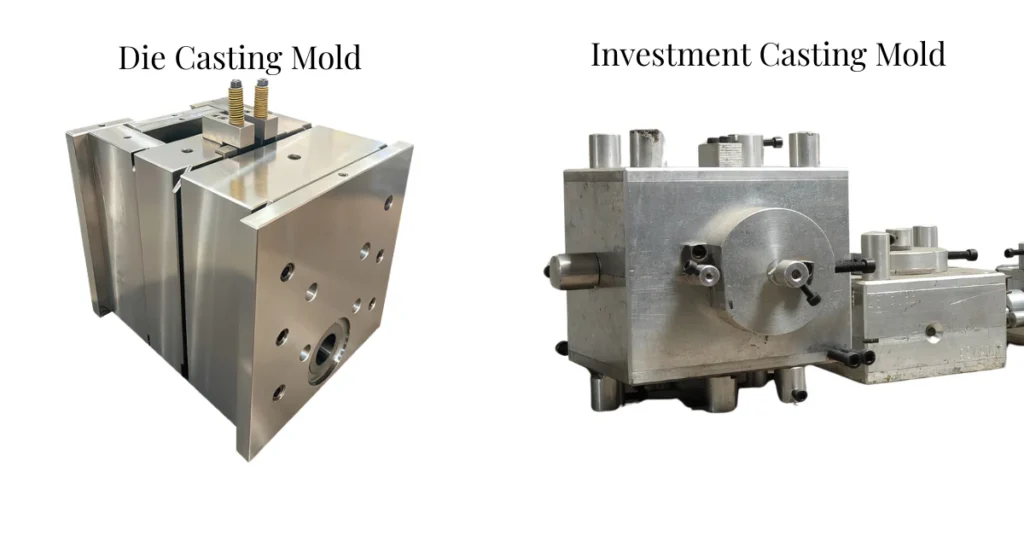
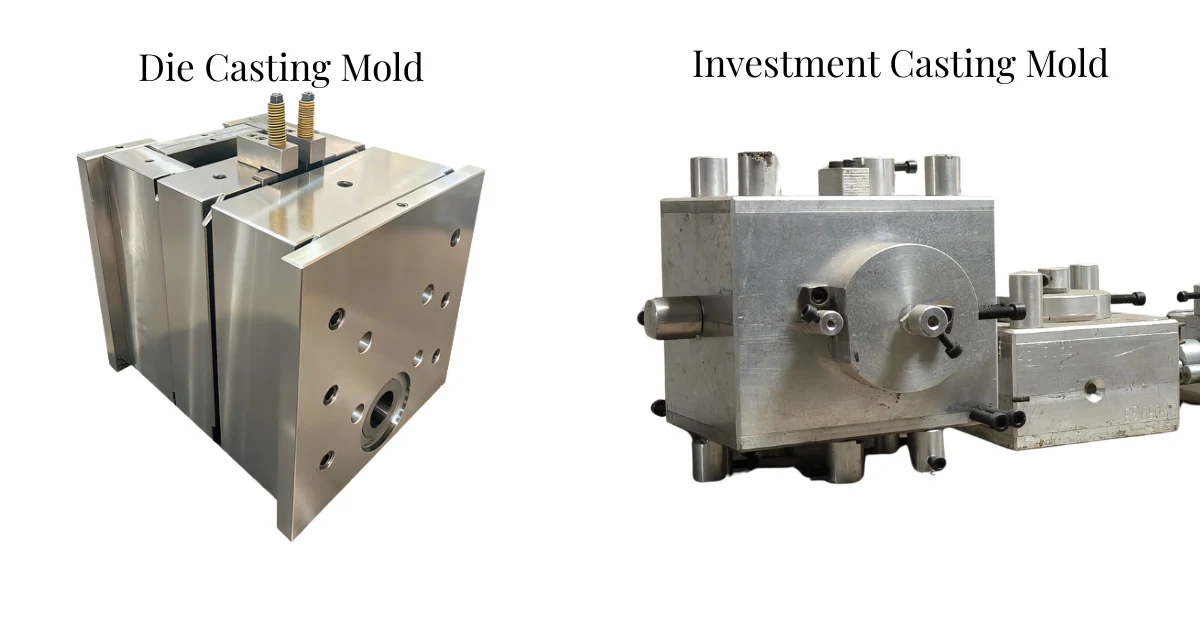
Investment casting and die casting both use reusable tooling, but the molds perform fundamentally different jobs.
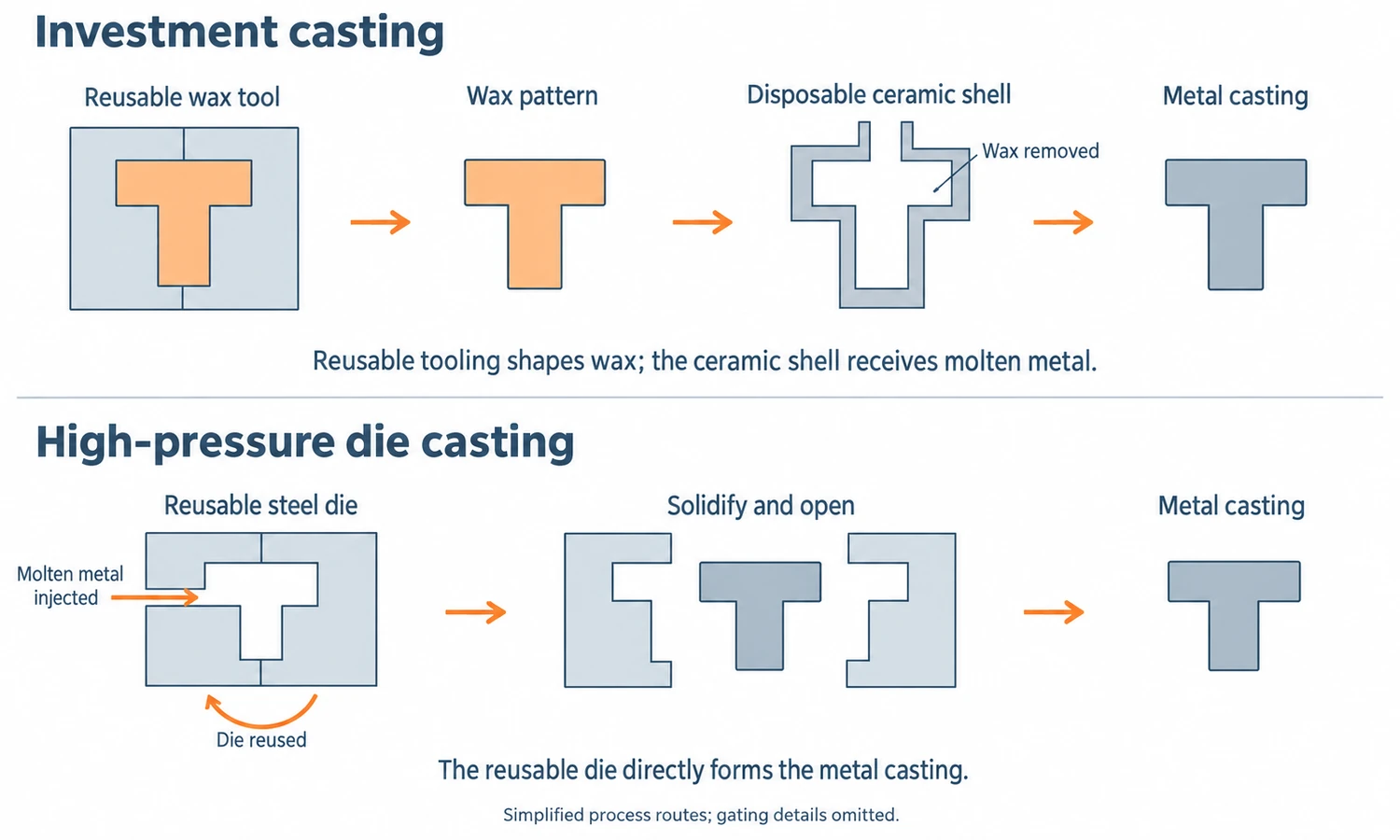
In investment casting, the reusable tool normally makes a wax pattern; molten metal never touches it. In die casting, the reusable steel die is itself the mold that receives molten metal under high pressure.
That single difference affects tooling material, construction, price, service life, internal geometry, prototyping, alloy choice, and production volume. This article compares the two processes specifically from the mold and tooling perspective.
Investment Casting Mold vs Die Casting Mold: Quick Comparison
| Factor | Investment Casting Tooling | Die Casting Die |
|---|---|---|
| Main purpose | Produce sacrificial wax patterns | Directly produce metal castings |
| Material contacting reusable tool | Wax | Molten metal |
| Mold contacting molten metal | Disposable ceramic shell | Reusable steel die |
| Typical tooling material | Aluminum or steel | Hot-work tool steel |
| Thermal load | Relatively low | High and repeatedly cycled |
| Pressure on tooling | Wax injection pressure | High-pressure metal injection |
| Cooling system | Relatively simple | Engineered cooling is important |
| Part removal | Wax pattern must leave tool | Solid metal casting must leave die |
| Internal geometry | Ceramic or soluble sacrificial cores available | Usually relies on mechanically removable cores/slides |
| Upfront tooling cost | Generally lower | Generally higher |
| Prototype without production tooling | Often possible | Actual die-cast prototype still needs a functional die |
| Typical production fit | Low, medium, and repeated production depending on part | Most attractive at high stable volumes |
The two processes may both use something called a “mold,” but the reusable tooling is exposed to completely different production conditions.
What Investment Casting Tooling and Die Casting Dies Do
In conventional investment casting, reusable tooling creates the wax pattern.
Wax is injected into a metal tool, cooled, removed, and later assembled for ceramic shell building. The Investment Casting Institute describes this as the standard production route for repeat investment casting.
The reusable tool finishes its main job before any casting alloy is melted.
The wax is later surrounded by ceramic. After dewaxing, that ceramic shell becomes the actual one-time mold for molten metal.
The process is:
reusable tooling → wax pattern → expendable ceramic shell → metal casting
Die casting removes the sacrificial-pattern stage.
Molten aluminum, zinc, magnesium, or another suitable alloy is injected directly into a reusable metal die. That die forms the component, routes the metal through runners and gates, removes heat, opens, and ejects the finished metal casting.
The process is:
reusable steel die → molten metal → metal casting
For more detail on tooling, ceramic cores, and ceramic shells in investment casting, see our Investment Casting Mold guide.
Materials in Contact With Investment Casting and Die Casting Tooling
The easiest way to understand the tooling difference is to look at what the reusable mold actually touches.
An investment casting wax tool sees pattern wax at relatively low temperature. Its main challenges are accurate filling, wax shrinkage, cooling, dimensional repeatability, and removing a relatively soft pattern without distortion.
A die casting die sees molten metal.
It repeatedly experiences rapid heating and cooling, high metal velocity, injection pressure, clamping force, lubrication, and mechanical ejection. It also has to control heat well enough for the next casting cycle to begin quickly.
NADCA’s description of die design and construction highlights metal flow, venting, cooling lines, ejector pins, runners, gates, slides, and cores as integral parts of a production die.
These very different working conditions explain why the tooling materials, construction, price, and service life cannot be compared as though the molds were doing the same job.
Investment Casting Wax Tooling Materials: Aluminum vs. Steel
Investment casting wax tools do not need to survive direct contact with the casting alloy, so the material can be selected around accuracy, rigidity, machining cost, production quantity, and expected tool life.
Aluminum and steel are both common choices.
At YTD, aluminum is particularly useful for many small and medium parts that require good wax-pattern accuracy. We can machine the tool directly from aluminum billet by CNC, producing the cavity and critical interfaces directly from the approved tooling design.
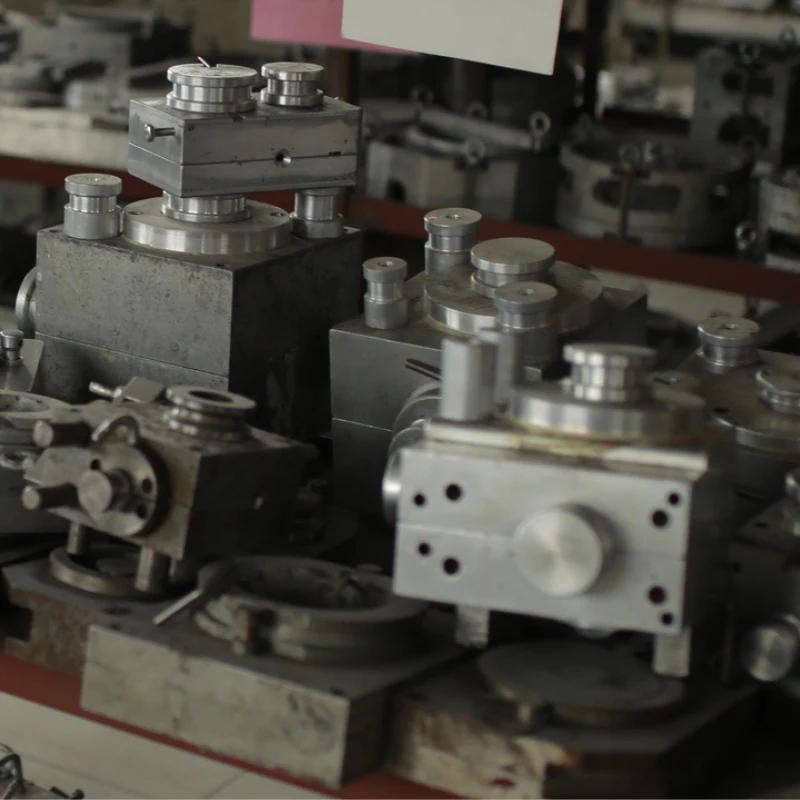
Aluminum also makes later modification relatively straightforward if first-article results show that a dimensional adjustment is needed.
Steel becomes more attractive when the mold is larger, requires greater rigidity, contains demanding moving features, or is expected to support a longer production program.
Tool material is therefore not selected from a rule that “steel is better.” The tool only needs to be as durable and stable as the production program requires.
Die Casting Die Materials and Tool Construction
Die casting tooling faces a much harsher environment.
The die must repeatedly receive molten metal, survive thermal cycling, resist wear and erosion, and continue opening and closing accurately through a large number of production cycles.
Hot-work tool steels such as H13 are widely associated with aluminum and magnesium die casting for this reason.
The construction itself is also more involved.
A typical production die has a fixed half and an ejector half. Depending on the component, it may also contain ejector pins, slides, moving cores, inserts, vents, runners, gates, and internal water or oil passages for temperature control.
Cooling is not a secondary feature. The die must remove enough heat for the casting to solidify while keeping the tool within a stable thermal range from cycle to cycle.
These requirements make the die an integral part of the die casting machine and production system—not simply a cavity that gives the part its shape.
Investment Casting Wax Tooling Manufacturing Methods
Investment casting tooling does not have to be manufactured the same way for every size of component.
At YTD, we use two main routes because machining a small precision tool and manufacturing a very large wax tool present different cost and material-use problems.
Small and Medium Precision Tooling: Direct CNC Machining
For small and medium castings with tighter dimensional or surface requirements, we can machine the wax tooling directly from aluminum or steel billet.
The cavity, parting surfaces, inserts, locating features, and other critical areas are created by CNC machining.
This route gives us direct control over the surfaces that determine wax-pattern geometry and is well suited to parts where pattern accuracy is an important part of the casting tolerance chain.
After the tooling is assembled, we inject trial wax patterns and inspect them before the mold is released for production.
Our investment casting mold manufacturing page shows this tooling route and actual tooling examples.
Large Wax Tooling: Lost Foam Cast Blank and CNC Machining
Machining a very large mold completely from solid billet can consume substantial material and machine time.
For some large castings with simpler geometry or lower overall tooling precision requirements, we use a different approach.
The main tool body is first produced as a near-net blank using lost foam casting. We then CNC-machine the cavity, mating surfaces, locating features, and other areas that actually require controlled dimensions.
The route becomes:
tool design → lost foam cast tooling blank → CNC finish machining → wax injection tool
This is essentially the same manufacturing logic used in many finished metal components: casting creates the bulk geometry, while machining creates precision only where it is needed.
It also shows why investment casting tooling should not be treated as one fixed type of mold. The most economical manufacturing route changes with tool size, accuracy requirements, geometry, and production quantity.
Tool Life and Failure Modes in Investment Casting and Die Casting
Investment casting wax tooling and die casting dies wear for different reasons.
Wax tooling mainly experiences mechanical wear. Parting surfaces can wear, moving inserts can loosen, alignment can change, and cavity surfaces can be damaged through long-term use.
The tool does not experience molten-metal thermal shock.
A die casting die does.
Every shot heats the die surface rapidly, followed by cooling before the next cycle. Over time, this contributes to thermal fatigue and heat checking. Erosion, soldering, wear, cracking, and damage to slides or ejector systems can also limit useful die life.
This difference matters when comparing quoted “tool life.”
A wax tool may be limited mainly by how long it continues to produce accurate patterns.
A die casting die has to maintain both dimensional accuracy and its ability to survive repeated high-temperature production cycles.
There is no useful universal cycle count for either process. Tool material, casting alloy, geometry, maintenance, production conditions, and required accuracy all affect service life.
Parting Lines, Draft, Ejection, and Core-Pull Limits in Die Casting
A reusable die must open after every casting cycle.
That simple requirement has a major effect on part geometry.
The solid metal component has to leave the die without becoming mechanically locked inside it. Surfaces in the primary opening direction normally require appropriate draft, while undercuts need slides, moving cores, or another withdrawal mechanism.
A straight hole can often be made with a metal core pin because that pin has a clear direction of removal.
A side feature may require a slide.
More complicated geometry can require several movements before the part can be ejected.
Die casting can therefore produce highly complex components, but the complexity has to be compatible with a reusable mechanical tool.
Every feature eventually has to answer one question:
How will the die or core move away from the finished metal part?
When no practical pull direction exists, the part may need redesign, post-casting machining, assembly from multiple components, or a more specialized core process.
Ceramic Cores and Internal Passages in Investment Casting
Investment casting approaches internal geometry differently because the core does not always have to be mechanically removed from the finished metal part.
A ceramic core can be made separately and positioned inside the wax injection tool. Wax is then injected around it.
The Investment Casting Institute’s wax pattern defect guidance specifically discusses patterns produced by injecting wax around ceramic or soluble cores.
After wax injection, the pattern contains the external wax geometry and the ceramic core inside it.
During dewaxing, the wax disappears but the ceramic core remains. Molten metal later fills around that core.
After solidification, the outer ceramic shell is broken away and the internal core is removed separately.
The core never has to slide mechanically out of the finished part.
That makes curved passages, branching channels, enclosed cavities, and internal geometry without a straight withdrawal direction much more natural for investment casting.
Die casting does have specialized sacrificial-core technologies, so enclosed passages are not absolutely impossible. But they are not the normal baseline of conventional HPDC tooling.
Investment casting already uses sacrificial patterns and expendable ceramic molds, so sacrificial internal geometry fits naturally into the process.
Part Complexity vs. Tooling Complexity
A more complicated finished part does not always require a more complicated reusable investment casting tool.
This is one of the easiest differences to miss when comparing the two processes.
In investment casting, the reusable tool only has to produce the wax pattern. The pattern is relatively soft, ceramic cores can be incorporated, and the final ceramic mold is destroyed after metal casting.
The final metal component never has to be mechanically ejected from that ceramic shell.
In die casting, the reusable tool must release the actual solid metal part and then close again for the next shot.
Slides, core pulls, ejector pins, shut-offs, and moving inserts all increase tool complexity.
So when people say that both processes can make “complex parts,” they may be talking about different types of complexity.
Die casting handles repeated thin-wall geometry and complex features extremely well when they can be designed around a reusable die.
Investment casting becomes especially valuable when the geometry is difficult to reconcile with mechanical ejection or core withdrawal.
3D-Printed Patterns for Investment Casting Prototypes
Investment casting has another tooling advantage during product development: the production wax tool can sometimes be skipped entirely.
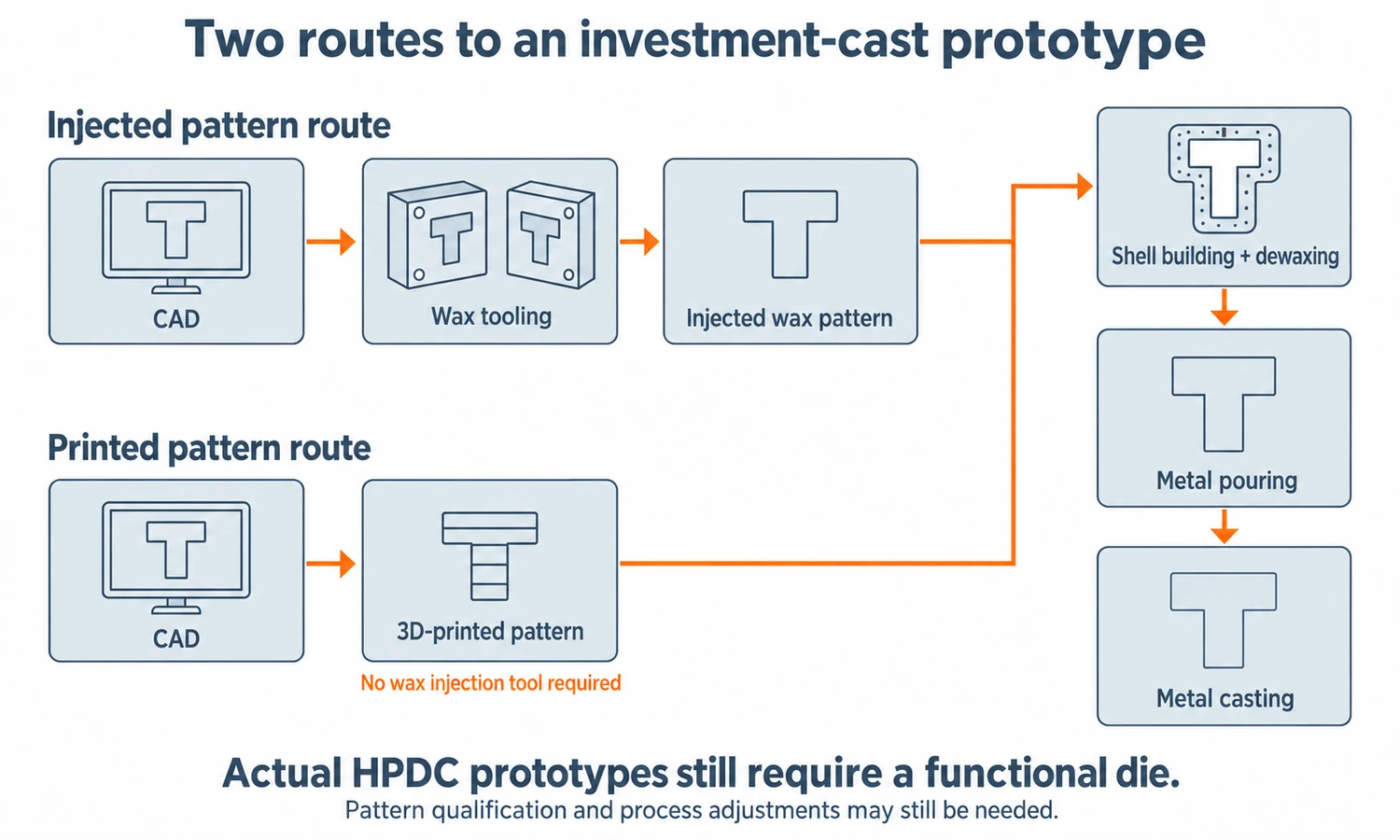
A sacrificial wax or wax-like pattern can be created directly from the customer’s CAD model using additive manufacturing.
The Investment Casting Institute recognizes printed patterns as an alternative to conventionally injected wax patterns, particularly for prototype and low-volume work. Its additive-manufacturing research also covers printed patterns and ceramic cores as routes for reducing fixed tooling during development.
At YTD, we can use 3D-printed sacrificial patterns for suitable rapid-prototype projects.
The production route changes from:
CAD → wax tooling → injected wax pattern → ceramic shell → casting
to:
CAD → 3D-printed sacrificial pattern → ceramic shell → casting
The hard tooling stage disappears.
This is particularly useful when only a few samples are needed or the design may still change.
Printed and Molded Wax Patterns in the Investment Casting Process
A printed sacrificial pattern and an injected wax pattern are not identical in every respect.
Surface texture, dimensional behavior, support removal, and burnout characteristics can differ, so the printed pattern has to be compatible with the shell process.
But after an acceptable pattern reaches shell building, most of the downstream manufacturing route is essentially the same.
The pattern is shelled, removed, replaced by molten alloy, and the casting then continues through cut-off, heat treatment, machining, and inspection as required.
That makes a printed-pattern casting much more representative of future investment-cast production than a prototype manufactured by an entirely different metal-forming process.
For many projects, the difference between a casting made from a printed sacrificial pattern and one made from an injected production pattern is small enough for the customer to evaluate real casting geometry and functionality before committing to hard tooling.
Once the design becomes stable and quantity grows, conventional wax injection tooling normally provides better pattern economics and repeatability.
Tooling Requirements for Die Casting Prototypes
A future die-cast component can certainly be prototyped without a production die.
It can be CNC machined, 3D printed, sand cast, or manufactured by another temporary process to evaluate fit, assembly, or basic function.
But that prototype is not actually die cast.
If the purpose of the sample is to validate the real HPDC process—metal flow, porosity, cooling, ejection, shrinkage, or die-produced dimensions—a functional die is still required.
The tool may be simplified for development, but the fundamental tooling stage cannot be removed.
This differs from investment casting.
Investment casting can replace the injected wax pattern with a printed sacrificial pattern while keeping the ceramic-shell and metal-casting stages almost unchanged.
So when design maturity is low or only a handful of actual cast samples are needed, the tooling barrier can be much lower for investment casting.
Tooling Cost and Production Volume
The two tooling systems lead to different production economics.
Investment casting usually requires less permanent-tooling investment, but every casting cycle still needs new patterns and a new ceramic shell.
Die casting requires a much larger investment in the permanent die, but once production is stable, the same tool can support rapid repeated cycles.
The general cost pattern is:
Investment casting: lower fixed tooling cost, more process cost in every part.
Die casting: higher fixed tooling cost, stronger economics when that cost is spread across a very large number of parts.
There is no universal break-even quantity.
A simple multi-cavity die may justify itself earlier than a very complicated die containing several slides. Likewise, complex investment casting tooling and ceramic-core tooling can raise the upfront investment.
Lifetime quantity matters more than the first purchase order.
A stable program expected to produce hundreds of thousands of aluminum parts gives die casting a very different economic case from a component that may only need several thousand pieces or still faces regular design changes.
Our broader Investment Casting vs Die Casting guide compares the complete processes beyond tooling.
How Tooling Affects Material Selection
The tooling architecture also helps explain why the material ranges of the two processes are so different.
The reusable investment casting tool only needs to survive wax injection. The high-temperature casting alloy contacts the disposable ceramic shell instead.
That allows investment casting to process carbon steel, alloy steel, stainless steel, nickel-based superalloys, and many other alloys with melting temperatures far above anything an ordinary reusable die could economically tolerate.
High-pressure die casting puts molten production metal directly against the reusable steel die on every cycle.
This is one reason HPDC is dominated by non-ferrous alloy families such as aluminum, zinc, and magnesium.
Between these two processes, a stainless-steel or superalloy requirement usually narrows the choice very quickly toward investment casting.
An aluminum or zinc part leaves more room for the geometry, volume, wall thickness, and tooling economics to decide.
Choosing Between Investment Casting and Die Casting From the Tooling
Looking at the mold first can narrow the process choice surprisingly quickly.
| Requirement | What the Tooling Suggests |
|---|---|
| Stainless steel, alloy steel, or nickel superalloy | Investment casting |
| Aluminum, zinc, or magnesium | Both may remain possible |
| Curved or enclosed internal passages | Investment casting with sacrificial cores often has an advantage |
| Many undercuts or difficult pull directions | Investment casting becomes more attractive |
| Very high stable lifetime volume | Die casting tooling becomes easier to justify |
| Design still changing | Investment casting generally has a lower tooling commitment |
| Need a few actual cast prototypes | Printed investment casting patterns can avoid hard tooling |
| Need samples made by the actual HPDC process | A functional die is required |
| Very thin walls and rapid production | Die casting has a major advantage |
| Lower upfront tooling budget | Investment casting generally has the advantage |
This is only a tooling-first filter.
Once both processes remain technically possible, mechanical properties, porosity requirements, heat treatment, tolerance, surface finish, machining, and finished-part cost still need to be evaluated.
Final Thoughts
Investment casting and die casting use reusable tooling in very different ways. Investment casting tooling primarily produces sacrificial patterns, while the die casting die directly forms molten metal under pressure.
That difference shapes the tool material, manufacturing method, price, life, internal geometry, prototyping options, and production economics.
For many projects, looking at what the mold must do—and what the finished part must escape from—is one of the clearest ways to choose between the two processes.
FAQs
Is an Investment Casting Mold Reusable?
The wax injection tool is reusable. The ceramic shell that actually receives molten metal is expendable and is broken away after each casting cycle.
Why Is Die Casting Tooling Usually More Expensive?
A die casting die has to withstand molten metal, high pressure, thermal cycling, and repeated ejection. It also normally includes cooling channels, ejector pins, gates, vents, and sometimes slides or moving cores.
Why Can Investment Casting Make Internal Shapes That Are Difficult to Die Cast?
Sacrificial ceramic cores can remain inside the mold during pouring and be removed after the metal solidifies. They do not need a straight mechanical pull direction from the finished part.
Can Die Casting Use Cores?
Yes. Metal core pins and moving slides are common. Specialized sacrificial-core methods can also extend the geometry further, but they add process and tooling complexity.
Can Investment Casting Be Prototyped Without a Metal Mold?
Yes. A suitable sacrificial pattern can be 3D printed directly from CAD and used for ceramic shell building, allowing actual investment-cast samples to be produced without conventional wax injection tooling.
Can Die Casting Skip Tooling for Prototypes?
A die-cast design can be prototyped by another manufacturing method. But if the sample must be produced by the actual die casting process, a functional metal die is still required.