Nickel alloy casting is used to produce complex components for environments where ordinary steels struggle with heat, corrosion, or mechanical stress.
But casting these alloys is not as straightforward as pouring conventional steel. Alloy chemistry, melting atmosphere, mold materials, solidification, heat treatment, and inspection can all affect the final component.
This guide focuses specifically on how nickel alloys are cast, which alloys and casting processes are commonly used, what manufacturing challenges to expect, and what engineers and buyers should consider before starting a nickel alloy casting project.
What Is Nickel Alloy Casting?
Nickel alloy casting is the process of melting a nickel-containing or nickel-based alloy and pouring it into a mold where it solidifies into the required component shape.
The basic casting principle is familiar, but nickel alloys cover a wide range of materials.
Some are corrosion-resistant alloys intended for chemical or marine environments. Others are high-temperature nickel-based superalloys designed to retain strength, resist creep, or withstand oxidation under extreme heat.
Because many of these materials are expensive and difficult to machine, casting can be particularly useful for creating complex near-net-shape components before final machining.
Why Cast Nickel Alloys?
Nickel alloys can be machined, forged, fabricated, and cast. Casting becomes attractive when the geometry makes other manufacturing methods inefficient.
Imagine a nickel-alloy component with:
- Curved external surfaces
- Internal passages
- Ribs and bosses
- Changing cross-sections
- Integrated mounting features
- Several surfaces requiring different machining tolerances
Producing the entire component from a solid billet could mean purchasing considerably more expensive alloy than remains in the finished part.
Nickel alloys can also be difficult to machine because many grades retain strength at cutting temperatures and may work-harden rapidly.
Casting creates most of the geometry first. Machining can then focus on sealing faces, bearing locations, threads, bores, and other critical areas.
This does not make casting automatically cheaper. Tooling, casting yield, production quantity, heat treatment, inspection, and machining still matter.
The main advantage is that material and machining effort can be concentrated where they are actually needed.
Which Nickel Alloys Can Be Cast?
Many nickel alloys can be cast, but the manufacturing route and process control vary significantly between grades.
Some common examples include:
| Alloy | Main Reason for Use | Typical Cast Applications |
|---|---|---|
| Inconel 625 | Corrosion resistance with useful strength | Marine, chemical, offshore and fluid-handling parts |
| Inconel 718 | High mechanical strength at elevated temperature | Turbine, energy and high-load structural components |
| Inconel 713C | High-temperature strength and creep resistance | Turbocharger rotors, turbine components |
| Hastelloy X | Oxidation resistance and high-temperature stability | Furnace and gas-turbine components |
| K18 | Cast nickel-based high-temperature superalloy | High-temperature industrial and turbine-related components |
| Nickel-Copper Alloys | Seawater and selected chemical resistance | Pumps, valves and marine components |
The exact alloy should be selected according to service conditions rather than simply specifying “nickel alloy” or “Inconel.”
It is also important to check whether the required specification applies to a casting rather than simply copying a wrought material designation onto a casting drawing.
For example, ASTM A494/A494M covers several nickel and nickel-alloy casting grades intended primarily for corrosion-resistant service.
How Are Nickel Alloys Cast?
Nickel alloys can be produced using several casting processes.
The appropriate method depends mainly on component geometry, size, production quantity, surface requirements, and alloy.
Investment Casting
Investment casting is particularly useful for complex nickel-alloy components requiring detailed geometry and near-net-shape production.
The basic investment casting process includes:
- Tooling and wax pattern production
- Wax tree assembly
- Ceramic shell building
- Dewaxing
- Shell firing
- Alloy melting
- Pouring or vacuum casting
- Solidification and shell removal
- Cut-off and cleaning
- Heat treatment
- CNC machining and inspection
This process allows several complex features to be formed directly in the casting rather than machined individually afterward.
YTD Foundry produces nickel-based superalloy components through its in-house investment-casting process. The practical route is confirmed for the specific alloy, geometry, quantity, and inspection requirements.
Sand Casting
Sand casting can be considered for substantially larger nickel-alloy parts or components where investment-casting precision is unnecessary.
Tooling can be less expensive for some programs, and sand casting can accommodate much larger components. Dimensional accuracy and surface finish are generally less refined than with investment casting, although the actual result depends on the foundry process and part requirements.
Nickel-alloy sand casting also requires foundry experience with the specific alloy because pouring temperature, feeding, solidification, and mold reaction remain important.
YTD supports sand-casting projects through our qualified casting network when the component is better suited to this process.
Centrifugal Casting
Centrifugal casting is another manufacturing route used in the nickel-alloy industry, particularly for rotationally symmetrical components such as tubes, sleeves, and rings.
During casting, the mold rotates and centrifugal force distributes molten metal against the mold wall.
It is useful for certain geometries but is not a general replacement for investment or sand casting.
Why Is Vacuum Melting Important for Nickel-Based Superalloys?
One of the biggest differences between ordinary alloy casting and high-performance nickel-superalloy casting is the melting environment.
Not every nickel alloy needs to be vacuum melted.
However, many high-temperature superalloys contain reactive elements such as aluminum and titanium. During melting, these elements can react with oxygen, nitrogen, or other gases in the atmosphere.
Contamination can alter alloy chemistry and influence the final microstructure and mechanical performance.
Vacuum melting reduces atmospheric interaction during this critical stage.
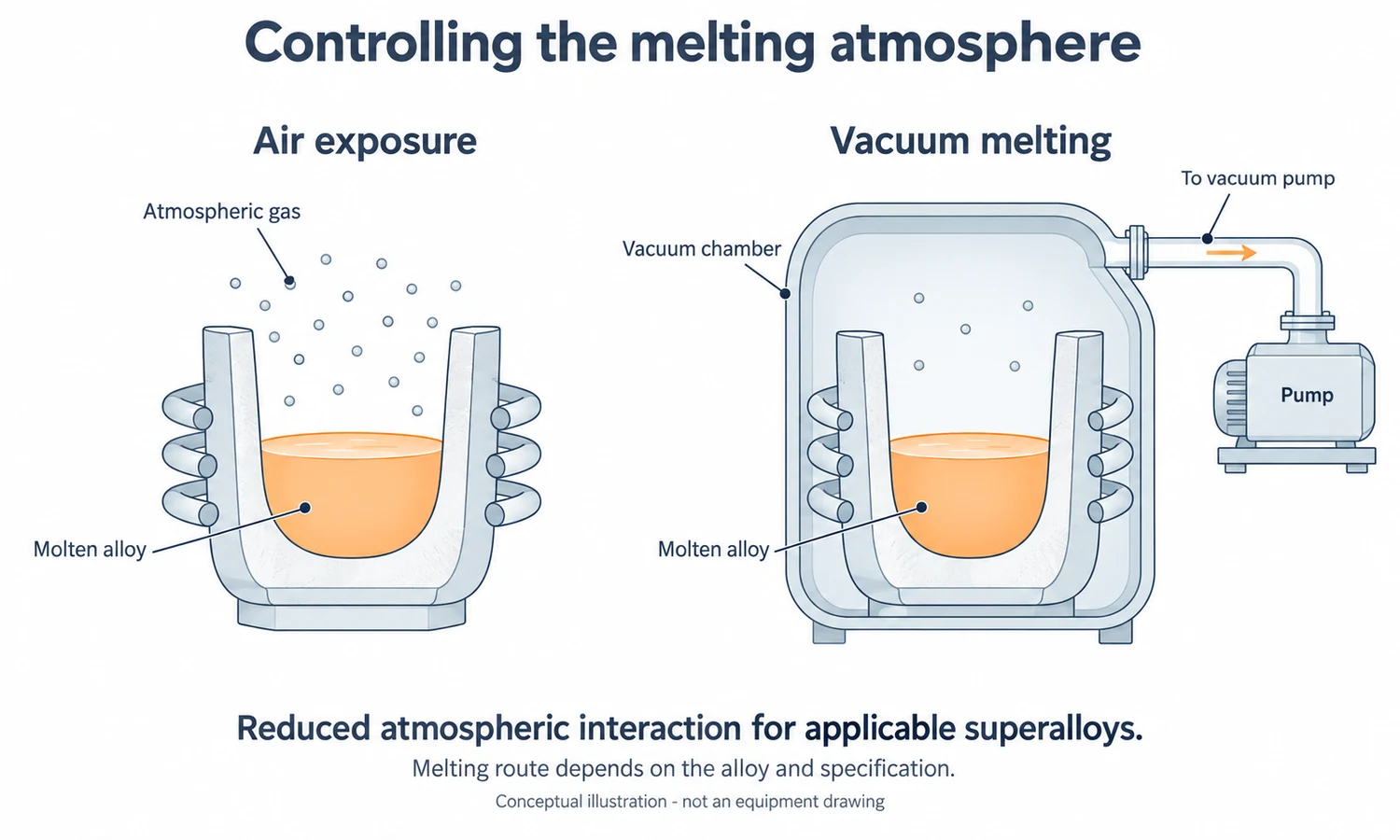
YTD Foundry has 50 kg and 100 kg vacuum furnaces available for applicable nickel-, cobalt-, and iron-based superalloy investment-casting projects. The melting route is confirmed according to the alloy and project requirements.
Vacuum does not solve every casting problem by itself. Shell preparation, pouring parameters, solidification control, alloy cleanliness, and subsequent heat treatment remain equally important.
Why Is Nickel Alloy Casting Difficult?
Nickel alloys are cast for demanding applications, but those same material characteristics often make them more difficult to process.
High Melting and Pouring Temperatures
Many nickel alloys require high processing temperatures.
This places greater demands on furnaces, ceramic shells, pouring systems, and process control.
The mold must withstand contact with molten metal without excessive reaction or failure.
Reactive Alloying Elements
Certain superalloys contain aluminum, titanium, and other reactive elements.
Controlling contamination during melting and casting becomes important because unwanted reactions can alter chemistry or create inclusions.
Shrinkage and Porosity
Like other cast metals, nickel alloys contract as they solidify.
Poor feeding or heavy isolated sections can create shrinkage porosity inside the component.
Gating and feeding design must therefore account for where the casting will solidify first and where molten metal is still needed to compensate for shrinkage.
Hot Cracking
Some nickel alloys are sensitive to cracking while the metal is still at high temperature.
Sharp transitions, restrained geometry, uneven cooling, and unsuitable process parameters can increase this risk.
Segregation and Microstructure
Nickel alloys often contain many alloying elements.
During solidification, these elements do not always distribute perfectly uniformly through the casting.
Solidification rate and subsequent heat treatment therefore play an important role in achieving the required final structure.
These challenges are why nickel alloy casting should be evaluated by alloy and component design rather than treated as a generic metal-casting operation.
Designing Parts for Nickel Alloy Casting
Good casting quality begins before the metal is melted.
The component geometry influences mold filling, cooling, shrinkage, distortion, machining, and ultimately cost.
Several principles are particularly important.
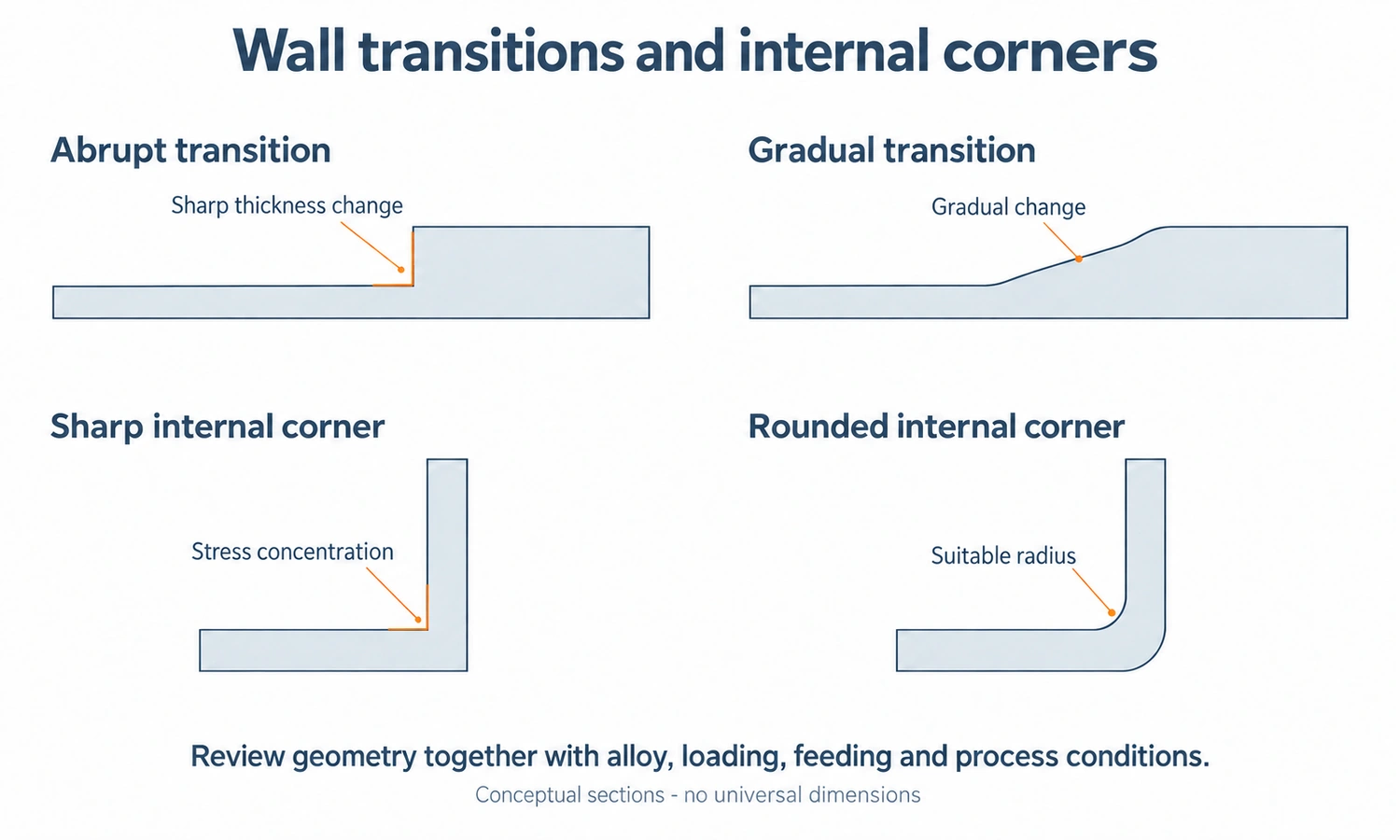
Avoid Abrupt Changes in Wall Thickness
A heavy section attached directly to a thin wall cools at a different rate.
This can create local hot spots and increase the risk of shrinkage or distortion.
Gradual transitions are generally easier to cast reliably.
Use Radii Instead of Sharp Internal Corners
Sharp internal corners can concentrate thermal and mechanical stresses.
Adding suitable radii also improves metal flow and reduces abrupt changes during solidification.
Consider Machining From the Beginning
Not every feature should be cast to final tolerance.
Critical bores, sealing surfaces, mounting faces, and threads are often better produced through post-cast CNC machining.
The drawing should therefore distinguish between:
- As-cast surfaces
- Machined surfaces
- Critical dimensions
- Reference datums
- Required machining allowances
Evaluate Internal Features Carefully
Investment casting can create internal cavities and passages using suitable core systems, but not every hole or channel is economical to cast.
Some features may be easier and more reliable to machine afterward.
For more detailed geometry considerations, our investment casting design guidelines cover wall thickness, radii, cores, tolerances, and common design mistakes.
What Happens After Nickel Alloy Casting?
A casting coming out of the mold is rarely a finished engineering component.
Several downstream processes may still be required.
Heat Treatment
Heat treatment can be essential to the final performance of nickel alloys.
Depending on the grade, processing may include solution treatment, aging, homogenization, or other specified thermal cycles.
Precipitation-hardening alloys such as Alloy 718 rely heavily on controlled heat treatment to develop the required mechanical properties.
The heat-treatment condition should therefore be determined from the material specification rather than chosen only after casting.
CNC Machining
Even precision investment castings often require machining where the design demands tighter dimensional control.
Common features include:
- Bearing seats
- Sealing surfaces
- Threads
- Precision bores
- Mounting faces
- Critical mating features
YTD combines casting with in-house CNC finishing so these operations can be planned together rather than treated as two unrelated manufacturing jobs.
Surface Finishing
Cleaning, blasting, polishing, passivation, or specialized coatings may be needed depending on the application.
YTD performs in-house sandblasting and shot blasting. Other surface finishing for castings, including plating, powder coating, blackening, painting, and similar treatments, can be coordinated through qualified partners when compatible with the alloy and project requirements.
How Are Nickel Alloy Castings Inspected?
Inspection requirements should match the risk and function of the component.
A cosmetic industrial bracket and a high-temperature turbine component should not automatically receive the same inspection plan.
Typical methods include:
Chemical Composition
Appropriate composition analysis is used to verify that the alloy chemistry meets the specified grade. The analytical method should cover the elements required by the specification.
For high-value nickel alloys, material traceability is especially important because small differences in chemistry can affect performance.
Dimensional Inspection
CMMs, gauges, and conventional measurement equipment are used to verify critical dimensions.
The inspection plan should distinguish between as-cast and machined features.
Dye Penetrant Inspection
Fluorescent or visible penetrant inspection can reveal surface-breaking cracks and discontinuities that may not be visible during ordinary visual inspection.
Radiographic Inspection
X-ray inspection can be specified when internal porosity, shrinkage, or other volumetric discontinuities need to be evaluated.
Mechanical Testing
Depending on the material specification and application, tensile testing, hardness testing, or other mechanical tests may also be required.
The required acceptance criteria should ideally be established before production begins.
Common Defects in Nickel Alloy Castings
A casting defect is not unique to nickel alloys, but high material cost and demanding applications make defect prevention particularly important.
Common concerns include:
| Defect | Typical Cause |
|---|---|
| Shrinkage Porosity | Insufficient feeding during solidification |
| Gas Porosity | Gas trapped or dissolved during melting and pouring |
| Inclusions | Oxides, shell material, slag, or other contaminants entering the metal |
| Hot Cracks | Thermal stress and alloy sensitivity during solidification |
| Misrun | Metal solidifies before completely filling the cavity |
| Surface Reaction | Interaction between molten alloy and mold material |
| Distortion | Uneven cooling or residual stress |
The solution is rarely “more inspection.”
Inspection detects defects; process control reduces the likelihood that they occur.
Tooling design, shell preparation, melting practice, gating, pouring, solidification, heat treatment, and handling all contribute to casting quality.
Cast vs. Wrought Nickel Alloy: Which Should You Choose?
Casting is not automatically the best manufacturing route simply because a nickel alloy can be cast.
Wrought and forged products may be more appropriate when the geometry is simple or the component requires properties associated with a mechanically worked material.
Casting becomes more attractive as geometry becomes complex and machining from solid becomes inefficient.
| Consideration | Casting | Wrought / Machined |
|---|---|---|
| Complex 3D Geometry | Strong advantage | Often requires extensive machining |
| Internal Features | Can be incorporated with suitable cores | Often difficult to machine |
| Material Utilization | Near-net shape can reduce waste | Substantial stock may need to be removed |
| Tooling | Usually required | Often little or no dedicated tooling |
| Very Low Quantity | Tooling may reduce economic advantage | Often practical |
| Simple Geometry | May be unnecessary | Frequently practical |
| Final Precision | Critical areas often machined | High CNC precision possible |
The decision should be based on the complete part—not only the raw material price.
For many components, the most effective route is casting the complex geometry and machining only the functional features.
Where Are Nickel Alloy Castings Used?
Nickel-alloy castings are most valuable when complex geometry is combined with demanding operating conditions.
| Industry | Typical Cast Components |
|---|---|
| Aerospace | Turbine hardware, housings, hot-section components |
| Energy | Gas-turbine components, heat-resistant hardware |
| Chemical Processing | Valve bodies, pump parts, impellers, process equipment |
| Oil & Gas | Valve and flow-control components, high-performance equipment |
| Marine & Offshore | Pumps, valves and seawater-handling components |
| Industrial Furnaces | Fixtures, burners, supports and furnace hardware |
| Automotive | Turbocharger and high-temperature exhaust components |
The industry name alone should never determine the alloy.
The same pump design, for example, may require completely different materials depending on the fluid, temperature, pressure, and expected service life.
What Should You Send to a Nickel Alloy Foundry?
A good RFQ contains more than a 3D model.
For a nickel alloy casting project, useful information includes:
- 2D drawing and/or 3D model
- Exact alloy or applicable material specification
- Required quantity and annual demand
- Operating temperature
- Corrosive environment or service medium
- Heat-treatment requirements
- Critical dimensions and tolerances
- Machined features
- Surface-finish requirements
- Nondestructive testing requirements
- Mechanical-property requirements
- Material certification requirements
If you only have an existing component, YTD Foundry can also support reverse engineering before tooling is developed.
This information allows the foundry to evaluate not only whether the part can be cast, but how it should be cast, heat treated, machined, and inspected.
Final Thoughts
Nickel alloy casting is less about whether nickel alloys can be cast and more about controlling how they are melted, formed, solidified, heat treated, machined, and inspected.
For complex components, investment casting can reduce material waste and machining while preserving the performance needed from high-value alloys.
YTD Foundry supports nickel-alloy projects from tooling and vacuum investment casting through heat treatment, CNC machining, inspection, and finishing. Send us your drawing, 3D model, or sample details, and we can evaluate the most practical manufacturing route.
FAQs
Can All Nickel Alloys Be Cast?
Many nickel alloys are castable, but not every wrought alloy should automatically be converted into a casting specification. Alloy chemistry, required mechanical properties, service conditions, and available casting grades should be reviewed first.
Can Inconel 718 Be Investment Cast?
Yes. Alloy 718 can be investment cast and is used for complex high-strength components. Casting, heat treatment, and final property requirements need to be controlled according to the applicable specification.
Why Are Some Nickel Alloys Vacuum Cast?
Vacuum processing helps limit atmospheric contamination and oxidation, particularly for superalloys containing reactive elements such as aluminum and titanium. Not every nickel alloy requires vacuum melting.
Is Cast Nickel Alloy Weaker Than Wrought Nickel Alloy?
Not in a simple universal sense. Cast and wrought materials have different microstructures and specifications. Their properties depend on alloy, heat treatment, casting quality, and product form, so the correct comparison should be based on the applicable engineering requirements.
Do Nickel Alloy Castings Need CNC Machining?
Often, yes. Casting produces the near-net geometry, while sealing surfaces, threads, bores, bearing seats, and other precision features are commonly machined afterward.
What Is the Best Casting Process for Nickel Alloys?
There is no single best process. Investment casting is well suited to complex precision components, sand casting can support larger parts, and specialized processes such as centrifugal casting suit certain rotational geometries. Part size, complexity, quantity, alloy, and final requirements determine the practical choice.