CNC machining from stock is often a good starting point for accessible shapes, changing designs, and projects that need precision features without developing a casting pattern tool. Investment casting becomes attractive when forming the main geometry in a mold can avoid extensive cutting, simplify a complex shape, or reduce work across repeated production.
For many metal parts, the practical choice includes both processes: investment casting creates the body, and CNC machining finishes the faces, bores, threads, and other features that need closer control.
Comparing the routes therefore starts with the finished component. The required material, geometry, dimensions, surface condition, quantity, and inspection must be the same before a lower price or shorter lead time means much.
How CNC Machining and Investment Casting Make a Part
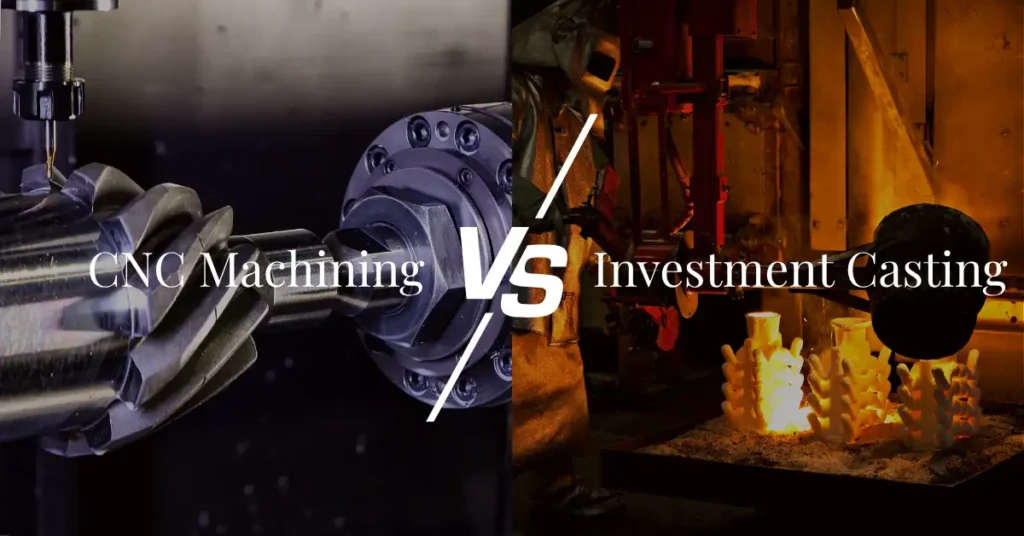
CNC machining uses computer-controlled machine tools to remove material through operations such as milling, turning, and drilling. A workpiece is held in a fixture while cutting tools create the required surfaces. In a route that starts from stock, that workpiece might be a bar, plate, or billet.
CNC describes the machining process, not the starting material. A CNC machine can also finish a forging or casting. Here, “machining from stock” means creating the part’s main geometry by cutting it from purchased stock; “cast and machine” means cutting selected features into a cast blank.
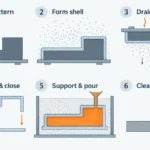
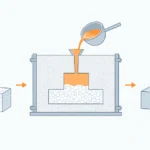
Investment casting, also called lost-wax casting, starts with an expendable pattern. Patterns are assembled with metal-delivery channels, coated repeatedly with ceramic slurry and refractory particles, and removed by heating. Molten metal is poured into the resulting shell. After solidification, the shell and delivery channels are removed, and the casting is cleaned and finished.
The Investment Casting Institute’s process overview explains this pattern-to-shell-to-metal sequence. Its near-net-shape result is a blank close to the finished geometry. Selected surfaces may still need machining.
| Decision factor | CNC machining from stock | Investment casting with required finishing |
|---|---|---|
| Geometry | Cutting tools and fixtures must reach and support the features being made. | Patterns, shells, and cores must form the geometry, and the casting must be fillable, cleanable, and inspectable. |
| Precision features | Dimensions are established directly through cutting and controlled workholding. | Some features remain as cast; critical dimensions can be established by later machining. |
| Initial work | Programming, setup, tools, and fixtures prepare the machining route. | Pattern development, casting-process development, trials, and any machining fixtures prepare the route. |
| Cost per finished part | Material, cutting time, setups, tool wear, and finishing are major drivers. | Pattern and shell production, casting acceptance, cleaning, heat treatment, and remaining machining are major drivers. |
| Design changes | Programs may be revised quickly, although stock, fixtures, and tools can also change. | A molded-pattern tool may need modification; printed patterns offer another development route. |
Geometry: Cutting-Tool Access vs. Mold and Core Design
A part’s shape affects both feasibility and cost. The useful question is how much work each route needs to create that shape.
Tool Access, Internal Corners, and Deep Features
In CNC milling, a rotating cutter leaves an internal corner radius related to its size. Specifying a much smaller radius can require a smaller tool, additional passes, and more cutting time. Deep pockets can require longer tool reach, increasing the challenge of keeping the cut stable and accurate.
Features hidden behind other geometry may require additional orientations, special tools, or another process. Each new setup also adds locating and handling work. Thin walls bring a different difficulty: cutting and clamping forces can deflect the workpiece, so support and the machining sequence matter.
These relationships are covered in Fictiv’s CNC machining design guide. They explain why two parts of similar size and material can have very different machining costs.
An open bracket with readily accessible faces and holes may be economical to machine from plate. Adding deep pockets and features on several sides can change that calculation substantially.
Cast Contours, Undercuts, and Internal Passages
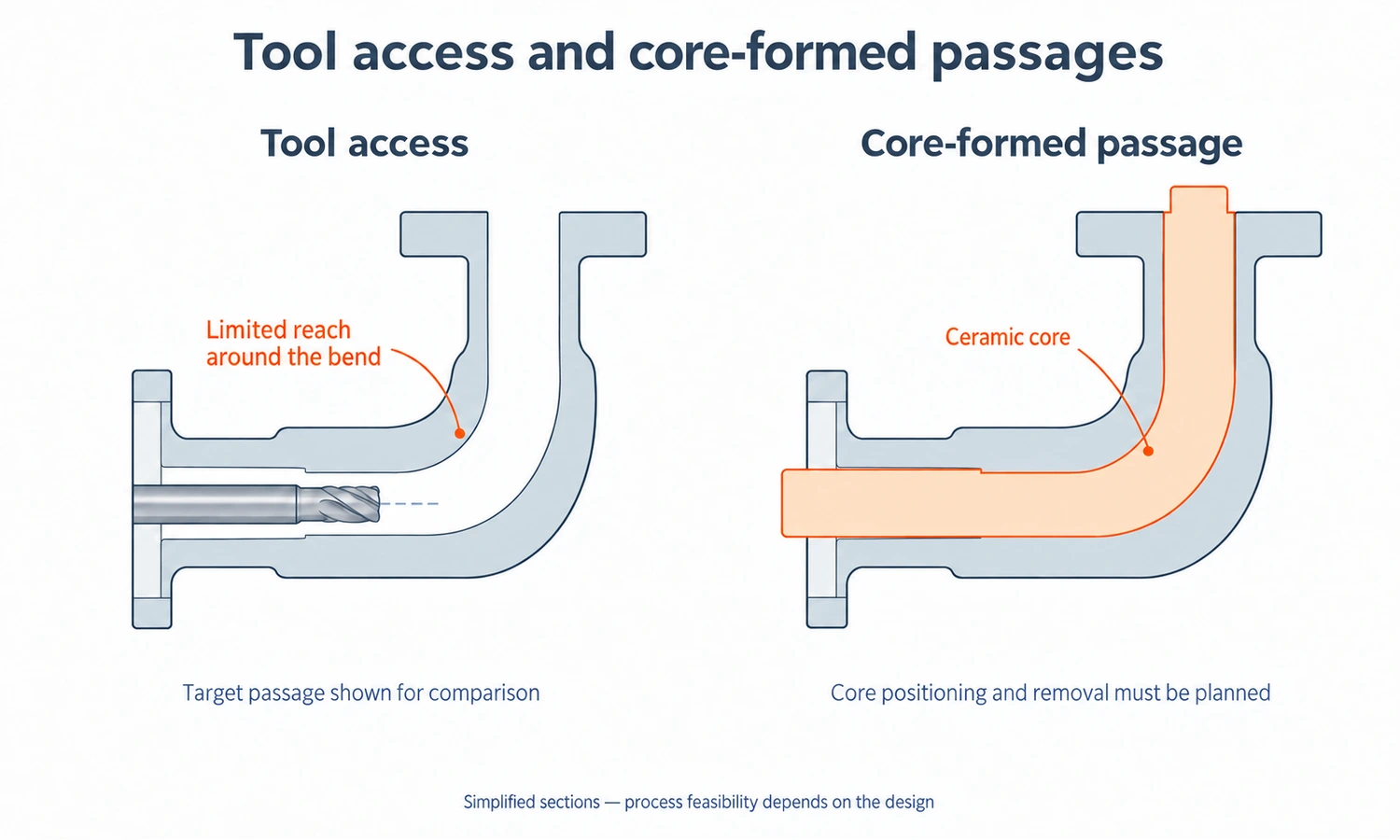
Investment casting forms the main geometry through a pattern and mold. It can reproduce curved surfaces, ribs, bosses, and suitable undercuts without cutting every contour out of solid stock. Cores can also create certain internal passages.
That freedom has its own conditions. The pattern must be producible, the shell must cover the necessary surfaces, cores must stay in position, and metal must fill and feed the sections during solidification. Afterward, shell and core material must be removable.
Consider a valve body with a curved flow passage and accurately located connection faces. Casting may form the body and passage, while machining establishes the connection faces, threads, and seating features. The passage offers a reason to consider casting; the precision interfaces offer a reason to retain machining.
A shape that is expensive to cut can also be expensive to cast. Core complexity, pattern-tool construction, cleaning, and inspection must be included in the comparison.
CNC vs. Investment Casting for Dimensional Accuracy and Surface Finish
Machining is commonly used where a final feature needs closer dimensional control than the as-cast route can reliably provide. That does not give every CNC machine, alloy, or feature the same tolerance.
Machined dimensions depend on the machine’s condition, tools, material, workholding, temperature, and measurement method. Investment-cast dimensions develop through pattern manufacture, shell making, pouring, contraction, heat treatment, and subsequent finishing. The ICI investment-casting design guide specifically relates achievable casting tolerances to the metal, size, and configuration.
A drawing may therefore contain three different instructions:
- An as-cast requirement for a surface or dimension that will remain unchanged after casting.
- A machining allowance that leaves extra material for later cutting.
- A finished requirement for the dimension or geometric relationship after machining.
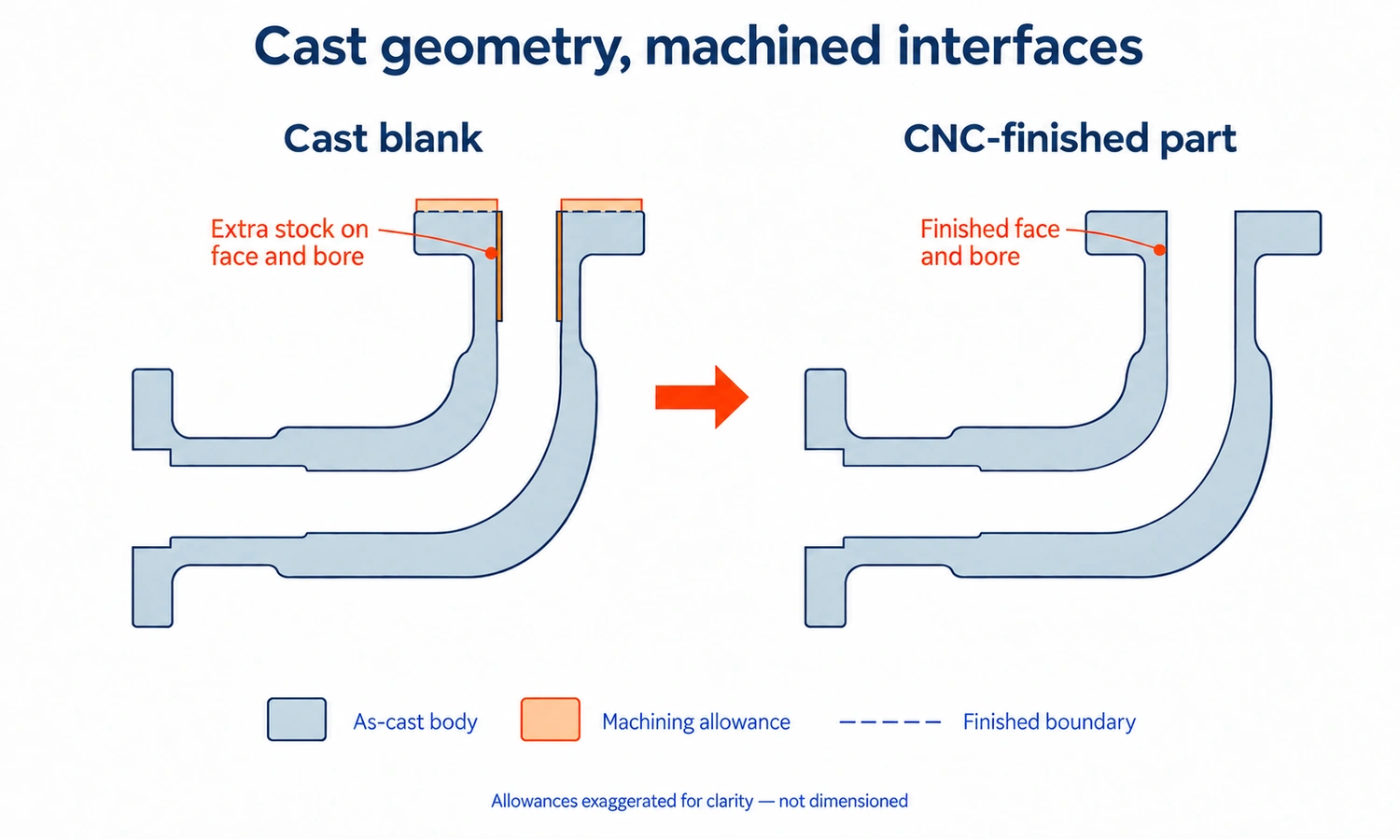
For the valve body, its outer profile might remain as cast while a seating bore and mounting face receive final machining. Their relationship matters as well as their individual sizes. A bore can have the correct diameter and still be incorrectly positioned relative to a mounting face.
Surface finish should be considered separately. Machining can leave feed marks, tool marks, burrs, or chatter. A cast surface reflects the pattern, ceramic shell, alloy, and cleaning operations. Either route may need further finishing to achieve the specified surface.
When comparing quoted roughness values, match the parameter and units. Ra, RMS, and Rz are different measures; a value in microinches also cannot be compared directly with one in micrometres. Specify the surface condition the part needs rather than selecting a process from an isolated roughness number.
CNC vs. Investment Casting: Material Form, Condition, and Strength
“CNC-machined” does not identify a material’s microstructure or strength. A machined component may start as wrought stock, a forging, or a casting. Its performance depends on that starting condition, the alloy and heat treatment, its geometry, and the relevant quality controls.
For machining from stock, the required grade and condition must be available in a usable size. Machinability then influences tools, cutting time, and the stability of the process.
For investment casting, the alloy must suit the melting, shell, filling, solidification, and heat-treatment route. An alloy that is difficult to machine is not automatically easy to cast. Similarly, similar chemistry does not by itself make a cast grade and a wrought grade interchangeable.
A strength comparison should therefore state the actual material specification, heat treatment, service requirements, and required tests. Changing from machined stock to a casting can require material qualification as well as dimensional approval. The process names alone cannot settle a question about fatigue, pressure service, or high-temperature performance.
How CNC and Investment Casting Costs Change with Production Quantity
CNC machining from stock usually avoids a dedicated wax-pattern die, but it still has preparation costs: programming, fixtures or soft jaws, cutting tools, setup, and first-article inspection. Its recurring costs include stock, cutting time, tool wear, handling, and finishing.
Investment casting may require pattern tooling and casting development. Each part also carries pattern, shell, melting, cleaning, and acceptance costs, plus any heat treatment and machining needed afterward.
The economic opportunity is to spend less on repeated material removal and finishing than the casting route adds elsewhere. The U.S. Department of Energy’s design-for-manufacturing material discusses this relationship between near-net-shape blanks, machining, allowances, and coordination costs.
An Illustrative Break-Even Calculation
The following USD amounts are assumptions chosen to explain the calculation. Both routes are assumed to meet the same finished-part requirements, with finishing and inspection included in the unit figures.
| Assumed cost | Machining from stock | Investment casting plus CNC finishing |
|---|---|---|
| One-time project costs | $1,000 | $7,000 |
| Cost per accepted finished part | $90 | $50 |
The casting route has $6,000 more in initial costs and saves $40 per finished part. Under these assumptions, that initial difference is recovered at:
$6,000 ÷ $40 = 150 parts
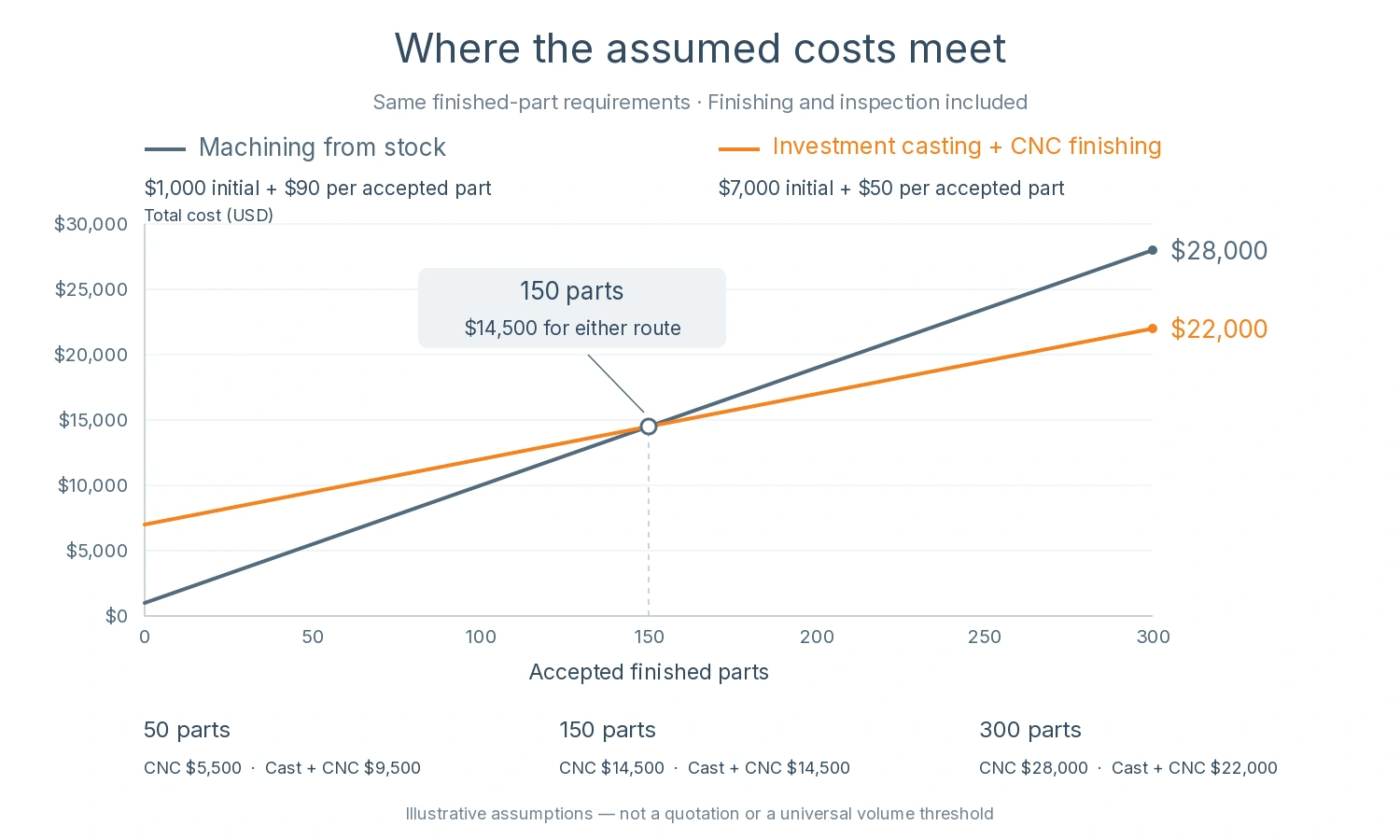
At 50 parts, the totals are $5,500 for machining from stock and $9,500 for casting plus machining. At 300 parts, they are $28,000 and $22,000 respectively.
The result changes when the assumptions change. If the cast part still needs extensive machining, its unit-cost advantage shrinks. If stock machining becomes faster with better fixtures or larger batches, the comparison also moves. Printed patterns can change the initial casting costs.
This calculation treats unit costs as constant and omits later design revisions. Actual quotations need to account for batch-dependent setup, casting and machining acceptance rates, tooling changes, and delivery requirements. The 150-part result belongs to this example; it is not a production-volume rule.
CNC and Investment Casting for Prototypes, Design Changes, and Lead Time
Machining from readily available stock can suit a prototype because it avoids developing a casting pattern tool and running the shell-making sequence. A revised design may be implemented through a program change, provided the existing stock, fixtures, and tools remain suitable.
That advantage depends on the part. Special stock procurement, difficult workholding, or long machining cycles can dominate the schedule. CNC lead time includes much more than the time the cutter spends in the material.
Investment casting adds pattern preparation, shell cycles, pouring, cleaning, and any subsequent heat treatment and machining. Traditional wax injection tooling also takes time to develop.
Printed expendable patterns offer an alternative for prototypes and some small batches. The ICI’s white paper on additive manufacturing patterns describes their use in prototype casting and low-volume production. Printing the pattern can avoid the conventional injection die, but the remaining casting operations still take place.
Distinguish the date of the first acceptable part from the delivery schedule for repeat orders. Initial tooling, fixtures, trials, and qualification may affect the first batch more heavily than later batches.
A machined prototype can help evaluate form and fit. It does not, by itself, demonstrate the material condition, internal quality, or repeatability of a later cast production route.
Investment Casting Plus CNC Machining
The combined route assigns each feature to the operation best suited to produce it. Casting creates the main body near its final shape; machining establishes the features that control fit, sealing, location, or assembly.
For the valve-body example, casting could create the external contour and internal flow path. CNC finishing could then establish a seating bore, connection faces, and threads. Much of the bulk shape would avoid machining, while critical interfaces would still be finished under controlled workholding.
The DOE’s discussion of casting followed by machining also makes an important point: savings depend on planning the blank and the machining together.
Design the Casting Around the Finished Features
Converting a fully machined part to a casting usually requires a casting drawing or model as well as the finished-part definition. The blank needs appropriate transitions, access for casting operations, and extra material wherever final machining is intended.
That machining stock must absorb expected casting variation and allow the cutter to clean up the required surface. Too little can leave unmachined areas; too much adds cutting time and material. A single allowance applied everywhere may not serve all features.
Establish Reliable Locating Surfaces
A fixture needs repeatable places to locate and hold the cast blank. Those contact areas may initially be as cast; an early machining operation can establish more precise reference surfaces for later work.
This sequence determines how casting variation is carried into, or removed from, the final dimensions. The machine’s positioning accuracy cannot compensate for a blank that lacks enough stock or cannot be held consistently.
Heat treatment and other operations that can change shape must also be considered when deciding when to establish final dimensions.
Verify Both the Blank and the Finished Part
Casting and machining introduce different quality risks. Casting evaluation may address filling, shrinkage, inclusions, cracks, or distortion. Machining evaluation may address tool wear, burrs, chatter, setup errors, or movement during cutting.
The acceptance plan should connect the relevant checks to the actual component. Dimensions and surface measurements establish finished geometry; material tests and any specified internal or surface examinations address other requirements. First-article work should validate the complete production sequence, including the relationship between the cast blank and its final machined features.
When to Choose CNC Machining, Investment Casting, or Both
The strongest candidate usually becomes clearer when geometry, material, precision features, and quantity are considered together:
- Start with machining from stock when the material is available, the geometry is accessible, design changes are likely, or casting would remove little of the total manufacturing work.
- Evaluate investment casting with limited finishing when a mold can create useful complexity and most surfaces can meet their requirements in the as-cast condition.
- Evaluate investment casting plus CNC machining when the body is expensive to cut from stock but a defined set of faces, bores, threads, or locating features still needs precision machining.
For an existing design, identify the features that drive machining time before proposing a casting conversion. For a new design, allow both routes to influence noncritical geometry while preserving the functional requirements. A modest change in an internal radius, wall transition, or access opening may alter the comparison more than a broad claim about either process.
Investment Castings with CNC Finishing from YTD Foundry
YTD Foundry provides custom investment castings with CNC finishing for parts made from drawings or physical samples. Tooling, casting, machining, inspection, and surface finishing can be organized around the finished component’s requirements. Printed wax patterns can also be considered for prototype and small-batch casting projects.
For a route review, provide the drawing or model, material grade and condition, expected quantities, and the features that must meet final dimensional or surface requirements. These details help identify which geometry can remain as cast, which features need machining, and what validation the proposed route requires.
FAQs
Can a Five-Axis CNC Machine Produce Every Investment-Cast Shape?
Additional axes can improve access and reduce some repeated setups, but a cutting tool, holder, and spindle still need clearance. An enclosed passage or an obstructed internal feature may require special tools, electrical discharge machining, a split design, or another manufacturing approach. The number of axes alone does not establish complete geometric access or a particular tolerance.
Does Investment Casting Waste Less Material Than CNC Machining?
A near-net-shape casting can reduce the amount cut away from stock. Casting also produces gates, runners, and other metal that does not remain in the finished component, alongside spent shell material and rejected parts. Machining produces chips, cutoffs, and unused stock.
Compare material inputs with accepted finished output, accounting for recoverable metal and rejects on both routes. Smaller chip volumes do not establish a lower environmental impact by themselves; energy, recovery, consumables, heat treatment, and transport also matter.