What Is Zinc Die Casting
Zinc die casting is a high-pressure manufacturing process used to produce accurate, repeatable metal components from zinc-based alloys. Molten zinc alloy is injected into a reusable steel die, where it rapidly fills the cavity, solidifies and is ejected as a near-net-shape part.
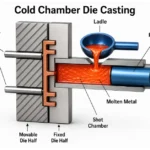
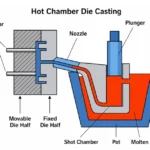
Most conventional zinc alloys are produced using hot chamber die casting because their relatively low melting temperatures allow the injection system to remain connected to the molten metal. This arrangement supports short production cycles and makes zinc particularly suitable for high-volume components requiring fine details, thin sections and consistent dimensions.
However, choosing zinc involves more than selecting a fast casting process. Different zinc alloys provide different combinations of strength, ductility, fluidity, dimensional stability, wear resistance and surface-finishing performance. The International Zinc Association identifies both the conventional ZAMAK family and higher-aluminum ZA alloys, each suited to different design and production requirements.
For buyers, the main questions are whether zinc suits the operating environment, which alloy should be specified, how the component should be designed for casting and finishing, and whether the expected production volume justifies the tooling investment. This guide focuses on those decisions rather than repeating the general die casting process.
Which Zinc Die Casting Alloy Should You Choose?
Zinc die casting is not based on a single material. The most common choices belong to the ZAMAK and ZA alloy families, and each offers a different balance of castability, strength, ductility, surface quality and wear performance. For buyers, alloy selection should start with the functional requirements of the part rather than simply choosing the most common grade.
ZAMAK 3
ZAMAK 3 is widely used because it provides a balanced combination of mechanical properties, dimensional stability, castability and finishing performance. It is a practical starting point for housings, hardware, connectors, decorative parts and other components where complex geometry and a good surface are important.
ZAMAK 5
ZAMAK 5 contains more copper than ZAMAK 3, which can improve strength, hardness and creep resistance. The trade-off is lower ductility. It can therefore be more suitable where the component requires higher mechanical strength or resistance to deformation under load, provided the application does not depend heavily on impact or forming after casting.
ZAMAK 2 and ZAMAK 7
ZAMAK 2 offers higher strength and hardness than the more commonly used ZAMAK grades and may be considered for parts exposed to greater mechanical loading or wear. ZAMAK 7 is selected when improved fluidity, ductility and surface quality are priorities, making it useful for fine features and thin sections.
ZA Alloys
The ZA family contains more aluminum than conventional ZAMAK alloys and is used when greater strength, bearing performance or wear resistance is required. ZA-8 can be processed in hot chamber equipment, while ZA-12 and ZA-27 are generally associated with cold chamber die casting because of their higher aluminum content and processing requirements.
The correct alloy should therefore be specified against measurable needs such as load, operating temperature, corrosion exposure, required finish, dimensional stability and expected service life. Where the drawing only states “zinc alloy,” these requirements should be reviewed before tooling so the supplier can recommend a suitable grade rather than making the material choice after the die has already been designed.
Benefits and Limitations of Zinc Die Casting
Zinc die casting is often selected when a part needs fine detail, good dimensional repeatability and an attractive surface finish at high production volumes. Zinc alloys flow well into narrow sections and detailed die features, allowing designers to combine ribs, bosses, lettering, mounting features and other geometry within a single casting.
The relatively low casting temperature of zinc also reduces thermal stress on the die compared with higher-temperature alloys. This can support longer tooling life and lower maintenance cost over a sustained production program. Fast solidification and hot chamber processing can also shorten cycle times, which improves productivity when annual volumes are high.
Another advantage is the ability to produce parts that require decorative or protective finishes. Zinc castings can be prepared for electroplating, painting, powder coating and other surface treatments, making them useful for hardware, consumer products, enclosures and visible components where appearance matters.
However, zinc is denser than aluminum and magnesium. Where minimum component weight is a primary design objective, this can be a significant disadvantage. Zinc alloys also have service-temperature limitations that must be considered carefully for components exposed to sustained heat or demanding thermal environments.
Part size can also affect process suitability. Zinc performs particularly well in small and medium precision components, but larger parts may become less attractive because of component weight, machine requirements and material usage.
For buyers, the decision should therefore be based on total part requirements rather than a single material property. Zinc is especially attractive when precision, thin sections, surface quality, fast production and long tooling life carry more value than achieving the lowest possible component weight.
Design Considerations for Zinc Die Cast Parts
Zinc performs particularly well when the component is designed around the strengths of the casting process. Thin walls, fine features, small bosses, ribs and detailed surface geometry can often be produced with less secondary machining than would be required with many other manufacturing methods.
Wall thickness should remain as consistent as practical. Abrupt changes from thin to heavy sections can disturb metal flow and create local hot spots during solidification. Where additional stiffness is required, ribs are generally more effective than simply increasing the thickness of the entire section. Fillets and radiused transitions also help reduce stress concentration and support smoother filling of the die.
Adequate draft is required so the casting can be released without excessive force or surface damage. Parting lines, ejector-pin locations, gates and overflows should also be considered early because they can affect visible surfaces and critical interfaces. Decorative faces, sealing areas and precision mating surfaces should be identified before the die layout is finalized.
Tolerance requirements deserve particular attention. Zinc die casting can achieve good dimensional repeatability, but applying very tight tolerances to every feature can unnecessarily increase tooling, inspection and machining cost. Critical dimensions, datum surfaces, threads, bearing locations and mating features should therefore be distinguished from non-critical geometry.
Buyers should also define which surfaces will be machined or plated. Machining allowances, cosmetic requirements and coating thickness can influence the final dimensions of the part. A DFM review before tooling release allows these requirements to be coordinated with die design rather than corrected after the first production samples are made.
Surface Finishing and Plating for Zinc Die Castings
Surface finishing is one of the areas where zinc die casting offers strong buyer value. Zinc castings can achieve a smooth as-cast surface and can also accept a wide range of decorative and protective finishes when the alloy, die design and pretreatment process are properly matched.
Electroplating is commonly used where appearance, corrosion protection or wear resistance is important. Nickel, chrome, copper and other plated systems may be specified depending on the required finish and service environment. Painting and powder coating are also used for functional or cosmetic applications, while polishing or mechanical finishing may be required before decorative coating.
The required finish should be defined before tooling because surface quality begins with the casting itself. Flow marks, porosity, flash, ejector-pin marks and parting lines that are acceptable on a hidden surface may become visible after plating or polishing. Cosmetic zones should therefore be identified on the drawing so gates, ejectors and parting lines can be positioned away from critical appearance areas where possible.
Buyers should also consider coating thickness when setting final dimensional tolerances. Threads, mating surfaces, press fits and electrical contact areas may require masking or controlled finishing to prevent the coating from interfering with assembly.
For parts exposed to moisture, chemicals or outdoor conditions, the RFQ should specify the operating environment rather than simply request a generic “corrosion-resistant finish.” This allows the finishing system and validation requirements to be matched to the actual service conditions.
Common Zinc Die Casting Defects and Quality Controls
Zinc die casting can produce highly repeatable parts, but defects still occur when metal temperature, die temperature, injection speed, venting or tooling condition move outside the required process window. For buyers, the important issue is not simply whether defects can occur, but whether the supplier has controls that prevent them from becoming recurring production problems.
Porosity may develop when air is trapped during filling or when shrinkage occurs in heavier sections. This can become important when the part will be machined, plated, pressure tested or used in a structurally critical area. A surface that appears acceptable in the as-cast condition may expose internal porosity after machining, so machining depth and sealing requirements should be defined before tooling.
Cold shuts and incomplete filling can result when the metal loses fluidity before the cavity is fully filled. Thin sections, long flow paths, poor gate design or unsuitable die temperature can increase this risk. Flash may appear when metal escapes along the parting line because of excessive pressure, die wear, poor closure or tooling damage.
Surface defects are particularly important on decorative zinc parts. Flow marks, blisters, inclusions and ejector damage can become more visible after polishing or plating, which means cosmetic acceptance criteria should be agreed before production.
Quality control should therefore combine stable process parameters with inspection focused on the actual function of the part. Dimensional checks, visual standards, coating inspection, material verification and any required leak or functional testing should be defined according to the drawing and application rather than applied as a generic inspection package.
Zinc Die Casting vs Aluminum Die Casting
Zinc and aluminum are both widely used for die-cast components, but they solve different design and sourcing problems. The better material depends on weight, part size, geometry, mechanical requirements, finishing needs and expected production volume rather than on material cost alone.
Zinc has higher density than aluminum, so it is generally less attractive where reducing component weight is a primary objective. Aluminum is therefore commonly preferred for larger automotive, structural and heat-management parts where strength-to-weight ratio is important. Buyers evaluating those applications should also review the requirements specific to aluminum die casting.
Zinc offers advantages when the component requires very fine details, thin sections, good dimensional repeatability or a high-quality decorative surface. Its lower processing temperature also places less thermal stress on steel dies, which can support longer tool life. Conventional ZAMAK alloys can additionally be processed in fast hot chamber machines, making them attractive for high-volume production of smaller precision parts.
Material selection should also consider the required finish. Zinc is well suited to decorative plating and can be a strong choice for visible hardware, fittings and consumer components. Aluminum may be more appropriate where lower weight, higher operating temperatures or larger part geometry are more important.
The most useful comparison is therefore at component level. Buyers should evaluate part weight, wall thickness, load, operating temperature, surface finish, annual volume, tooling life and secondary operations before deciding between zinc and aluminum.
Where Is Zinc Die Casting Most Suitable?
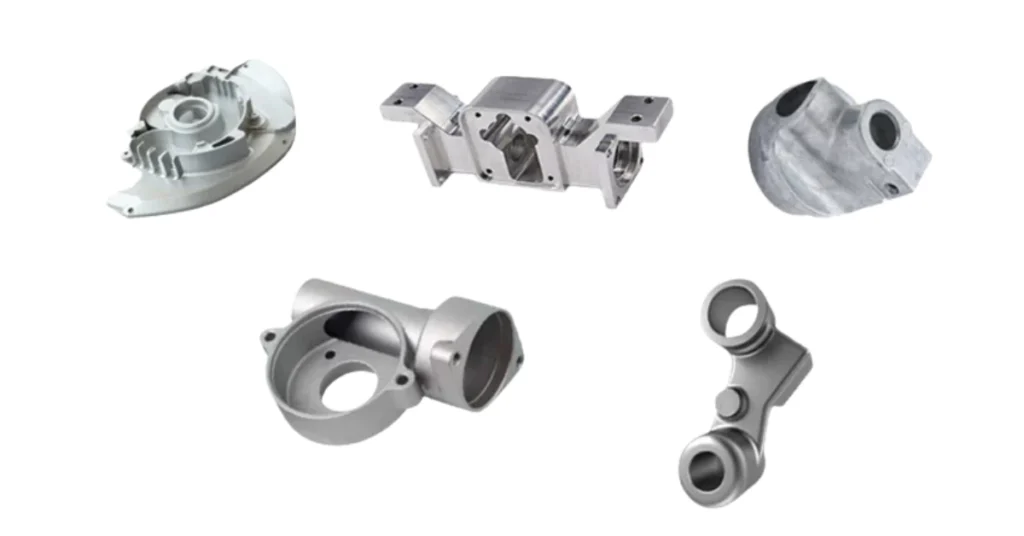
Zinc die casting is particularly effective for small and medium-sized components that require high dimensional consistency, detailed geometry and repeat production. Common applications include locks and latches, handles, connectors, electrical housings, gears, brackets, fittings, appliance components, automotive hardware and decorative consumer parts.
The process becomes especially attractive when several features can be incorporated directly into the casting. Ribs, bosses, mounting points, lettering and other details may reduce the need for separate components or extensive machining. This can simplify assembly and improve repeatability across large production batches.
Zinc is also a strong candidate where appearance matters. Components that require chrome or nickel plating, painting or another decorative finish can benefit from zinc’s ability to reproduce fine surface detail. For this reason, it is frequently considered for visible hardware and consumer-facing products as well as purely functional components.
Production volume is an important part of the decision. Steel dies require a significant initial investment, so zinc die casting is generally more economical when the design is stable and the tooling cost can be distributed across repeat production. Low-volume projects or parts that are still undergoing frequent design changes may be better served initially by machining, prototyping or another manufacturing process.
Buyers should therefore consider zinc die casting when the value of repeatability, complex geometry, surface quality, short cycle times and long tooling life outweighs the upfront tooling cost and the higher material density compared with aluminum.
What Buyers Should Include in a Zinc Die Casting RFQ
A zinc die casting quotation is more reliable when the supplier receives enough information to evaluate the alloy, tooling, finishing and inspection requirements together. Buyers should provide a 3D CAD model and controlled 2D drawing showing the required zinc alloy, critical dimensions, tolerances, datums and any features that will require machining.
Annual volume and expected program life are equally important because they influence cavity count, tooling design and the economics of the production process. The RFQ should also identify cosmetic surfaces, plating or coating requirements, threaded features, mating surfaces and any areas where ejector marks or parting lines would be unacceptable.
Where the component has functional requirements such as load capacity, corrosion resistance, electrical performance or leak tightness, these should be stated directly rather than left for the supplier to infer from the drawing. Required inspection documents, material certification, dimensional reports and sample-approval expectations should also be agreed before production.
Tool ownership, expected die life, maintenance responsibility and replacement conditions should be clarified with the quotation. A DFM review before tooling release can then confirm whether the proposed zinc alloy, geometry, finish and tolerances can be produced consistently without adding avoidable machining or inspection cost.
Conclusion
Zinc die casting is a strong option for high-volume parts that require fine detail, dimensional consistency, good surface quality and efficient production. Its advantages are especially valuable for smaller precision components where thin sections, decorative finishes and long tool life matter more than minimizing part weight.
The best results depend on selecting the correct zinc alloy, designing the part for casting, defining finishing requirements early and matching inspection to the real function of the component. Buyers should therefore evaluate zinc at the complete program level, including tooling, production volume, secondary operations, quality requirements and expected service conditions.
A clear RFQ and an early DFM review reduce uncertainty before tooling and help ensure that alloy selection, geometry, finish and production expectations are aligned from the start.
FAQs
What is the best zinc alloy for die casting?
There is no single best grade for every part. ZAMAK 3 is a common general-purpose choice because it balances castability, dimensional stability and finishing performance. ZAMAK 5 can offer higher strength and hardness, while ZAMAK 7 is useful where fluidity and surface quality are more important. ZA alloys may be considered when greater strength or wear resistance is required. The final choice should be based on load, operating temperature, finish, geometry and service conditions.
Is zinc die casting stronger than aluminum die casting?
Zinc can provide high strength and stiffness for compact parts, but material selection should not be based on strength alone. Aluminum is much lighter and is often preferred for larger or weight-sensitive components. Zinc is frequently more attractive for smaller precision parts, thin sections and detailed geometry.
Can zinc die cast parts be plated?
Yes. Zinc die castings are widely used with decorative and protective finishes such as nickel and chrome plating, as well as painting and powder coating. The required finish should be specified before tooling because cosmetic surfaces, porosity, parting lines and ejector locations can affect the final appearance.
Is zinc die casting suitable for low-volume production?
It can be used for low-volume production, but permanent steel tooling creates a significant upfront cost. The process becomes more economical as production quantity increases and the tooling investment is distributed across more parts. For early prototypes or designs that are still changing, machining or another temporary production method may be more economical.
Why is zinc commonly used in hot chamber die casting?
Most conventional zinc alloys melt at relatively low temperatures and are compatible with the submerged injection system used in hot chamber machines. This allows the metal to be injected without a separate ladling step, supporting fast cycle times and making zinc well suited to high-volume production.