Parts designed for investment casting come out more accurate, and, of course, cheaper to finish and complete. If you’re looking for a resource to guide you through it, this guide covers the fundamentals and what you need to start.
We’ll be talking about the design rules that get you there, with the real numbers behind each crucial step.
Investment Casting Design Guidelines
Before starting, it’s imperative that you understand that there are guidelines when it comes to investment casting. The reason why is because most of the cost is won or lost here in the geometry itself.
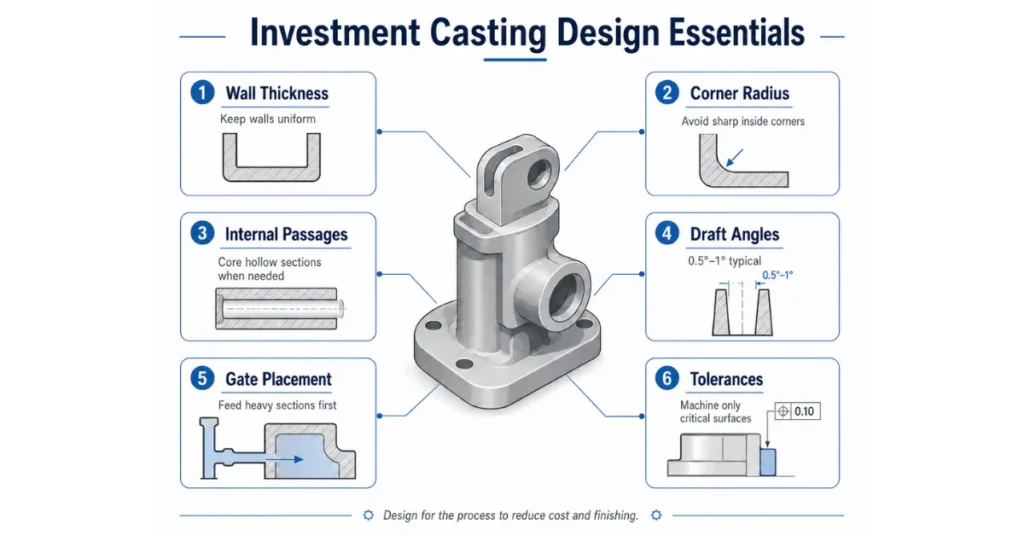
In our experience, here are the five choices that matter most, each with the rule of thumb behind it.
Wall Thickness
Most investment cast walls fall between 2.5 mm and 5 mm. Shorter flow paths can be about 1.5 mm, especially with aluminum.
It’s important to keep the wall thickness as even as possible. Ribs can add strength, while heavy bosses or hubs are usually better cored out.
Corner Radius
Sharp inside corners can lead to poor filling or cracks. A quick tip is to start inside the radius around half the thickness of the wall for a more precise and accurate measure.
Furthermore, outside corners also benefit from a small radius because smoother corners help the wax pattern and molten metal move more easily.
Internal Passages
In case you didn’t know, cooling channels and hollow sections can be cast directly into the part with ceramic or soluble wax cores. That can save the hassle of drilling or welding later, when needed.
The main limits show up with passages that are very deep or narrow. Blind cored holes are usually kept to about four times their diameter, so anything beyond that should be reviewed with the foundry early.
Draft Angles
Around 0.5 to 1 degree is the usual draft needed for many investment cast parts. Some flat surfaces can even stay at zero.
On the other hand, having more draft can help with taller or deeper features. Even so, it’s rarely the first detail to settle during design.
Gate Placement
Last but most definitely not least are gate controls. This part is where the metal enters the component. It should feed the heavier section first, allowing the metal to move toward thinner areas.
Gate removal leaves small marks that are best cleaned. Cosmetic surfaces should be seen and managed early so the gate is going to be less visible.
These are some of the guidelines and rules we’ve come up with in years of servicing businesses and people in the world to do it.
What Tolerances Can You Actually Hold?
Investment casting holds the tightest tolerances of all processes. But, it’s still a casting method, not a grinding or a cutting one. This one question decides a big share of your finishing cost.
- Plan on about plus or minus 0.1 mm across the first 25 mm, growing with size
- A well-optimized part can hold near 0.2 percent of the dimension
- A tightly controlled one can reach 0.1 percent, given friendly geometry
- Cast the general shape to a normal tolerance
- Machine only the seats and data that genuinely control fit
The takeaway is simple. You don’t have to hold the whole part to the tightest number, so, avoid over-tolerancing. In fact, spending too much time in a casting is the fastest way to overspend for no real gain.
When is Investment Casting the Wrong Choice?
Like what we keep on mentioning, investment casting isn’t the best and fittest process for every small component. You can always count on sand casting for components that are huge and large. While simple parts produced in huge numbers may cost less with die casting or stamping.
In addition, investment casting can also fall short when a part needs extremely tight tolerances or a mirror-like finish. In those cases, machining is often the better option.
NOTE: Sometimes the best and most efficient approach is to cast the main shape, then machine only the surfaces that need extra precision.
The Mistakes That Cost the Most
While investment casting looks promising, there are a few things you will want to consider, too. Most casting problems trace back to a small set of design habits, and each of these is actually easily avoidable once you learn where and how to look for them.
To help you with your journey, these are the issues we flag most when we do our series of quality inspection checks.
- Don’t make blind holes too deep. They may be hard to fill or clean. Keep them shallow, or open the shape more.
- Use tight measurements only where they matter. Not every part needs to be exact. Focus on the areas that must fit with another piece.
- Keep both thick and thin areas balanced. Heavy spots can cool unevenly and leave small holes inside the metal. Remove extra volume if you can.
- Move the parting line away from visible areas. It can leave a small mark, so place it where it will not affect the look or seal.
- Round off the sharp inside corners. A small curve helps the metal flow and lowers the chance of cracks.
To be clear, these aren’t just the problems and issues, they’re just the common ones. As far as the problems, these aren’t necessarily difficult to fix on the drawing. They only turn expensive once the tool is cut and the first parts come back wrong.
Design Your Investment Casting With YTD Foundry
The cheapest casting is the one designed for the process from the very start, and that’s the stage where we can help most. Investment casting is our whole focus at YTD Foundry, and we can be the business you can trust every step of the way.
Learning how to design a part for investment casting is one thing, but finding a reliable manufacturer to help you with it is another. Send your model and your sketch for us to see what you’re working with. We have teams, so we’ll give you tips and strategies on how to execute this properly.
Get a free estimate of what you need today!