What is CF3M Stainless Steel?
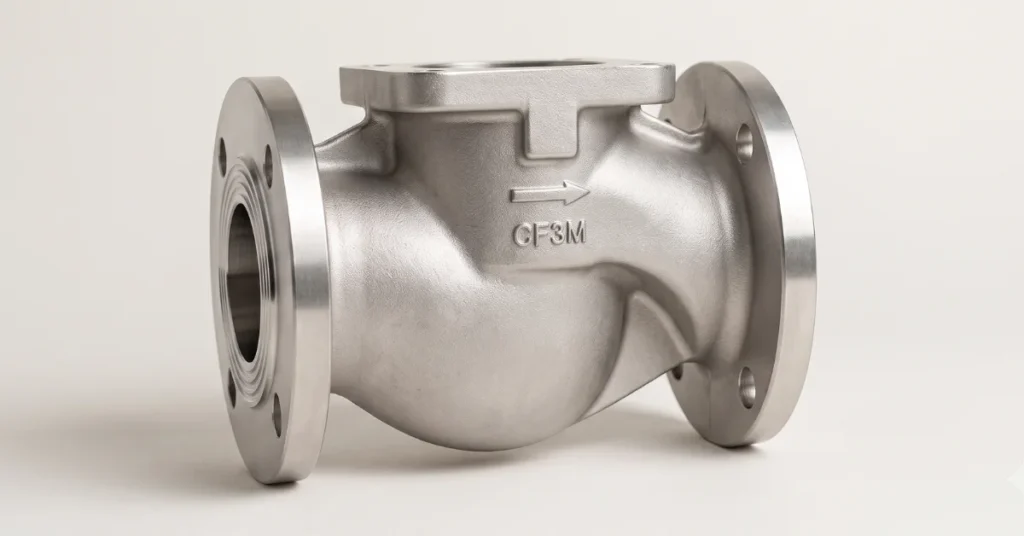
CF3M is a cast austenitic stainless steel material, defined under ASTM A351 gr CF3M — the cast equivalent of 316L.
This alloy is preferred for critical castings because the molybdenum gives it strong resistance to pitting in salty or chemical environments, and the ultra-low carbon eliminates the need for post-weld heat treatment.
What Does CF3M Mean?
The designation “CF3M” follows the ACI (Alloy Casting Institute) standard for cast stainless steels:
- C (Corrosion Resistant): Indicates the alloy is designed for liquid-phase corrosion service.
- F: Designates its position on the Fe-Cr-Ni phase diagram, identifying it as an austenitic structure (approx. 19% Cr, 9% Ni).
- 3: Denotes the maximum carbon content of 0.03%. This ultra-low carbon level prevents sensitization and intergranular corrosion during welding.
- M: Signifies the addition of Molybdenum (2.0%–3.0%), which significantly boosts pitting resistance in chloride environments.
CF3M Stainless Steel Chemical Composition & Material Properties
To ensure the reliable operation of your components in environments involving high pressure and corrosive media, CF3M castings must strictly comply with international metallurgical standards.
Chemical Composition
| Element | Content (%) |
| Carbon (C) | ≤0.03 |
| Chromium (Cr) | 17.00-21.0 |
| Nickel (Ni) | 9.0-13.0 |
| Molybdenum (Mo) | 2.0-3.0 |
| Manganese (Mn) | ≤1.50 |
| Silicon (Si) | ≤1.50 |
| Phosphorus (P) | ≤0.040 |
| Sulfur (S) | ≤0.040 |
| Iron (Fe) | Balance |
Material Properties
| Properties | Value |
| Tensile Strength (min) | ≥ 485 MPa (70 ksi) |
| Yield Strength (min) | ≥ 205 MPa (30 ksi) |
| Elongation (min) | ≥ 30% |
| Hardness (Brinell) | 136 – 202 HB |
| Melting Range | 1430 – 1440 °C |
| Density | ~7.98 g/cm³ |
CF3M Stainless Steel Equivalent Material Standards
The table below shows all equivalent grades across major international standards for your reference.
| Standard | Material Equivalent |
| ASTM (Primary) | A351 CF3M |
| UNS | J92800 |
| Wrought Equivalent | AISI 316L |
| DIN (Germany) | 1.4409 (GX2CrNiMo19-11-2) |
| JIS (Japan) | SCS16A |
| BS (British) | 316C12E |
| ASTM(Other Casting Specifications) | A743/A744 CF3M |
Key Advantages of CF3M Stainless Steel
Understanding why CF3M is specified over other alloys helps you optimize both performance and manufacturing costs:
Superior Corrosion Defense
The addition of molybdenum provides this material with significant performance advantages over grades without it. In chloride-rich environments—seawater, chemical streams, and salt-laden atmospheres—your parts resist localized corrosion.
No Sensitization Risk
Controlling the carbon content to below 0.03% eliminates the risk of sensitization during welding. Your cast parts can go straight into service after welding—no post-weld heat treatment, no delays.
Complex Shape Casting
CF3M casts reliably into your intricate shapes like pump housings and valve bodies.
You get one-piece integrity for parts that would otherwise require multiple components, reducing your assembly time and eliminating potential leak paths.
Heat Treatment Ease
The solution annealing range of 1040–1150°C gives you flexibility in heat treatment. You can achieve consistent properties across castings of varying section thicknesses with simpler process control.
CF3M vs. 316L vs. CF8M – How to Choose the Right Grade
You can avoid premature field failure and extra manufacturing costs by seeing how CF3M compares to its main alternatives.
CF3M vs. 316L (Cast vs. Wrought)
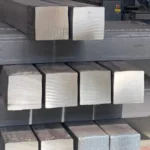
- 316L is a wrought grade — typically rolled or forged into bars, sheets, and pipes.
- CF3M is its cast counterpart, designed specifically for components with complex geometries.
When your part requires a one-piece casting rather than machined bar stock, CF3M gives you the same proven corrosion resistance, but in a form that can be cast directly into finished shape — saving you machining time and material waste.
CF3M vs. CF8M (Low Carbon vs. Standard Carbon)
CF8M allows up to 0.08% Carbon, while CF3M limits carbon to 0.03%.
If your castings require subsequent welding, the ultra-low carbon content of CF3M eliminates the risk of sensitization and removes the need for post-weld heat treatment, making it a safer and more cost-effective choice.
The Best Casting Process for CF3M Stainless Steel
For CF3M stainless steel, investment casting (specifically the silica sol lost-wax process) is universally recognized as the best and most common manufacturing method, accounting for over 80% of precision CF3M fluid-handling components produced globally.
Because CF3M is heavily specified for complex, high-performance parts like valve internals and pump housings, investment casting is the natural choice. It delivers exceptional dimensional accuracy (typically CT5-CT6 tolerances) and a superior surface finish (Ra 3.2-6.3 µm). This precision minimizes the need for costly secondary machining, allowing your intricate internal geometries and flow paths to be cast near-net-shape directly from the mold.
While investment casting dominates small to medium precision parts, resin sand casting serves as the primary alternative for much larger, heavier components.
- Resin Sand Casting: Offers lower initial tooling costs and easily accommodates massive parts (like industrial desalination pump bodies) that exceed investment casting size limits.
- The Trade-off: It yields a significantly rougher surface finish and looser dimensional tolerances compared to investment casting. This means you will inevitably spend more time and money on post-casting machining to meet final specifications.
Ultimately, for the intricate, leak-free applications where CF3M truly excels, investment casting provides the best balance of precision, performance, and total manufacturing cost.
How We Guarantee Quality in Custom CF3M Castings
At YTD Foundry, we put quality first at every stage of production — not just to meet the standard, but to make sure your CF3M castings arrive ready for reliable, long-term service.
- Material verification: every heat is analyzed via Optical Emission Spectrometry (OES) before pouring to ensure carbon remains strictly (≤0.03%) and Molybdenum is within range.
- Controlled Heat Treatment: Castings undergo computer-monitored solution annealing (1040°C+ followed by rapid water quenching) to ensure complete carbide dissolution.
- Non-destructive testing: critical areas are inspected by radiography, dye penetrant, or ultrasonic methods to detect subsurface flaws before machining.
- Dimensional inspection: key features are checked against your drawings, and we supply a full inspection report with every shipment.
Typical Custom CF3M Cast Parts We Manufacture
We utilize silica sol investment casting for tight-tolerance, intricate parts, and resin sand casting for heavy-duty industrial components.
Typical custom parts we manufacture include:
- CF3M Ball Valve Bodies & Plugs for seawater and chemical service
- Pump Casings & Impellers for marine and desalination systems
- Flanges & Pipe Fittings designed for welded chemical processing pipelines
- Manifold Blocks & Safety Components operating under high pressures and corrosive media
Each part is cast, machined, and inspected to your drawing, giving you a finished component that’s ready to bolt in and perform — exactly as specified, exactly where you need it.
Conclusion
CF3M offers the ideal balance of 316L-level corrosion defense, excellent weldability, and the geometric freedom of custom metal casting. Whether you need investment cast precision valve components or large sand-cast pump bodies, partnering with an experienced foundry ensures optimal material integrity. Have a custom CF3M project? Let’s talk.
FAQs
What is the primary difference between CF3M and 316L?
316L refers to wrought steel products (bars, plates, and forgings), whereas CF3M is specifically designed for metal casting processes. Both offer equivalent corrosion resistance, but CF3M allows for complex, near-net shape geometries that reduce machining costs.
Is CF3M magnetic?
While CF3M is primarily austenitic, sound castings usually contain 5%–15% delta ferrite to prevent hot tearing during solidification. As a result, CF3M castings may exhibit a slight magnetic attraction compared to wrought 316L.
Is CF3M suitable for welding?
Yes. Its ultra-low carbon (<0.03%) prevents sensitization, eliminating post-weld heat treatment.
Can CF3M be investment cast or sand cast?
Yes. Investment casting for intricate parts, sand casting for larger components.