What is CG8M Stainless Steel?
CG8M is a high-molybdenum austenitic stainless steel casting grade, covered under ASTM A351 for pressure-retaining castings and ASTM A743/A744 for corrosion service.
It’s the cast equivalent of wrought 317 — and its defining advantage over other cast grades is simply more molybdenum.
What Does “CG8M” Mean?
The ACI (Alloy Casting Institute) naming system breaks down the grade into four characters — here’s what each means and what it delivers to the material:
- C – The “C” stands for corrosion-resistant cast steel. That’s your signal that this alloy is formulated for aggressive casting media, not general structural service.
- G – The “G” locks in 18.0–21.0% chromium and 9.0–13.0% nickel. Those ranges give CG8M its austenitic structure and stable corrosion resistance across a broad temperature spectrum.
- 8 – The number “8” means limited carbon at 0.08%. Low carbon is what keeps this alloy weldable and resistant to intergranular attack after welding.
- M – The “M” is for molybdenum, at 3.0–4.0%. That high Mo content pushes the PREn to about 31 (CF8M is at 28), making CG8M notably more resistant to pitting and crevice corrosion in chlorides and acids.
That combination is what gives CG8M its edge: corrosion resistance that handles chlorides and acids, weldability that simplifies fabrication, and the toughness to perform across a wide temperature range.
Chemical Composition & Mechanical Properties of CG8M
CG8M Chemical Composition
Here’s the exact composition that gives CG8M its corrosion edge — notably the higher molybdenum that separates it from CF8M.
| Element | Content (%) |
| Carbon (C) | ≤ 0.08 |
| Chromium (Cr) | 18.0 – 21.0 |
| Nickel (Ni) | 9.0 – 13.0 |
| Molybdenum (Mo) | 3.0 – 4.0 |
| Silicon (Si) | ≤ 1.50 |
| Manganese (Mn) | ≤ 1.50 |
| Phosphorus (P) | ≤ 0.040 |
| Sulfur (S) | ≤ 0.040 |
CG8M Mechanical Properties
These numbers tell you what the material can withstand — useful when you’re sizing wall thicknesses for pressure-containing castings.
| Properties | Value |
| Tensile Strength | ≥ 520 MPa (75 ksi) |
| Yield Strength | ≥ 240 MPa (35 ksi) |
| Elongation | ≥ 30% |
| Hardness (Brinell) | 150 – 200HBW |
CG8M Equivalent Material
Standard systems vary by region, but the material is the same. This table helps you map CG8M to its equivalents.
| Standard | Equivalent |
| ASTM (Cast) | ASTM A351 / A743 CG8M |
| UNS (Cast) | J93000 |
| UNS (Wrought) | S31700 |
| Wrought Equivalent | AISI 317 / ASTM A240 317 |
| DIN (Germany) | 1.4448 |
| EN (Europe) | X3CrNiMo17-13-3 |
| JIS (Japan) | SUS 317 |
CG8M Engineering Selection Guide
CG8M vs. CF8M (Cast 316)
CF8M has 2.0–3.0% molybdenum; CG8M has 3.0–4.0%. That extra 1% gives CG8M a PREn of 31 vs. 28 — enough to resist pitting in chlorides and reducing acids where your CF8M parts often fail.
If your pumps or valves see aggressive acids or bleach service, CG8M is the upgrade that pays for itself in longer equipment life.
CG8M vs. CG3M (Cast 317L)
CG3M limits carbon at 0.03%, CG8M at 0.08%. The trade-off: CG3M withstands field welding without post-weld annealing; CG8M needs solution heat treatment after welding but gives better as-cast high-temperature strength.
When heat treatment can be controlled, CG8M delivers more strength — when it can’t, CG3M is the safer bet.
CG8M vs. Wrought 317 Stainless Steel
Same chemistry, different form. Wrought 317 comes as bar or plate; CG8M is poured into a mold. For pump volutes and multi-port valve bodies with internal passages, CG8M gives you a seamless one-piece casting. For simple flanges or fittings, you’re better off with wrought.
CG8M vs. Duplex 2205 (CD3MN)
Duplex offers higher strength and a PREn of 35 — great for seawater. But in reducing acids (sulfuric, phosphoric), duplex can suffer hydrogen embrittlement; CG8M stays stable.
You’re better off with CG8M for acidic service with moderate chlorides, and duplex when seawater immersion and maximum strength justify its higher cost.
Common Applications of CG8M Castings
FGD Systems (Flue Gas Desulfurization)
Wet scrubbers handle hot gases with chlorides and abrasive lime slurries. CG8M stands up to both the corrosion and the erosion — which is why you’ll find it in:
- Scrubber nozzles
- Slurry circulation pump casings and impellers
- Agitator shafts and blades
- Mist eliminator supports
If you’ve seen 316 parts pit out in under a year, you already know why this grade gets specified for these cast components.
Pulp & Paper Industry
Bleach plants are brutal — chlorine dioxide, chlorides, heat. Not many cast grades can handle it. CG8M is one that does.
- Chlorine dioxide bleaching tower valves and mixer shafts
- Washer drum filters and vat linings
- Digester blow valves in hot sulfite liquor service
- Pump casings for bleach plant filtrates
For bleach plant service, this is the cast grade you turn to when others have failed.
Chemical & Petrochemical Processing
Organic acids at elevated temperatures are corrosive enough. Add trace chlorides, and they become pitting machines. CG8M handles both.
- Reactor outlet nozzles and manway covers
- Heat exchanger channel heads and tubesheets
- Distillation column feed nozzles and tray supports
- Pumps and valves for dilute sulfuric acid at moderate temperatures
It’s not as cheap as 316, but it’s a lot cheaper than replacing equipment every few months.
What Can We Do for Your CG8M Casting
CG8M is known for its corrosion resistance — but that performance only happens if the metallurgy is done right. Here’s how our foundry achieves peak metallurgical performance through the following methods:
Molybdenum Segregation Control
During solidification, high molybdenum levels tend to micro-segregate in dendritic regions, creating Mo-depleted zones that lower localized corrosion resistance. We strictly control pouring temperatures and cooling rates to ensure uniform chemical distribution across heavy sections.
Sigma Phase Elimination
Certain hard particles can form and turn the casting brittle. We prevent this with high-temperature heat treatment (1050–1120°C), followed by rapid water quench. That keeps your castings tough and corrosion-resistant.
PREN Verification & ASTM G48 Testing
We test every melt of your CG8M castings and calculate the PREN (targeting ≥31). We also run ASTM G48 pitting tests. Every shipment comes with a complete MTR — so you know exactly what you’re getting.
Versatile Process Capabilities
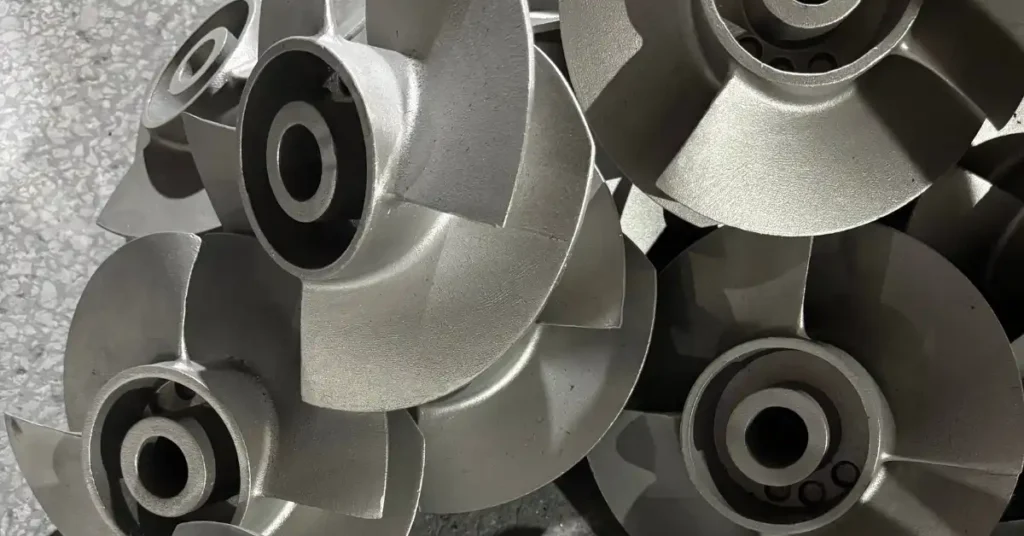
In our foundry, we can cast CG8M by using both investment casting (silica sol) and sand casting, depending on your component size, dimensional tolerance, and surface finish requirements:
- Investment Casting: Ideal for small-to-medium, high-precision components with complex internal passages.
- Sand Casting: Best suited for medium-to-heavy, thick-sectioned pressure parts.
Conclusion
CG8M is the cast equivalent of 317, with 3.0–4.0% molybdenum and a PREn of 31. It outperforms CF8M in chlorides, acids, and bleach service. But chemistry alone isn’t enough — proper foundry control makes the difference. Need a foundry that knows how to handle this grade? At YTD Casting, we’ve got you covered. Send your drawings.
FAQs
Is CG8M suitable for investment casting or sand casting?
CG8M is fully compatible with both processes. Investment casting is typically selected for small, intricate, high-precision components (such as nozzles and small impellers) requiring smooth surface finishes. Sand casting (specifically resin sand) is preferred for larger, heavy-wall pressure-containing parts like large pump casings and big valve bodies.
Is CG8M equivalent to 317L?
No. CG8M is the cast equivalent of 317 (0.08% carbon max). The cast equivalent of 317L is CG3M (0.03% carbon max). The difference is carbon content.
Is CG8M magnetic?
Yes — slightly. While wrought 317 is non-magnetic, cast CG8M contains 5–20% ferrite to prevent hot cracking, which makes it mildly magnetic.
What filler metal should be used to weld CG8M?
ER317L (AWS ER317L). It matches the molybdenum level of CG8M to maintain pitting resistance in the weld zone.
What is the main advantage of CG8M over CF8M?
CF8M contains 2.0–3.0% Mo, whereas CG8M contains 3.0–4.0% Mo. While CG8M carries a higher raw material cost, its higher PREN (~31 vs ~28) significantly extends equipment service life in aggressive chloride, bleach, and acid environments where CF8M prematurely fails.
What ASTM standards cover CG8M?
ASTM A351 for pressure-retaining castings, and ASTM A743 / A744 for general and severe corrosion service.
Does CG8M require heat treatment after welding?
Yes. CG8M needs solution annealing after welding to restore full corrosion resistance. If post-weld heat treatment isn’t practical, consider CG3M (317L) instead.