Hot chamber die casting is used to manufacture small and medium-sized metal parts at high production rates. It is most commonly selected for zinc and certain magnesium alloys because these metals can remain in contact with the machine’s submerged injection system without rapidly damaging it.
For buyers, the main benefit is not simply faster production. Short cycle times can reduce unit cost when annual demand is high enough to justify permanent tooling. However, the process is not suitable for every alloy, component size, or order volume. Material selection, tooling design, surface requirements, machining needs, and expected production quantity should therefore be reviewed before the die is approved.
This guide explains when hot chamber casting is suitable and what buyers should specify when requesting a quotation.
What Is Hot Chamber Die Casting?
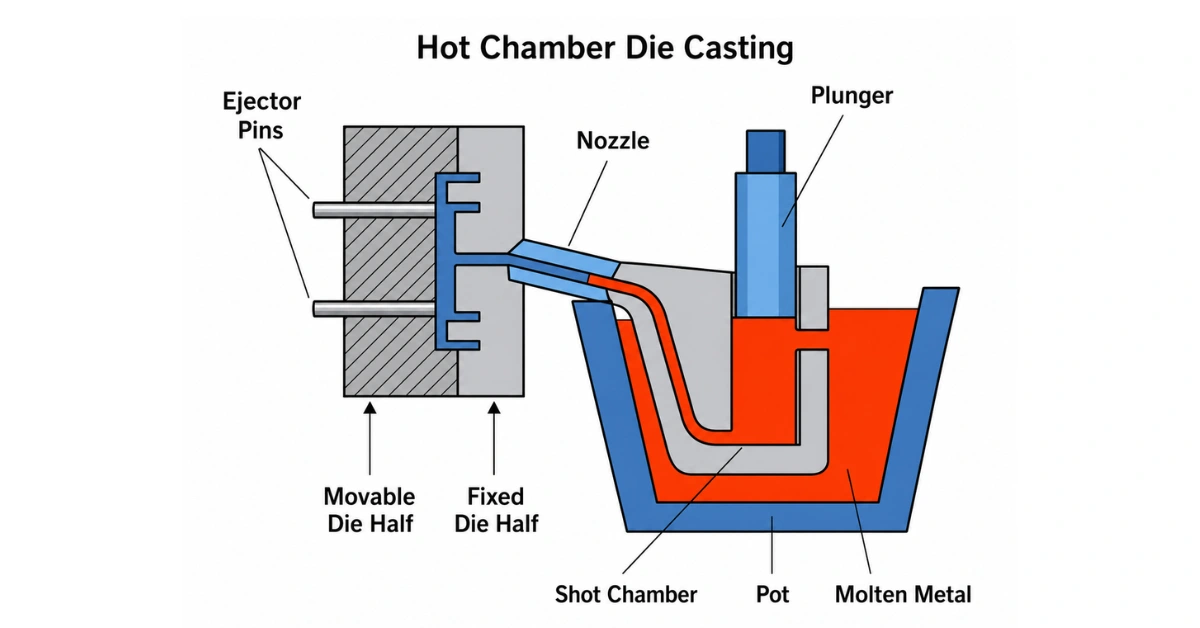
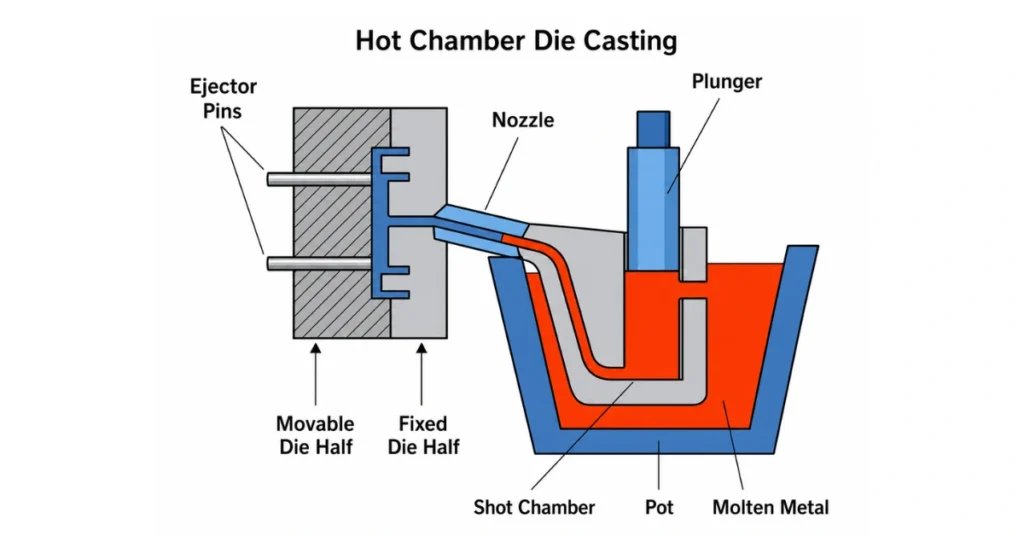
Hot chamber die casting is a type of high pressure die casting in which the injection mechanism is partly submerged in a furnace containing molten metal. A powered plunger forces the metal through a gooseneck and nozzle into a reusable steel die.
Because the metal does not need to be transferred into a separate shot chamber for every cycle, production is faster than conventional cold chamber casting. The North American Die Casting Association identifies this integrated metal-delivery system as the main feature of the process.
Buyers should view hot chamber casting as one specific form of die casting, selected mainly according to alloy compatibility, part geometry, production volume, and required secondary operations.
How the Hot Chamber Die Casting Process Works
The process begins with molten metal held in an integrated furnace. When the die closes, a plunger moves downward and forces metal through the gooseneck and nozzle into the die cavity. Pressure is maintained while the casting solidifies. The die then opens, ejector pins release the part, and excess metal from gates and runners is removed.
Because the injection system remains in contact with the molten alloy, there is no separate ladling stage. This shortens the cycle and reduces temperature loss between the furnace and the die. The result is faster, more consistent production for alloys that are compatible with the submerged components.
For buyers, this matters because cycle speed influences unit cost, production capacity, and delivery planning. However, a fast machine does not guarantee a good part. Die temperature, injection pressure, fill speed, venting, cooling time, and metal cleanliness must still be controlled. These process parameters should be validated during sampling before full production begins.
Which Metals Are Suitable for Hot Chamber Die Casting?
Hot chamber die casting is mainly used for alloys that melt at relatively low temperatures and do not rapidly attack the submerged injection system. Zinc is the most common choice because it offers good fluidity, fine detail, thin-wall capability, dimensional stability, and a surface suitable for plating or decorative finishes.
Selected magnesium alloys may also be processed in hot chamber machines. Magnesium is lighter than zinc and can suit components where weight reduction is important. However, alloy selection, melt protection, machine configuration, and process control require careful review. Buyers should confirm that the supplier regularly casts the specified magnesium grade rather than assuming all magnesium alloys use the same process.
Conventional hot chamber equipment is generally not used for aluminum. Molten aluminum can react with and damage iron-based components that remain immersed in the metal. Most aluminum die casting therefore uses cold chamber machines, where the molten alloy is transferred into a separate shot sleeve for each cycle. Specialized aluminum hot chamber systems exist, but they are not the standard production route.
For buyers, the alloy decision should be based on part weight, strength, corrosion exposure, surface finish, plating requirements, operating temperature, and total cost. Changing from zinc to aluminum or magnesium may require a different machine, die design, wall thickness, and finishing plan.
When Does Hot Chamber Die Casting Make Economic Sense?
Hot chamber die casting becomes most economical when production volume is high enough to spread the tooling cost over a large number of parts. The steel die, slides, cores, trimming tools, and inspection fixtures create significant upfront costs, but the fast cycle can reduce the cost per part during repeat production.
Annual demand alone does not determine the business case. Buyers should also consider the expected program life, number of cavities, part weight, alloy price, machine size, secondary machining, plating, inspection, and likely design changes. A multi-cavity die may increase output, but it also raises tooling complexity and may not be justified when demand is uncertain.
Before approving tooling, buyers should request a cost breakdown separating the die, samples, machining, finishing, inspection, packaging, and production price. The quotation should also state the assumed annual quantity and expected die life.
For prototypes or small orders, machining or another casting process may have a lower total cost despite a higher unit price. Hot chamber casting is strongest where the design is stable, repeat demand is predictable, and short production cycles can recover the tooling investment over the life of the program.
What Parts Are a Good Fit for Hot Chamber Die Casting?
Hot chamber die casting is best suited to relatively small or medium-sized components produced in repeat volumes. The process works particularly well where the part requires thin sections, fine surface detail, close dimensional consistency, or features that would otherwise need several machining operations.
Typical candidates include housings, brackets, handles, connectors, locks, fittings, decorative hardware, and small mechanical components. However, the application name is less important than the geometry and performance requirements. A simple product may still be unsuitable if it contains large heavy sections, severe wall-thickness changes, deep undercuts, or areas that are difficult to vent.
Zinc is often preferred where the design requires thin walls, detailed features, threads, or a plated cosmetic finish. Magnesium may be considered where lower weight is a priority. Buyers should identify visible surfaces, sealing areas, critical dimensions, threaded features, machining locations, and restricted ejector-mark positions before the die is designed.
Surface finishing also affects process selection. Plating, powder coating, painting, polishing, or decorative finishing may require tighter control of porosity, flow marks, flash, and handling damage. The drawing should clearly separate functional surfaces from cosmetic surfaces.
A DFM review should therefore examine not only whether the part can be cast, but whether it can be ejected, trimmed, machined, finished, inspected, and packed without adding avoidable cost or rejection risk.
Quality Risks and Controls in Hot Chamber Die Casting
Hot chamber casting can produce consistent parts, but fast filling and short cycles require stable control of metal temperature, injection settings, die temperature, venting, and cooling.
Gas porosity may form when air is trapped during filling. This becomes important when the part has sealing requirements, deep machining, plating, or a cosmetic finish. Buyers should identify pressure-tight areas and machining depths before tooling so that gates, vents, and overflow locations can be planned accordingly.
Cold shuts or incomplete filling may occur where metal flow meets at a low temperature or thin sections freeze too early. Flash can develop when the die does not close correctly, the parting line wears, or injection pressure is excessive. Dimensional drift may result from die wear, unstable cooling, or changes in process conditions.
For plated zinc parts, surface defects can remain visible after finishing or cause blistering and adhesion problems. Cosmetic surfaces should therefore be identified separately from ordinary functional surfaces.
The inspection plan should match the part’s actual risk. It may include first-article dimensional inspection, visual standards, coating or plating checks, thread inspection, leak testing, and periodic verification of critical dimensions. X-ray inspection should only be specified where internal porosity creates a genuine functional risk.
Before production approval, buyers should review sample parts together with the dimensional report, material certification, surface standard, and any required functional test results.
Hot Chamber vs Cold Chamber Die Casting
The main difference is how molten metal enters the injection system. In hot chamber casting, the injection mechanism remains immersed in the molten alloy. In cold chamber casting, metal is transferred into a separate shot sleeve for each cycle.
Hot chamber machines generally provide shorter cycles and are commonly used for zinc and selected magnesium alloys. Cold chamber machines are slower because of the transfer step, but they can process aluminum and other alloys that would damage a submerged injection system.
Buyers should not select between the two processes based on speed alone. The correct choice depends first on alloy compatibility, followed by part size, wall thickness, required properties, tooling design, surface finish, production volume, and secondary operations.
Where the alloy has already been specified, the machine type may largely be determined. Where material remains flexible, the supplier should compare the complete part cost and performance rather than only the casting cycle.
What Buyers Should Include in the RFQ
A useful RFQ should provide enough information for the supplier to evaluate alloy suitability, tooling requirements, machine size, finishing, inspection, and total production cost.
Buyers should submit the 3D model and a controlled technical drawing identifying the alloy grade, annual quantity, expected program life, critical dimensions, tolerances, threads, machining locations, cosmetic surfaces, and restricted ejector or gate-mark areas. The drawing should also state any plating, coating, polishing, leak testing, or functional requirements.
The quotation should separate tooling, samples, casting, machining, finishing, inspection, packaging, and shipping costs. It should also confirm the assumed cavity count, expected die life, sample approval process, production lead time, and responsibility for tool maintenance or replacement.
Where the design is still flexible, buyers should request a DFM review before approving the die. Early review can identify heavy sections, difficult undercuts, unnecessary machining, unsuitable tolerances, and surface requirements that may increase tooling cost or rejection risk.
Conclusion
Hot chamber die casting is a strong option for repeat production of zinc and selected magnesium parts requiring short cycle times, fine detail, dimensional consistency, or high-quality surface finishes. Its suitability depends on more than production speed: alloy compatibility, part geometry, tooling cost, finishing, inspection, and total program demand must be evaluated together.
Before requesting a quotation, prepare the 3D model, technical drawing, alloy, annual quantity, critical tolerances, surface requirements, and inspection needs. Submit these details to YTD Foundry for a DFM review and project quotation.
FAQs
What metals are used in hot chamber die casting?
Zinc is the most widely used metal because it fills thin sections well, reproduces fine details, and supports plating or decorative finishes. Selected magnesium alloys can also be processed. Lead and tin alloys are technically compatible, although their use depends on product, regulatory, and safety requirements.
Why is aluminum normally not hot chamber die cast?
Molten aluminum can attack conventional iron-based components that remain immersed in the metal. Aluminum parts are therefore normally produced on cold chamber machines, where the alloy is transferred into a separate shot sleeve for each cycle. Specialized aluminum hot chamber systems exist, but they are not the standard route.
Is hot chamber die casting cheaper than cold chamber die casting?
It can provide lower unit costs because it normally operates with shorter cycles. However, the final cost also depends on the alloy, part weight, machine size, tooling complexity, cavity count, machining, finishing, inspection, and annual demand. Buyers should compare total delivered cost rather than cycle time alone.
Is hot chamber die casting suitable for low-volume orders?
It is usually more attractive for repeat production because permanent steel tooling creates a significant upfront cost. For prototypes or small quantities, machining or another casting process may be more economical. The decision should be based on total program demand, design stability, tooling life, and expected future orders.