Investment casting, also known as lost wax casting, is a precision metal casting process used to produce complex parts with tight tolerances, fine details, and excellent surface finish. It is widely used for stainless steel, carbon steel, aluminum, and other alloys where dimensional consistency and near-net-shape geometry matter.
At its core, the process works by creating a wax replica of the part, building a ceramic shell around it, removing the wax, and then pouring molten metal into the resulting cavity. While the principle is straightforward, the final casting quality depends on how well each stage is controlled—from tooling and wax pattern accuracy to shell strength, pouring conditions, and post-cast finishing.
This guide walks through the full investment casting process step by step, explains why each stage matters, and shows how process control affects the quality of the final part.
Investment Casting Process at a Glance
Although the full production route includes many detailed operations, the investment casting process can be understood in seven core stages:
- Tooling or pattern preparation– create the mold or pattern used to form wax replicas
- Wax pattern making– produce accurate wax versions of the final part
- Tree assembly– attach multiple wax patterns to a central runner system
- Ceramic shell building– build a heat-resistant shell around the wax tree
- Dewaxing and shell firing– remove the wax and strengthen the ceramic mold
- Melting and pouring– melt the alloy and fill the shell cavity with molten metal
- Shell removal, finishing, and machining– separate castings, clean them, and bring them to final specifications
Each of these stages affects the final result in a different way. Pattern accuracy influences geometry and surface quality, shell building determines mold strength and detail reproduction, and pouring plus finishing ultimately affect internal soundness, dimensional control, and delivery condition.
Why Process Control Matters in Investment Casting
Investment casting is often chosen because it can produce shapes that would be difficult, expensive, or inefficient to machine from solid material. But that advantage only holds if the process is controlled correctly.
In practice, the most important quality factors usually come from five areas:
- Wax pattern accuracy– affects dimensional consistency and surface detail from the very beginning
- Tree and gating design– influences metal flow, feeding efficiency, yield, and defect risk
- Shell quality and drying control– affects surface finish, shell strength, and pouring reliability
- Melting and pouring control– determines alloy chemistry, fill quality, and the risk of shrinkage or gas-related defects
- Post-cast finishing and machining– ensures the raw casting becomes a shipment-ready component that meets drawing requirements
For this reason, a good investment casting supplier is not simply one that can “pour metal,” but one that can keep the entire process under control from tooling through finishing.
Step 1: Tooling and Mold Manufacturing
For production investment castings, the process usually begins with tooling. A metal mold is manufactured based on the customer’s part drawing or 3D model and is then used to produce wax patterns with repeatable geometry.
Depending on part complexity, production volume, and dimensional requirements, tooling may be made from aluminum alloy, copper alloy, or tool steel. Common manufacturing methods include CNC machining and EDM, especially when the pattern contains fine details, shut-offs, or complex internal features.
Why the mold matters
The quality of the tooling directly affects the consistency of the wax patterns, which means it also affects the consistency of the final castings. Errors introduced at the tooling stage tend to carry through the entire process, so dimensional compensation and mold design need to be addressed early.
Key considerations typically include:
- Shrinkage allowance– the tool must account for metal shrinkage during solidification and cooling, as well as wax and shell-related dimensional changes
- Parting line design– parting locations should be planned to reduce flash, simplify pattern removal, and minimize downstream grinding
- Pattern ejection and mold life– the tooling must support stable production without damaging delicate pattern features
For prototype or low-volume projects, tooling-free routes such as 3D printed wax patterns may also be used instead of a conventional injection mold.
Step 2: Wax Pattern Making
Once the tooling is ready, wax patterns are produced as exact replicas of the final casting geometry. These patterns form the basis of the ceramic mold, so their dimensional accuracy and surface condition are critical to the entire process.
There are two common ways to create investment casting wax patterns:
Injection wax patterns
For production work, molten wax is injected into a metal die under controlled pressure using a wax injection machine. This method offers good repeatability and is the standard choice for medium- to high-volume production.
Process parameters such as wax temperature, injection pressure, holding time, and cooling conditions must be adjusted according to the part geometry and wall thickness. If the pattern cools unevenly or deforms during removal, dimensional variation will be carried into the final casting.
3D printed wax patterns
For prototypes, bridge production, or parts with very complex geometry, wax patterns can also be produced directly from 3D data using additive manufacturing. This avoids tooling cost and shortens development lead time, making it useful for low-volume or design-validation work.
Why the wax pattern matters
Wax patterns are not just temporary shapes—they define the geometry that the ceramic shell will reproduce. Pattern quality directly influences:
- dimensional accuracy of the casting
- surface finish and detail reproduction
- stability of thin walls, edges, and small features
- consistency from one casting batch to the next
In some projects, wax material selection also matters. Different wax systems may be chosen depending on pattern rigidity, dimensional stability, soluble core requirements, and production efficiency.
Step 3: Wax Pattern Finishing and Inspection
After the wax patterns are removed from the tooling, they are inspected and finished before assembly. Small flashes, gate marks, mold-release residue, or parting line imperfections are removed at this stage.
This may seem like a minor operation, but it is important because the ceramic shell reproduces the wax surface in detail. Any visible imperfection left on the wax pattern can transfer into the shell and then into the final metal part.
Why inspection for wax pattern matters
Proper wax finishing helps improve:
- surface consistency of the final casting
- dimensional stability at parting lines and edges
- shell integrity during slurry coating
- overall cosmetic quality before any metal is ever poured
For appearance-critical or tight-tolerance components, wax inspection and cleanup are often more important than they first appear.
Step 4: Tree Assembly and Gating Design
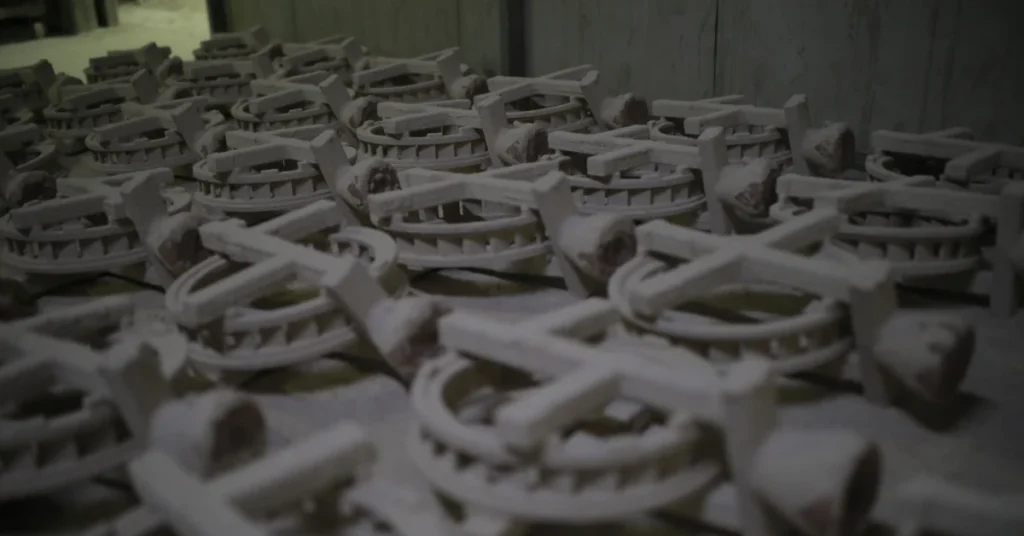
To improve efficiency, individual wax patterns are attached to a central wax runner system to form a wax tree or cluster. This allows multiple parts to be cast in one shell and creates the flow path through which molten metal will later enter the mold.
But tree assembly is not just a matter of attaching parts together. It is also the stage where the gating and feeding logic of the casting system is established.
What happens in this step
Wax patterns are welded to a central sprue and arranged in a layout designed to suit the size, weight, geometry, and feeding requirements of the part. The number of patterns on each tree depends on the casting weight, shell size, and the flow behavior required for the alloy being poured.
Why this step matters
Tree layout and gating design affect several critical outcomes:
- metal flow into the mold
- feeding efficiency during solidification
- casting yield and material utilization
- risk of shrinkage porosity, misruns, or cold shuts
- shell coating access between parts
If patterns are placed too close together, slurry and refractory sand may not coat the gaps properly, which can weaken the shell. If the gating layout is poorly designed, the metal may fill unevenly, trap air, or fail to feed heavy sections during solidification.
For this reason, tree design is one of the most important engineering steps in investment casting, especially for thin-wall parts, complex geometries, or castings with a large section-thickness variation.
Step 5: Tree Cleaning
Before shell building begins, assembled wax trees are cleaned to remove dust, fingerprints, mold-release residue, and other contaminants from the wax surface. Cleaning may be done by immersion, spray washing, ultrasonic cleaning, or manual brushing, depending on the part and production setup.
Why this step matters
A clean wax surface improves bonding between the wax tree and the ceramic slurry used in the next stage. If contamination remains on the wax, it can lead to shell defects, poor face-coat adhesion, or surface inclusions on the final casting.
Although it is a relatively simple operation, tree cleaning supports shell quality and surface consistency later in the process.
Step 6: Ceramic Shell Building
Ceramic shell building is one of the most critical stages in the investment casting process. Its purpose is to create a strong, dimensionally stable, heat-resistant mold around the wax tree—one that can survive dewaxing, shell firing, and contact with molten metal while still reproducing fine surface detail.
How the shell building works
The wax tree is repeatedly dipped into a liquid ceramic slurry and then coated with refractory sand or stucco. After each coat, it is dried under controlled conditions before the next layer is applied. This cycle is repeated multiple times until the required shell thickness and strength are reached.
A typical shell is built in layers:
- Primary or face coat– uses finer refractory materials to capture surface detail and produce a smoother casting surface
- Backup coats– use coarser refractory materials to build shell thickness, strength, and permeability
Depending on the alloy, part geometry, and shell system, refractory materials may include zircon, fused silica, mullite, corundum, or other ceramic media. Common binder systems include silica sol for higher precision and surface quality, and water glass where lower cost or different production priorities apply.
Why shell building matters
Shell quality has a direct impact on:
- surface finish of the casting
- dimensional fidelity to the wax pattern
- shell strength during dewaxing and pouring
- filling reliability for thin-wall or detailed features
- resistance to shell cracking, leakage, or erosion during pouring
Critical process controls in shell building
Shell building is also one of the most process-sensitive stages. Important controls include:
Slurry consistency
The viscosity and composition of the slurry must be kept within the correct range so the shell coat is uniform and stable.
Particle gradation between layers
The face coat and backup coats should be designed as a system. Fine materials help capture detail, while coarser materials build strength and permeability.
Drying temperature and humidity
Each layer must dry under controlled environmental conditions. If drying is too aggressive, the shell can crack; if drying is incomplete, the shell may remain weak or unstable between coats.
Drying time
Each coat needs enough time to cure before the next layer is added. Rushing the shell-building cycle increases the risk of delamination, poor shell strength, and shell failure during dewaxing or pouring.
In many investment casting operations, shell building is the longest stage in the entire process, but it is also one of the most important for quality consistency.
Step 7: Dewaxing
Once the ceramic shell has reached the required strength, the wax inside must be removed to create a hollow mold cavity. This is the dewaxing stage.
In industrial investment casting, dewaxing is typically carried out in a steam autoclave or other rapid-heating system. The goal is to remove the wax quickly while minimizing stress on the ceramic shell.
Why dewaxing matters
Dewaxing is more complicated than simply melting the wax out. Wax expands as it heats, and if that expansion is not controlled properly, it can crack the ceramic shell before the shell is ever poured.
Rapid dewaxing helps minimize this risk by melting and draining the wax before excessive internal pressure builds inside the shell. A stable dewaxing process helps protect:
- shell integrity
- cavity accuracy
- downstream pouring reliability
- final casting quality
Recovered wax is often filtered and reused in non-critical wax applications such as runner or gating wax, depending on the foundry’s wax management system.
Step 8: Shell Firing and Preheating
After dewaxing, the ceramic shell still needs to be fired at high temperature. Shell firing serves two main purposes:
- to sinter and strengthen the ceramic shell
- to remove residual wax, moisture, and organic residues before pouring
The dewaxed shell is placed in a high-temperature furnace and heated according to the shell system and alloy requirements. This stage converts the green shell into a stronger ceramic mold capable of withstanding the thermal shock and metallostatic load of molten metal.
Why shell firing matters
Shell firing affects:
- final shell strength and thermal stability
- shell cleanliness before pouring
- resistance to thermal shock
- casting surface quality and gas-related defect risk
A properly fired shell is also commonly preheated before pouring rather than being allowed to cool completely. Pouring into a hot shell helps maintain metal fluidity, reduces thermal shock, and improves filling of thin sections or intricate features.
Step 9: Alloy Melting
While shell preparation is taking place, the casting alloy is melted and conditioned for pouring. The exact melting route depends on the alloy system, batch size, and quality requirements. Common melting equipment may include medium-frequency induction furnaces or vacuum induction furnaces for specialized materials.
What happens in alloy melting
Raw charge materials are loaded into the furnace and melted under controlled conditions. During melting, the foundry monitors temperature, chemistry, slag formation, and melt cleanliness to ensure the metal is suitable for pouring.
Why alloy melting matters
Melting is not just about turning solid metal into liquid metal. It is the stage where alloy chemistry, melt cleanliness, and temperature control are stabilized before the metal enters the mold. Poor melting practice can lead to:
- chemistry drifting outside specification
- oxide or slag inclusions
- inconsistent pouring temperature
- higher defect risk in the final casting
Key controls in alloy melting
Typical controls at this stage include:
- chemical composition verificationbefore pouring
- temperature monitoringbased on alloy and part requirements
- slag removal and melt cleaningto reduce inclusions
- batch traceabilityfor quality control and certification requirements
For critical castings, composition is often checked with a spectrometer before the metal is released for pouring.
Step 10: Pouring
Pouring is the stage where molten metal enters the ceramic shell and fills the cavity created by the wax pattern. It is one of the most visible steps in the process, but its success depends heavily on the quality of all the upstream steps—especially shell building, shell firing, gating design, and melt preparation.
What happens when pouring metal
The fired shell is transferred for pouring, and molten metal is introduced through the pouring cup into the gating system and part cavities. The metal then fills the mold, begins to solidify, and ultimately forms the final casting geometry.
Why pouring matters
Pouring conditions strongly influence:
- filling of thin sections and fine details
- turbulence and air entrapment
- mold erosion risk
- feeding during solidification
- surface quality and internal soundness
Critical process controls
Pouring temperature
Each alloy has its own suitable pouring range. If the temperature is too high, it can increase mold erosion, oxidation, or grain coarsening. If it is too low, the metal may lose fluidity too early and cause misruns or cold shuts.
Pouring speed and flow stability
The metal must enter the shell smoothly and consistently. Unstable flow can increase turbulence, air entrapment, and oxide-related defects.
Shell temperature at pouring
Shell preheat temperature affects how quickly the metal loses heat after entering the cavity. This is especially important for thin-wall or highly detailed parts.
Pouring is therefore best understood not as a standalone action, but as the final execution of all the engineering work done earlier in the process.
Step 11: Cooling, Shell Removal, and Cut-Off
After pouring, the metal is allowed to solidify and cool under controlled conditions. Once the casting tree has cooled sufficiently, the ceramic shell is removed and the individual parts are separated from the gating system.
Shell removal may involve vibration, impact, or other mechanical methods, followed by cutting or grinding to separate the parts from the runner system.
Why this step matters
This stage affects:
- the condition of the casting surface after shell removal
- the amount of grinding or finishing required
- the risk of damaging thin or delicate features during knockout
- the efficiency of downstream processing
Although this is a later-stage operation, poor shell removal or cut-off practice can still create unnecessary cosmetic or dimensional issues if handled too aggressively.
Step 12: Finishing, Heat Treatment, Machining, and Inspection
At this point, the part is no longer just a raw casting—it is entering the stage where it becomes a finished component ready for assembly or shipment.
Depending on the part requirements, post-cast operations may include:
- gate grinding and surface cleanup
- shot blasting or sand blasting
- straightening where required
- weld repair if permitted by specification
- heat treatment to achieve required mechanical properties
- CNC machining of critical features
- dimensional inspection and final quality checks
Why post-processing matters
The final delivery condition of an investment casting is often determined here. Even if the raw casting is sound, the part still has to meet the customer’s drawing, tolerance, surface, and performance requirements.
This stage is also where the value of a full-service supplier becomes clear. A foundry that can combine casting with in-house heat treatment, machining, and inspection can reduce handoff risk, simplify sourcing, and provide better control over the full route from raw casting to finished part.
Key Quality Controls Throughout the Investment Casting Process
Although investment casting involves many individual operations, several quality controls have an outsized impact on the final result.
1. Dimensional control starts at the pattern stage
The final casting can only be as accurate as the pattern and shell system allow. Tooling design, wax stability, and shrinkage compensation all begin affecting dimensions before metal is ever poured.
2. Gating design determines more than just fill
A good tree layout supports not only mold filling, but also feeding, yield, and defect reduction. Poor gating design can lead to shrinkage, turbulence, incomplete filling, and unnecessary scrap.
3. Shell quality is central to both surface finish and casting soundness
Shell building affects detail reproduction, shell strength, gas permeability, and resistance to cracking or erosion. In many cases, shell quality is one of the biggest separators between a stable casting process and an inconsistent one.
4. Melt chemistry and cleanliness must be verified before pouring
Chemical composition, slag control, and melt temperature all need to be checked before the alloy enters the shell. Once the metal is poured, most chemistry-related mistakes cannot be corrected.
5. Post-cast operations are part of quality, not just cleanup
Heat treatment, machining, straightening, and inspection are not “extra” steps—they are part of the route that turns a casting into a qualified component.
When Is Investment Casting the Right Choice?
Investment casting is especially well suited to parts that require:
- complex geometry that would be difficult or costly to machine
- good surface finish and finer detail than sand casting can typically provide
- tight dimensional consistency in the as-cast condition
- near-net-shape production to reduce machining time and material waste
- internal features, thin walls, or shape complexity that benefit from a precision mold process
- medium-volume production, where tooling cost can be justified by part complexity and repeatability needs
It is commonly used in industries such as automotive, motorsport, pump and valve systems, machinery, marine hardware, agricultural equipment, food machinery, and general industrial components.
Investment casting may be less suitable for very large low-precision parts, extremely simple geometries that are easier to machine or fabricate, or ultra-high-volume non-ferrous parts better suited to die casting.
What a Full-Service Investment Casting Supplier Should Be Able to Support
If you are sourcing custom investment castings, the process itself is only part of the evaluation. You also need to understand what the supplier can control in-house.
A capable investment casting manufacturer should be able to support most or all of the following:
- tooling design and wax pattern development
- conventional wax injection and, where needed, rapid pattern routes
- tree assembly and gating engineering
- silica sol or water glass shell systems depending on project needs
- controlled dewaxing, shell firing, and alloy melting
- material verification and process traceability
- heat treatment, surface finishing, and machining
- final inspection and shipment in raw cast, semi-finished, or fully machined condition
The more of these steps are managed under one roof, the easier it is to control lead time, quality consistency, and responsibility across the project.
Final Thoughts
Investment casting is often described as a precision casting process, but precision does not come from the process name alone. It comes from how well each stage is controlled—tooling, wax patterns, tree design, shell building, dewaxing, shell firing, melting, pouring, and finishing all contribute to the final result.
For buyers and engineers, understanding the process helps explain why some suppliers deliver stable, repeatable castings while others struggle with variation, defects, or excessive secondary work. For manufacturers, it highlights where quality is really built: long before the metal reaches the mold.
Investment Casting Service Provided by YTD
At YTD Casting, we manage investment casting as a complete manufacturing route rather than a single foundry operation. From tooling and wax pattern production to shell building, pouring, post-processing, and machining, our goal is to help customers move from drawing to finished component with better process control, consistent quality, and fewer handoff risks.
If you have a custom investment casting project, send us your drawing or 3D file. Our team can review the part, recommend a suitable casting route, and quote both raw cast and fully machined options.
FAQs
What is the minimum wall thickness achievable in investment casting?
It depends on the alloy, part size, and geometry, but investment casting can generally support thinner walls than sand casting and is well suited to parts with fine detail and relatively thin sections. The practical minimum should be evaluated together with the supplier based on the actual part design.
Why is shrinkage allowance considered during tooling design?
Because the final casting changes dimension at multiple stages—wax cooling, shell formation, metal solidification, and post-cast cooling. Tooling must compensate for these changes so the finished casting stays within the required tolerance range.
What is the difference between silica sol and water glass investment casting?
Silica sol systems are typically used when better surface finish, tighter dimensional control, and higher process stability are required. Water glass systems can be more cost-effective for some parts, depending on size, quality requirements, and production priorities.
Why is shell building so important in investment casting?
Because the shell is the mold that directly receives molten metal. Its strength, permeability, dimensional stability, and surface quality all affect the final casting result.
How do you prevent porosity or gas-related defects?
Defect prevention usually requires a combination of good gating design, proper shell firing, controlled pouring practice, clean melt handling, and process control during solidification. There is rarely a single “fix”; it is the result of the full process working correctly.
Can investment castings be delivered fully machined?
Yes. Many projects require more than a raw casting. Depending on the supplier’s in-house capability, parts can often be delivered with heat treatment, machining, surface finishing, and final inspection completed before shipment.