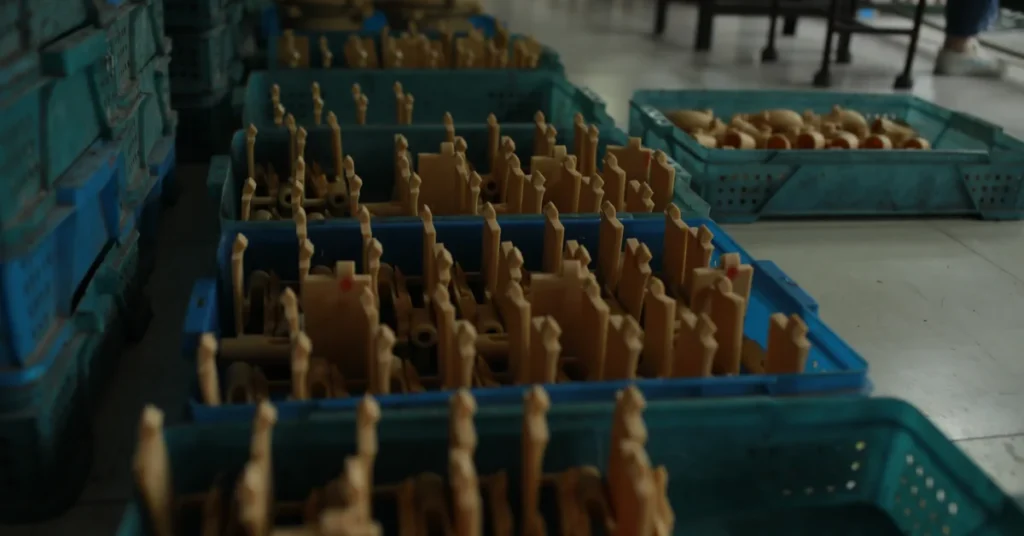
A wax pattern is the sacrificial shape used to create the ceramic mold in investment casting. It represents the future casting, but it is not simply an exact wax copy of the finished part. Its dimensions may already include compensation for wax shrinkage, metal shrinkage, and later machining.
Because the ceramic shell reproduces the pattern, dimensional errors, distortion, flash, and surface defects created in the wax room can continue into the metal casting.
What Is a Wax Pattern in Investment Casting?
A wax pattern is a temporary positive model of the component that will later be cast in metal.
For industrial repeat production, the pattern is normally produced by injecting prepared pattern wax into reusable tooling. Once the wax has cooled sufficiently, the tool opens and the solid pattern is removed.
The Investment Casting Institute identifies wax injection into a die as the conventional industrial route while also recognizing additively manufactured sacrificial patterns as an alternative for suitable projects.
Investment Casting Institute: Wax Pattern Creation
The terminology is important.
A wax pattern is not the reusable mold used to produce it. The reusable metal tool is the wax injection tooling or pattern die.
It is also not the ceramic mold that eventually contains molten metal. That mold is created later by building a refractory shell around the pattern.
The relationship is:
wax tooling → wax pattern → ceramic shell cavity → metal casting
YTD explains these distinctions in more detail in its guide to Investment Casting Mold: Wax Tooling, Ceramic Cores & Shell Molds.
How Production Wax Patterns Are Made by Wax Injection
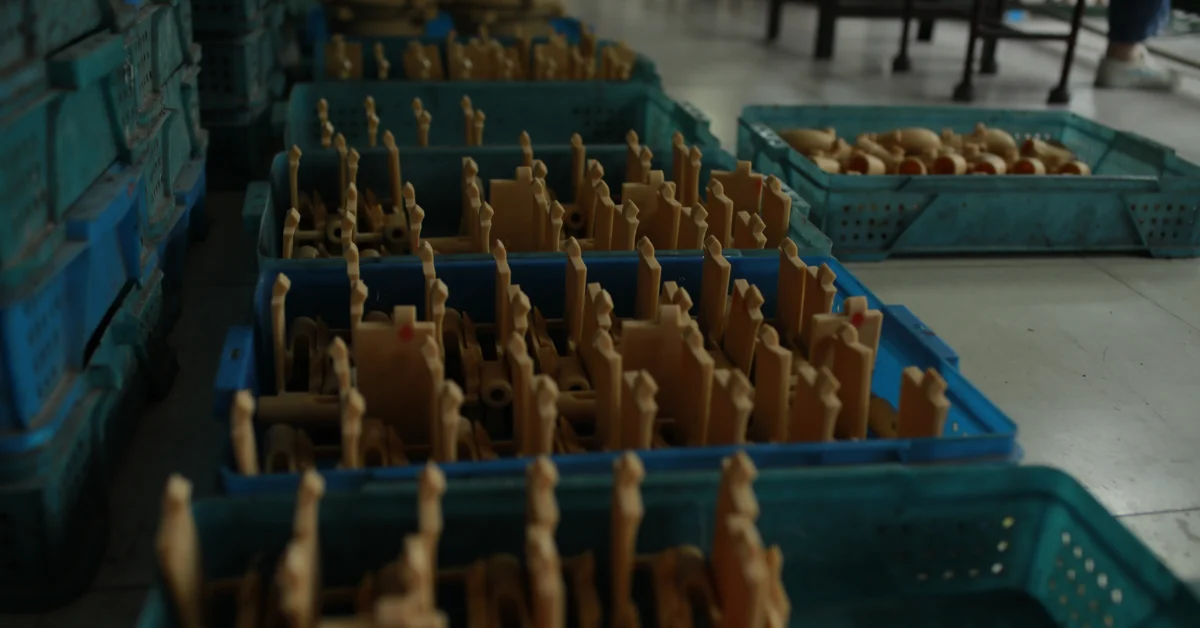
For repeat production, wax injection is normally preferred because one reusable tool can produce large numbers of similar patterns.
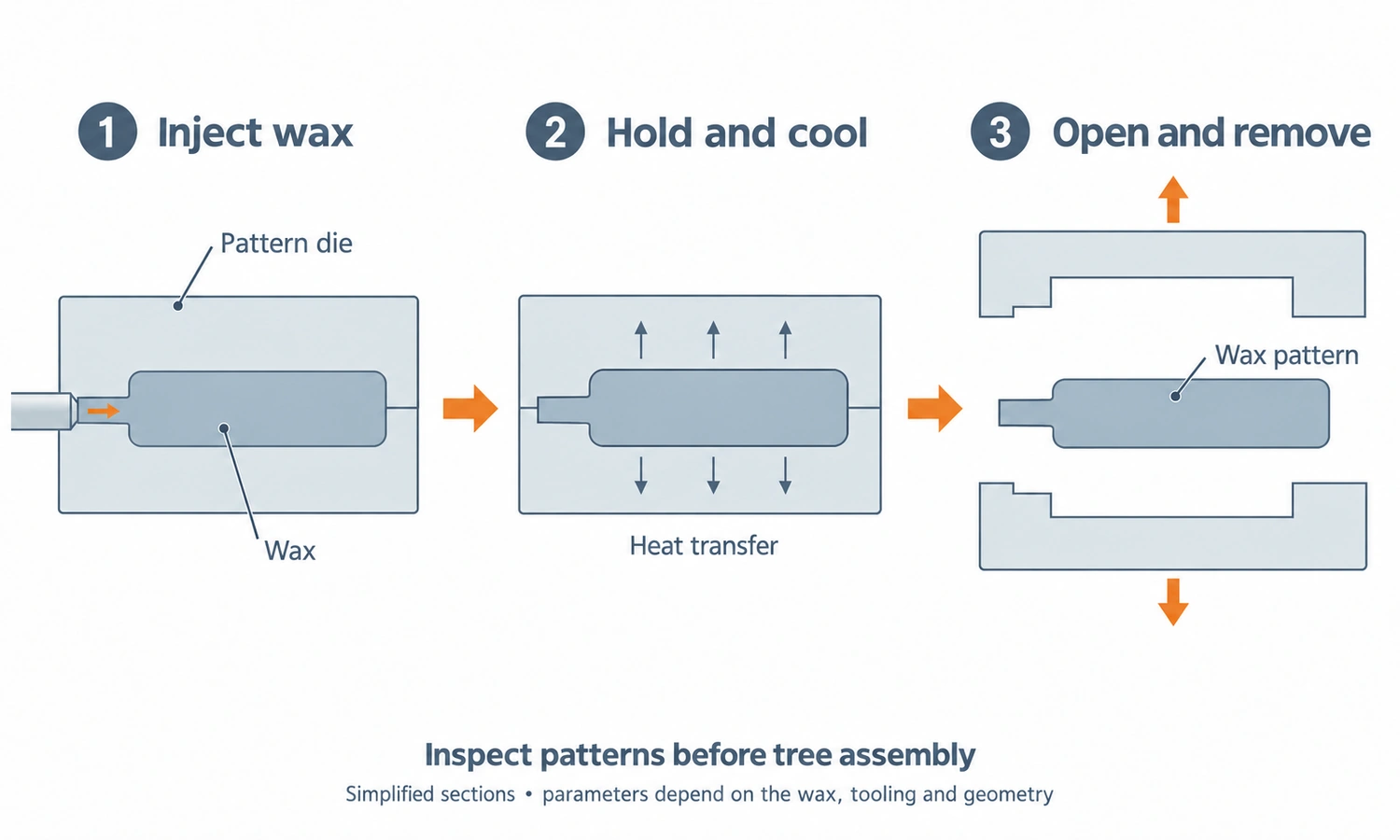
The tool is first prepared and brought into a controlled operating condition. Pattern wax is then injected into the cavity, where it fills the geometry and begins transferring heat into the tooling.
The injection stage is followed by holding, packing, and cooling. The exact sequence and parameters depend on the wax system, tooling, and geometry rather than one universal recipe.
Once the pattern has become sufficiently stable, the tool opens and the wax part is removed.
That sounds similar to plastic injection molding, but wax behaves differently. It is relatively soft, thermally sensitive, and capable of continuing to shrink or distort as it cools.
A pattern removed too early may still be soft enough to deform. Keeping it constrained inside the tooling for a different amount of time can also change the dimensional result.
Research into investment-casting pattern accuracy consistently shows that injection temperature, die temperature, pressure, holding or dwell time, wax properties, and component geometry interact to determine the final pattern dimensions.
This is why wax injection is a controlled manufacturing process rather than simply “filling a mold with melted wax.”
Wax Pattern Dimensions Include Process Allowances and Shrinkage Compensation
Wax patterns are often described as exact replicas of the desired casting.
That description is useful for explaining the basic process, but it can be misleading from an engineering perspective.
The pattern tooling has to anticipate several dimensional changes that occur later.
First, the wax changes dimension between injection and its stable condition.
Later, the ceramic shell can contribute additional dimensional effects.
Finally, the molten alloy contracts as it solidifies and cools.
If the casting will be machined, selected surfaces may also need intentional machining allowance.
The complete dimensional chain is therefore closer to:
tooling dimension → wax pattern dimension → shell cavity dimension → as-cast dimension → finished machined dimension
Oak Ridge National Laboratory describes wax-pattern dimensions as the result of thermal expansion and contraction, deformation, material properties, tooling restraint, and process variables such as die temperature, injection pressure, injection temperature, and dwell time.
ORNL: Material Properties for Predicting Wax Pattern Dimensions
This also explains why there is no reliable universal statement such as:
“Wax always shrinks by exactly 1%.”
A shrinkage allowance that works for one geometry, tooling design, wax formulation, and process condition should not automatically be copied to another part.
The correct allowance comes from a combination of material knowledge, process experience, tooling design, and actual pattern and casting measurements.
Wall Thickness and Part Geometry Change Wax Pattern Shrinkage and Distortion
Wax does not necessarily shrink uniformly throughout a complex pattern.
Consider a component with a thick boss connected to a thin wall.
The thin region loses heat quickly, while the heavy section remains warm for longer. The two areas therefore do not reach a stable condition at the same time.
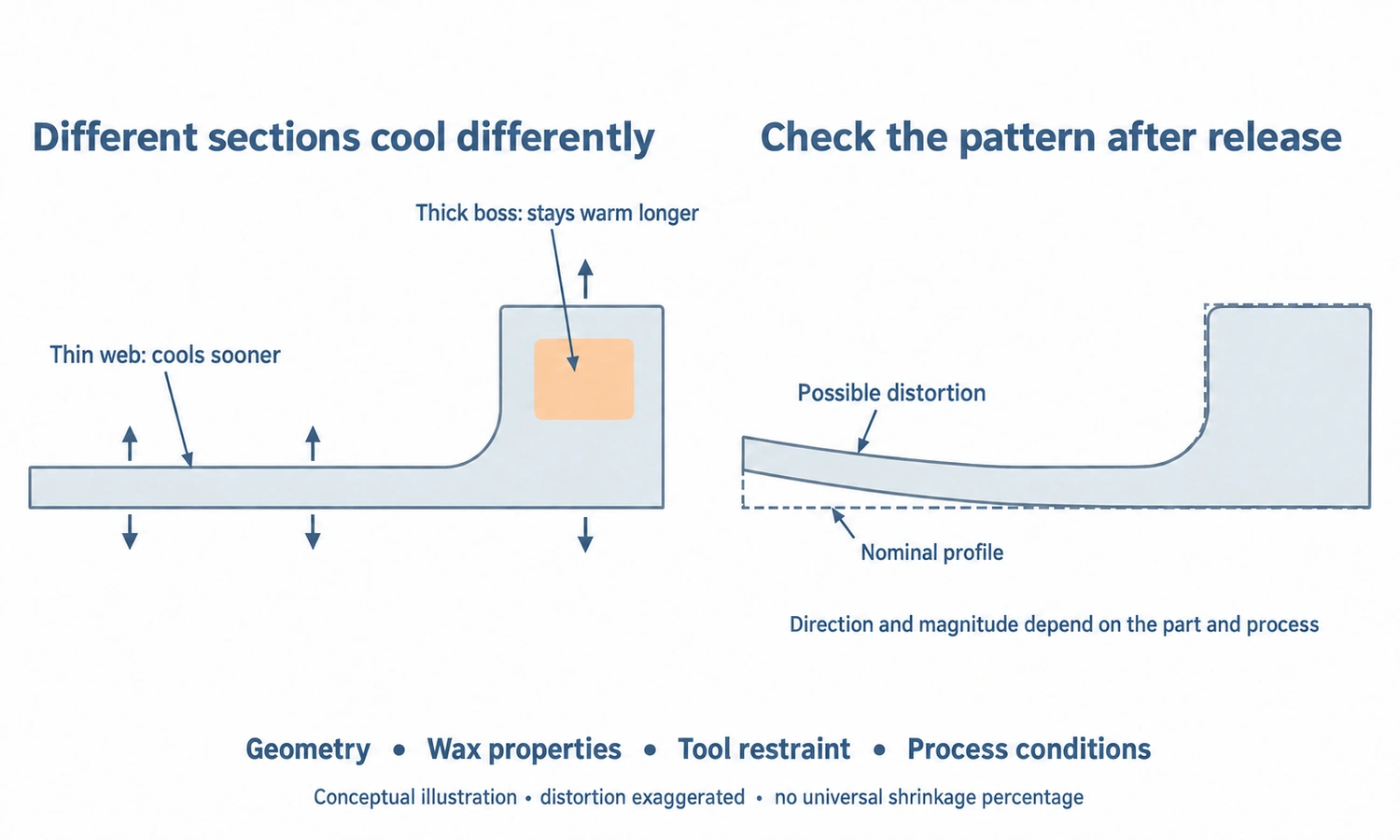
Tooling also constrains some dimensions more strongly than others while the pattern is inside the die.
Once the pattern is removed, those constraints disappear.
This is why the geometry of the component matters just as much as the nominal shrinkage behavior of the wax.
Experimental work on wax-pattern dimensional stability has shown that section thickness and geometry significantly influence dimensional variation, and that thicker sections can behave differently from thinner ones under the same nominal injection conditions.
For a foundry, dimensional control therefore cannot consist only of measuring one simple test bar and applying the same percentage to every feature on a complex casting.
Critical dimensions have to be evaluated according to the actual component.
Injection Pressure, Temperature, Holding Time, and Cooling Affect Pattern Accuracy
Wax injection parameters do not act independently.
Raising pressure may help fill certain features but also changes cavity pressure and packing behavior.
Changing wax temperature alters flow behavior and cooling.
Holding time determines how long the pattern remains constrained inside the tool while it solidifies.
Tool temperature affects heat transfer between the wax and the die.
Research comparing different wax-injection conditions shows that holding time and packing pressure can significantly affect dimensional stability, while the relative importance of individual parameters changes with tooling and geometry.
This is why statements such as:
“Higher wax pressure gives better patterns”
or
“Lower wax temperature always reduces shrinkage”
are too simplistic.
The foundry develops a process window in which the cavity fills correctly, the pattern remains dimensionally stable, and the wax can be removed without damage.
The purpose of process control is repeatability—not maximizing one injection parameter.
Ceramic and Soluble Cores Can Be Incorporated Into Wax Patterns
Some castings contain internal geometry that cannot be created by the external wax pattern alone.
A ceramic core can be positioned inside the wax injection tool before injection. Wax is then formed around the core, creating a composite pattern with wax on the outside and ceramic defining selected internal passages.
The ceramic core remains after dewaxing and occupies space during metal pouring. After the alloy has solidified, the ceramic material is removed to reveal the internal passage.
Soluble wax cores provide another option for certain geometries. A removable core can first create an internal feature within the main wax pattern and then be dissolved or otherwise removed before the ceramic shell reaches later stages.
The important principle is that the internal geometry has to be controlled just as carefully as the external wax surface.
A displaced or distorted core can create incorrect wall thickness even when the outside of the wax pattern looks perfect.
For complex cored castings, pattern inspection therefore includes not only the external geometry but also core positioning where applicable.
Common Wax Pattern Defects and Their Effect on the Final Casting
Wax-pattern defects matter because the ceramic shell copies what it sees.
The Investment Casting Institute maintains an entire Atlas of Wax Pattern Defects, emphasizing that pattern quality is an important starting point for producing consistent castings. Its defect categories consider the interaction among wax material, pattern dies, equipment, cores, and injection conditions.
Investment Casting Institute: Atlas of Wax Pattern Defects
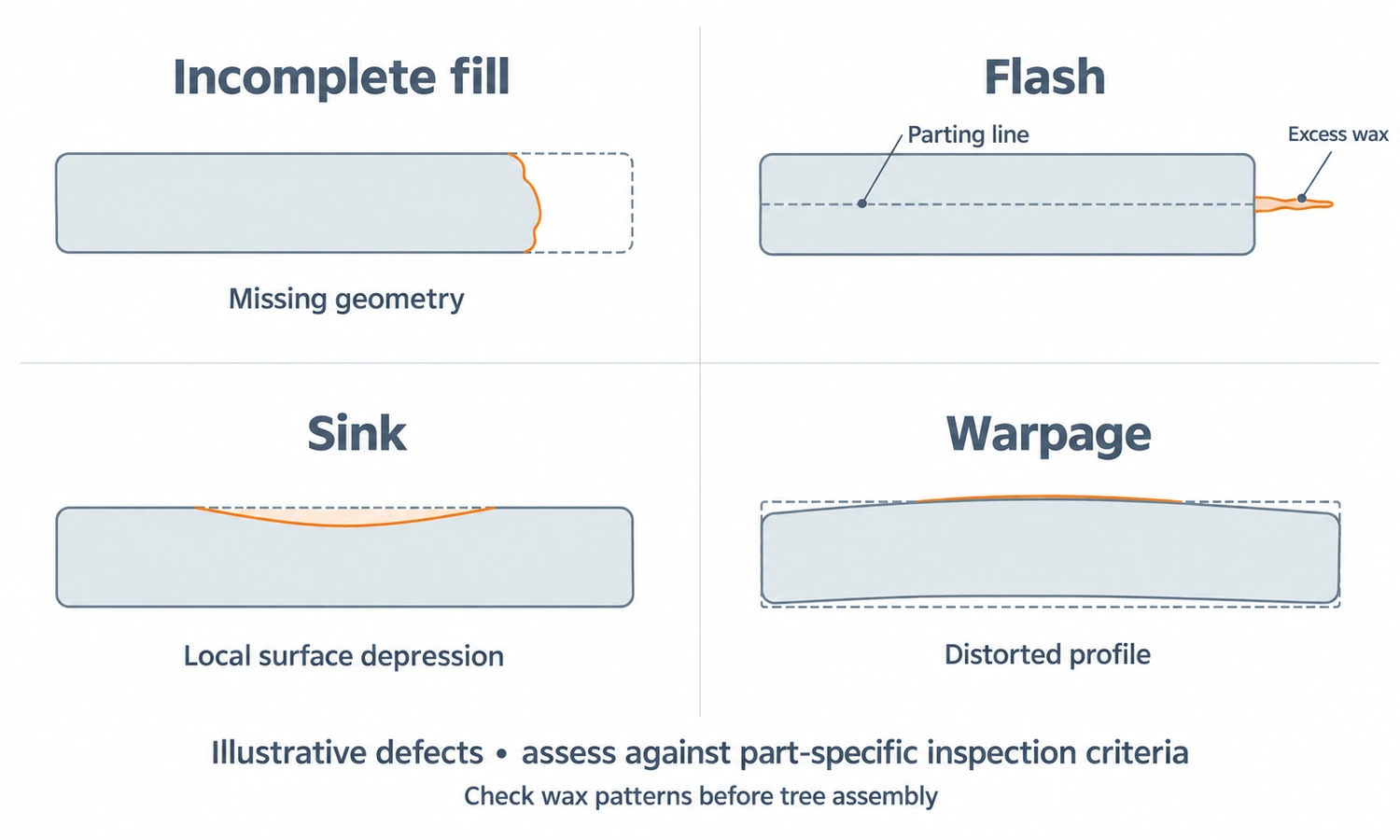
Several defects are particularly important in industrial production.
| Wax Pattern Problem | What It Means for Production |
|---|---|
| Incomplete fill / misrun | Wax has not completely reached part of the tooling cavity |
| Air bubbles or internal voids | Gas has been trapped during wax preparation or injection |
| Sink or local shrinkage | Heavy sections have contracted as the wax cooled |
| Flow or knit lines | Separate wax flow fronts have met or cooled during filling |
| Flash | Wax has entered gaps at tooling parting surfaces or inserts |
| Distortion / warpage | Pattern geometry has moved during cooling, ejection, or handling |
| Cracks or damaged features | Pattern was stressed during molding, removal, handling, or assembly |
Not every visible mark on wax automatically creates a rejected metal casting, and foundries may have approved repair practices for minor pattern imperfections.
But significant dimensional errors, distortion, cracks, or unstable geometry should not simply be hidden during wax finishing.
Once an unacceptable pattern enters shell building, every later operation adds cost to a problem that already existed.
Wax Patterns Should Be Inspected Before They Are Assembled Into a Tree
One of the most economical places to reject a defective investment casting is while it is still made of wax.
At this point, no ceramic shell has been built and no alloy has been melted or poured.
Inspection therefore happens before tree assembly.
The foundry may check critical dimensions, surface condition, parting-line flash, completeness of small features, distortion, gate connection areas, and core location where applicable.
The inspection method depends on the component.
A simple production part may use dedicated gauges and visual standards. More dimensionally demanding patterns may require conventional measurement equipment or CMM inspection during tooling approval and first-article development.
The objective is not necessarily to measure every dimension on every wax pattern.
It is to control the characteristics most likely to affect the later casting and confirm that the established wax-injection process remains stable.
This is an important difference between pattern inspection and final casting inspection.
The pattern is checked to prevent process errors from moving downstream. The finished casting is later checked against the actual customer drawing and material requirements.
Individual Wax Patterns Become a Wax Tree Before Shell Building
After inspection, individual patterns are attached to the wax gating system.
Multiple patterns may share a central sprue, forming what is commonly called a wax tree, cluster, or assembly.
The joints between the patterns and the sprue are not temporary in a geometric sense.
After dewaxing, the spaces occupied by those wax joints become gates through which molten metal travels into the casting cavities.
Pattern assembly therefore connects two separate manufacturing concerns:
wax handling and metal-flow design
A tree must hold the patterns securely during shell building, but its spacing, orientation, and gate positions also affect shell access, metal filling, solidification, casting yield, and later cut-off.
YTD explains this stage in detail in Wax Tree for Casting: Assembly, Gating, Yield & Design.
The key point for this article is that wax-pattern production is complete before tree design begins, but the quality of those patterns determines the quality of the assembly available to the next stage.
The Ceramic Shell Copies the Wax Pattern Surface and Geometry
Once the tree is assembled, ceramic shell building begins.
The wax assembly is repeatedly coated with ceramic slurry and refractory particles until the mold has enough thickness and strength for dewaxing and metal pouring.
At this point, the pattern becomes the master surface from which the ceramic cavity is created.
A tooling line, wax repair, surface defect, flash, or small geometric feature can therefore be transferred into the shell.
That relationship explains why wax-pattern surface quality matters even though the wax itself never becomes part of the finished component.
After the shell is complete, the wax is removed.
The Investment Casting Institute’s process description shows this progression from pattern creation to assembly and ceramic mold formation.
YTD’s Investment Casting Process: Step-by-Step Guide follows the complete sequence from pattern making through shell building, pouring, finishing, and inspection.
Injected Wax Patterns vs. 3D-Printed Sacrificial Patterns
A production investment casting does not always require an injected wax pattern.
Additive manufacturing can create sacrificial patterns directly from CAD data, allowing a prototype or low-volume casting to proceed without conventional wax injection tooling.
However, the term 3D-printed wax pattern should be used carefully.
Some additive systems really do print wax or wax-like materials. Others use polymers specifically designed to burn out from an investment shell.
The broader and more accurate term is therefore 3D-printed sacrificial pattern unless the material is known to be wax.
The main economic difference is straightforward.
Conventional wax injection requires an initial tooling investment but produces repeatable patterns efficiently once production is established.
Printed patterns avoid that tooling cost but place more cost into each individual pattern.
This makes additive patterns particularly useful for prototypes, design validation, bridge production, or very low quantities.
Research into rapid investment casting has highlighted exactly this advantage: eliminating conventional pattern tooling can shorten development time and make low-volume investment casting more practical.
For stable repeated production, wax injection normally remains the stronger economic route.
Wax Pattern and Investment Casting Wax Are Related but Different Topics
The wax pattern is the manufactured object.
Investment casting wax is the material system used to produce that object and other wax-room features.
Those topics overlap but should not be treated as identical.
Pattern wax needs properties that support filling, dimensional stability, handling, joining, shell compatibility, and dewaxing. Other waxes may be used for sprues, gates, assembly, repair, or soluble-core applications.
For buyers, however, selecting a wax formulation is rarely the main sourcing decision.
The more important questions are whether the foundry can produce repeatable patterns, control their dimensions, identify defects before shell building, and maintain the process across production batches.
For a material-focused explanation of pattern waxes and other wax-room materials, see YTD’s Investment Casting Wax: What It Does, Types & Pattern-Making Options.
Keeping these two articles separate avoids confusing what the wax is with how the wax pattern is manufactured and controlled.
How YTD Controls Wax Patterns Before Investment Casting
At YTD Foundry, wax-pattern production is part of the in-house investment casting workflow.
The process begins before wax is injected.
Tooling is designed and manufactured with the expected wax behavior, casting shrinkage, machining allowance, parting structure, and pattern removal in mind.
Trial patterns are then produced during tooling development so the actual wax dimensions and surface condition can be checked rather than relying only on the CAD model or tooling dimensions.
During production, wax injection conditions are controlled according to the component and established process. Patterns are inspected before tree assembly so obvious filling defects, flash, distortion, surface damage, or dimensional problems are not unnecessarily carried into ceramic shell building.
Where ceramic cores or other special internal features are required, their positioning also becomes part of pattern control.
After approval, the accepted patterns move to tree assembly and the rest of YTD’s in-house investment casting process.
Casting simulation can be used later in process development to study molten-metal filling and solidification, but it should not be confused with wax-pattern control. Wax quality begins with tooling, injection, cooling, handling, and inspection.
Final Thoughts
Wax patterns may disappear before metal is poured, but they establish the geometry from which the ceramic mold is created.
Their quality depends on more than the wax material itself. Tooling dimensions, injection conditions, wall thickness, cooling, handling, cores, and inspection all affect the pattern that enters shell building.
For this reason, controlling the wax pattern is one of the earliest opportunities to control dimensional accuracy and prevent defects in investment casting.
FAQs
What Is a Wax Pattern Used for in Casting?
A wax pattern creates the positive geometry from which the investment-casting ceramic mold is formed. The wax is later removed, leaving a cavity that molten metal fills.
Is a Wax Pattern the Same Size as the Final Metal Part?
Not necessarily. Pattern and tooling dimensions may include compensation for wax shrinkage, alloy shrinkage, and required machining allowance. The correct dimensions depend on the complete manufacturing process.
How Are Industrial Wax Patterns Made?
Repeat-production patterns are normally made by injecting prepared pattern wax into reusable tooling. After cooling, the pattern is removed, inspected, and prepared for tree assembly.
Why Do Wax Patterns Shrink or Warp?
Wax changes dimension as it cools and can deform while still warm or under residual stress. Geometry, section thickness, wax properties, tooling restraint, injection pressure, temperature, holding time, and cooling conditions can all influence dimensional behavior.
Can Wax Pattern Defects Appear on the Final Casting?
Yes. The ceramic shell reproduces the wax pattern, so flash, surface damage, distortion, or other geometric defects can be transferred downstream if they are not corrected or rejected before shell building.
Can Wax Patterns Contain Ceramic Cores?
Yes. A ceramic core can be positioned inside the wax tooling so wax forms around it. The ceramic core later remains during metal pouring to create selected internal passages.
Can Investment Casting Be Done Without Wax Injection Tooling?
Yes. 3D-printed sacrificial patterns can bypass conventional hard tooling for prototypes and low-volume production. For repeated production, injected wax patterns are normally more economical and easier to standardize.