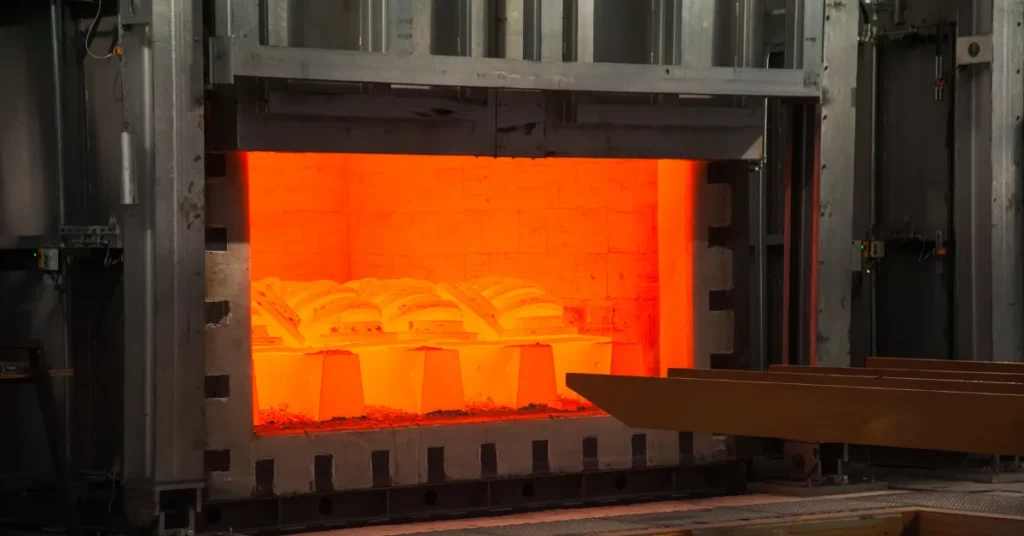
Heat treatment for casting uses controlled heating and cooling to adjust a casting’s strength, hardness, toughness, corrosion resistance, or dimensional stability. The right method depends on the alloy, section thickness, and required properties. This guide explains the main processes, their material-specific uses, and how heat treatment fits into finished-part production.
Why Castings Need Heat Treatment: Properties and Dimensional Stability
Casting gives a component its shape, but the structure formed during solidification may not provide the properties required of the finished part. In carbon and low alloy steels, for example, normalizing can replace a coarse, uneven structure with a finer, more consistent one. This changes how the material behaves under load and during machining.
Dimensional stability is another concern. Residual stresses are internal stresses that remain in a part even when no external load is applied. Their redistribution during subsequent processing can cause movement. A suitable stress relief treatment reduces these stresses and the risk of later dimensional changes.
These are different objectives. A casting can need stress relief without needing maximum hardness, or need softening before machining rather than strengthening. Heat treatment should address the property that matters to the application.
Do all castings need heat treatment? No. Where the applicable specification permits an as-cast condition and the casting meets its requirements, an additional treatment may be unnecessary. Other grades or specified conditions depend on heat treatment. The casting process name alone—sand casting, investment casting, or die casting—does not settle the question.
Common Casting Heat Treatment Methods Compared
The main methods are easier to understand by separating their purposes. This table is an overview of treatment routes, not a furnace recipe.
| Process | What happens | Main purpose and typical use |
|---|---|---|
| Annealing | The casting is heated and cooled according to the alloy’s annealing cycle; a full anneal of steel normally includes slow furnace cooling. | Soften suitable materials, improve ductility, and make subsequent machining easier. |
| Normalizing | Steel is heated into its transformation range, held, and then cooled in air. | Develop a finer, more uniform structure in carbon and low alloy steel castings. |
| Quenching and tempering | Suitable steel is heated, cooled fast enough to harden, and then reheated below its transformation range. | Develop a specified balance of strength, hardness, and toughness. |
| Stress relieving | The part undergoes a controlled thermal cycle selected to reduce residual stress while limiting unwanted changes to its condition. | Reduce the risk of dimensional movement during later machining or service. |
| Solution treatment | The alloy is heated to dissolve selected constituents into the metal matrix, followed by controlled cooling. | Establish a suitable structure in certain stainless steels or prepare heat-treatable aluminum for aging. |
| Aging | A suitable alloy is held at room temperature or at an elevated temperature so strengthening precipitates develop. | Increase strength in heat-treatable aluminum and precipitation-hardening alloys. |
| Austempering | The casting is heated, rapidly transferred to a controlled-temperature bath, held, and finally cooled. | Produce the required structure and properties in austempered ductile iron (ADI). |
The differences between annealing, normalizing, and quench hardening are illustrated in the Steel Founders’ Society of America heat treatment handbook. For annealing, the broader term includes several cycles, so “annealed” does not always mean the same temperature and cooling method.
Heat Treatment by Material: Steel, Stainless Steel, Aluminum, and Cast Iron
Carbon and Alloy Steel: Normalizing, Quenching, and Tempering
Normalizing may provide the required structure and properties for a steel casting; some grades are subsequently tempered. When the specified properties require greater hardening, quenching and tempering may be appropriate.
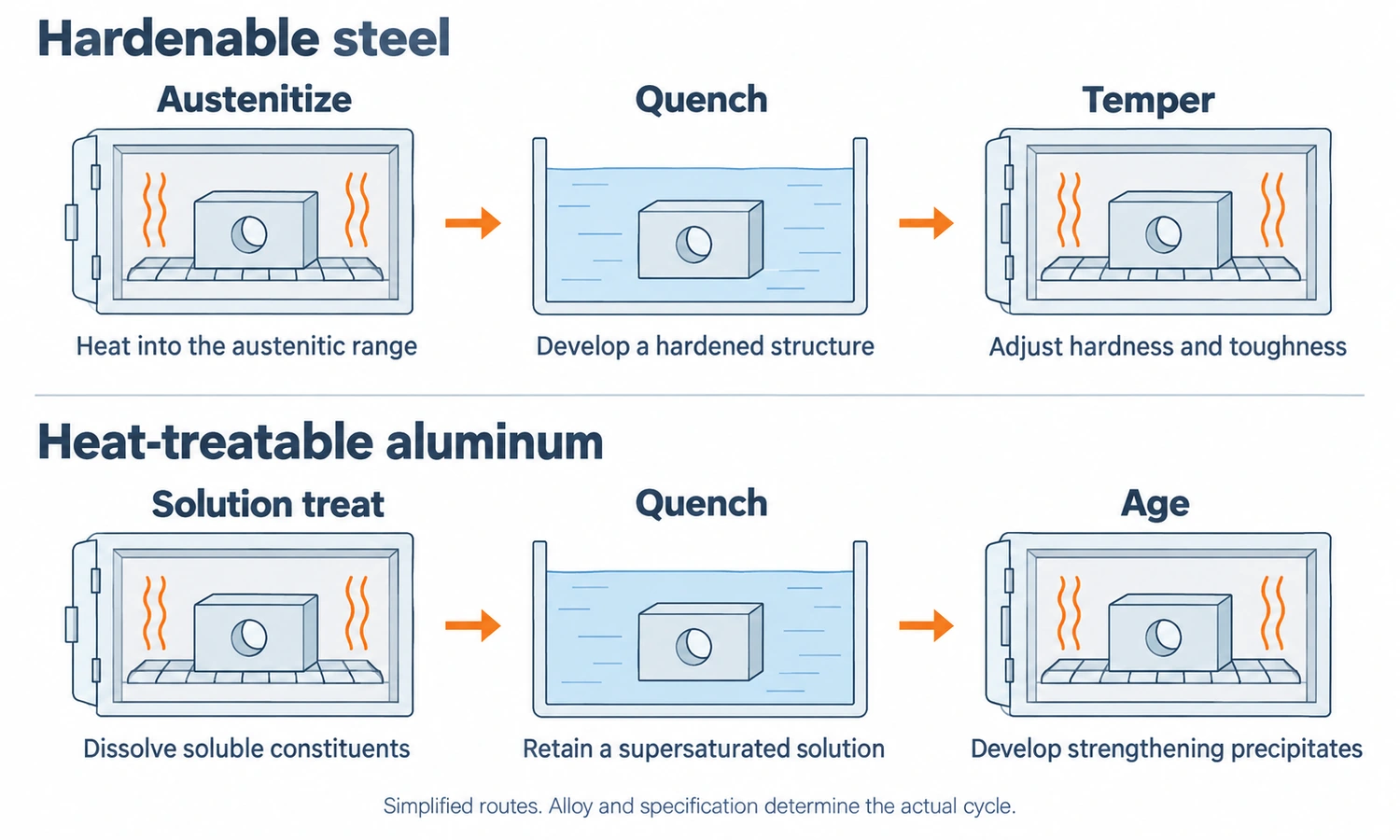
In a hardenable steel, rapid cooling can form martensite, a hard microstructure. The as-hardened condition can be too brittle for the intended duty. Tempering adjusts that condition, usually giving up some hardness to improve toughness—the ability to absorb energy before fracture. This is why asking for the highest possible hardness can work against the needs of a component exposed to impact.
Section thickness matters too. The center of a thick casting cools differently from its surface, and the steel must have sufficient hardenability to develop the required structure through the relevant section. Hardness measures the material’s condition; hardenability describes its ability to harden to depth.
Stainless Steel: Solution Treatment, Hardening, and Aging
“Stainless steel” is too broad a description for selecting heat treatment.
For an austenitic casting grade such as CF8M, solution treatment is used to dissolve constituents that can impair corrosion performance, followed by suitable cooling. The objective differs from quench-hardening a carbon steel casting. A martensitic stainless casting such as CA6NM, by contrast, can be hardened and then tempered.
Precipitation-hardening stainless steels use another mechanism: an appropriate solution treatment and aging sequence develops fine precipitates that strengthen the material. Their final condition depends on the selected treatment.
A stainless casting can therefore undergo a high-temperature treatment and rapid cooling without the purpose being to make it as hard as possible.
Aluminum Castings: Solution Treatment and T5, T6, and T7 Tempers
Heat-treatable aluminum castings commonly use solution treatment followed by quenching and aging. A356-T6 is one familiar alloy-and-condition combination. Immediately after solution treatment and quenching, the material is relatively soft; aging develops the strengthened condition. Quenching here prepares the alloy for aging rather than hardening it through the steel martensite mechanism.
The temper designation describes the treatment condition:
| Temper | Basic meaning for aluminum castings |
|---|---|
| T5 | Cooled from casting and artificially aged, without a separate solution treatment. |
| T6 | Solution heat treated and artificially aged. |
| T7 | Solution heat treated and overaged or stabilized, typically trading some peak strength for greater stability. |
These definitions are explained in the Australian Aluminium Council’s Aluminium Data—Ingots and Castings, pages 22–23. T6 identifies a condition; it does not specify one temperature-and-time schedule for every aluminum alloy.
Can die cast aluminum be heat treated? Sometimes. Entrapped gas in conventional high-pressure die castings can expand during solution treatment and cause blistering. The Australian Aluminium Council also describes successful treatment using modified cycles, so a blanket “die castings cannot be heat treated” is inaccurate. Suitability must be established for the particular alloy, casting quality, and cycle. A standard treatment used for a sand casting should not automatically be transferred to a high-pressure die casting.
Gray and Ductile Iron: Stress Relief, Annealing, and Austempering
Gray iron contains graphite flakes, while ductile iron contains graphite nodules. Heat treatment primarily changes the surrounding metal matrix; it does not turn gray iron into ductile iron. For gray iron, available treatments include stress relief, annealing, and hardening, selected according to the required properties. ASM International: Heat Treating of Gray Irons, public abstract.
Heat treatment of ductile iron changes its matrix—the metal surrounding the graphite nodules—to obtain properties that may not be readily achievable in the as-cast condition. Depending on the objective, treatments include annealing, normalizing, stress relieving, and hardening. ASM International: Heat Treatment of Ductile Iron, public abstract.
Austempered ductile iron, or ADI, requires a specific austempering route. The casting is heated, transferred rapidly to a controlled-temperature bath, and held before final cooling. Composition, section thickness, and the required ADI grade determine the actual cycle. ADI is a particular material condition, not a name for every heat-treated iron casting. AFS/SFSA: Austempering heat treatment.
How to Select the Heat Treatment Cycle: Alloy, Properties, and Section Thickness
A heat treatment cycle combines three controls: how the casting is heated, how long it remains at temperature, and how it cools. Changing one can change the result even if the other two stay the same.
Temperature enables the intended metallurgical change. Holding time must allow the relevant sections to reach the required condition and the transformation to proceed. Cooling then helps determine the structure that remains. A furnace reaching its set temperature does not, by itself, establish that the center of a heavy casting has reached that temperature.
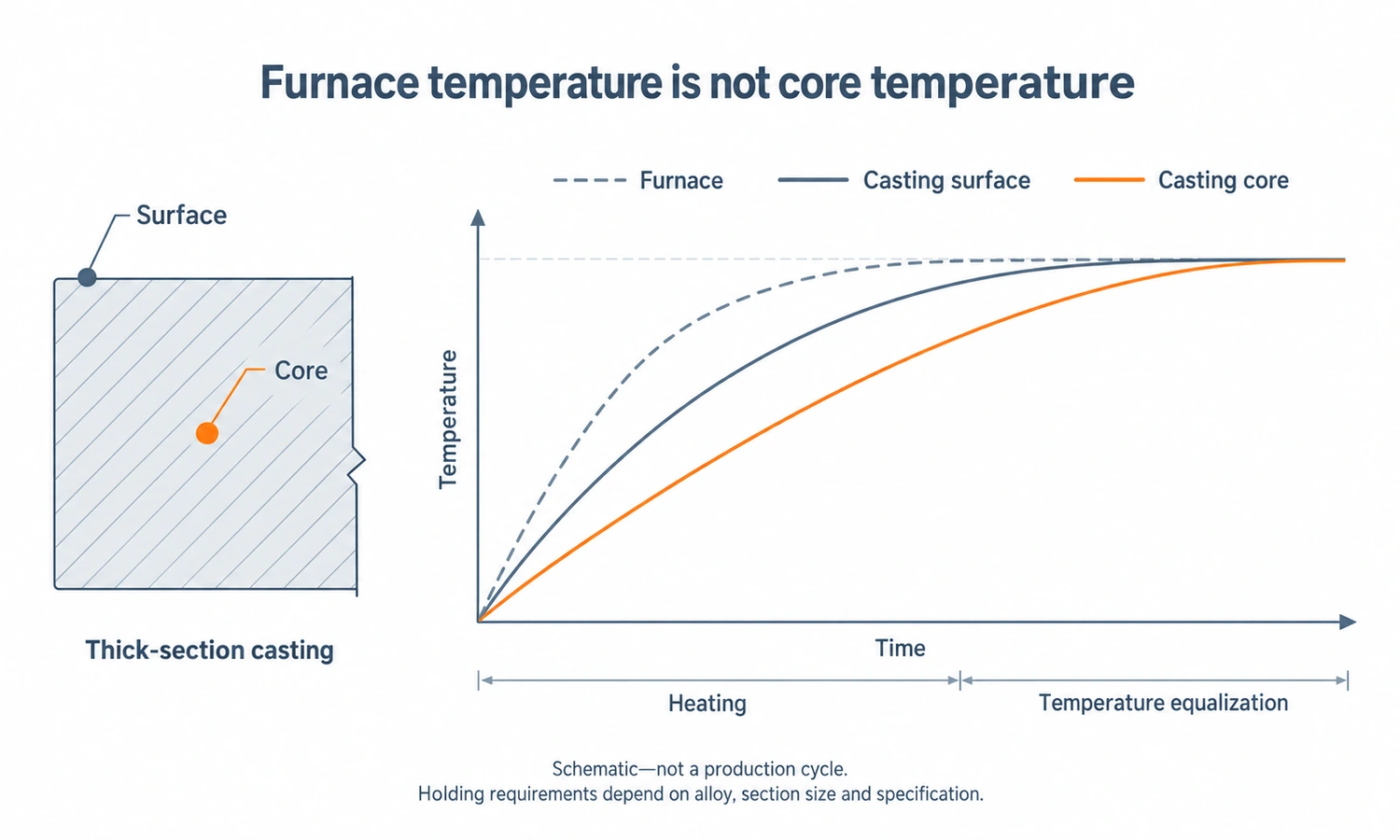
For a specific component, a useful selection sequence is:
- Identify the exact alloy grade and applicable material or customer specification.
- Define the required delivery condition and properties, including any hardness, strength, toughness, or corrosion requirements.
- Consider section thickness, geometry, casting quality, and the remaining manufacturing operations.
- Select and verify a treatment procedure against those requirements.
There is consequently no reliable answer to “How many hours should a casting be heat treated?” without more information. A published cycle for a different alloy or section size is a reference to investigate, not a production instruction.
At YTD Foundry, our custom investment casting service brings tooling, casting, heat treatment, and finishing into one project. We review the manufacturing route around your drawing or sample, material, and delivery requirements, so the required material condition can be considered alongside the casting’s geometry.
Can Heat Treatment Repair Casting Porosity and Shrinkage Defects?
Conventional furnace heat treatment should not be treated as a general repair for porosity, shrinkage cavities, or inclusions. Improving the surrounding metal’s properties does not establish that an internal defect has disappeared.
Hot isostatic pressing, or HIP, is a separate process that combines high temperature with high gas pressure to close suitable internal porosity. Its pressure-assisted densification mechanism is different from ordinary annealing or hardening. It also requires an assessment of the material and defect involved.
Heat Treatment Risks: Distortion, Quench Cracking, and Surface Damage
Heat treatment itself can introduce problems. Distortion and quench cracking are important concerns, and increasing quench severity can increase those risks. Surface oxidation or decarburization may also need control through the furnace atmosphere. Correct processing therefore includes cooling conditions and surface protection, as well as temperature.
When to Heat Treat Castings: Before or After Machining?
The manufacturing sequence should allow for any dimensional movement and the material condition needed for machining. For example, stress relieving may be placed after rough machining and before final finishing. The appropriate sequence depends on the treatment and component; “machine first” and “heat treat first” are not universal rules.
YTD combines casting production with CNC machining for finished cast components. This lets customers include critical holes, mating surfaces, and final dimensions within the same casting project. The machining sequence is selected around the material, heat treatment, and dimensional requirements of the part.
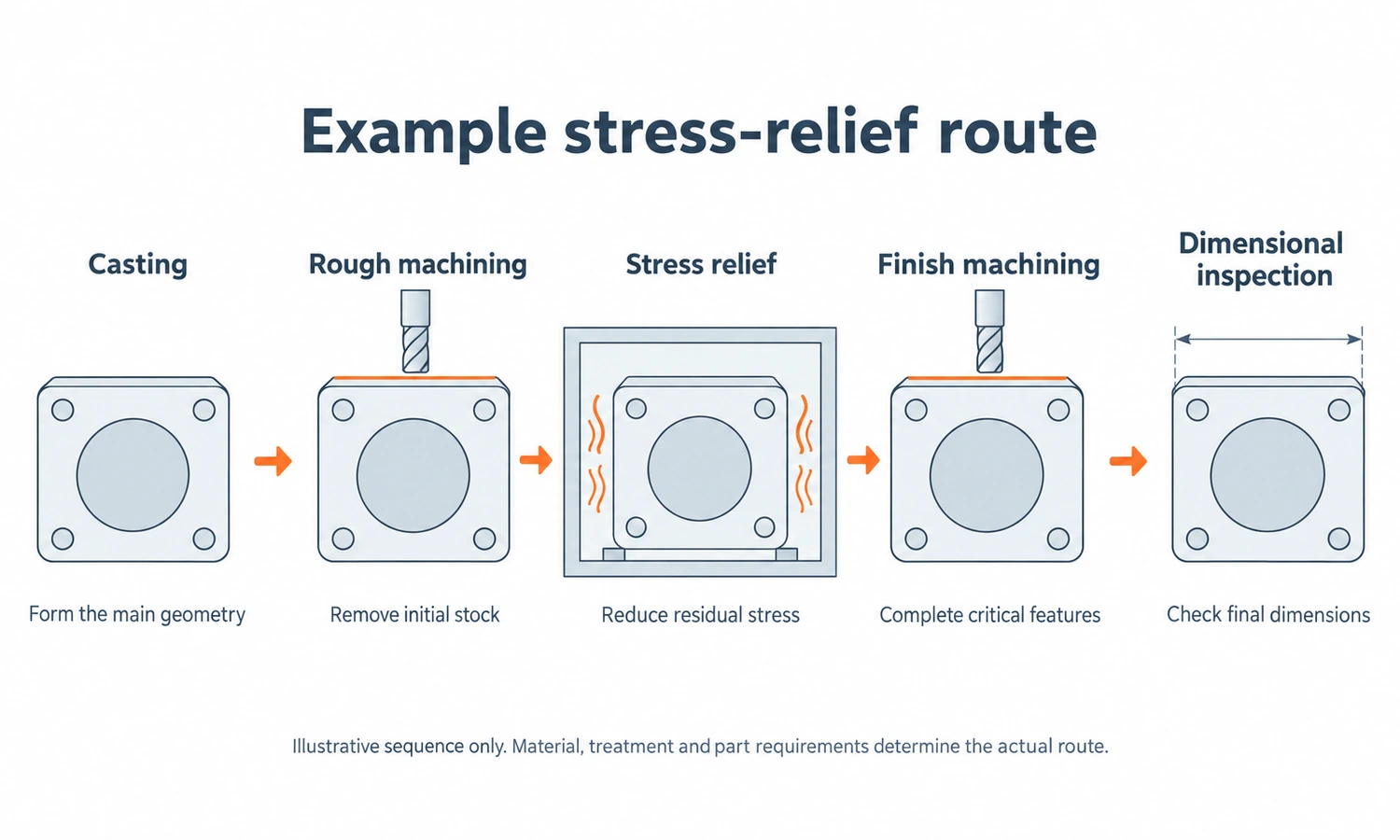
How to Verify Heat Treatment: Process Records, Testing, and Inspection
Agree on verification requirements before production. Different evidence answers different questions:
| Evidence | What it helps establish |
|---|---|
| Heat treatment records | Whether the recorded cycle followed the agreed processing requirements. |
| Hardness or mechanical testing | Whether the tested locations or specimens meet the specified property requirements. |
| Microstructure examination | Whether the relevant metallurgical condition has developed. |
| Dimensional and appropriate nondestructive inspection | Whether the casting meets dimensional and defect acceptance requirements after processing. |
The applicable specification determines which checks are required and how samples are selected. A hardness result alone does not demonstrate corrosion resistance, internal soundness, or dimensional conformity.
Conclusion: Match Heat Treatment to the Casting’s Requirements
The right heat treatment matches the casting’s alloy and service requirements while accounting for machining, dimensional stability, and inspection. Specify the final properties you need, then develop the processing route around them. For a custom casting project, share your drawing or sample with YTD Foundry to discuss material selection, heat treatment, and finished-part delivery.
FAQs
Is Annealing the Same as Stress Relieving?
They can have overlapping effects, but their purposes differ. Annealing is often chosen to soften a material and improve ductility. Stress relieving focuses on reducing residual stress while limiting unwanted changes to the existing condition. A treatment intended to preserve hardness should not be replaced with a softening anneal without reviewing the requirements. [Bodycote: Annealing](https://www.bodycote.com/what-we-do/precision-heat-treatment/annealing-normalising/annealing/); [Stress relieving](https://www.bodycote.com/what-we-do/precision-heat-treatment/stress-relieving-atmosphere-vacuum/).
Do Investment Castings and Sand Castings Need Different Heat Treatments?
The casting method alone does not determine the treatment. Castings made by either process may use the same broad treatment route when their alloys and required properties are similar. The actual cycle still needs to account for section thickness, geometry, and the casting’s starting condition; a procedure should not be transferred solely because the alloy name matches.
Can Only the Surface of a Casting Be Hardened?
Yes, for suitable materials and geometries. Induction hardening can selectively heat and harden areas of steel or cast iron components while retaining the core microstructure. This can be useful where a working surface needs wear resistance. The alloy, required hardened depth, and component geometry determine whether this approach is suitable. [Bodycote: Induction hardening](https://www.bodycote.com/what-we-do/precision-heat-treatment/hardening-and-tempering-atmosphere-vacuum/induction-hardening/).
Does a Casting Need Heat Treatment After Welding or Weld Repair?
It may, depending on the alloy, service conditions, and applicable specification. For example, restoring corrosion performance can be a reason to heat treat a welded CF8M casting. The requirements should be established in the approved welding and manufacturing procedures; postweld treatment is not automatically the same for every casting. [SFSA: CF8M fabrication and welding considerations](https://cdn.sfsa.org/wp-content/uploads/2021/10/s8.pdf).