Ceramic slurry is the liquid coating used to begin building the shell around a wax pattern in investment casting.
It may look like only one intermediate material, but its behavior affects how accurately the shell copies the wax, how each ceramic layer builds, and how well the finished mold survives drying, dewaxing, firing, and metal pouring.
This guide focuses on ceramic slurry in investment casting: what it does, what it contains, why viscosity matters, how the slurry changes during production, and how shell problems can eventually appear on the metal casting.
What Is Ceramic Slurry?
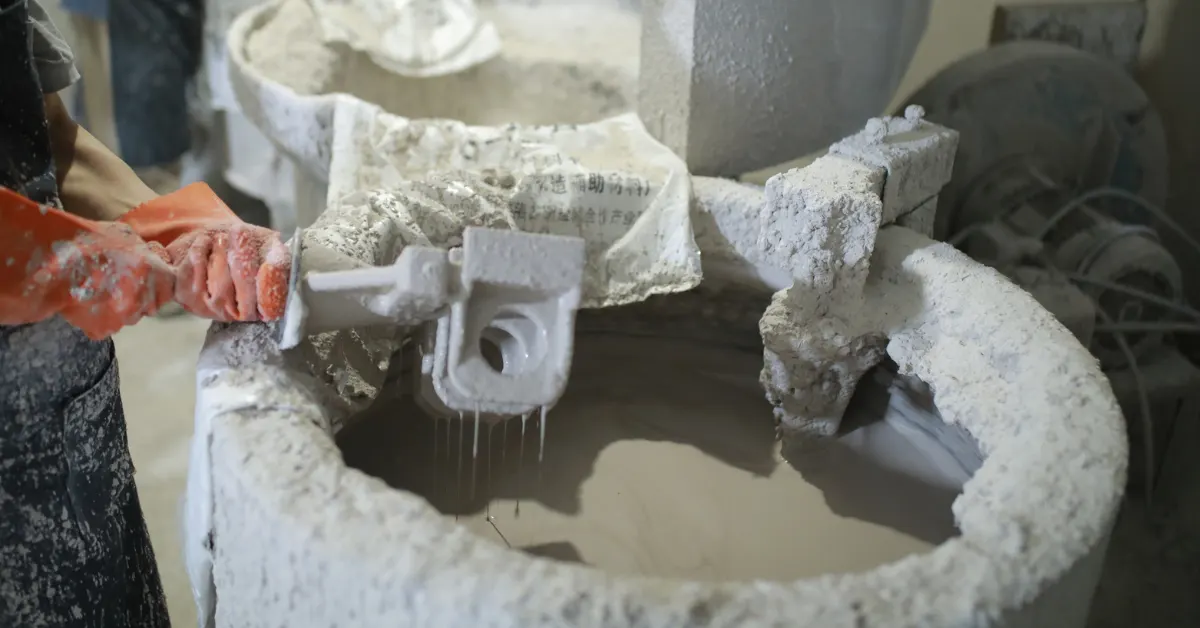
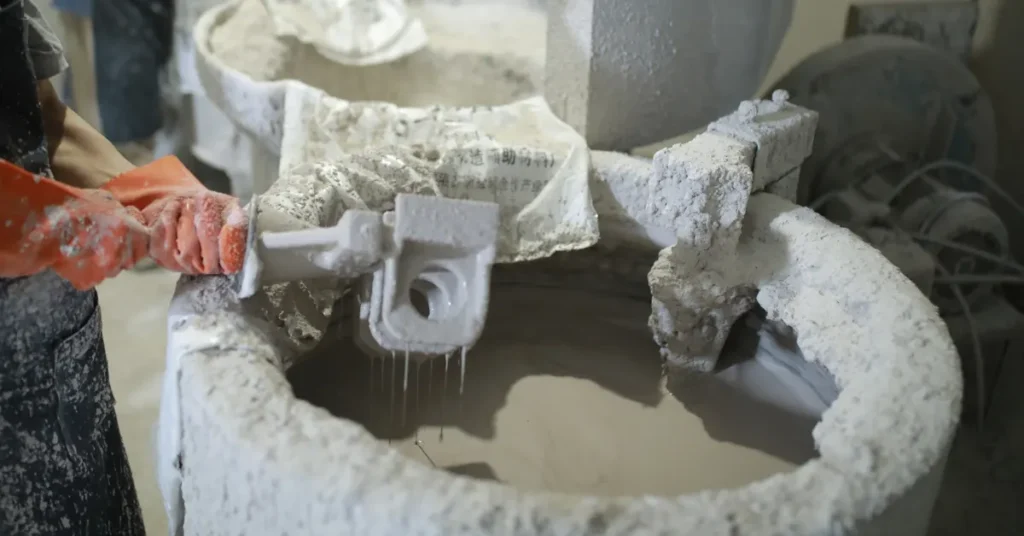
In general terms, ceramic slurry is a suspension of fine ceramic particles dispersed in water or another liquid medium. Ceramic slurries are used in processes ranging from slip casting and coating to tape casting and other ceramic-forming methods.
In investment casting, the purpose is much more specific.
The slurry is used to place a controlled layer of fine refractory material onto a wax pattern.
After dipping, dry refractory grains are applied to the wet coating. The layer is allowed to dry, and the process is repeated until a complete ceramic shell surrounds the wax assembly. The Investment Casting Institute describes shell building as this repeated sequence of slurry coating, stucco application, and drying.
That shell later becomes the mold into which molten metal is poured.
So although the slurry never becomes part of the finished metal component, it helps create the surface and structure of the mold that does.
For the complete manufacturing sequence, see YTD’s investment casting process guide.
What Ceramic Slurry Actually Does in the Shell
It is useful to think of the ceramic shell as having two different jobs.
The inside of the shell must reproduce the wax pattern accurately and remain compatible with molten metal.
The rest of the shell must provide enough structure to survive handling, wax removal, firing, and pouring.
Ceramic slurry helps create both.
During the first coats, it creates the fine ceramic surface that eventually faces the molten alloy.
During later coats, slurry binds successive refractory layers together and contributes to the thickness and structural integrity of the mold.
This is why shell building is not simply a matter of repeatedly covering the wax with “ceramic.”
Each layer has a purpose.
The final shell has to balance several requirements at once:
- Surface reproduction
- Strength before firing
- Strength at pouring temperature
- Resistance to thermal shock
- Chemical compatibility with the alloy
- Permeability
- Dimensional stability
Research on investment-casting shells treats these properties as an interacting system rather than independent characteristics.
What Is in Investment Casting Ceramic Slurry?
There is no universal slurry formula that works for every investment-casting foundry.
Formulation depends on the alloy, shell system, coat position, drying method, refractory selection, and qualified production process.
Most systems, however, contain several functional groups.
| Slurry Component | What It Does |
|---|---|
| Refractory Flour | Provides the heat-resistant ceramic solid |
| Binder | Holds refractory particles together as the coat dries |
| Liquid Medium | Allows the slurry to flow, wet, and coat the pattern |
| Wetting Agent | Helps the coating spread over the wax |
| Antifoam | Reduces bubbles and foam during mixing and dipping |
| Other Additives | Adjust stability, rheology, drying, or shell performance |
Refractory Flour
Refractory flour is the fine ceramic powder suspended in the liquid phase.
Common shell materials can include zircon, fused silica, alumina, and aluminosilicates, although their use varies with the shell system and alloy.
The refractory does more than survive heat.
Its particle size, chemistry, thermal expansion, interaction with the binder, and compatibility with molten metal can all influence shell and casting behavior.
This makes refractory selection particularly important in the first layers, where the ceramic surface eventually contacts the alloy.
Binder
The binder creates the bond between refractory particles as the coating dries and later develops into a fired ceramic structure.
Water-based colloidal silica is widely used in modern shell systems, although other binder technologies also exist.
The binder system should not be confused with the complete slurry.
Two foundries could both say they use “silica sol” while still using different refractory materials, solids loading, additives, drying conditions, and shell constructions.
YTD’s comparison of silica sol and water glass casting looks more closely at how different binder systems fit into the broader investment-casting process.
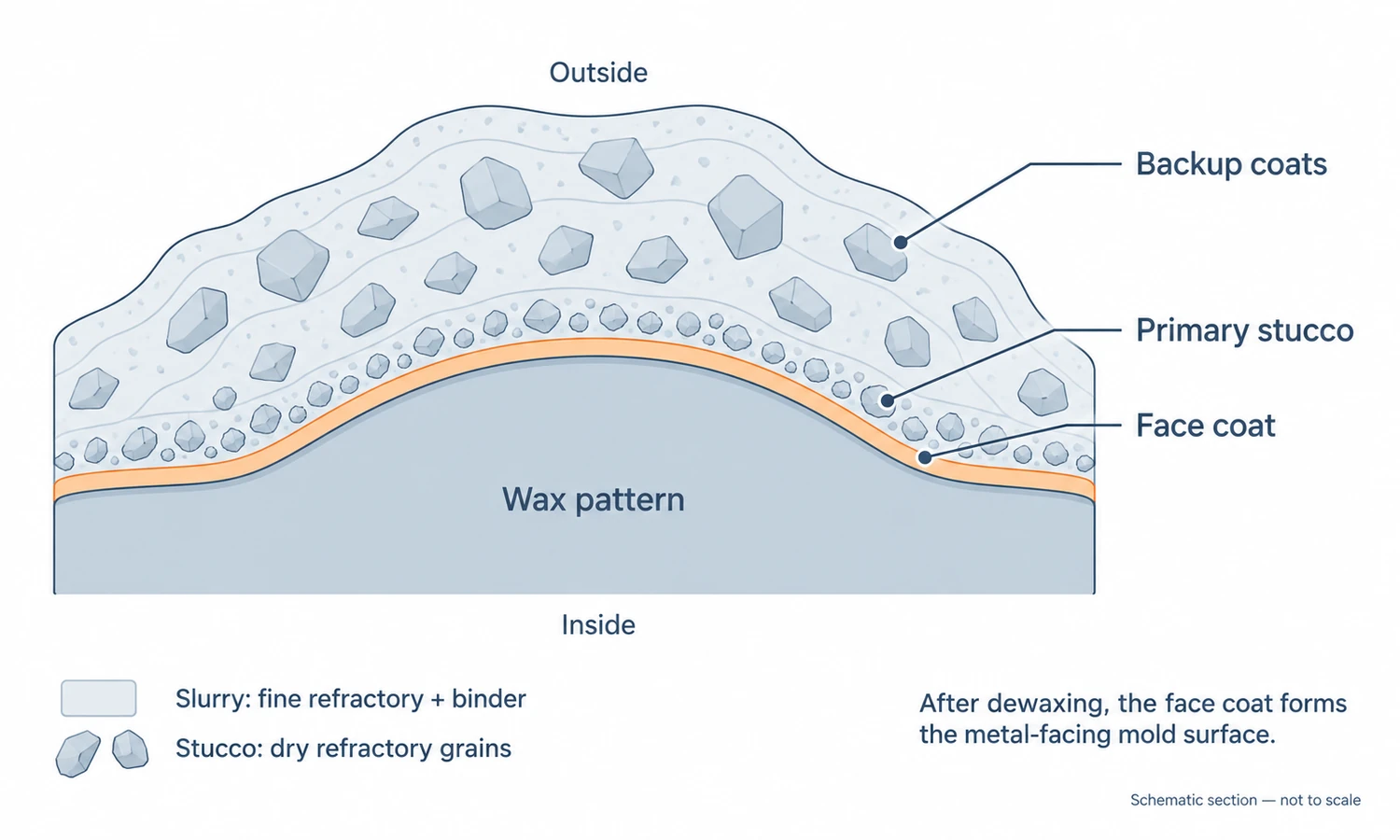
Primary Slurry and Backup Slurry Have Different Jobs
One of the most useful things to understand about ceramic slurry is that the shell does not necessarily use the same formulation from the wax surface to the outside layer.
Primary or Face-Coat Slurry
The primary coat is the first ceramic layer applied to the wax.
This layer eventually becomes the mold surface that touches the molten metal.
Its priorities include:
- Wetting the wax evenly
- Reproducing fine geometry
- Creating a consistent mold surface
- Limiting undesirable metal-mold reactions
- Supporting the required casting finish
Research on ceramic shells identifies the primary face coat as an important contributor to the surface condition of the resulting casting.
Fine refractory materials are therefore commonly associated with primary coats.
Backup Slurry
Later coats have a different priority.
Once the mold surface has been established, the shell needs thickness and structural strength.
Backup layers help the shell survive handling, dewaxing, firing, and the pressure and thermal load generated when metal is poured.
Their refractory size, slurry behavior, and stucco system can therefore differ from the primary coat.
The useful distinction is:
The face coat creates the casting interface. Backup coats build the mold around it.
That explains why copying one slurry formulation for every coat is not a useful way to understand shell design.
Ceramic Slurry and Stucco Are Not the Same Material
Slurry and stucco work together, but they have different functions.
Slurry is the wet suspension containing fine refractory particles and binder.
Stucco is dry, coarser refractory grain applied to the outside of the wet slurry coat.
A shell-building cycle can be simplified as:
Dip → Drain → Stucco → Dry
Then the process repeats.
The slurry creates the continuous ceramic layer.
The stucco adds particle structure, creates a surface for the next layer to bond to, and helps build shell thickness.
This distinction matters because a thicker slurry is not simply a replacement for stucco.
Investment-casting shells obtain their properties from the interaction between slurry, refractory grain, drying, and successive layers—not from one material alone.
What Ceramic Slurry Viscosity Actually Controls
Viscosity receives a lot of attention in foundries because it affects how the slurry behaves during dipping and drainage.
But the useful question is not:
Is the viscosity high or low?
It is:
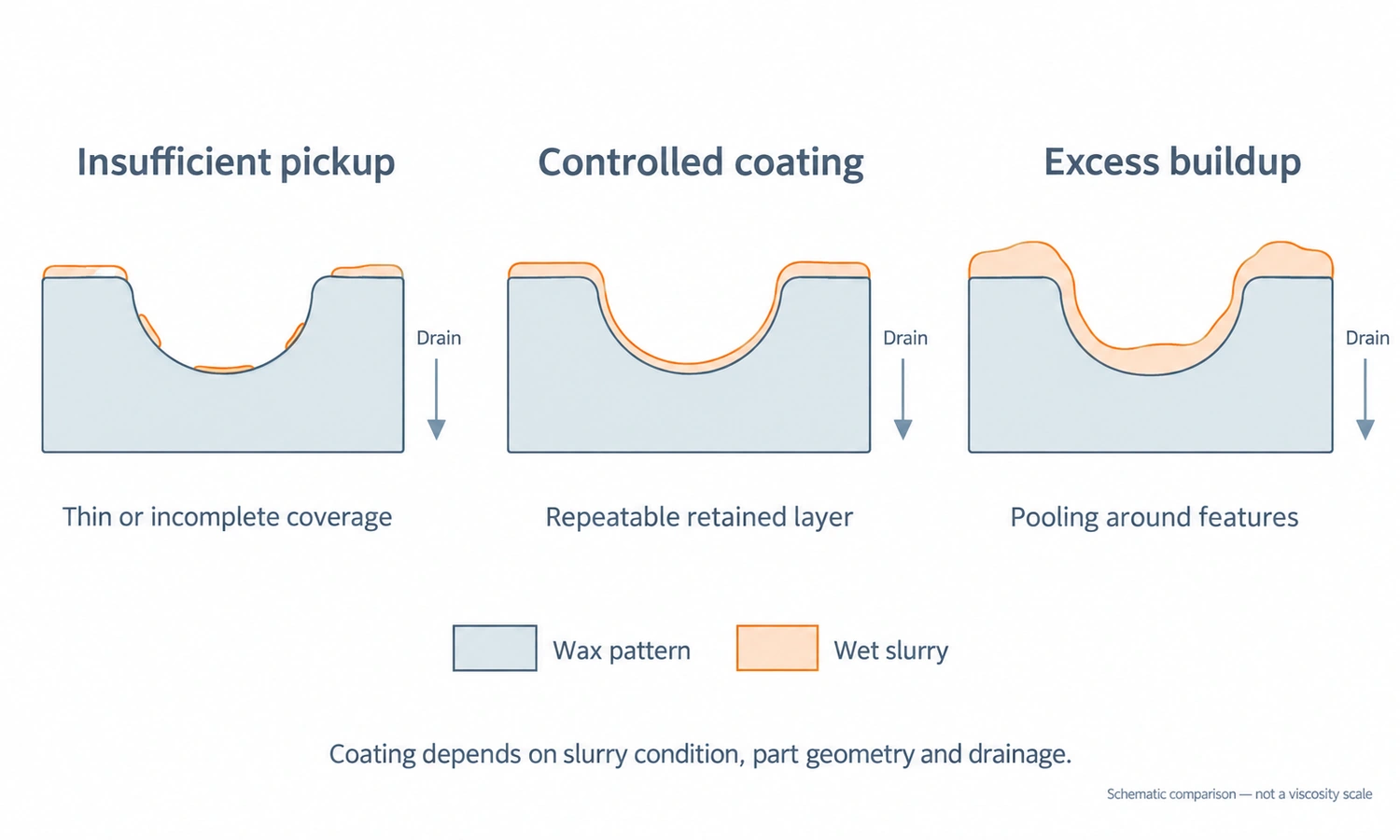
Does the slurry leave the correct, repeatable coating on this wax pattern?
When the wax tree comes out of the slurry tank, some liquid coating remains on the surface while the excess drains away.
That retained coating influences how much ceramic material is added during that cycle.
Slurry That Is Too Thin for the Qualified Process
Possible consequences include:
- Insufficient coating pickup
- Slow shell buildup
- Poor coverage in difficult areas
- Local differences in layer thickness
Slurry That Is Too Thick for the Qualified Process
Possible consequences include:
- Excess buildup around features
- Poor drainage
- Uneven coatings
- Loss of fine detail
- More difficult dipping
- Non-uniform drying
Studies of primary investment-casting slurries have found that excessive viscosity can make wax-cluster immersion and uniform coating more difficult.
The goal is therefore repeatable coating behavior inside a qualified process window, not the highest possible solids content or the thickest possible slurry.
Why One “Correct Viscosity” Number Is Misleading
A common internet question is:
What viscosity should ceramic slurry have?
There is no useful universal answer.
The number depends on factors such as:
- Refractory material
- Particle size distribution
- Solids loading
- Binder system
- Primary or backup coat
- Measurement equipment
- Test temperature
- Shear conditions
A time measured with one flow cup cannot simply be compared with a result from a different cup or a rotational viscometer.
Ceramic slurries can also show non-Newtonian behavior, meaning apparent viscosity may change with shear conditions rather than remaining constant like a simple Newtonian liquid. ISO’s ceramic-slurry viscosity framework explicitly recognizes several different rheological behaviors.
So a statement such as:
“Our slurry viscosity is 20 seconds.”
is incomplete without knowing how, when, and under what test conditions it was measured.
For production control, repeatability using the foundry’s qualified measurement method matters more than matching a number taken from another facility.
What Causes Ceramic Slurry to Change During Production?
A working slurry tank is not chemically or physically frozen in time.
Its behavior can drift as production continues.
Water Loss
With water-based systems, evaporation changes the relationship between liquid and refractory solids.
That can change viscosity and coating behavior if the slurry is not maintained within its process window.
Refractory Additions
Adding refractory flour changes solids loading and can affect viscosity, density, drainage, and pickup.
The change is not necessarily linear because particle size and particle packing also matter.
Temperature
Fluid viscosity is temperature-dependent.
A slurry tested under one shop condition should not automatically be compared with the same numerical result at a substantially different temperature.
Mixing and Aging
A newly prepared slurry may continue changing as refractory particles become fully wetted and dispersed and entrained air is removed.
This is one reason slurry preparation is more than simply adding powder until the mixture “looks right.”
Contamination
Stucco grains, wax residues, dust, foreign chemicals, or other material entering the slurry can gradually alter its condition.
The important point is that slurry control is a production activity, not a one-time formulation exercise.
How Slurry Problems Appear on the Final Casting
The customer does not receive the ceramic shell.
It is broken away after the metal solidifies.
But poor shell control can still leave visible or internal consequences on the final part.
| Shell or Slurry Problem | Possible Casting Consequence |
|---|---|
| Poor wetting of the wax | Incomplete or irregular mold surface |
| Air bubbles in the primary coat | Local surface imperfections |
| Uneven coating buildup | Non-uniform shell behavior |
| Damage or delamination between coats | Shell failure or inclusions |
| Shell cracking | Metal fins, leakage, or rejected castings |
| Incomplete drying | Reduced shell integrity |
| Poor alloy-shell compatibility | Surface reaction or difficult cleanup |
| Loose ceramic material | Non-metallic inclusions |
Not every casting defect can be blamed on the slurry.
Wax-pattern quality, gating, pouring temperature, alloy cleanliness, shell firing, and other variables also influence the result.
The useful lesson is that surface quality begins before any metal enters the mold.
YTD’s guide to improving investment casting surface finish looks at wax quality, shell construction, pouring, and finishing as one connected process.
Drying Is Part of Slurry Performance
A well-formulated slurry can still produce a poor shell if the coating is not dried correctly.
Water-based shell systems gain strength as moisture is removed and the binder develops the ceramic bond.
If the next coat is applied too early, the existing layer may not have enough strength or stability.
Research on investment-casting shells links incomplete drying with problems such as reduced shell integrity, peeling, and inclusion risk.
Drying too aggressively can create a different problem.
Rapid moisture gradients can introduce stress into a shell that is still developing strength.
This means slurry condition and drying conditions should not be evaluated independently.
A foundry can have the “correct” slurry and still make inconsistent shells if:
- Airflow varies
- Humidity changes significantly
- Drying time is shortened
- Complex geometry traps moisture
- Layers build faster than they can stabilize
The real process is therefore:
Slurry + stucco + drainage + drying + repeated shell buildup
—not slurry alone.
Does the Metal Alloy Change the Slurry System?
Yes, particularly at the primary interface.
The first ceramic layer eventually contacts molten metal, so refractory compatibility becomes more important as alloy temperature or chemical reactivity increases.
A shell system suitable for one common steel grade should not automatically be assumed suitable for every alloy.
Reactive metals make this especially clear.
Titanium, for example, can react strongly with both atmosphere and mold materials when molten, which places much greater demands on melting conditions and ceramic-face materials. See YTD’s titanium investment casting guide for that specific problem.
High-temperature superalloys can also require more careful coordination between shell material, pouring conditions, and thermal behavior.
This is why slurry selection should begin with the casting alloy and required result, not with a favorite refractory recipe.
What Should Casting Buyers Specify?
Most buyers do not need to specify:
- A slurry viscosity number
- A refractory flour percentage
- A specific wetting-agent dosage
- A foundry’s exact binder-to-flour ratio
Those are production-process controls unless a qualified customer specification explicitly requires them.
A buyer is usually better served by defining the outcome:
- Alloy and material standard
- Dimensional requirements
- Critical surfaces
- Surface-finish requirement
- Inspection requirements
- Operating environment
- Heat treatment
- Cleanliness or special process requirements
The foundry then has to choose and control the wax, shell, melting, pouring, heat treatment, and finishing processes required to achieve those results.
That distinction matters.
A slurry recipe can be “correct” on paper and still be unsuitable for a particular alloy, geometry, climate, drying system, or production line.
For ordinary custom industrial castings, specify what the casting must achieve; let the foundry own the qualified shell-making process.
Ceramic Shell Building at YTD Foundry
Ceramic shell building is part of YTD Foundry’s in-house investment-casting workflow.
The important point is not that YTD uses one supposedly universal ceramic-slurry recipe.
It is that shell building is treated as part of the complete casting process.
Wax quality, part geometry, shell construction, alloy selection, drying, dewaxing, firing, pouring, and final inspection all affect one another.
For customers, this means the discussion starts with the casting requirement rather than with an isolated slurry parameter.
If a drawing identifies the alloy, critical dimensions, surface requirements, operating conditions, and inspection needs, those requirements can be considered together when the manufacturing route is developed.
Final Thoughts
Ceramic slurry should not be treated as a standalone recipe.
In investment casting, it works together with refractory stucco, drying, shell design, alloy chemistry, dewaxing, and pouring to create the mold that ultimately controls the casting surface and geometry.
For buyers, the most useful specification is usually the required casting result—not the foundry’s slurry formula. A capable foundry should control the shell-making process needed to achieve that result.
FAQs
What Is Ceramic Slurry in Investment Casting?
It is a suspension of fine refractory material in a liquid binder system used to coat wax patterns during ceramic-shell building. After dipping, stucco is applied and the layer is dried before additional coats are added.
What Is Ceramic Slurry Made Of?
An investment-casting slurry normally contains refractory flour, a binder and liquid medium, together with small amounts of additives that can help control wetting, foam, stability, or flow behavior. The exact formulation depends on the shell system and application.
What Is the Difference Between Ceramic Slurry and Stucco?
Slurry is the wet coating containing fine ceramic particles and binder. Stucco is a coarser dry refractory grain applied to the wet slurry. The two work together to build the ceramic shell.
Why Does Ceramic Slurry Viscosity Matter?
Viscosity influences dipping, drainage, coating pickup, and the uniformity of each shell layer. The important target is the qualified range for a particular slurry system rather than one universal viscosity value.
Why Are Different Slurries Used for Face and Backup Coats?
The first coat must reproduce the wax surface and remain compatible with molten metal. Later coats mainly build thickness and structural strength, so their refractory size and slurry requirements can differ.
Can Ceramic Slurry Cause Casting Defects?
It can contribute to defects if wetting, coating uniformity, stability, interlayer bonding, or drying are poorly controlled. However, final casting defects can also originate from wax, gating, melting, pouring, firing, alloy behavior, or other parts of the process.