What is CD3MN Material?
Definition
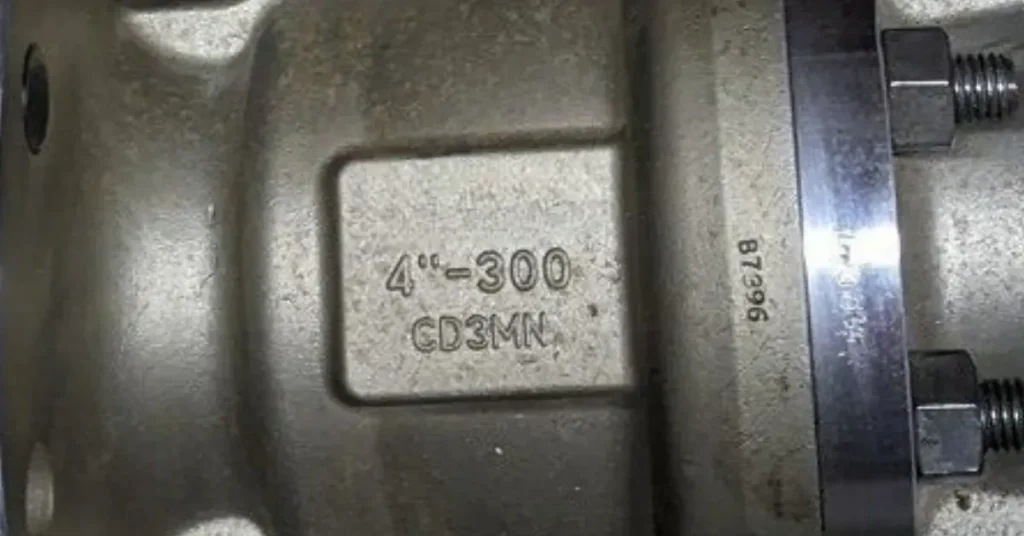
CD3MN is a high-performance duplex stainless steel casting alloy standardized under ASTM A995 / A890 Grade 4A, engineered specifically for custom liquid metal processes such as silica sol investment casting and resin sand casting.
Characterized by a balanced 50/50 ferrite-austenite microstructure, it delivers high yield strength (≥ 415 MPa) along with superior resistance to chloride pitting, crevice corrosion, and stress corrosion cracking in demanding fluid-handling components.
What Does “CD3MN” Mean?
The name “CD3MN” follows the standard ACI (Alloy Casting Institute) designation system, where each character defines a critical elemental or functional aspect of the cast alloy:
- C represents corrosion-resistant service, indicating that this alloy is formulated specifically for liquid chemical and marine corrosion environments rather than heat-resistant applications.
- D designates a duplex alloy structure (~22% Chromium) that forms a dual-phase matrix to combine the high mechanical strength of ferrite with the toughness of austenite.
- 3 specifies the ultra-low carbon limit (≤ 0.03 %) to prevent chromium carbide precipitation during casting cooling and eliminate intergranular corrosion risks.
- M highlights the 2.5%–3.5% molybdenum addition, which significantly boosts localized pitting and crevice corrosion resistance in acidic and saline media.
- N signifies 0.10%–0.30% nitrogen micro-alloying, an essential element that stabilizes the austenite phase and elevates the alloy’s Pitting Resistance Equivalent Number (PREN) to 34–36.
CD3MN Chemical Composition & Mechanical Properties
CD3MN Material Chemical Composition
The CD3MN chemical composition is precisely balanced to achieve its duplex structure and corrosion resistance.
| Element | Content (%) | Function |
| Carbon (C) | ≤0.03 | Ultra-low carbon design to avoid intergranular corrosion |
| Chromium (Cr) | 21.0 ~ 23.5 | Core corrosion-resistant element, forms a dense passivation film |
| Nickel (Ni) | 4.5 ~ 6.5 | Stabilizes austenite, improves toughness and tensile strength |
| Molybdenum (Mo) | 2.5 ~ 3.5 | Significantly enhances resistance to pitting and crevice corrosion |
| Nitrogen (N) | 0.10 ~ 0.30 | Strengthens austenite, adjusts the two-phase ratio |
| Manganese (Mn) | ≤1.50 | Deoxidizes, stabilizes microstructure |
| Silicon (Si) | ≤1.00 | Deoxidizer |
| Copper (Cu) | ≤1.00 | Improves corrosion resistance |
CD3MN Mechanical Properties
The mechanical properties of CD3MN castings meet or exceed the following ASTM requirements.
| Property | Value (min) |
| Tensile Strength | 620 MPa (90 ksi) |
| Yield Strength | 415 MPa (60 ksi) |
| Elongation | 25% (typically ~28-29%) |
| Hardness (Brinell) | 200 – 260 HB |
| Impact Toughness (-40°C) | ≥54 J (40 ft-lbs, ASTM A923 Method B) |
The Equivalent Grades of CD3MN
To streamline global sourcing, CD3MN is recognized under multiple standard systems worldwide. The table below summarizes its equivalent designations across casting specifications
| Standard | Grade |
| ASTM A890 | CD3MN |
| ASTM A995 | Grade 4A |
| UNS (Cast) | J92205 |
| UNS (Wrought) | S31803 / S32205 |
| Equivalent Wrought | Duplex 2205 |
| EN / DIN Equivalent | 1.4470 (GX2CrNiMoN22-5-3) |
Comparison with Other Casting Materials
When it comes to casting duplex stainless steels, not all grades are created equal. The following comparisons show why CD3MN is the superior choice—not just on paper, but in actual foundry production.
CD3MN vs. Wrought 2205
CD3MN is the casting equivalent of wrought 2205 duplex stainless steel (UNS S31803). Their chemical compositions and mechanical properties are nearly identical—the difference lies in the manufacturing process.
When your design calls for 2205 but requires a casting, CD3MN (ASTM A995 Grade 4A) is the direct replacement.
CD3MN vs. CD4MCu
CD4MCu (Grade 1A) is an early duplex casting alloy that has been removed from current ASTM standards. In casting production, it is particularly troublesome due to microstructure imbalance that causes cracking, especially in heavy sections and welds.
With CD3MN, your castings come out sound and reliable, thanks to its nitrogen-stabilized duplex structure that eliminates the cracking problems you often get with CD4MCu.
CD3MN vs. CE3MN
CE3MN (Grade 5A) is a super duplex with higher alloy content for extreme temperatures and highly aggressive acids. But from a foundry perspective, its castability is only “Medium” vs. CD3MN’s “Good”, making it more crack-sensitive and harder to cast into complex shapes.
For your typical seawater or chemical environment, CE3MN is overkill—CD3MN casts easier, costs less, and still meets all your performance requirements.
CD3MN vs CD4MCuN
CD4MCuN (Grade 1B) is the nitrogen-improved successor to CD4MCu with similar “Good” castability. However, its lower elongation (18% vs. 29%) means poorer toughness, especially in heavy-section castings.
When your casting has complex geometry or heavy sections, CD3MN gives you the ductility and weldability that CD4MCuN simply can’t match, with comparable corrosion resistance.
Typical Applications of CD3MN Castings
CD3MN castings are widely used in chloride-rich and high-stress environments across the following industries.
- Seawater pumps: Casings, impellers, and diffusers for marine, offshore oil platforms, and coastal power generation.
- Valves: Valve bodies, discs, and trim components for desalination plants and severe chemical processing lines.
- Marine equipment: Propeller hubs, shaft couplings, and high-pressure piping manifolds.
- Oil & gas: Flowline components handling sour gas(H2S) and produced water.
We have supplied precision CD3MN castings for all these applications to global customers, ensuring long-term operational reliability where corrosion resistance and mechanical strength are equally essential.
CD3MN Casting Process & Heat Treatment Guide
Investment Casting vs. Sand Casting
We produce CD3MN castings using two optimized casting processes:
- Investment casting (silica sol) is our choice for complex, thin-walled components like impellers and small valve bodies.
- Sand casting is used for larger, heavy-section parts such as pump casings and diffusers.
The right process depends on your component geometry, dimensional tolerance, and quantity requirements.
Solution Annealing & The 30-Second Water Quench
CD3MN castings must undergo solution annealing at 1040°C–1120°C, followed by rapid water quenching within 30 seconds of leaving the heat treatment furnace.
This rapid cooling is vital: slow cooling between 600°C and 1000°C precipitates brittle intermetallic phases (such as the sigma phase, σ-phase), which severely impair impact toughness and destroy corrosion resistance.
Every heat treatment cycle at our foundry is monitored and verified with digital temperature charts.
Quality Control & Inspection Standards for CD3MN Castings
Phase Balance & ASTM A923 Corrosion Testing
We verify that every CD3MN casting achieves the mandatory 40%–60% ferrite-austenite phase balance using a calibrated Ferritescope or metallographic examination.
Furthermore, we perform ASTM A923 testing (Method B Charpy impact and Method C ferric chloride corrosion) to confirm the complete absence of detrimental intermetallic phases.
NDT and Mill Test Certificates (EN 10204 3.1)
To ensure internal and external integrity, we perform Non-Destructive Testing (NDT), including Radiographic Testing (RT) for internal soundness and Liquid Penetrant Testing (PT) for surface defect detection.
Every shipment is delivered with EN 10204 3.1 Mill Test Certificates (MTC), documenting heat chemical analysis, mechanical test results, and heat treatment logs for complete material traceability.
Conclusion
In summary, CD3MN provides the ideal solution for components requiring exceptional strength and severe corrosion resistance. At YTD Casting, we specialize in custom metal casting services, turning your engineering specifications into precision, certified CD3MN parts. Ready to optimize your next project? Contact YTD Casting today to share your CAD drawings and receive an immediate quote from our team.
FAQs
Is CD3MN stainless steel magnetic?
Yes. Because CD3MN contains roughly 50% ferrite, it is magnetic—unlike standard 300-series austenitic stainless steels, which are non-magnetic.
What is the maximum operating temperature for CD3MN castings?
CD3MN is typically recommended for continuous service temperatures below 300°C (572°F). Prolonged exposure in the 350–500°C range can cause 475°C embrittlement, while exposure above 600°C risks sigma phase formation.
What filler metal should be used to weld CD3MN castings?
ER2209 or E2209 filler metal is recommended to maintain the proper duplex phase balance and corrosion resistance in the weld joint.
Are CD3MN and ASTM A995 Grade 4A the exact same material?
Yes. CD3MN is the ACI designation, while Grade 4A is the grade identifier under the ASTM A995 and A890 casting specifications.
How machinable are CD3MN castings compared to 316L?
CD3MN is more challenging to machine due to higher yield strength and rapid work-hardening. Low speeds, heavy feeds, and carbide tooling are recommended.
Why choose investment casting over sand casting for CD3MN impellers?
Investment casting produces smooth surface finishes and near-net shapes, drastically reducing expensive CNC machining on complex CD3MN internal flow paths.
What files do I need to send YTD Casting for a CD3MN quote?
Send your 3D CAD models (STEP/IGES) along with 2D drawings specifying dimensions, machining tolerances, and required NDT testing levels. Our engineering team will review your project and respond within 24 hours.