1. What Is Sand Casting?
Sand casting is a metal forming process in which molten metal is poured into a mold cavity formed by packing sand around a pattern. The sand is mixed with a bonding agent — clay, chemical resin, or a similar binder — so it holds its shape after the pattern is removed. Once the metal solidifies, the sand mold is broken away to release the casting.
Because each mold is destroyed and used only once per casting cycle, sand casting belongs to the category of expendable mold casting processes.
Why Is Sand Casting So Popular?
The process has been used for thousands of years and is still preferred today for a simple reason: the tooling (the pattern) is far less expensive than the hardened steel dies required for die casting, and sand molds impose almost no practical limit on part size, wall thickness, or alloy choice. This makes sand casting equally suitable for a single prototype, a short production run, or tens of thousands of parts per year.
For many industrial applications, no other manufacturing process can match the combination of flexibility and affordability offered by sand casting.
2. How Does Sand Casting Work?
The sand casting process follows a consistent sequence regardless of the sand type or material being cast. Understanding each stage helps explain where cost, lead time, and quality risk come from.
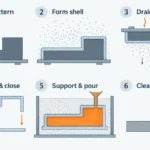
Step 1: Pattern Creation
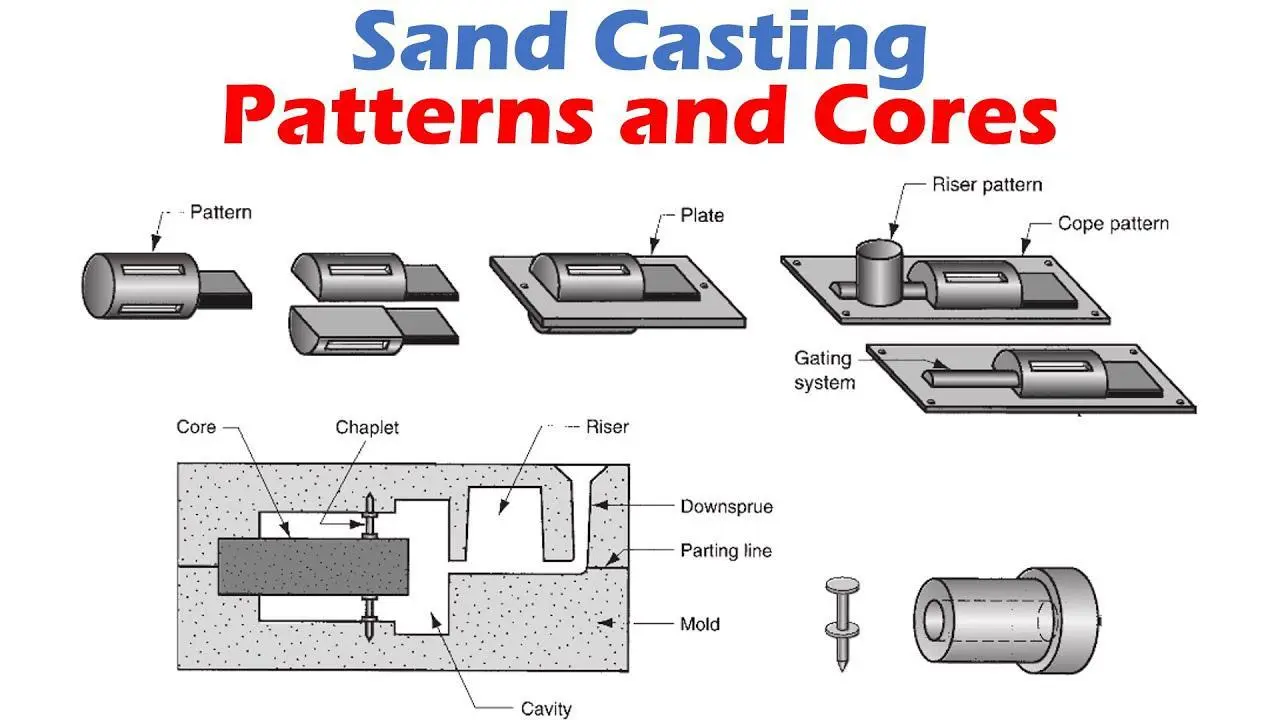
The process begins with engineering. A physical pattern is produced based on the final component’s CAD geometry. This pattern is what forms the negative cavity inside the sand mold. Patterns are intentionally designed slightly larger than the final part to account for the natural shrinkage of the metal as it cools from a liquid to a solid state, as well as to leave extra material for secondary CNC machining.
Read more: Sand Casting Pattern Design Guide
Step 2: Mold Preparation
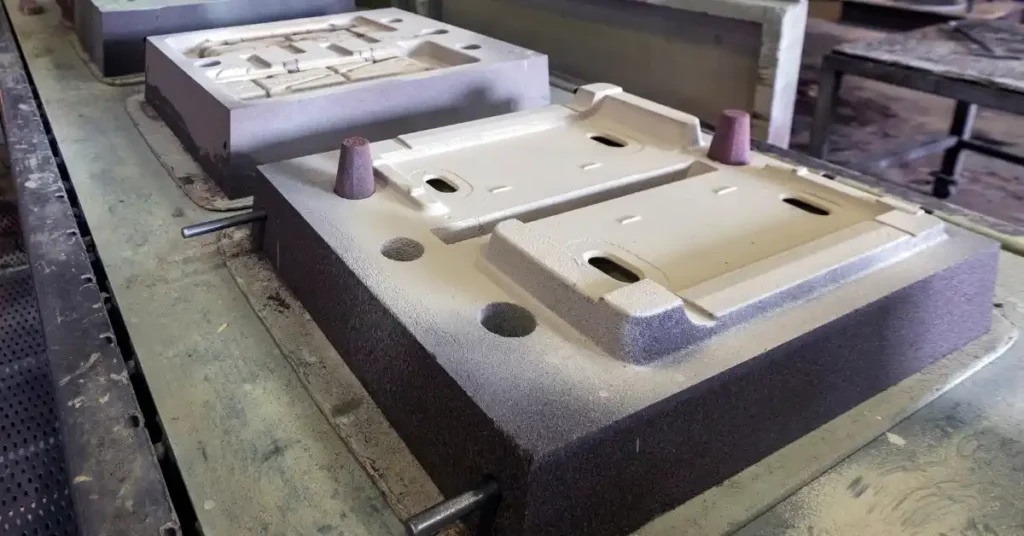
Specialized casting sand is packed and compacted tightly around the pattern inside a rigid frame known as a flask. The flask is typically divided into two halves: the upper half (the cope) and the lower half (the drag). After the sand is compacted, the two halves are separated, and the pattern is carefully extracted, leaving a perfect negative cavity inside the mold.
Read more: Sand Mold Making
Step 3: Core Installation
If the custom part requires internal passages, hollow sections, or complex undercuts, sand cores are manufactured separately. These cores are meticulously placed inside the drag half of the mold cavity. When the metal is poured, it flows around the core, creating the internal hollow structures.
Read more: Sand Core Making.
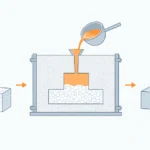
Step 4: Metal Pouring
The cope and drag are closed and securely clamped together to prevent the liquid metal from lifting the top half. Molten metal, heated to precise metallurgical specifications, is then poured into the mold through a carefully designed gating system (a network of sprues, runners, and gates that control the speed and flow of the metal).
Step 5: Cooling and Solidification
The metal cools and solidifies inside the mold cavity. This step requires strict thermal management. Foundries utilize risers (reservoirs of extra molten metal) that feed liquid metal back into the casting as it shrinks, preventing internal voids. The cooling time can range from a few minutes for small aluminum parts to several days for massive steel components.
Step 6: Shakeout and Finishing
Once fully solidified, the sand mold is broken away in a process called “shakeout.” The raw casting undergoes cleaning (often via shot blasting), grinding to remove the gating system and risers, and any necessary heat treatment or CNC machining to achieve the final precision dimensions.
3. Types of Sand Casting
Not all sand casting is the same. The sand binder system and pattern approach you choose has a major effect on cost, lead time, achievable tolerance, and surface finish. Below is an overview of the five main types in use today.
Green Sand Casting
Green sand casting is the most common and lowest-cost method. Sand is mixed with clay and water rather than a chemical binder, requires no baking, and can be reclaimed and reused many times. The term “green” refers to the moisture content in the sand, not the color. However, the surface finish and dimensional accuracy are moderate compared to other sand processes.
- Best for: High-volume, general-tolerance castings such as pipe fittings, engine components, and machinery housings.
- Advantages: Offers the absolute lowest mold cost, supports very fast automated production rates, and the sand mixture is highly recyclable (often over 90% reclamation).
Resin Sand Casting
Resin sand casting (also called no-bake or air-set sand casting) uses sand bonded with a chemical resin that cures at room temperature without heat.
- Best for: Medium-volume production where green sand’s tolerance isn’t sufficient but the part doesn’t justify shell or investment casting.
- Advantages: Provides significantly better dimensional accuracy, improved surface finish, higher mold strength, and virtually eliminates moisture-related gas defects like porosity.
Shell Mold Casting
Shell molding uses fine-grained sand coated with a thermosetting phenolic resin. The sand is dumped over a heated metal pattern, causing the resin to cure and form a thin, hard “shell” that perfectly replicates the pattern. Because it requires a durable metal pattern, tooling cost is higher than green or resin sand.
- Best for: Higher-volume production of small to medium precision parts.
- Advantages: Excellent surface finish and tight tolerances with a fast cycle time.
Lost Foam Casting
Lost foam casting (evaporative pattern casting) completely replaces traditional removable patterns. Instead, a pattern made from expandable polystyrene (EPS) foam coated in a refractory wash is buried in unbonded dry sand. When the molten metal is poured directly onto the foam, it vaporizes instantly, and the metal perfectly replaces the foam volume. Each foam pattern is single-use, so this process favors parts with automated foam pattern production at moderate to high volumes.
- Best For: Exceptionally complex geometries and consolidated assemblies (combining multiple parts into one).
- Advantages: Eliminates the need for a parting line or draft angles, allowing highly complex, consolidated geometries that would otherwise require multiple cores. Heavily reduces secondary machining, and offers unparalleled design freedom for internal channels.
Read more: Lost Foam Casting
3D Printed Sand Casting
3D printed sand casting prints the mold or cores directly from CAD data using binder jetting, which deposits liquid binder onto layers of sand, building the mold and cores without ever needing a physical pattern. This makes it the fastest route from design to first casting.
- Best for: Fast prototypes, short runs, and parts with internal geometry too complex for conventional tooling — though unit cost is higher than tooled sand processes.
- Advantages:Zero pattern tooling costs, incredibly fast development cycles (weeks reduced to days), and unlimited geometric freedom for aerospace and automotive R&D.
| Type | Tooling Cost | Typical Volume | Dimensional Accuracy | Surface Finish | Best Fit |
| Green Sand | Low | High | Moderate | Moderate | General-purpose, high-volume parts |
| Resin Sand | Low–Moderate | Medium | Good | Good | Larger parts needing better accuracy |
| Shell Mold | Moderate–High | Medium–High | Very Good | Very Good | Small precision parts, repeatable runs |
| Lost Foam | Moderate | Medium–High | Good | Good | Complex, consolidated geometries |
| 3D Printed Sand | Very Low (no pattern) | Low | Good | Good | Prototypes, short runs, complex internals |
4. Materials Used in Sand Casting
Sand casting supports a broader range of alloys than almost any other casting process, which is one of its core advantages.
Aluminum is chosen for its light weight, good machinability, and reasonable casting fluidity. Common alloys like A356 and A380 are used widely in automotive brackets, housings, and aerospace fittings where weight reduction matters.
Read more: Aluminum Sand Casting
Steel (carbon and low-alloy grades) offers high strength and toughness for heavy-duty applications such as mining and construction machinery components and structural parts. Steel’s higher pouring temperature and greater shrinkage require more careful gating and risering design than non-ferrous alloys.
Read more: Steel Sand Casting
Iron — both gray iron and ductile iron — remains one of the most cost-effective sand casting materials. Gray iron offers excellent wear resistance and vibration damping, making it common in machine bases and engine blocks, while ductile iron provides higher strength and ductility for pipe fittings, valve bodies, and automotive components.
Read more: Iron Sand Casting
Stainless steel is selected when corrosion resistance is essential — food processing equipment, chemical handling, marine hardware, and pump and valve bodies. Common cast grades like CF8 and CF8M correspond to wrought 304 and 316 stainless.
Read more: Stainless Steel Sand Casting
5. Sand Casting Engineering and Design Considerations
Getting good results from sand casting starts at the design stage, well before any sand is packed.
Design Considerations
Design guidelines that consistently improve casting quality include maintaining uniform wall thickness to reduce shrinkage-related defects, applying draft angles of roughly 1–3° per side so the pattern releases cleanly, and using generous fillets rather than sharp internal corners to improve metal flow and reduce stress concentration. Parting line placement also matters — it should simplify both pattern construction and mold assembly while keeping flash to a minimum.
Read more: Sand Casting Design Guide
Sand Casting Tolerance
Tolerances achievable in sand casting vary by process type and casting size. Green sand typically holds looser tolerances, while resin and shell processes can achieve significantly tighter dimensional control. As a general rule, linear tolerances in standard sand casting fall in the range of roughly ±0.4 mm to ±1.5 mm per 100 mm of dimension, with machining stock added on critical features.
Sand Casting Defects
Common defects in sand casting include gas and shrinkage porosity, sand inclusions, cold shuts, misruns, and hot tears. Most of these trace back to gating and risering design, pouring temperature control, mold venting, or sand compaction — which is why defect prevention is largely a design and process-control problem rather than something fixed after the fact.
Sand casting surface
Surface finish out of the mold depends heavily on the sand type — green sand typically produces a coarser as-cast finish, while shell and resin sand processes yield noticeably smoother surfaces. Where a functional surface is required, shot blasting and selective machining are used to bring castings to specification.
6. Sand Casting vs. Other Manufacturing Processes
Choosing between sand casting and an alternative process usually comes down to volume, geometry complexity, required precision, and total program cost — not just piece price.
Cost Structure
Tooling cost for sand casting is low to moderate compared to die casting’s hardened steel dies, but piece cost per part doesn’t drop as steeply with volume as it does for die casting once that higher tooling is amortized. For low-to-medium volumes — roughly one piece up to a few thousand — sand casting is usually the more economical overall choice.
Read more: Sand Casting Costs
Vs. Investment Casting
Investment casting delivers tighter tolerances, finer surface finish, and supports more complex thin-wall geometry, but at higher piece cost and longer lead time due to wax pattern and ceramic shell building. Sand casting wins for larger, heavier parts and for projects where precision requirements don’t justify investment casting’s added cost.
Vs. Die Casting
Die casting is largely limited to non-ferrous alloys (aluminum, zinc, magnesium) and requires significant tooling investment, but offers fast cycle times well suited to high-volume thin-wall parts. Sand casting handles ferrous alloys and larger or heavier parts that die casting cannot produce at all.
Vs. Forging
Forging produces superior mechanical properties — better grain flow and strength — for highly stressed components, but is far more limited in geometric complexity and carries high tooling cost. Sand casting allows more intricate shapes, internal cavities, and thin ribs at a fraction of the tooling investment.
7. Advantages and Disadvantages of Sand Casting
Understanding the dual-sided nature of sand casting ensures it is applied to the correct engineering projects.
Advantages
- Low Tooling Cost:Patterns and core boxes are significantly cheaper to manufacture than the permanent steel dies used in die casting.
- Large Part Capability:Foundries can routinely produce massive parts ranging from a few grams to over 100 tons.
- Broad Material Selection:Nearly all castable metals, regardless of their melting point, can be safely processed in refractory sand.
- High Design Flexibility:Highly complex internal cavities, fluid passages, and undercuts can be seamlessly created using expendable sand cores.
- Recyclable Molding Materials:Up to 90-95% of green casting sand can be mechanically reclaimed, screened, and reused in the next batch, making it highly sustainable.
Limitations
- Lower Dimensional Accuracy:Typical tolerances (CT9-CT12) are wider compared to precision processes like investment casting or direct CNC machining.
- Rougher Surface Finish:The granular nature of sand leaves an as-cast surface finish of Ra 10-20 μm, meaning critical mating surfaces require additional machining.
- Slower Production Rates:Because each mold is entirely consumed and destroyed during production, the cycle time is slower than permanent mold methods.
- Greater Process Variability:Controlling moisture, binder ratios, and sand compaction requires strict quality control systems to prevent defects.
8. When Should You Choose Sand Casting?
Sand casting is a powerful tool, but it is not the right solution for every single manufacturing project. The following operational guidelines can help procurement and engineering teams determine whether it is the best manufacturing process for their needs.
Choose Sand Casting If:
- Part weight exceeds several kilograms (up to several tons).
- Production volume is low to medium (from 1 to 10,000 units).
- Upfront tooling and capital expenditure budgets are strictly limited.
- Complex internal cavities, pipes, or fluid channels are required.
- Heavy-duty iron or steel alloys are the preferred material.
- Extremely large physical dimensions are involved.
Consider Other Processes If:
- Extremely tight, near-net-shape tolerances are required straight out of the mold.
- A flawless, mirror-like surface appearance is critical without post-polishing.
- Production volumes exceed hundreds of thousands of identical parts.
- Ultra-thin walls (under 2 mm) are a critical design requirement.
9. Typical Applications of Sand Casting
Because of its unparalleled size range and material flexibility, sand casting serves as the structural foundation for the world’s heaviest and most critical industries.
Automotive and Transportation
- Engine blocks and structural engine mounts
- Cylinder heads with complex internal water cooling jackets
- Heavy-duty brake drums and calipers
- Suspension parts and wheel hubs
Pumps and Valves
- Industrial water and chemical pump housings
- High-pressure valve bodies and flanges
- Complex internal fluid impellers
- Large-diameter pipe fittings and elbows
Heavy Equipment and Agriculture
- Massive gearbox and transmission housings
- Machine tool bases and heavy lathe beds
- Construction machinery structural components (excavator arms)
- Heavy counterweights for tractors and cranes
Energy and Power Generation
- Wind turbine rotor hubs and massive base frames
- Gas and steam turbine exterior housings
- Large electric generator frames
- Nuclear and hydroelectric fluid routing components
10. Conclusion
Sand casting remains one of the most versatile, resilient, and cost-effective metal manufacturing processes available to modern engineers today. Its unique ability to produce massive, incredibly complex components from a virtually limitless range of materials makes it an absolute necessity across the automotive, industrial, energy, and heavy equipment sectors.
Whether you are evaluating a new product design, comparing manufacturing methods to optimize a supply chain, or sourcing a reliable and capable foundry partner, understanding the fundamental mechanics, advantages, and limitations of sand casting is the first critical step toward making the right production decision for your business.
11. Working With the Right Sand Casting Partner
Choosing the right combination of sand type, alloy, and design approach has a direct effect on cost, lead time, and part performance — and the right choice isn’t always obvious from a drawing alone. Whether sand casting, investment casting, or another process is the best fit for your part, our engineering team can review your geometry, tolerance requirements, and volume to recommend the most cost-effective path to production. Contact us to discuss your project, or explore our Investment Casting Service if your application calls for tighter tolerances or finer surface finish than standard sand casting provides.
FAQs
What is sand casting used for?
Sand casting is used to produce metal parts across nearly every industry, from small brackets to multi-ton machine bases, whenever the application calls for low tooling cost, design flexibility, or an alloy not suited to die casting.
Is sand casting suitable for prototypes?
Yes. Sand casting is heavily used for prototypes, particularly for large metal components. Utilizing rapid prototyping techniques like 3D printed sand molds or cheap wooden patterns allows engineers to test physical metal parts in a matter of days without committing to expensive permanent tooling.
What is the minimum wall thickness for sand casting?
Typically, the absolute minimum wall thickness is 3-5 mm, heavily depending on the specific metal alloy’s fluidity and the overall size of the geometry. Attempting to cast thinner walls greatly increases the risk of misruns and cold shuts.
Can stainless steel be sand cast?
Yes. Stainless steel is commonly produced through sand casting, especially for large marine components, food processing equipment, and chemical pump housings that require exceptional corrosion resistance combined with high structural integrity.
Is sand casting expensive?
Generally, no. Sand casting is among the most economical metal casting processes in existence. While the per-part cost might be higher than die casting at ultra-high volumes, the incredibly low tooling cost makes it the most cost-effective solution for large parts or low-to-medium volume production runs.
How accurate is sand casting?
Typical dimensional tolerances for standard sand casting range from ISO 8062 CT9 to CT12. While this is sufficient for structural features, any critical mating faces, bearing journals, or threaded holes will require secondary CNC machining to achieve high-precision fits.