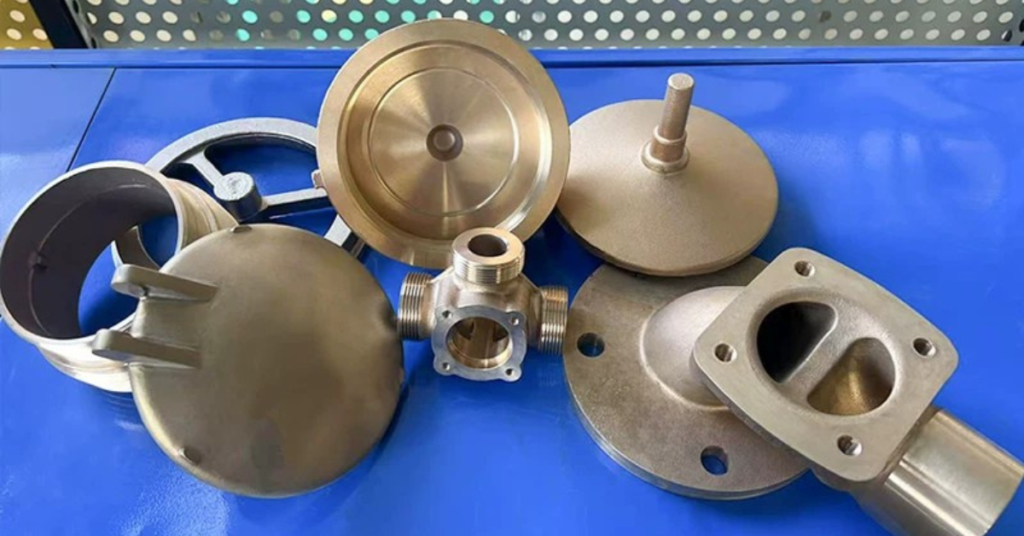
Investment brass casting is used for detailed parts that need a clean finish with strength and corrosion resistance. In addition to that, brass also machines and polishes well, making it useful for valves, fittings, handles, and decorative hardware.
This guide covers the main alloys, how zinc affects casting, and where brass castings are commonly used.
What Brass Investment Casting Involves
The process follows the usual lost-wax method. A wax pattern is coated in ceramic slurry until a shell forms around it. Then, the wax is melted out, and molten brass fills the cavity that remains.
Brass works especially well here because it can hold small details. Threads, lettering, knurling, and thin decorative areas can come out close to their final shape, reducing the machining and processing in the latter parts of the manufacturing process.
Why Choose Brass Over Other Casting Alloys?
Brass makes the most sense when a part needs to work well and have a clean finished look. That’s why you’ll commonly find them in fittings, handles, hardware, and other parts that are tactile and visual.
Brass vs. Bronze
For heavy wear and load-bearing surfaces, bronze is usually the better choice. It’s also a practical move for applications that would need it to be exposed to seawater for long periods. For many everyday fittings and decorative parts, though, brass is often more practical. It’s cheaper than many bronze alloys, machines easily, and offers good levels of corrosion resistance.
Brass vs. Stainless Steel
Strength is where stainless steel has the advantage. Structural parts or components under very high loads may need it. Brass is easier to machine and much simpler to polish. For visible hardware like valves and fittings, that can mean less finishing work and a better-looking surface.
Brass vs. Zinc Die Casting
Last but not least is zinc. Zinc die casting is a challenge when very large quantities need to be made at a low cost. You’ll usually go and choose brass when what you need requires more strength, better water resistance, or a higher-quality finish.
Which Brass Should You Cast In?
Zinc is what separates one cast brass from another. It’s also what decides more than color. The more zinc an alloy carries, the cheaper and brighter it runs, and the faster it corrodes in water.
There are seven (7) grades that cover nearly everything you will encounter.
| Grade | Copper | Character | Best for |
| C85700 Yellow Brass | 60 to 65% | Brightest color, superb machinability | Decorative hardware, trim |
| C85800 Die Cast Yellow | ~58% | Flows into the finest detail | Intricate decorative work |
| C85200 High Copper Yellow | ~72% | Middle ground on cost and corrosion | General hardware, fittings |
| C84400 Semi-Red Brass | ~81% | Water-capable at lower pressures | Budget plumbing components |
| C83600 Red Brass | ~85% | The plumbing industry standard | Valves, pressure fittings |
| C87500 Silicon Brass | ~82% | Best fill and smoothest as-cast surface | Thin walls, fine features |
| DZR Brass | Varies | Arsenic blocks zinc leaching | Potable and chlorinated water |
Red Brass
For parts that carry water under pressure, C83600 is a common choice. Its higher copper content gives it better corrosion resistance and makes it easier to control during casting. Valve bodies and pressure fittings often use it.
Silicon Brass
C87500 handles complex and detailed shapes well and can leave a smoother surface straight from the mold. They’re actually more useful and effective when the shape itself is the main challenge.
High Copper Yellow Brass
More copper gives C85200 better corrosion resistance than standard yellow brass without moving all the way to red brass. Making it useful for decorative hardware that may see some moisture.
Semi-Red Brass
For lower-pressure plumbing parts, C84400 can be a sensible middle ground. It handles water reasonably well without the higher cost of red brass, which is often enough for simpler fittings and components.
Die Cast Yellow Brass
For dry decorative hardware, C85800 is a strong option. It flows easily into lettering and small details, though it does not handle long water exposure well.
Dezincification-Resistant Brass
Years of contact with water can slowly pull zinc out of ordinary brass. DZR brass is made to reduce that damage and help the metal stay strong longer.
Semi-Red Brass
When red brass is more than a low-pressure part needs, C84400 can make more sense. It gives decent water resistance while keeping the material cost lower.
Where Cast Brass Is Used
You’ll see brass in many different industries. However, the reason changes with the part.
- Valves and Plumbing: Water-handling parts often use red brass or DZR grades. These alloys hold up better when moisture is always present.
- Architectural Hardware: Yellow brass is common on door handles, window fittings, and other visible pieces because it polishes well and takes plating cleanly.
- Electrical Components: Terminals and switchgear parts benefit from brass because it conducts electricity well enough and is easy to machine.
- Lighting and Instruments: Fine details can be cast directly into fixture bodies and lamp fittings. That greatly reduces extra machining and processing.
- Marine Fittings: Brass works for cleats, trim, and deck hardware that see occasional saltwater. For constant seawater exposure, bronze is usually the better choice.
NOTE: These are only some of the common uses for cast brass. The material also appears in decorative products, machinery, fittings, hardware, and other parts where corrosion resistance, easy machining, or appearance matters.
Get Your Brass Investment Castings From HDC
A brass spec is usually just the starting point. Depending on the part, another alloy may offer the strength, corrosion resistance, or cost advantage you actually need.
While YTD Foundry doesn’t currently produce brass investment castings, our team specializes in investment casting across a wide range of alloys. Send us your sketch and requirements; we’ll help you explore the best material for production.