The investment casting of turbine blades asks more of a foundry than almost any other job in metalworking. These blades work under heavy loads and stay exposed to very high temperatures for long periods, so it definitely needs specialization when they’re made.
This article looks at what turbine blade investment casting is, how they’re cast, how their grain structure affects service life, which superalloys are commonly used, and more!
What Is Turbine Blade Investment Casting?
Turbine blade investment casting, from the term itself, is the process in which turbine blades are made through the investment casting process. The process is done to form the cooled airfoils found in jet engines and gas turbines. It shapes nickel superalloys into a near-net blade, with the internal cooling passages already inside it.
Why Are Turbine Blades Investment Cast?
The same reason why businesses opt for investment casting instead of any other process, and it’s because it can make much of a turbine blade before heavy machining begins. This is especially useful for parts that are difficult to cut from solid metal.
The Shape Is Difficult to Machine
A turbine blade has a curved shape that needs to be extremely accurate. Furthermore, many blades are hollow, with passages inside that carry cooling air. Those spaces can be done during casting with a core. Trying to machine the same passages afterward would be far more difficult.
The Metal Is Hard to Cut
Many turbine blades are made from nickel-based superalloys. They work well at high temperatures, but they are difficult to machine. Casting forms most of the blade first so that there’s less material to remove after.
Some Blades Need Controlled Cooling
For certain turbine blades, the way the metal cools during casting matters too. The process is controllable to produce directionally solidified or single-crystal blades. That structure forms while the metal is cooling, instead of just being an additive later.
How Are Turbine Blades Investment Cast?
Investment casting of turbine blades starts by making the inside shape first, then building the blade around it. Each step has a clear job, from forming the mold to pouring the metal and checking the finished blade.
Here’s how the process works from start to finish.
Step 1: Make the Cooling Core
For hollow turbine blades, a ceramic piece is what’s actually made first. This piece creates the small cooling paths that will later sit inside the blade. Think of it as a placeholder and the metal will form around it.
Step 2: Form the Wax Blade
Then, the next step is to make the wax blade. Wax is formed around the ceramic core until it looks like the finished turbine blade.
The core stays inside the wax, already sitting where the cooling paths need to be. You can also chip in old different wax blades for casting.
Step 3: Build the Ceramic Mold (Outer Mold)
Next comes the mold that will actually hold the molten alloy. The wax blade is covered with layers of ceramic. Each layer dries before another one goes on.
After enough layers are added, the ceramic becomes strong enough to hold hot metal.
Step 4: Remove the Wax
Once the ceramic is ready, the wax has done its job and you can now remove it.
Heat removes it from inside the shell, leaving an empty space in the exact shape of the blade. The ceramic core remains inside because it still has to form the cooling passages during casting.
Step 5: Pour the Superalloy
The empty mold is heated before the metal goes in to ensure that the liquid metal doesn’t cool and harden fast. For many high-temperature turbine blades, this is done under vacuum. The liquid metal fills the blade shape and flows around the ceramic core.
Molten alloy then fills the space once occupied by the wax. It also flows around the ceramic core rather than through it, and it’s how the hollow structure survives inside the blade.
Step 6: Control How the Blade Cools
The metal must now turn solid. How it cools can change the structure inside the blade. Some blades have many metal grains, while more advanced versions may be made with grains running mainly in one direction.
Single-crystal turbine blades take this even further by growing the blade with one main crystal structure.
Step 7: Open the Cooling Passages
After the metal has cooled, the ceramic shell around the blade is removed. The core inside needs to be also taken out. After that, the cooling passages are left open inside the turbine blade.
Chemical removal is often needed to clear that core from the blade. Once done, the cooling passages are open inside the metal part.
Step 8: Finish and Check the Blade
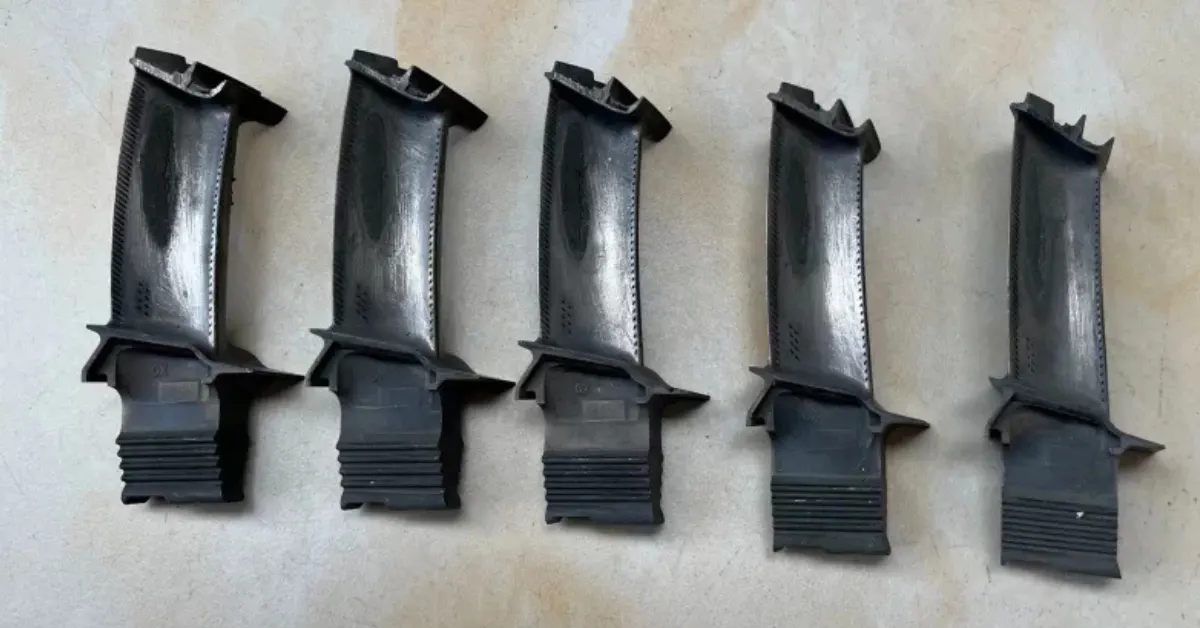
At this point, the blade is almost done. There are just some areas that still need extra work where you’ll need to machine certain surfaces so they fit correctly inside the engine. In addition, you can also use heat treatment to give the alloy the strength it needs.
For the last bit, you’ll have to check and inspect the blade. Good manufacturers check both the outside and hidden areas inside the casting before the part is approved for use.
Turbine Blade Casting Grain Structures
The way the metal cools changes the inside of the turbine blade. That matters because blades work under heavy force and very high heat for long periods.
One problem is creep, which means the metal slowly stretches over time. The grain structure helps decide how well the blade can resist that.
- Equiaxed: The metal cools into many small grains pointing in different directions. It is the simplest and lowest-cost option, but it handles less heat than the other two.
- Directionally Solidified: The grains grow mainly in one direction along the blade. This gives better strength at high temperatures and works well in hotter turbine sections.
- Single Crystal: The blade forms as one continuous crystal with no grain boundaries. It can handle the highest temperatures and used in the hottest parts of modern turbine engines.
In simpler terms, the hotter the turbine section gets, the more important the grain structure becomes.
Superalloys Used in Turbine Blade Casting
Turbine blades need metals that can stay strong under very high heat. Nickel-based superalloys are the main choice, while cobalt alloys are used for certain turbine parts.
CMSX-4
CMSX-4 is a nickel-based superalloy made for single-crystal turbine blades. It is used in hot engine sections where the blade has to keep its strength for long periods.
- Used for:Single-crystal turbine blades
- Known for:High-temperature strength and creep resistance
René N5
Another single-crystal nickel alloy, René N5 is also made for demanding turbine conditions. It contains rhenium and other elements that help the metal perform under heat.
- Used for:High-temperature turbine blades
- Known for:Long-term strength in hot engine sections
Cobalt-Based Superalloys
Cobalt alloys are less common for rotating blades and are seen more often in turbine vanes. They handle repeated heating and cooling particularly well.
- Used for:Turbine vanes and other hot-section parts
- Known for:Resistance to repeated temperature changes
Where Are Investment Cast Turbine Blades Used?
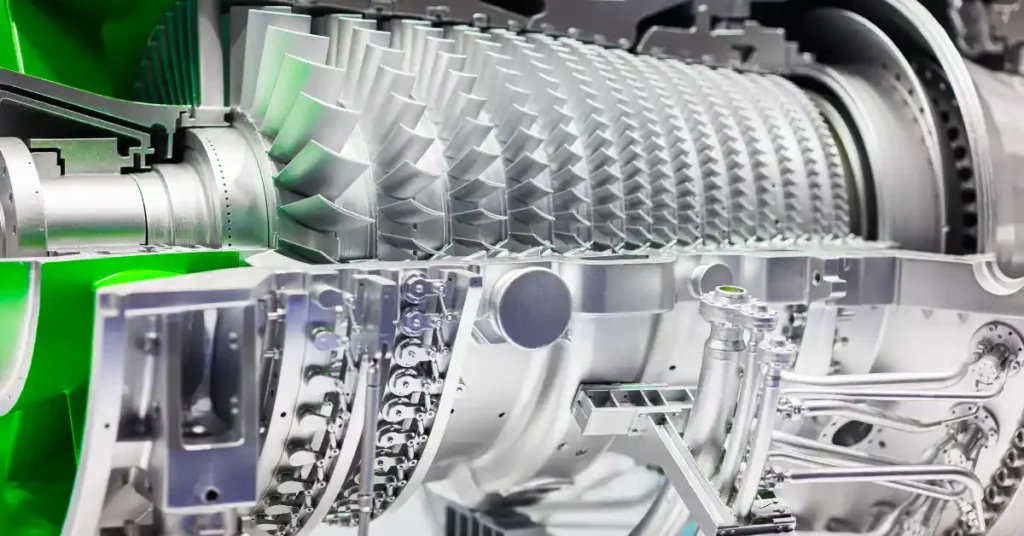
Investment cast turbine blades are used wherever a turbine has to keep working in very hot gas. The job changes from one industry to another, but the need for heat resistance stays the same.
Aircraft Engines
The toughest work is usually inside jet engines. Turbine blades are located near the combustor, where temperatures are extremely high. These blades help turn hot gas into the power needed to keep the engine running.
Power Generation
Large gas turbines use investment cast blades to generate electricity. Inside a power plant, the blades may run for long periods without stopping. That makes heat resistance and long service life especially important.
Marine Turbines
On large ships, gas turbines can provide the power needed for propulsion. They’re especially common in naval use. Because the engine runs at high temperatures, the turbine blades need to stay strong while spinning under heavy load.
Helicopter Engines
Turboshaft engines use turbine power to turn the helicopter rotor rather than produce jet thrust. Turboprop aircraft work in a similar way, using the turbine to drive a propeller. You use investment cast blades where the hottest engine sections need stronger materials.
Auxiliary Power Units
An APU is a smaller turbine engine used when the main aircraft engines are not providing power. You’ll often see it used on the ground for electricity or other onboard systems. Its turbine blades still face high heat, just on a smaller scale than the main engine.
Rocket Turbopumps
At the more extreme end, turbine parts also appear inside rocket turbopumps. These systems move fuel through the rocket engine at very high speed, putting the turbine under intense heat and load.
Get Your Cast Turbine Blades From YTD Foundry
Making turbine blades takes careful control from casting through final inspection. At YTD Foundry, investment casting is our focus, so we understand what these demanding parts require.
Tell us every detail and aspect we need to know and we’ll be more than happy to help you! Get a free quotation of the orders you need!