Investment casting parts show up in more places than most people realize. You actually see them in things as simple as kitchen faucets to as complex as jet engines. So, in this guide, we’ll be walking you through the different parts they make and industries that lean on them.
We’ll keep it simple and practical; we’ll give them to you with real examples instead of plain literature and theory.
What Parts Can Be Made With Investment Casting?
Investment casting works well for small and medium metal parts with detailed shapes. It can produce thin walls and features that would be difficult to machine. Most parts weigh less than 10 kg, though larger castings are possible. Steel walls can be around 1.5 mm thick, while aluminum may go thinner with the right mold design.
The process can also create hollow areas and internal channels by using special cores. This makes it useful for parts that need cooling passages or spaces inside the casting. Production can range from a few prototypes to thousands of parts each year. In some cases, one casting can replace several welded or machined pieces.
Below are some of the most common investment casting parts made.
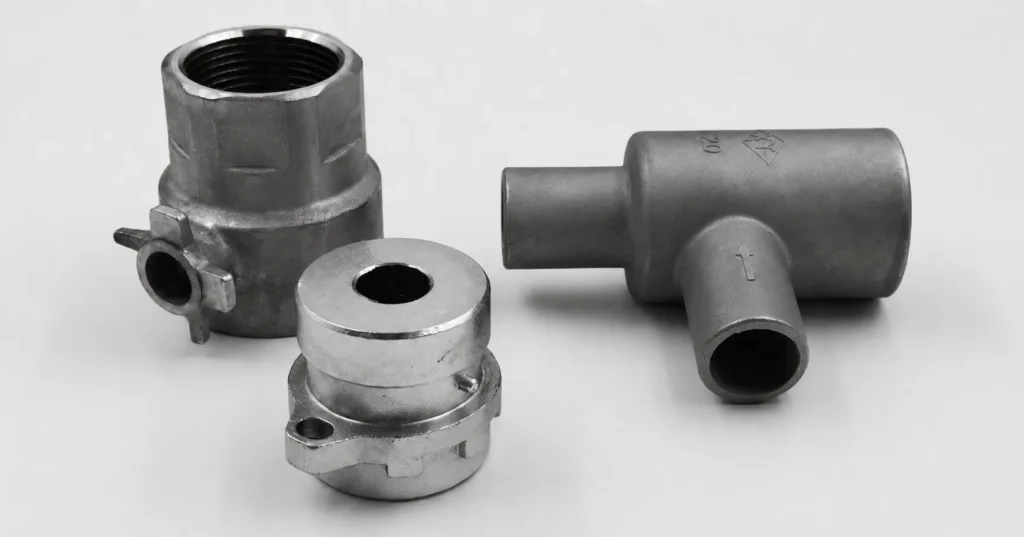
Common Investment Casting Components
There are specific parts and components you can make with investment casting more often because the process handles detailed shapes well.
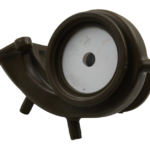
Pump Parts
Curved blades and internal flow paths are difficult to cut from solid metal. Casting forms these shapes more directly, which makes it useful for pumps and compressors.
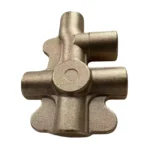
Valve Bodies
Valve bodies often need strong metal walls and a sealed internal cavity. Stainless steel and carbon steel are common choices for these parts.
Turbine Blades and Vanes
These parts have thin, curved shapes that need a high level of detail. Investment casting is widely used for blades in aircraft engines and power turbines.
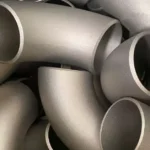
Brackets and Housings
Single castings can replace several pieces that you can actually bolt or weld together. This reduces the number of joints in the finished part.
Gears
You can cast the main shape close to its final form. Only the working surfaces may need extra machining afterward.
Manifolds and Nozzles
Internal ports and flow paths can be built into the casting. This can reduce the number of separate machining steps.
Surgical Instruments
Small stainless steel tools often need clean edges and a smooth finish. Investment casting helps create the shape before final polishing.
These examples all have one thing in common: they are harder to make from a solid block of metal. Casting the shape first can save time and reduce extra work.
Which Industries Use Investment Casting Parts?
Investment casting is used when a part needs a detailed shape, reliable strength, or less machining after casting. Different industries rely on it for different reasons.
Aerospace
Turbine blades with a twisted airfoil is slow and wasteful to cut from solid, so casting pours it near final shape in one go. The process also handles nickel superalloys that hold up past 1,000°C, which is exactly what a running engine demands.
- Turbine blades:smooth, accurate airfoil curves straight from the mold
- Superalloys:nickel grades that keep their shape past 1,000°C
- Lighter brackets:cast as one piece to cut airframe weight
Medical
Casting builds a clean, precise profile early, before the polishing that finishes a surgical instrument. Cobalt-chrome and titanium pour well and sit safely in the body, which is why implant makers reach for them.
- Surgical tools:clean, defined edges before final polishing
- Body-safe metals:titanium and cobalt-chrome for implants
Energy
Down a well or inside a turbine, a part faces heat and pressure that never let up, so a hidden seam is a real risk. Casting shapes tough alloys into one solid form, which is why the sector trusts it for valves and blades alike.
- Turbine parts:built for constant high-heat service
- Stainless pumps:corrosion resistance for wells and plants
- One-piece valves:no seam to leak under pressure
Automotive
Most car parts are stamped by the million, but a few curved shapes resist those methods and push makers toward casting instead. Turbocharger wheels release cleanly from a mold, and low-volume motorsport runs skip the cost of hard tooling.
- Turbo wheels:fine, balanced vanes that are hard to machine
- Rockers:cast close to their final size
Defense
Field gear gets dropped and remounted for years, so it has to hold tight dimensions without loosening. One-piece castings remove the joints that work free over time, which keeps the equipment reliable where it counts.
- Optical housings:held to close, repeatable dimensions
- Stainless build:stands up to years of outdoor use
What Materials Are Used for Investment Casting Parts?
Investment casting works with many metals, making it useful across many business industries. Often, the right and best choice depends on the strength and weight the part needs. There are instances where you need to largely consider heat resistance in choosing the material, too.
Here are some of the most common materials you’ll find in investment casting.
Carbon and Low-Alloy Steel
These steels are often used for strong parts that still need to stay affordable. WCB and 4140 are common examples for brackets, housings, and other structural pieces.
Stainless Steel
For parts exposed to water or chemicals, stainless steel would usually be the better fit. Grades such as 304 and 316 resist corrosion, while 17-4PH is chosen when more strength is needed.
Aluminum
Aluminum keeps the finished part light without making it weak. A356 and A357 are common for vehicle parts and other designs where weight matters.
Superalloys
Some parts work in high and extremely hot environments, especially inside furnaces, turbines, and the like. Inconel and cobalt alloys can keep their strength at temperatures above 600°C.
Copper Alloys
Brass and bronze are widely used for valves or other parts for decoration. Moreover, they cast well when the design includes smaller and finer details, too.
Titanium
Titanium offers high strength without adding much weight. Ti-6Al-4V is often used for aircraft parts and medical components where both strength and low weight matter.
Overall, the material should fit and match the job the components need to do. Strong and durable steel may work for heavy housing, but aluminum or titanium makes more sense when weight needs to stay low.
Why Do Industries Choose Investment Casting?
Investment casting wouldn’t be considered great if it wasn’t for businesses and industries needing them more frequently compared to other methods. Reasons come up over and over, whatever the business and sector. They, however, all trace back to shape and the cost of getting that shape.
- Parts arrive close to final size, so machining is kept to only what truly needs it
- Internal passages and thin walls cast in one piece, with no assembly to add later
- A single casting can replace a welded assembly, cutting both weight and weak points
- Many parts come out with a finish clean enough to coat or use with no extra work
- One process spans everything from carbon steel to nickel superalloys
- Tolerances stay tight and repeatable, which means less inspection and rework down the line
Put together, these advantages explain why investment casting keeps its place in industries where a part is too detailed, too loaded, or too costly to machine any other way.
How Investment Casting Compares to Other Methods
Investment casting isn’t the only way to make a metal component; the right pick depends on the shape and quantity.
| Method | Best for | Surface finish | Tooling cost |
| Investment casting | Complex, detailed parts | 1.6 to 3.2 µm Ra | Moderate |
| Machining | Simple or ultra-precise parts | Excellent | Low, but slow |
| Sand casting | Large, simple castings | Rough | Low |
| Die casting | High-volume light metals | Good | Very high |
Machining wins when a part is simple or needs the tightest possible tolerances. Sand casting takes over once parts grow large and lose their fine detail. Die casting rules high volumes in aluminum or zinc, though it cannot touch steel.
Investment casting sits in the middle of all this. It earns its place when a shape is too complex to machine cheaply, yet too detailed for sand casting to capture.
Get Your Investment Casting Parts From YTD Foundry
If your part is complex or hard to machine, investment casting parts are worth a serious look. The process fits a wide range of components across every industry above.
Investment casting is our bread and butter here at YTD Foundry; it’s not just a sideline we offer. We pour everything from carbon steel to nickel superalloys, and then finish and inspect each part in house, with CMM checks that confirm it matches your drawing before it ships.
Send your sketch along with your comprehensive spec, and we’ll tell you honestly whether investment casting fits the job or not. You’ll get a free quote from us, too!