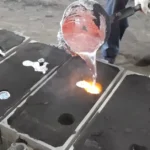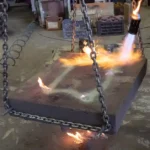
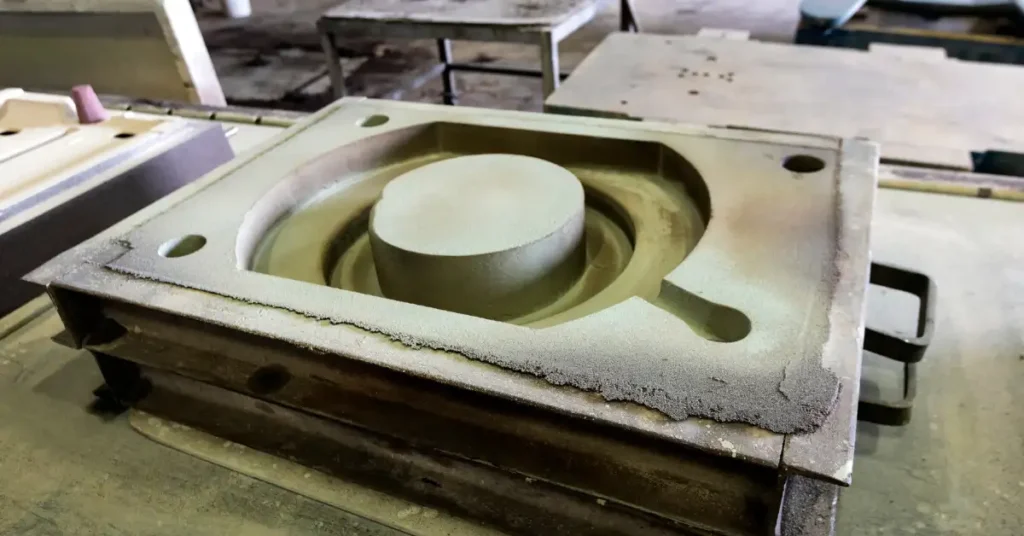
Green sand casting is a sand-molding process that pours metal into a mold made from moist, clay-bonded sand. The word green describes the mold’s damp, undried condition when it is poured. It does not refer to the color of the sand.
This simple definition explains both the appeal and the difficulty of the process. Water and clay let loose grains become a mold without a separate baking or room-temperature resin-curing stage. After pouring, the mold is broken apart and much of the sand can be conditioned for another cycle. Yet the same moisture, clay, compaction, and reused sand that make the system practical must stay in balance if the mold is to hold its shape, release gas, and produce a clean casting.
What Is Green Sand Made Of, and Why Is It Called “Green”?
The American Foundry Society glossary defines green sand as moist clay-bonded molding sand. An industrial mixture generally contains base sand, clay, water, and additives. Each component has a different role:
- Base sand forms the granular body of the mold and must withstand contact with hot metal.
- Clay, commonly bentonite, coats and bonds the grains when it is properly activated.
- Water activates the clay and helps give the mixture plasticity and green strength.
- Additives may be used to adjust selected properties, but their type and purpose depend on the alloy, casting, and foundry system.
There is no universal green sand recipe. Two foundries can both use green sand while running different base sands, clay systems, additives, molding machines, and control ranges. Even within one foundry, the mixture changes as returned sand is heated, cooled, abraded, and blended with replacement materials. A useful description therefore goes beyond percentages and asks how the whole system is prepared and controlled. Our guide to sand casting materials explains how base sands, binders, additives, coatings, and core materials play different roles.
How Does Green Sand Casting Work from Sand Preparation to Shakeout?
Green sand casting follows the same broad logic as other expendable-mold casting methods: make a cavity, fill it with metal, let the metal solidify, and remove the mold. What distinguishes the process is how the molding sand develops enough strength to complete those steps.
1. How Is Green Sand Prepared and Tested Before Molding?
New and returned sand are mixed with the required water, clay, and other additions. Mixing is not just a way to distribute ingredients. It develops the clay-water bonds and brings the sand to a condition in which it can flow around a pattern, compact evenly, and retain the cavity after the pattern is removed.
The condition at the molding machine matters more than the nominal recipe alone. Sand temperature, evaporation, return time, and mixing energy can change how the same measured amount of water behaves. Foundries therefore sample and test the prepared sand instead of assuming that an addition made at the mixer guarantees the result at the mold.
2. How Is a Green Sand Mold Formed Around the Pattern?
Prepared sand is placed around a pattern and compacted. In a conventional horizontal mold, the upper half is the cope and the lower half is the drag. The two halves are formed, the pattern is withdrawn, and the mold is closed. Draft on surfaces parallel to the withdrawal direction helps the pattern leave without tearing the cavity.
Automated lines can form horizontal molds with matchplates or produce vertical, flaskless molds in a continuous string. These are different ways to arrange and handle the mold; they do not change the underlying clay-and-moisture bonding mechanism. Foseco’s green sand process overview illustrates both horizontal and vertical arrangements.
3. What Do Cores, Gates, Risers, and Vents Do in the Mold?
The pattern creates the main external form, but the cavity also needs a controlled path for molten metal. A sprue, runners, and gates carry metal into the part cavity. Risers or feeders can supply liquid metal as the casting solidifies and contracts. Vents and permeable mold material provide paths for air and evolved gases.
Internal passages may require separately made cores. A core placed inside a green sand mold does not have to use the same moist clay-bonded mixture as the surrounding mold. Core strength, gas behavior, positioning, and removal are separate parts of the production plan.
4. What Happens When Molten Metal Enters a Green Sand Mold?
Molten metal enters the closed mold and fills the spaces left by the pattern and gating system. During this short event, the mold surface faces heat, flowing metal, pressure, and gases. The sand must remain intact long enough to preserve the shape while still allowing gases to move away from the metal.
The mold does not control the result by itself. Melt quality, pouring temperature and rate, gating, feeding, section thickness, and solidification all interact with mold behavior. This is why a surface cavity or inclusion cannot be assigned to “bad sand” from appearance alone.
5. How Does Shakeout Release the Casting and Recover the Sand?
After the metal has solidified sufficiently, the mold is broken apart during shakeout. The casting proceeds to gate and riser removal, cleaning, and any specified heat treatment, machining, or inspection. The pattern can be used to form another mold, but the mold that received the metal is not reusable. For the wider sequence and the role of patterns and cores, see this sand casting guide.
How Is Green Sand Reused After Shakeout?
After shakeout, magnets, screens, crushers, coolers, dust collection, and other equipment may remove metal, break up lumps, control fines, and bring the returned sand back toward a usable condition. Fresh sand, clay, water, or other materials are added as needed. The exact treatment depends on the foundry system.
This creates two different kinds of reuse that are easy to confuse. Internal recirculation returns suitable sand to molding. Beneficial reuse sends sand that can no longer meet foundry requirements to an approved use outside the foundry. The U.S. Environmental Protection Agency notes that foundry sand may be reused numerous times internally before part of the stream is removed and replaced. In a 2007 estimate cited by the EPA, U.S. foundries generated about 10 million tons of spent foundry sand annually, and less than 30% was recycled. Those historical figures cover spent foundry sands generally, not green sand alone, and they describe material after it leaves the internal casting cycle.
Repeated use does not mean zero waste or automatically establish a lower total environmental impact. Sand composition, contamination, local rules, transport, and the proposed end use still matter. Inside a foundry, shakeout, sand handling, and reclamation can also release dust. The NIOSH foundry control manual treats measures such as process isolation, exhaust ventilation, housekeeping, and performance monitoring as plant-level controls.
Which Green Sand Properties Must Foundries Control?
A mold needs enough strength to survive pattern withdrawal, handling, core setting, and pouring. It also needs enough permeability for gases to pass through, a surface that resists erosion, and a consistency that lets the molding machine reproduce the cavity. Improving one property without watching the others can move the problem rather than solve it.
The scale of this control problem is visible in the AFS sand-testing catalog. It treats at least 10 distinct measurements relevant to molding-sand condition as separate checks: moisture, active clay, compactability, permeability, green or dry compression strength, wet tensile strength, friability, loss on ignition, grain fineness, and pH. Sand temperature is another important operating condition. The point is not that every line must use one identical test package. It is that no single number describes the mold.
| Property or test | The practical question it helps answer |
|---|---|
| Moisture and active clay | Is the clay-water bonding system in a usable condition? |
| Compactability | How much does loose prepared sand respond to a defined compaction action? |
| Compression and wet tensile strength | Can the molded sand resist selected loads in its green, heated, or dried condition? |
| Permeability | How readily can gases pass through a standardized sand specimen? |
| Friability | How resistant is the green sand surface to abrasion and grain loss? |
| Grain fineness, loss on ignition, and pH | What do particle distribution, heat-sensitive constituents, and chemical condition reveal about the system? |
How Do Moisture and Compaction Affect Mold Strength and Permeability?
If the clay is not adequately activated or the sand is insufficiently compacted, the mold may lack strength and lose grains. At the other extreme, excess moisture, excessive compaction, or an unfavorable buildup of fines can make gas escape more difficult. Higher strength by itself is not the finish line; the mold must have the right combination of properties for the casting and molding method.
This is also why permeability should not be read as a standalone quality score. A very open sand structure can let gases pass, but it may create a different mold-metal interface and affect surface penetration. Venting, cores, coating, pouring practice, and cavity geometry all influence what happens in the actual mold.
Why Does Returned Green Sand Need Repeated Testing and Adjustment?
Every pouring cycle changes part of the sand. Heat removes moisture, alters clay and additives near the casting, and can break grains during handling and reclamation. Dust and fine particles may accumulate; new material and core-sand residues may enter the return stream. Hot return sand can also make moisture control less predictable through faster evaporation.
A stable green sand system is therefore maintained as a moving process. Representative samples, trend data, and timely corrections are more informative than an occasional test result compared with a fixed recipe.
What Causes Common Green Sand Casting Defects?
Green sand variables help explain many casting problems, but they rarely identify the cause on their own. Several defect paths are especially useful to understand:
- Gas cavities or porosity: gas may come from the metal, moisture, binders, cores, or trapped air. Permeability and venting matter, but melt treatment, pouring, and cavity geometry must also be checked.
- Sand inclusions and erosion: grains or pieces of mold can break loose and become trapped in the casting. Sand strength, friability, pattern withdrawal, core setting, gating, and metal flow can all contribute.
- Penetration and burn-on: metal can enter pores or react at the mold surface, leaving a rough adherent layer. Grain distribution, compaction, coating, metal pressure, alloy, and pouring temperature can affect the result.
- Mold or core shift: misalignment, movement, or damage can change wall thickness and feature position. Locating surfaces, closing, core support, handling, and metal forces deserve review.
The visible indication is a starting point for investigation, not a complete diagnosis. A useful review combines the defect’s shape and location with molding records, sand tests, core information, pouring data, and sectioned or inspected castings. This guide to sand casting defects follows those evidence paths in more detail.
What Surface Finish and Dimensional Accuracy Can Green Sand Casting Produce?
Green sand casting is often described as producing a rougher surface and wider dimensional variation than processes such as shell molding or investment casting. That is a useful general tendency, but it is not a universal tolerance or surface specification. In its study of steel castings, the Steel Founders’ Society of America found that variation within and between foundries was greater than the average dimensional difference among green sand, no-bake, and shell molding. The study is specific to steel castings, but it clearly shows why the process name cannot replace a foundry’s demonstrated capability. Grain size and distribution, mold hardness, pattern condition, coating, parting alignment, alloy, pouring, cleaning, and line control all affect the result.
Part geometry changes the comparison as well. A short rib close to the gate and a long thin wall do not fill under identical conditions. A dimension contained within one mold half may behave differently from a dimension that crosses the parting line. Internal dimensions add the behavior and positioning of a core.
Critical fits, sealing faces, bearing seats, and accurately located holes may still need machining. The casting drawing should distinguish dimensions and surfaces that may remain as cast from those that must be finished later. A visually smoother surface does not by itself guarantee flatness, position, or fit.
How Does Green Sand Compare with Dry Sand, No-Bake, and Shell Molding?
These names all involve sand, but they do not describe interchangeable versions of one mold. The most useful first comparison is how each mold develops and keeps its strength before pouring.
| Molding method | How the mold is held or conditioned | What this changes in practice |
|---|---|---|
| Green sand | Clay and controlled moisture bond the sand in its undried state. | No separate drying or chemical cure is needed; preparation and molding condition must be controlled continuously. |
| Dry sand | A formed clay-bonded sand mold is dried before pouring. | Drying changes mold strength and moisture behavior but adds time and energy before pouring. |
| No-bake sand | A chemical binder hardens the mold at room temperature. | Working time, curing, handling strength, gas generation, shakeout, and reclamation depend on the binder system. |
| Shell molding | Resin-coated sand cures against a heated metal pattern to form a rigid shell. | The heated tooling and thin shell change tooling needs, mold making, surface reproduction, and suitable production arrangements. |
None of the four is automatically the best sand-casting process. Green sand can serve manual molding and highly automated production. No-bake is often considered for molds or cores whose size, geometry, or handling favors chemically developed strength. Shell molding can be attractive when its tooling and surface or dimensional tendencies suit the part. Dry-sand molding addresses a different moisture and strength condition than pouring a green mold.
The comparison becomes useful only after the part is defined. Alloy, overall size, section thickness, shape, core demand, surface and dimensional requirements, production quantity, tooling budget, cycle time, finishing, and total cost all influence the answer.
When Is Green Sand Casting a Good Choice?
Green sand deserves serious consideration when a reusable pattern can form the external shape, the mold can be drawn and closed reliably, and the expected as-cast surface and dimensional variation leave a practical finishing route. Its short mold-making cycle and ability to circulate sand make it compatible with repeat production, while simple equipment can also support smaller or less automated work.
It may be a less natural fit when fine detail, delicate sections, difficult parting geometry, demanding as-cast surfaces, or complex cores dominate the part. That does not create an automatic rejection. It means the design should be compared with another molding or casting process using the same finished-part requirements.
The deciding evidence comes from the actual route: the foundry’s molding method and control history, the way the part will be oriented and fed, the core plan, the dimensions left for machining, and sample castings that confirm the result. “Green sand casting” names the bonding and molding method. It does not, by itself, specify one level of accuracy, one production volume, or one finished-part cost.