When I first looked up the types of sand casting, I expected to find one short, agreed-upon list. Instead, some sources discussed green sand and no-bake molds, others listed silica and chromite, and still others introduced facing sand, backing sand, and core sand.
The lists look contradictory, but they are usually answering different questions.
If the question is about sand casting processes, the main types include green sand, dry-sand and skin-dried molding, no-bake or air-set molding, sodium-silicate/CO2 molding, shell molding, the V-process, lost-foam casting, and 3D-printed sand molds and cores.
The easiest way to understand those names is to ask one simple question: what keeps the loose sand in the required shape while the metal is poured and solidifies?
The Simple Idea Behind the Different Processes
Sand grains do not hold the shape of a casting cavity by themselves. A foundry needs a way to form the sand around a pattern and keep the mold stable long enough to receive molten metal.
Different processes solve that problem in different ways:
- Moisture and clay hold a green-sand mold together.
- Heat removes moisture and strengthens a dry-sand or skin-dried mold.
- Chemical binders harden no-bake and sodium-silicate sand.
- A heated pattern forms the thin resin-bonded shell used in shell molding.
- Plastic film and vacuum support unbonded sand in the V-process.
- An expendable foam pattern remains inside the sand in lost-foam casting.
- A printer builds a sand mold or core directly from digital data.
Once this is clear, the process names stop looking like an arbitrary vocabulary list. Each name points to a different way of making the temporary mold.
If the complete pattern-to-casting sequence is unfamiliar, this sand casting process guide explains the basic steps.
What Are the Main Types of Sand Casting?
The following are the major molding routes that appear most often in technical discussions. They are not ranked from best to worst. Each exists because it solves a different combination of mold-making, geometry, production, and casting-quality problems.
Green Sand Casting
Green sand is a moist mixture of base sand, clay, water, and any additives required by the foundry. The word green means the mold is used in an uncured or undried condition. It has nothing to do with the color of the sand.
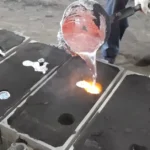
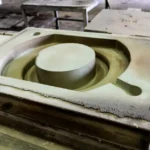
The sand is packed around a reusable pattern, the pattern is removed, and the mold is assembled for pouring. Because the mold does not need a separate drying or chemical-curing stage, the cycle can be simple, fast, and well suited to mechanized production. This makes green sand common in repeat work, although it is not limited to high-volume casting.
The same moisture that helps make the sand moldable also has to be controlled. Moisture, clay condition, grain characteristics, and compaction can all influence mold strength, gas escape, surface texture, and dimensions. Green sand is versatile, but it does not automatically provide the detail or dimensional stability associated with shell molding or a well-controlled chemically bonded mold.
Dry-Sand and Skin-Dried Molds
A dry-sand mold begins as a moist sand mold and is then dried before pouring. A skin-dried mold is heated only at and near the mold surface rather than through its full thickness.
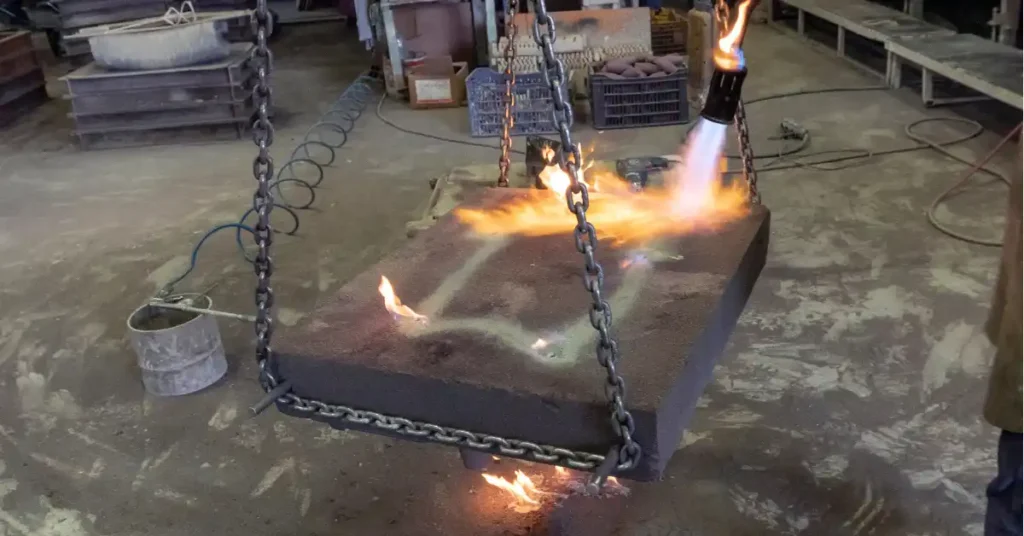
Why add this step? Removing moisture can strengthen the mold and improve the surface exposed to molten metal. Fully dried molds are therefore useful for some large or heavy castings that place greater demands on mold strength. The cost is extra coating, heating, drying time, and handling.
Dry-sand molding should not be confused with no-bake molding. One is strengthened by drying a previously moist mold; the other hardens through a chemical binder system at room temperature.
No-Bake or Air-Set Sand Casting
In no-bake molding, sand is mixed with a chemical binder and hardener. The mixture is placed around the pattern and cures at room temperature. Air-set is another common name for this route.
The hardened mold is stronger and more stable than ordinary moist sand, which helps with large molds, difficult shapes, and complex conventional cores. When the whole process is controlled, no-bake molding can also provide better surface and dimensional results than green sand.
“No-bake” does not mean “no waiting” or “no extra work.” The foundry still has to manage mixing, working time, curing, binder use, emissions, shakeout, and sand reclamation. Many no-bake systems use resin, but resin sand is a larger family that also includes heat-cured and gas-cured processes.
Sodium-Silicate or CO2 Sand
This is a specific chemically bonded process. Sodium silicate, also called water glass, acts as the inorganic binder. Carbon dioxide is passed through the prepared sand to harden the mold or core quickly.
The process is useful when a foundry needs a strong mold or core without an organic resin binder. In some applications, it can improve the surface and dimensional result compared with conventional moist sand. Its main practical difficulty appears later: hardened water-glass sand can resist breakdown, making shakeout and reclamation more difficult.
Shell Molding
Shell molding uses resin-coated sand and a heated metal pattern. Sand that touches the hot pattern cures into a thin, rigid shell. Two shell halves are then joined to form the mold.
The controlled shell can reproduce fine detail and provide a better surface and more repeatable dimensions than ordinary sand molding. It is often considered for smaller and some medium-sized castings where those results matter. The tradeoff is the need for a dedicated metal pattern, coated sand, heat, and specialized production equipment.
V-Process or Vacuum Molding
The V-process is unusual because the sand contains no conventional clay or resin binder. Plastic film covers the pattern, dry sand is placed around it, and vacuum makes the sand mass rigid enough to retain the cavity.
Vacuum continues to support the mold during pouring. When it is released after solidification, the unbonded sand falls away more easily, which simplifies shakeout and avoids bonded-sand waste. The process can produce a broad range of casting shapes and sizes with good consistency, but it depends on reliable film and vacuum equipment and is less widely available than green-sand molding.
Lost-Foam Casting
Lost-foam casting takes a different approach to the pattern. A polystyrene foam pattern is placed in unbonded sand and stays there during pouring. Molten metal replaces the foam and takes its shape, so the pattern is consumed every time a casting is made.
The interesting advantage is geometric. Several foam sections can be joined into one complex pattern with internal passages. This can reduce the number of conventional cores, mold joints, and parting lines, along with some of the alignment problems they create.
The difficulty has not disappeared; it has moved. Pattern accuracy, coating permeability, and uniform sand packing now become important process variables. If they are not controlled, the casting can develop distortion, porosity, or fold-type defects.
3D-Printed Sand Molds and Cores
In 3D sand printing, a printer builds the mold or core directly from a digital file by depositing binder into layers of sand. No conventional pattern or core box is needed for that printed piece.
This is especially useful for prototypes, designs that change frequently, replacement parts with no surviving tooling, and complex cores that would be difficult to assemble from several pieces. It lets the foundry make shapes that may be inconvenient rather than impossible with traditional tooling.
It is still a manufacturing process, not a quality button. The digital file, aggregate, binder, printed strength, storage, handling, and removal of loose sand all need control. Each mold also takes printing time and material, so a reusable pattern may become more economical when the same geometry is produced repeatedly. The American Foundry Society’s printed-sand practices reflect this wider process scope.
Where Do Hot-Box, Warm-Box, and Cold-Box Fit?
These terms describe ways of curing chemically bonded sand and are widely associated with core making. Hot-box and warm-box systems use heat to activate curing. Cold-box systems use a gas or vapor catalyst without heating the core box in the same way.
They appear in lists of sand casting types because cores are an essential part of many sand molds. However, they should not automatically be treated as complete-mold alternatives to green sand, shell molding, or lost foam. A foundry may use one process for the main mold and another for its cores.
Why Do Some Lists Name Different “Types of Sand”?
After understanding the molding processes, the conflicting lists become much easier to untangle. A source may be classifying the mineral grains rather than the process, or it may be naming prepared sands by where they are used.
Types of Base Sand
Base sand, or aggregate, makes up most of a mold or core. Silica, usually in the form of quartz, is the most widely used foundry aggregate. Chromite, zircon, and olivine are other options.
These minerals behave differently when heated and when they contact a particular molten metal. A foundry considers grain size, permeability, refractoriness, thermal expansion, strength, chemical compatibility, availability, and cost. Naming the mineral does not tell us how the sand is bonded or how the mold is made.
Sand Named by Its Job
- Facing sand sits next to the pattern and forms the surface that will contact the molten metal.
- Backing or floor sand fills the mold volume behind a facing layer.
- System sand is prepared for use throughout the main body of a molding system.
- Core sand makes the cores that form internal cavities or features.
- Parting sand or parting compound prevents surfaces from sticking where a pattern or mold section needs to separate.
A single mold can therefore have several valid labels. It might use a no-bake molding process, silica as its main aggregate, a different facing sand at the metal surface, and a cold-box core. Each term describes a different part of the same mold.
For more on aggregates, binders, water, and additives, see what sand casting molds are made from.
How Can You Tell Which Process Fits a Casting?
There is no universal best type. Each process is trying to solve a different manufacturing problem, so it helps to begin with the result you need rather than with a preferred process name.
- If the priority is a fast, repeatable molding cycle with reusable patterns, green sand is a common starting point.
- If a large or difficult conventional mold needs more strength and stability, drying or a chemically bonded system may help.
- If fine detail, surface quality, and repeatable dimensions justify dedicated tooling, shell molding may be a better fit.
- If internal geometry would otherwise require many cores or mold joints, lost foam may simplify the pattern and mold assembly.
- If the design changes often, tooling is missing, or the core geometry is unusually complex, 3D-printed sand may offer useful flexibility.
- If easy shakeout without a conventional binder is important and the required equipment is available, the V-process may be worth considering.
These are starting points, not guarantees. The casting metal, part size, section changes, internal geometry, critical surfaces, dimensional requirements, expected quantity, and downstream machining can change the answer.
Cost also extends beyond the pattern or mold. Core making, curing, equipment time, sand treatment, cleaning, machining, inspection, and scrap risk all contribute to the finished-part cost. A process with cheaper tooling may still create more work later.
Finally, every process changes the variables a foundry must control. Green sand brings moisture and compaction into focus. Chemically bonded sand adds binder, curing, and gas behavior. Lost foam adds the foam pattern, coating, and sand packing. Printed sand adds file preparation and printed properties. None of these processes is automatically free from defects; this guide to sand casting defects explains how their visible form and location can help an investigation.
The Short Version
The number of sand casting types depends on what is being classified. For molding processes, the most useful distinction is how the sand is formed and kept stable. For materials, the distinction is the aggregate. For prepared sands, the distinction may be the job they perform in the mold.
You do not need to memorize every name at once. Start with the mold: what holds it together, what happens to the pattern, and whether a core is made separately. From there, the advantages, limitations, and likely applications of each process become much easier to understand.
FAQs
Why do some sources list only four types of sand casting?
There is no industry-wide rule that limits sand casting to four types. One list may include only the most common molding processes, while another may group methods by binder, curing method, base sand, or the job the sand performs in the mold.
Can foundry sand be reused?
Foundry sand can often be conditioned, reused, or reclaimed. What can be recovered depends on the aggregate, binder, casting metal, contamination, and treatment system used by the foundry.
What are the main disadvantages of sand casting?
A new expendable mold is required for each casting, and the process introduces variables related to sand, binders, moisture, compaction, cores, and mold handling. Castings may also need cleaning or machining to achieve the required surface and dimensions. The actual disadvantages vary with the molding method and the part.