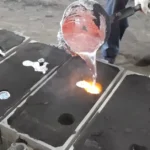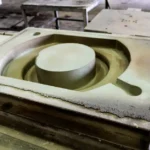
How can loose sand become a rigid mold without baking? No-bake sand casting uses a chemical reaction to hold the grains together. That makes it useful for substantial, complex castings—but also makes mixing, timing, and mold preparation central to the result.
What Is No-Bake Sand Casting?
No-bake sand casting uses sand mixed with a chemical binder and hardener to form a mold that sets at ambient temperature. The hardened mold receives molten metal and is broken apart after the casting solidifies.
It is also commonly called air-set casting oder self-setting sand casting. Air-set does not mean that air dries the mold like wet paint: the mixed chemicals react to develop strength.
The name describes how the sand is bonded, not the metal being cast. It also does not mean the entire manufacturing route is free of heating. Metal still has to be melted, coatings may need drying, and castings may need heat treatment.
No-bake belongs to the broader family of chemically bonded sand processes. Foseco distinguishes self-hardening systems from systems activated by heat or gas. This matters because “resin sand,” “cold-box,” and “no-bake” are not interchangeable names for every chemically bonded mold or core.
How the No-Bake Casting Process Works
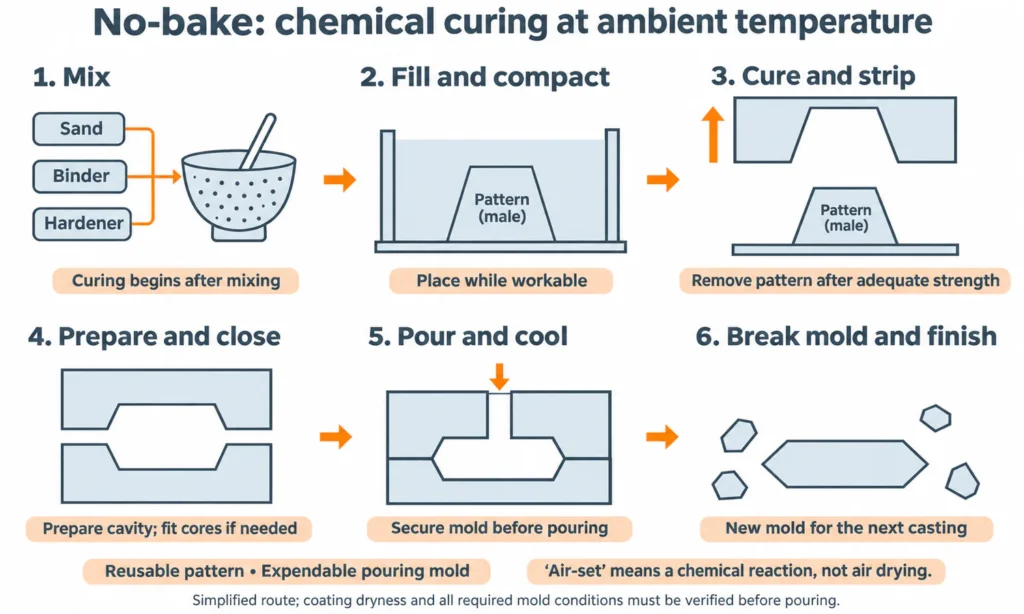
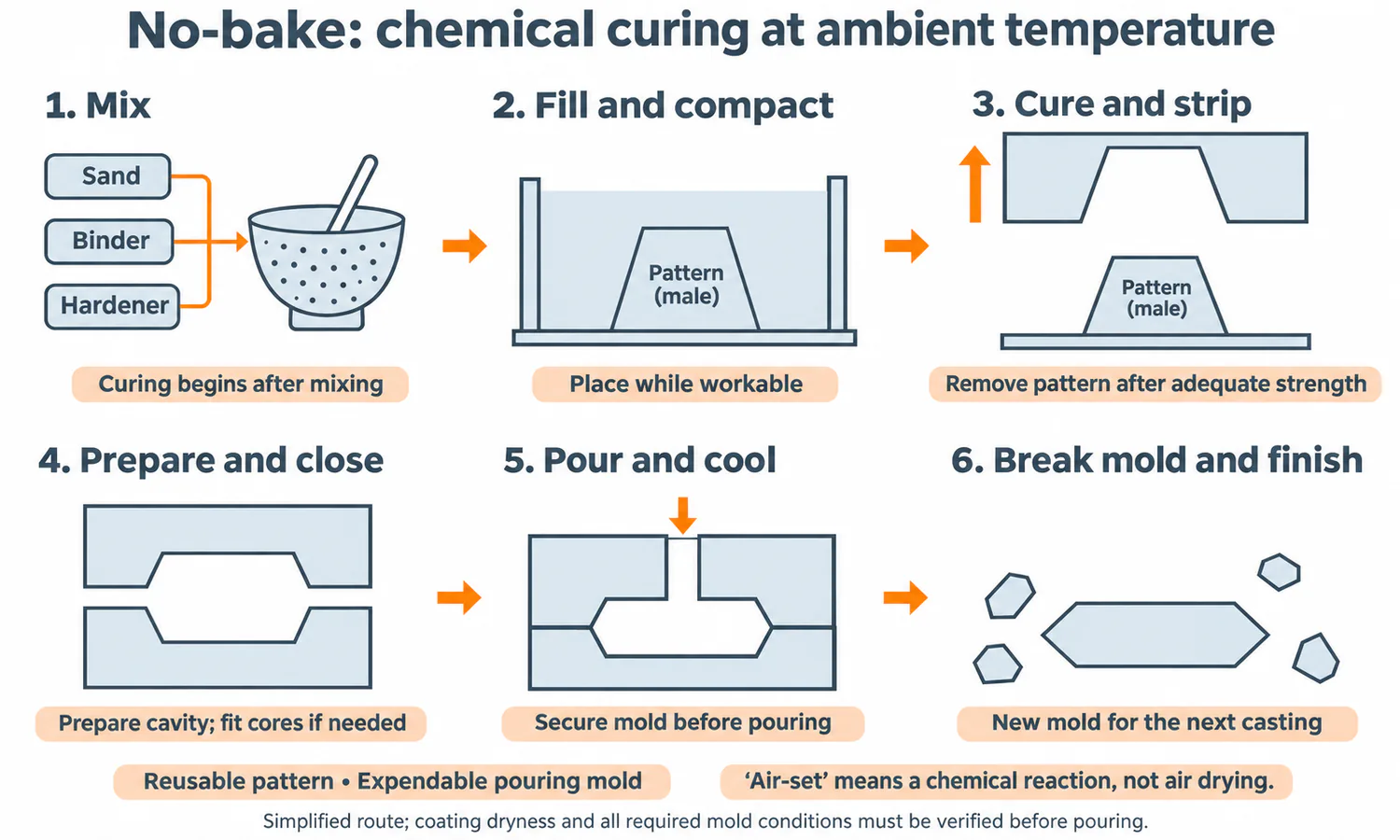
The usual route is to make the mold around a reusable pattern, let the sand gain strength, remove the pattern, assemble the mold, and pour. Each pouring mold is expendable; the pattern can make another one.
1. Prepare the Pattern and Mold Layout
The pattern establishes the cavity that will receive metal. Wood, polymer, or metal tooling may be used according to the production requirements.
The layout must allow the pattern to be withdrawn and the mold to be assembled accurately. It also accounts for metal contraction, machining stock, and locations that support any cores. A rigid mold does not remove the need for suitable draft and a practical parting arrangement.
2. Mix the Sand, Binder, and Hardener
The foundry meters the selected chemicals into prepared sand and distributes them through a mixer. Mixing starts the curing reaction, so the sand must reach the pattern and be packed while it remains workable.
Consistent proportions and uniform mixing matter more than simply adding enough resin to make the sand feel hard. Poor distribution can leave weak areas even when another part of the same mold appears sound.
3. Fill and Cure the Mold Halves
Mixed sand is placed around the pattern and compacted using the selected molding arrangement. The upper and lower portions are commonly called the cope and drag.
The sand then gains enough strength for the pattern to be removed without damaging the cavity. Stripping too early can distort or break the mold; waiting longer than necessary occupies tooling and slows production. Vulcan Engineering’s no-bake process overview describes the sequence from mixing and compaction through stripping and mold handling.
4. Prepare the Cavity and Install Cores
Loose sand and damaged areas are addressed before closing. A refractory coating may be applied to control interaction between the sand and molten metal. Where used, it must reach the required dry condition before pouring.
Cores create internal passages or other features the main mold cannot form. Their position determines the surrounding metal wall, so core support and alignment require attention. A no-bake mold can also contain a core made by a different process. Our casting cores guide explains these arrangements.
5. Close the Mold and Pour
The mold sections are aligned and secured for pouring. Molten metal enters through the gating system, while feeders supply additional liquid metal where needed during solidification.
Mold rigidity supports the cavity shape, but filling and feeding still determine whether metal reaches thin sections and whether shrinkage is adequately supplied. A strong mold cannot compensate for an unsuitable gating or feeder design.
6. Remove the Sand and Finish the Casting
After suitable cooling, the mold is broken away. Gates and feeders are removed, and the casting proceeds through the required cleaning, heat treatment, machining, and inspection.
Recovered sand may be processed for reuse. This does not reuse the original mold: the cavity has been destroyed, and the next casting needs a newly formed mold.
Sands and Binders Used in No-Bake Molding
No-bake is a curing method, not one fixed sand recipe. The aggregate provides the mold’s granular structure, while the binder system holds it together.
Silica is widely used. Specialty aggregates may be selected where thermal behavior, metal penetration, surface requirements, or alloy compatibility justify them. Grain distribution, cleanliness, and the condition of reclaimed sand influence binder demand and mold performance. Our sand casting materials guide explains the separate roles of sand, binder, additives, and coatings.
Common organic binder families include:
| Binder family | How it sets | What distinguishes it |
|---|---|---|
| Furan no-bake | Furan-based resin reacts with an acid hardener | An established self-setting system; formulation and sand chemistry affect performance |
| Phenolic urethane no-bake, or PUNB | Binder components react with a mixed-in catalyst | The curing arrangement differs from gas-cured phenolic urethane cold-box |
| Alkaline phenolic no-bake | Alkaline phenolic resin is cured with an ester hardener | Another self-setting route with its own processing and reclamation requirements |
Mancuso Chemicals lists these no-bake binder families separately from cold-box and heat-activated products. Inorganic self-setting systems also exist, so “no-bake” should not be treated as another name for furan resin alone.
The foundry selects a system around the alloy, mold size, working time, strength, gas behavior, shakeout, and reclamation requirements. More binder is not automatically better: the mold needs adequate performance throughout its life, including removal after pouring.
How Long Does a No-Bake Mold Take to Harden?
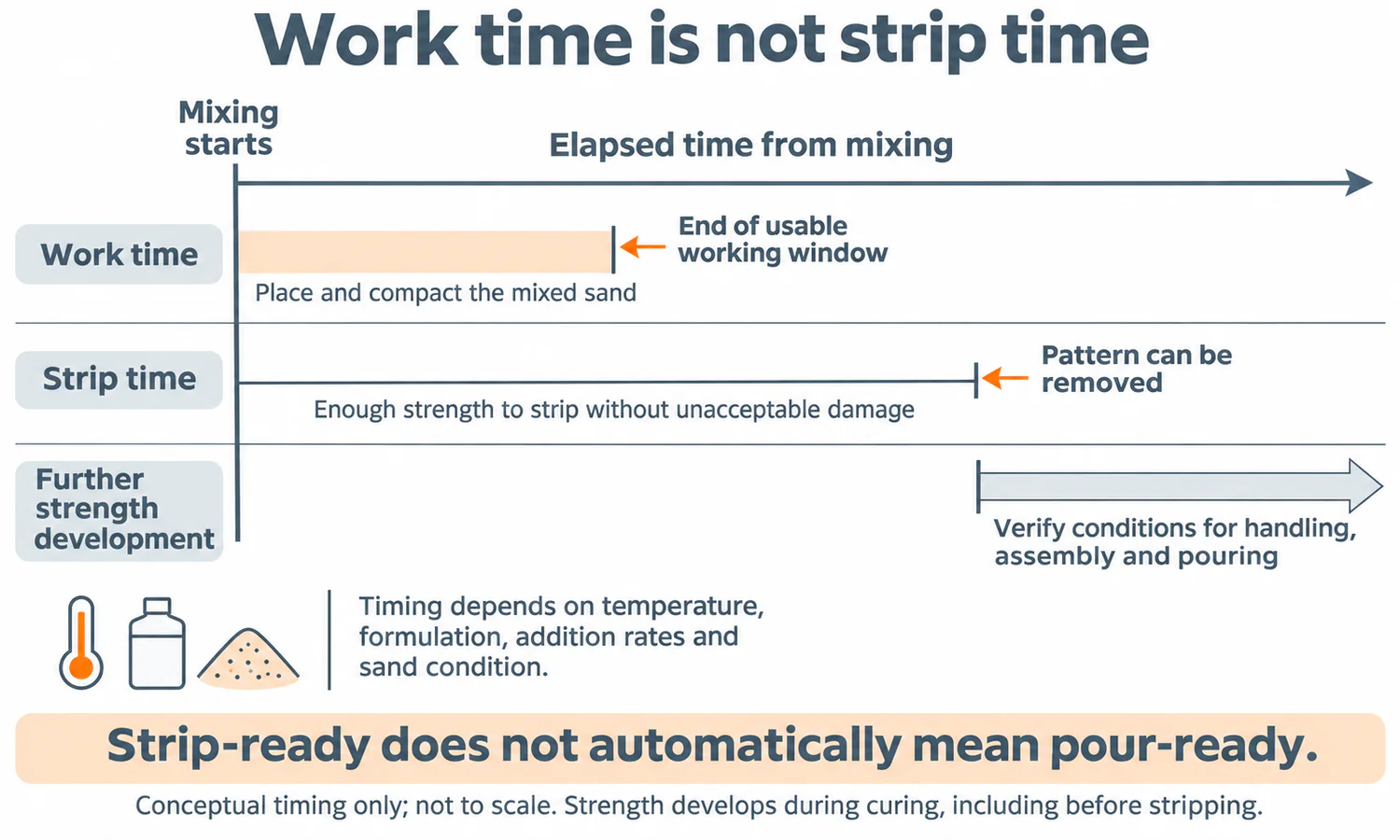
There is no single curing time. The useful distinction is between work time, strip time, and the strength required for later handling and pouring.
| Bühne | What it means |
|---|---|
| Work time | The usable period for placing and compacting the mixed sand |
| Strip time | The elapsed time needed to remove the pattern without unacceptable damage |
| Further strength development | Continued hardening needed for subsequent handling, assembly, storage, or pouring |
For a concrete product example, Foseco publishes 2–30 minute set times for its POLISET E system in its chemically bonded casting overview linked above. This is a supplier’s product range, not a universal no-bake cycle time or permission to pour every mold after two minutes.
Sand temperature, chemical temperature, formulation, addition rates, and sand condition all affect the result. Palmer Manufacturing’s sand-mixing guidance explains why temperature control, metering, and mixing consistency belong together.
This creates a practical balance: the mix must stay workable long enough to fill the mold, then develop strength soon enough to release the tooling. Making the reaction faster can shorten the filling window as well as the waiting period. That is why curing is planned around the actual mold-making operation.
Suitable Metals and Applications
No-bake molding is used with cast irons, steels, aluminum alloys, copper alloys, and other suitable casting alloys. The binder and mold system must match the metal and application; a process name alone does not establish compatibility with every grade.
Typical applications include pump and valve bodies, equipment housings, machine components, and castings with substantial sections or complex core assemblies. Large parts often benefit from building a rigid mold without fitting the whole mold into a curing oven.
Zum Beispiel, Waukesha Foundry describes no-bake production for pump, valve, petrochemical, and industrial components. Its work also illustrates that the process can support repeat production, rather than only one-off castings.
No-bake can make smaller parts too. Whether it is economical depends on the equipment, mold-making rate, tooling, and finishing work. A large casting also needs enough melting, pouring, lifting, and cooling capacity; mold-making flexibility alone does not establish a foundry’s size limit.
Vorteile und Einschränkungen
Hauptvorteile
- Rigid molds before pouring. Hardened mold sections support handling and assembly, which is useful for substantial shapes and multiple cores.
- Flexible tooling and production arrangements. Different pattern materials and mold layouts allow the process to suit varied component designs and order patterns.
- Useful dimensional and surface control. Stable molds can reduce some movement and damage associated with softer molding systems, provided the rest of the process is controlled.
- No baking step to cure the basic mold. Chemical hardening allows large molds to be made without a mold-curing oven.
These benefits explain why no-bake is often considered for complex, large, or varied industrial work. They do not mean that every no-bake casting is more accurate or cheaper than an alternative.
Main Limitations
Chemical binders add recurring cost. The curing window also requires coordinated mixing, filling, stripping, and handling. Temperature changes or inconsistent reclaimed sand can disturb a production cycle that previously worked well.
Organic binders generate gases and emissions when exposed to hot metal. A rigid mold can still have gas-related defects if the binder system, coating condition, permeability, and venting are unsuitable.
Finally, the mold must break down sufficiently for the casting and cores to be cleaned. Strength during pouring and ease of removal afterward are different requirements. Sand reclamation is another processing operation, with its own equipment and quality controls.
No-Bake vs Other Casting Processes
| Verfahren | How the mold or core gains strength | When the comparison matters |
|---|---|---|
| No-bake / air-set | Mixed-in chemicals react at ambient temperature | Rigid molds, flexible layouts, large or complex work |
| Grüner Sand | Moist clay-bonded sand is compacted | Repeated production where rapid molding and sand-system economics are attractive |
| Schalenformung | Resin-coated sand cures against heated tooling | Repeatable parts suited to metal pattern tooling and thin shell molds |
| Cold-box coremaking | A gas triggers hardening after the sand mix is shaped | Core production; cold-box cores may be installed in no-bake molds |
| Feinguss | A refractory mold is formed around an expendable pattern | Fine detail or geometry that benefits from a sacrificial pattern |
Green sand also normally avoids baking before pouring. The difference is the bond and hardening mechanism, not simply the absence of an oven. Our green sand casting guide explains that process.
No-bake is often attractive at low or medium volumes, but it is not inherently restricted to them. Mechanized mixing and mold-handling systems can support repeat production. Conversely, green sand can produce large castings. Compare the actual production routes rather than using part size or quantity as an absolute dividing line.
Accuracy, Surface Finish, and Machining
No-bake molds can provide good dimensional stability, but the process does not carry one universal tolerance or roughness value. Pattern condition, mold alignment, core location, metal contraction, and later processing all affect the finished dimensions.
Der Steel Founders’ Society of America’s dimensional guide draws on historical analysis of more than 140,000 features on production steel castings. It reports that variation within and between foundries can exceed average differences between molding processes. That supports a practical conclusion: confirm capability for the feature and supplier instead of relying on the label “no-bake.”
A pump housing illustrates the distinction. Its outer walls and curved passage may be suitable as cast, while a flange face and bearing bore need Bearbeitung. Mold rigidity helps establish a consistent starting shape; it does not automatically produce the required sealing flatness or bearing fit.
Surface texture is a separate requirement. Sand grading, coatings, metal-mold interaction, and cleaning affect it. Specify the relevant surfaces and measurement parameter rather than asking only for a “smooth casting.”
Common Defects and Process Controls
The useful question is which part of the process could create the observed problem. The following are investigation directions, not diagnoses from appearance alone.
| Problem | Areas to investigate |
|---|---|
| Broken edges or sand inclusions | Mixing consistency, mold strength, stripping damage, loose sand, and metal flow |
| Gasporosität | Binder and core gas, coating dryness, venting, permeability, and melt condition |
| Mold or core shift | Locating features, core support, assembly, and mold securing |
| Roughness, penetration, or burn-on | Sand properties, coating, compaction, and pouring conditions |
| Shrinkage cavities | Feeding paths, local section changes, and solidification behavior |
Adding resin is not a general solution to every defect. It may address a strength problem while increasing gas generation or making reclamation harder. Likewise, a shrinkage cavity requires investigation of feeding and solidification, even if the mold is well made. Our Leitfaden für Sandgussfehler explains the main defect families.
Sand Reclamation and Environmental Considerations
Used no-bake sand can often be reclaimed, but breaking the mold into loose grains is only the start. The reclaimed material must have suitable residual binder, fines, temperature, and chemical condition for the selected process.
Mechanical treatment removes material from grain surfaces; thermal reclamation can remove suitable organic residues. The appropriate route depends on the binder and aggregate. Foseco’s no-bake binder information discusses reclamation alongside specific products, rather than one recovery rate for every system.
Skipping a mold-curing oven does not make the whole process emission-free. A 2025 pilot-scale study of casting binders used 60 kg iron-alloy castings in 110 kg sand molds and found substantial differences between binder systems. Its results reinforce the need to evaluate binder chemistry and the complete production route, including extraction, reclamation, and disposal.
Cost, Lead Time, and Process Selection
No-bake is worth evaluating when mold rigidity, complex cores, part size, or flexible production justify its chemical and handling costs. For a stable part made in very large quantities, an automated green-sand route may offer stronger economics. For small, intricate features, investment casting may reduce enough additional work to be competitive.
St. Paul Foundry identifies several air-set cost drivers, including chemicals, molding and setting time, coatings, sand temperature control, reclamation, and finishing. Tooling is only one part of the comparison.
Lead time also includes pattern manufacture, first-article approval, pouring schedules, cooling, heat treatment, machining, and inspection. A short binder set time does not translate directly into a short delivery promise.
For a useful quotation, provide the alloy, drawing, quantities, critical dimensions, machining requirements, and acceptance criteria. Compare the cost of the required finished casting, including any core work and inspection, rather than the price of a raw casting alone.
Abschluss
No-bake sand casting creates rigid molds through chemical curing at ambient temperature. It is useful for varied, complex, and substantial castings, but its success depends on controlled mixing, curing, assembly, and pouring. Choose it around the part’s requirements and complete manufacturing cost, including finishing and inspection.
Häufig gestellte Fragen
What Is the Difference Between No-Bake and Green Sand?
Both avoid baking the mold before pouring, but the bond is different. No-bake uses mixed-in chemicals that react to harden the sand at ambient temperature. Green sand uses moist clay-bonded sand that is compacted around the pattern. Green sand suits rapid repeated molding, while no-bake provides rigid molds for large or complex work.
What Does "Air-Set" Mean?
Air-set means the binder and hardener react chemically at ambient temperature to develop strength. It does not mean air dries the mold the way it dries wet paint.
How Long Does a No-Bake Mold Take to Set?
There is no universal time. The practical measures are work time (how long the mix stays usable) and strip time (when the pattern can be removed without damage). Foseco’s POLISET E system publishes 2–30 minute set times as a product range, and sand temperature, formulation, and addition rates all affect the result.
What Metals Can Be Cast in No-Bake Molds?
Cast irons, steels, aluminum alloys, copper alloys, and other suitable casting alloys are all used. The binder and mold system must match the metal and application—the process name alone does not establish compatibility with every grade.
What Are the Disadvantages of No-Bake Casting?
Chemical binders add recurring cost, the curing window requires coordinated mixing and handling, and organic binders generate gases and emissions when exposed to hot metal. The mold must also break down sufficiently for shakeout, and sand reclamation becomes another controlled operation.
Is No-Bake Only for Large Castings?
No. It is often chosen for large and complex work because rigid molds can be made without a curing oven, but mechanized no-bake lines also support repeat production of smaller parts. Economics depend on equipment, mold-making rate, tooling, and finishing work.