A low die casting unit price can hide a substantial startup bill. To understand the real expense, separate tooling, production, finishing, and delivery. Published supplier figures and a worked budget below show how those costs change with part design, manufacturing requirements, and order quantity.
How Much Does Die Casting Cost?
For a custom die casting project, tooling alone can require thousands to well over $100,000. The finished-part price then depends on weight, complexity, production volume, and the work required after casting.
Two US manufacturers publish useful reference ranges:
| Published source | Tooling reference in USD | Umfang |
|---|---|---|
| Kinetic Die Casting | $5,000–$75,000 | Aluminum die casting; size and complexity affect price |
| Lakeshore Die Cast | $15,000–$150,000 | The supplier’s own part-size range; dependent on geometry |
These are supplier-published references checked in November 2026, not a current market survey or quotations for your drawing. Neither page clearly dates the pricing. The ranges overlap because suppliers handle different parts and tooling packages.
A published aluminum-part example gives a more concrete reference: $22,000 for die inserts, $8.20 for the casting and $8.00 for remaining machining. The case below shows how those figures affect the total purchase cost. A separate planning model later explains each cost category.
This guide concerns conventional high pressure die casting, particularly aluminum parts. Miniature zinc components and very large structural castings need different budgets. Our die casting process guide explains the manufacturing stages.
A Published Aluminum-Part Cost Example
Kinetic’s comparison, linked above, concerns a customer’s aluminum sand-cast component considered for conversion to die casting. The design involved ten drilled holes and top and bottom faces that required milling in the sand-cast route.
| Cost item | Sand-cast route | Proposed die-cast route |
|---|---|---|
| Casting | $21.00 | $8.20 |
| Bearbeitung | $11.00 | $8.00 |
| Casting plus machining | $32.00 | $16.20 |
| Initial pattern or die inserts | $1,500 | $22,000 |
For 1,000 parts including new tooling, these figures total $33,500 for sand casting and $38,200 for die casting. At 5,000 parts they total $161,500 and $103,000, respectively. The larger initial tooling bill is outweighed by repeated production savings.
This is a supplier’s published comparison, not proof of completed production at these prices. Its date, part weight and detailed alloy are not disclosed. Use it to understand a real quoted cost relationship, rather than as a current price for a similar-looking part.
What Goes Into a Die Casting Quote?
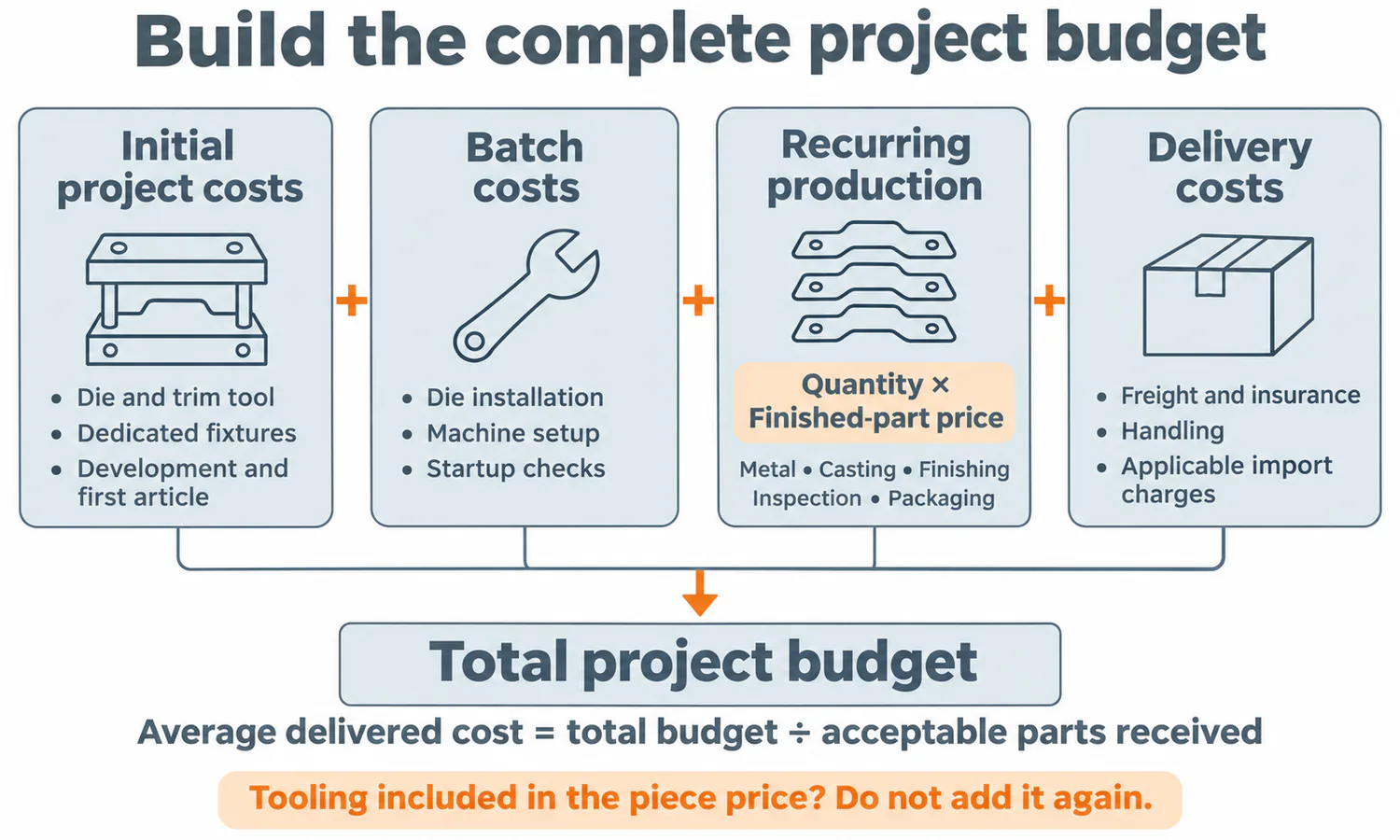
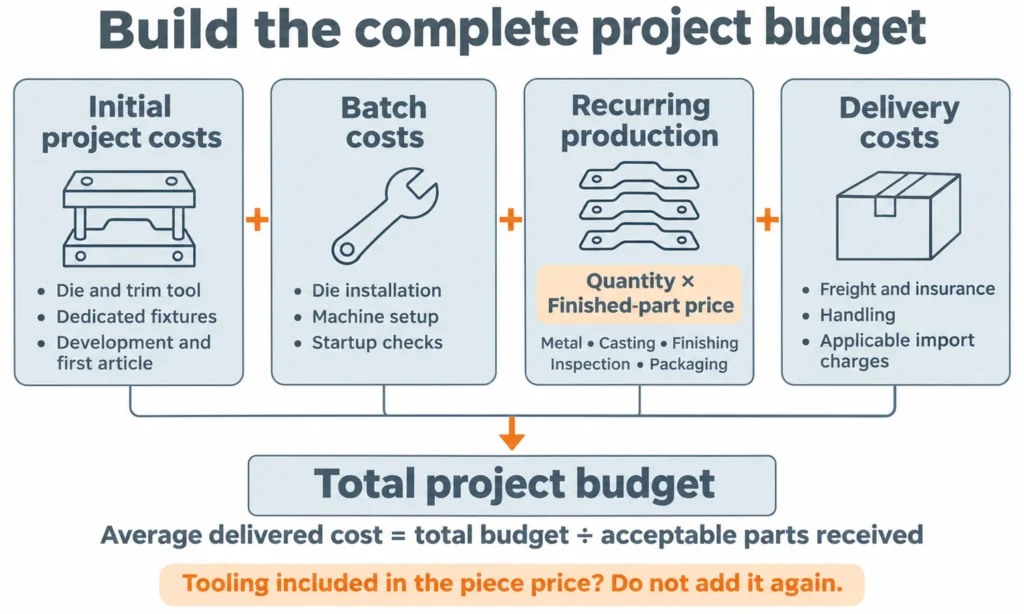
Separate the quotation into three manufacturing categories, then add delivery costs.
| Cost category | Typical items | How it affects the budget |
|---|---|---|
| Initial project costs | Casting die, trim tool, dedicated fixtures, development and first-article work | Paid upfront or recovered through an agreed piece-price charge |
| Batch costs | Installing the die, machine setup, startup checks | Repeated when production is restarted |
| Recurring part costs | Metal, casting, trimming, machining, finishing, inspection, packaging | Paid for each supplied part |
| Delivery costs | Freight, insurance, handling and applicable import charges | Added according to the agreed delivery scope |
A practical calculation is:
Total budget = initial project costs + batch costs + quantity × recurring finished-part price + delivery costs.
Average cost per delivered part is that total divided by the number of acceptable parts received. If tooling is already included in the piece price, do not add the same tooling charge again.
The distinction between cost and selling price also matters. A supplier’s quote covers commercial overhead and profit as well as production. An estimate built only from alloy price and machine time will usually leave out part of the bill.
Werkzeugkosten
Die Size and Complexity
A simple die that opens in one direction generally costs less than one requiring several moving slides. Side holes, undercuts, deep features, multiple cavities, and demanding surface requirements add design and manufacturing work.
The outside dimensions matter too. A lightweight but broad enclosure can need a large die and substantial clamping capacity. Part weight alone cannot predict tooling cost.
CustomPartNet’s die casting guide connects production cost to machine size, projected area, injection pressure, and cycle time. It also explains why side actions add tooling expense. These relationships are more useful than a universal mold-price-per-kilogram rule.
Ask what the tooling amount includes: a complete die, cavity inserts using an existing holder, a trim tool, machining fixtures, gauges, and initial trials are different deliverables.
Tool Life and Maintenance
Tooling cost does not necessarily disappear after the first purchase. Inserts can require repair or replacement, and an engineering change can make an otherwise usable die obsolete.
For example, a hypothetical $30,000 tool contributes $0.30 per part over 100,000 accepted parts. If it must be replaced after that quantity, producing a million parts does not reduce its contribution to $0.03. Ten identical tools would still contribute $0.30 per part, before maintenance.
Use the expected output of acceptable parts, rather than a headline shot-life figure. A shot is one machine cycle; a multi-cavity die can produce several parts per shot, and some may be rejected.
Material and Alloy Cost
The metal bill begins with alloy price and weight, but three weights need separating:
- Net casting weight: metal remaining in the casting after trimming.
- Shot weight: all metal injected, including runners, overflows, and other metal removed afterward.
- Effective charged weight: the quantity used in the supplier’s costing after accounting for returns, losses, and recovery costs.
Returned metal has value, so charging the full shot weight as permanently consumed metal can overstate cost. Treating all returned metal as free can understate it: melting, handling, oxidation losses, and composition control still have consequences.
Consider a hypothetical 0.30 kg casting made with a 0.50 kg shot. At an assumed alloy price of $4/kg, the net metal represents $1.20 and the gross shot $2.00. Neither number, by itself, establishes the final material charge. Ask how the remaining 0.20 kg is credited and what recovery costs are included.
Alloy selection also affects processing. Zinc and aluminum differ in density, casting behavior, and suitable production equipment. Compare complete part designs and manufacturing routes, not only their price per kilogram.
Metal prices can change during a program. NADCA’s Commercial Practices for Die Casting Buyers recommends defining quantities and itemizing material cost when requesting quotations. It also discusses alloy-price adjustments, batch requirements, and maintenance responsibilities. A useful quote states its alloy-price basis and validity period.
Machine Time, Cycle Time, and Cavities
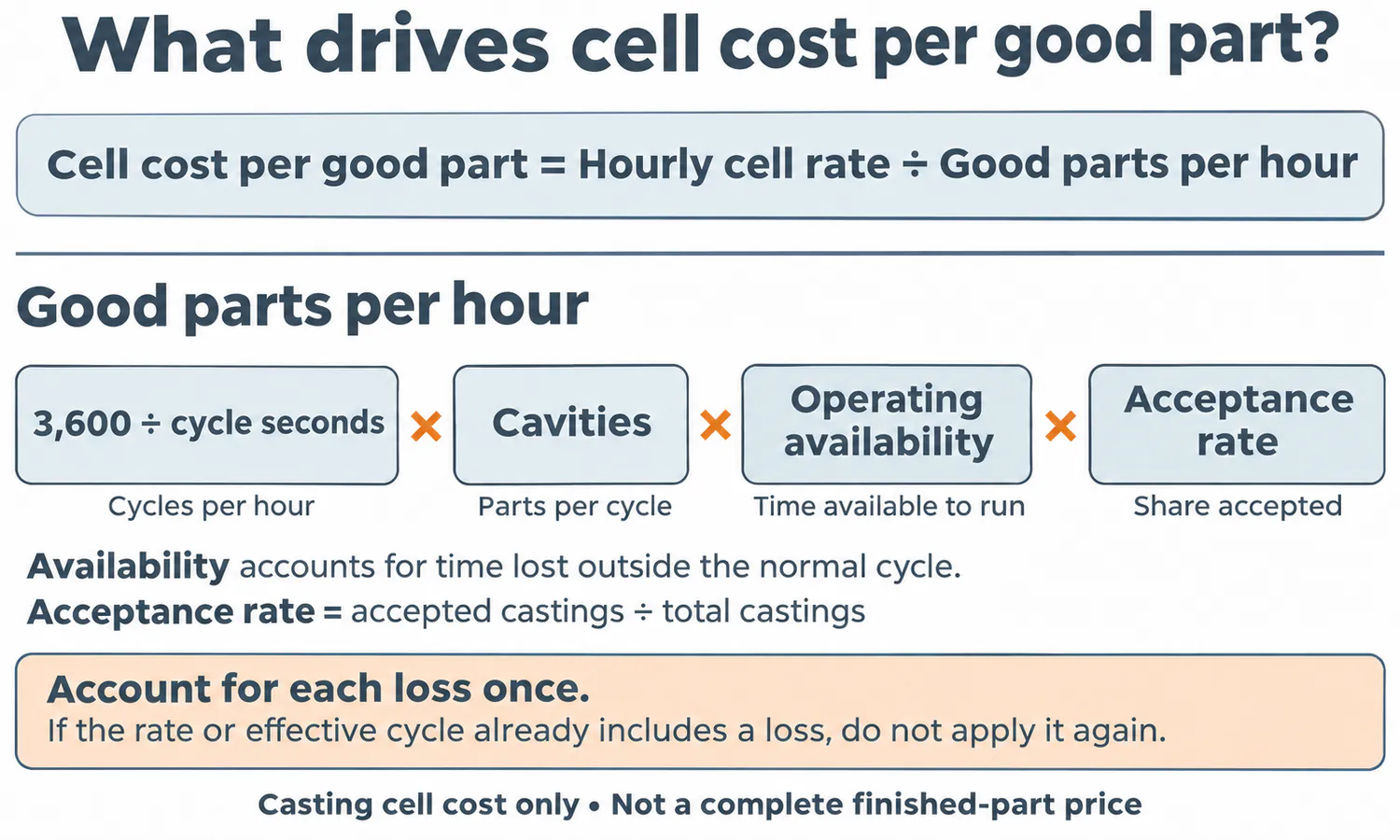
Casting cost depends on how many acceptable parts the production cell makes per hour.
Cell cost per good part = hourly cell rate ÷ good parts per hour.
Good parts per hour = 3,600 ÷ cycle seconds × cavities × operating availability × acceptance rate.
Here, operating availability accounts for time lost outside the normal cycle; acceptance rate accounts for rejected castings. If the quoted hourly rate or effective cycle already includes those losses, avoid counting them twice.
Boothroyd Dewhurst’s die casting cost-estimating guide lists illustrative rates of $80–$150/hour for cold-chamber equipment and $35–$60/hour for hot-chamber equipment. These are model references, not local supplier quotations or a complete finished-part price.
The following calculation shows why cavity count matters. Both scenarios assume full operating availability and 95% acceptance; the rates and cycles are illustrative.
| Input or result | Single cavity | Two cavities |
|---|---|---|
| Hourly cell rate | $120 | $160 |
| Cycle time | 45 seconds | 50 seconds |
| Good parts per hour | 76 | 136.8 |
| Casting cell cost per good part | $1.58 | $1.17 |
The two-cavity arrangement saves about $0.41 in cell cost per good part in this example, despite the more expensive machine. However, its die, feed system, and maintenance may cost more. The saving must recover those additional expenses.
An hourly cell rate may already cover the operator, energy, depreciation, and maintenance. Adding those same expenses as separate lines would inflate the estimate.
Machining, Finishing, and Quality Costs
Machining and Surface Finish
Threads, precision bores, sealing faces, and tight positional tolerances can require machining after casting. Each setup adds handling and fixturing as well as cutting time.
Surface requirements can add deburring, blasting, polishing, coating, masking, and cosmetic inspection. A hidden functional housing and a visible consumer-product handle need different finishing budgets, even when their weights are similar.
There is a documented example of how much process choice can matter. In Dynacast’s GoPro conversion case study, the customer reports approximately 50% initial savings when moving a machined component to die cast aluminum. The account emphasizes forming features directly and reducing secondary work. That is a result for one component, not an expected saving for every conversion.
For cost reduction, identify which surfaces actually need machining and which cosmetic areas require special treatment. Removing an unnecessary operation can be more valuable than negotiating a small reduction in the metal rate.
Inspection, Rejection, and Rework
Quality requirements affect both testing expense and the number of parts that pass. Define critical dimensions, appearance, leak performance, and internal-soundness requirements before obtaining prices. Our casting inspection guide explains the different methods and their coverage.
Rejected metal may be recyclable, but the work already spent on it is not recovered. A defect discovered after machining and coating wastes more processing than one found immediately after casting.
A documented automotive example makes the timing effect tangible. In the May 2022 issue of Die Casting Engineer, page 25, IoTco describes an aluminum HPDC component with 3.5% scrap in a 160,000-part lot: 5,600 rejected parts. The article reports per-part cost figures of $3.80 at the foundry, $11 at machining and $28 at assembly, with corresponding scrap exposure of $21,280, $61,600 and $156,800. Those are the source’s cost figures at stages along its value stream, not a finished-part sales quotation. The practical lesson is to find casting defects before expensive downstream work.
Planning Model: Cost Breakdown and Order Quantity
Assume a 0.30 kg aluminum housing made with a single-cavity die. The design is stable, selected features are machined, and the part receives a basic coating.
The following amounts are assumptions for demonstrating the calculation. They are separate from the published cases above. Replace the inputs with quotation data to estimate your own project.
Initial Costs
| Artikel | Angenommene Kosten |
|---|---|
| Casting die | $26,000 |
| Trim tooling and machining fixtures | $3,000 |
| First-article and process qualification work | $1,000 |
| Total initial costs | $30,000 |
Recurring Finished-Part Price
| Artikel | Assumed cost per accepted part |
|---|---|
| Effective material charge after return accounting | $1.20 |
| Casting cell: $120/hour × 45 seconds ÷ 3,600 | $1.50 |
| Trimming and deburring | $0.35 |
| CNC-Bearbeitung | $1.20 |
| Surface finishing | $0.80 |
| Routine inspection and packaging | $0.45 |
| Net rejection and rework allowance | $0.25 |
| Commercial overhead and profit allowance | $0.75 |
| Total recurring price | $6.50 |
The cell rate covers productive cell expenses. The commercial allowance covers costs outside that cell and profit. Normal operating interruptions are assumed to be reflected in the effective cycle; the rejection allowance is separate. The earlier 95% acceptance example is not applied again here.
Order Budget
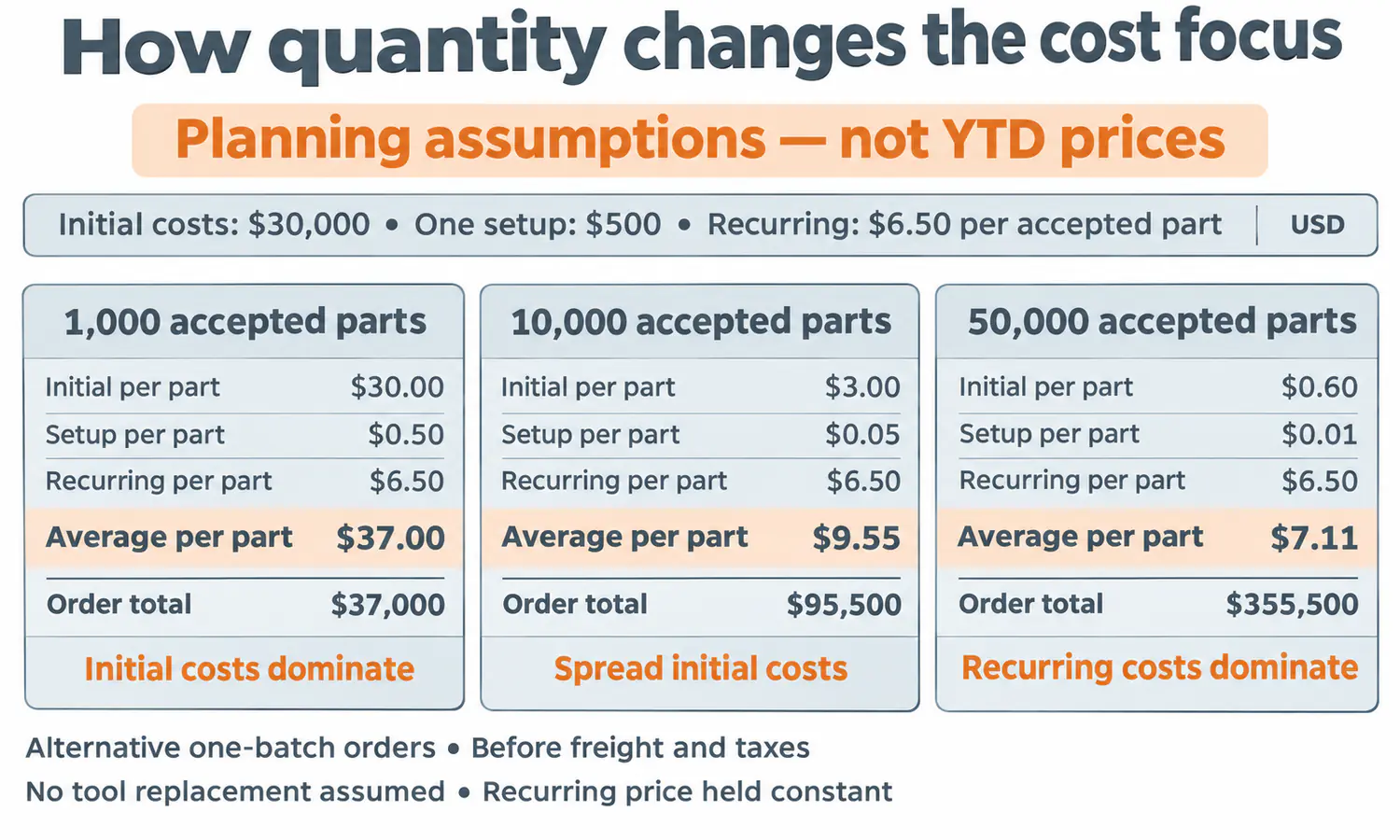
Each row below represents an alternative quantity produced in one batch, with a $500 setup. The tool is assumed to cover the stated quantity without replacement. The recurring price stays constant to isolate the effect of spreading initial costs.
| Accepted quantity | Initial costs | Setup | Recurring production | Total before freight and taxes | Average per part |
|---|---|---|---|---|---|
| 1,000 | $30,000 | $500 | $6,500 | $37,000 | $37.00 |
| 10,000 | $30,000 | $500 | $65,000 | $95,500 | $9.55 |
| 50,000 | $30,000 | $500 | $325,000 | $355,500 | $7.11 |
At 1,000 parts, initial project costs dominate. At 50,000, recurring production dominates, so machining time, finish requirements, and process efficiency deserve more attention.
A later 10,000-part reorder using the same paid tooling would require $65,500 under these assumptions, before delivery and taxes. That is different from the cumulative average cost across the entire program.
Sensitivity to Changes
For the 10,000-part example, relatively small changes have visible consequences:
| Change, with other assumptions held constant | Approximate budget increase |
|---|---|
| Tooling costs $5,000 more | $5,000, or $0.50 per part |
| Cycle increases by 10 seconds at $120/hour | $3,333, or $0.33 per part |
| Additional machining costs $1 per part | $10,000 |
| Alloy price rises $0.50/kg on 0.30 kg charged weight | $1,500 |
| Four setups instead of one, at $500 each | $1,500 |
These are isolated calculations. In production, changes can interact: a thicker wall may increase material use and cycle time together. A new feature may affect both tooling and machining.
When Does Die Casting Become Economical?
Compare complete manufacturing routes at the quantity you realistically expect to buy. There is no universal minimum quantity at which die casting wins.
For a simplified comparison:
Break-even quantity = additional initial investment ÷ recurring saving per part.
Using the published comparison above, a new project needs an additional $22,000 − $1,500 = $20,500 for tooling and saves $15.80 per part. Break-even is approximately 1,298 parts. If the sand-casting pattern is already paid for, recovering the full new die investment instead takes approximately 1,393 parts. The difference is whether existing tooling is a sunk cost.
Uncertain demand and likely design changes favor delaying expensive tooling. Stable designs with repeat demand make the investment easier to justify. Sand casting, machining, or another route can still be the lower-total-cost choice for a short program.
Delivery Costs and Comparable Quotes
A factory price is not necessarily your delivered cost. Confirm transport, packaging, insurance, import charges, and which party handles each stage. Use current shipment and destination information rather than a blanket percentage.
For example, adding an assumed $2,000 freight bill to the 10,000-part budget raises it from $95,500 to $97,500, or from $9.55 to $9.75 per part, still before taxes or import charges.
For comparable quotations, provide the same drawing revision, alloy, annual demand, order sizes, machining, finish, inspection, and delivery requirements. Ask each supplier to separate tooling, batch charges, and the finished-part price. Also establish whether future metal-price changes, major tool repairs, and replacement tooling are included.
Abschluss
Die casting cost combines upfront tooling with recurring production and delivery expenses. Budget the finished, accepted part at realistic quantities. The largest saving may come from simpler tooling, fewer machining operations, faster cycles, or better yield—not necessarily a lower alloy price.
Häufig gestellte Fragen
How Much Does a Die Casting Die Cost?
Tooling can require thousands to well over $100,000. Two published supplier ranges are $5,000–$75,000 (Kinetic) and $15,000–$150,000 (Lakeshore), but size, slides, cavities, and surface requirements drive the price—part weight alone cannot predict tooling cost.
How Much Do Die Cast Parts Cost Each?
It depends on weight, complexity, volume, and the work required after casting. The worked example in this guide uses $6.50 per finished part with $30,000 in initial project costs, giving $37,000 total for 1,000 parts or $95,500 for 10,000 parts before freight and taxes.
What Is the Break-Even Quantity for Die Casting?
There is no universal minimum. A simplified break-even uses additional initial investment divided by the recurring saving per part. Recalculating Kinetic’s published sand-casting-versus-die-casting example gives about 1,393 parts, excluding other cost differences.
Was beeinflusst die Zykluszeit und die Kosten beim Druckguss?
Cell cost per good part depends on the hourly cell rate and good parts per hour, which follows cycle seconds, cavity count, operating availability, and acceptance rate. In the worked example, two cavities produced 136.8 good parts per hour versus 76, cutting cell cost per good part from $1.58 to $1.17 despite the more expensive machine.
Is Die Casting Cheaper Than Machining?
It can be. Dynacast’s GoPro conversion case study reports approximately 50% initial savings when moving a machined component to die cast aluminum. The savings come from forming features directly and reducing secondary work—not every conversion delivers the same result.
What Should I Ask for in a Die Casting Quote?
Provide the same drawing revision, alloy, annual demand, order sizes, machining, finish, inspection, and delivery requirements to every supplier. Ask them to separate tooling, batch charges, and the finished-part price, and establish whether metal-price changes, major tool repairs, and replacement tooling are included.