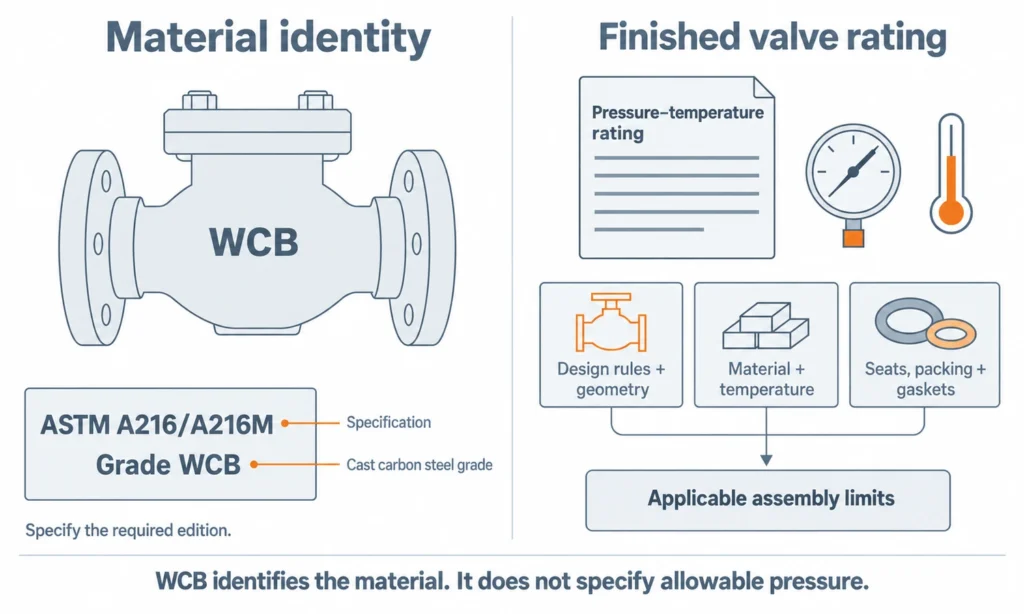
WCB often appears on valve bodies, casting drawings and material certificates. It identifies a particular carbon steel casting grade, but it does not tell you everything about the finished component. Understanding its chemistry, strength and service limits makes that marking much more useful.
What Is WCB Material?
WCB is a cast carbon steel grade specified in ASTM A216/A216M, commonly used for valve bodies, bonnets, fittings and other pressure-containing components. Its UNS designation is J03002. It is steel, not cast iron or stainless steel.
ASTM A216/A216M covers three grades: WCA, WCB and WCC. The letter B identifies the grade within that group; it is not a valve pressure class or a general quality score. ASTM’s current A216/A216M specification page describes carbon steel castings suitable for high-temperature service and fusion-welded assembly.
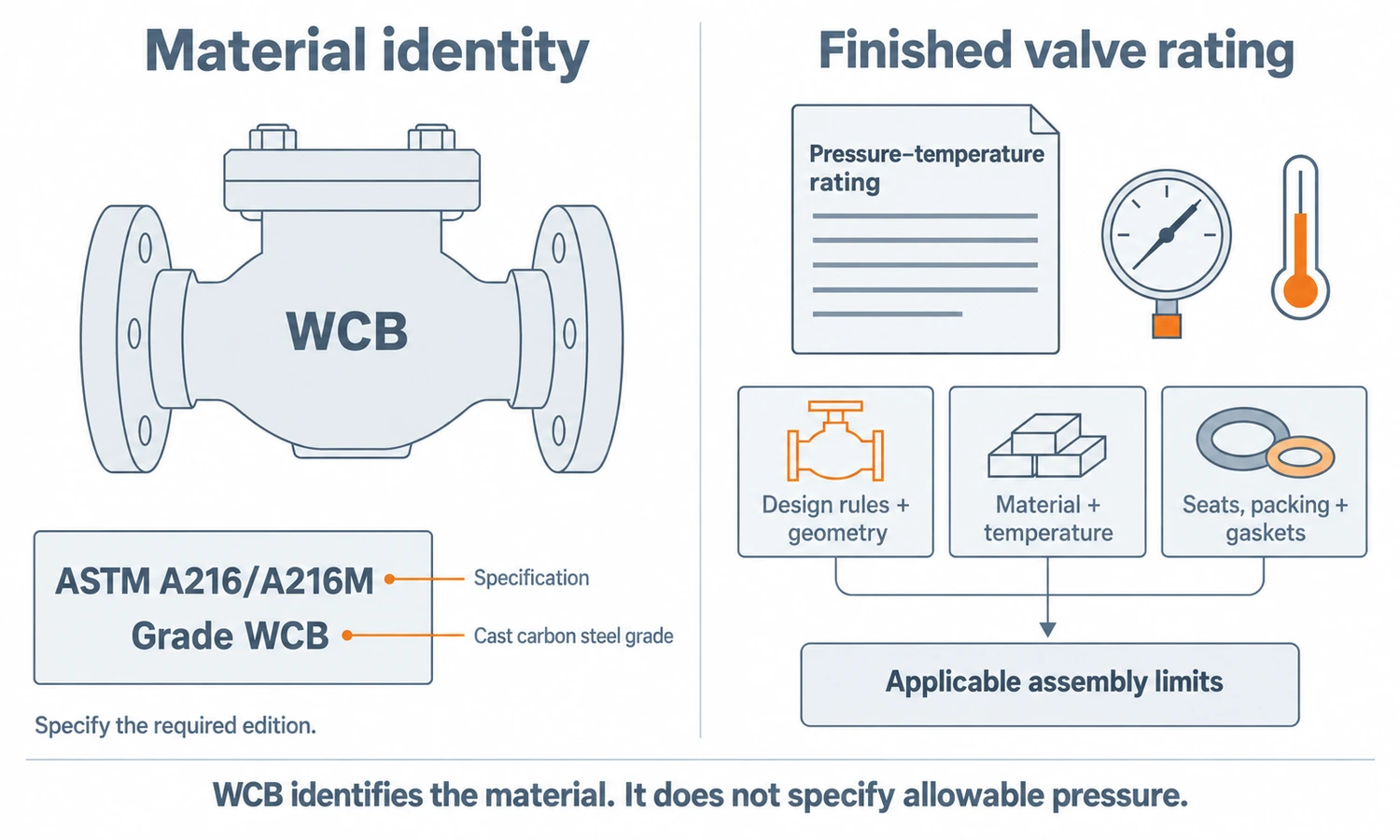
For a drawing or purchase specification, write ASTM A216/A216M Grade WCB, together with the required edition and any additional requirements. This is more useful than an expanded acronym because it identifies the material specification and grade precisely.
The word cast also matters. WCB does not mean wrought carbon steel. Its shape is produced by pouring molten steel into a mold, followed by the required heat treatment and finishing.
WCB Chemical Composition
WCB is mainly iron, with controlled carbon, manganese, silicon and residual elements. The figures below are published composition limits by mass, rather than a recipe requiring every heat to contain exactly these amounts.
| Element | Published WCB limit, wt.% |
|---|---|
| Carbon, C | 0.30 maximum |
| Manganese, Mn | 1.00 maximum, subject to the carbon adjustment below |
| Silicon, Si | 0.60 maximum |
| Phosphorus, P | 0.035 maximum |
| Sulfur, S | 0.035 maximum |
| Chromium, Cr | 0.50 maximum |
| Nickel, Ni | 0.50 maximum |
| Molybdenum, Mo | 0.20 maximum |
| Copper, Cu | 0.30 maximum |
| Vanadium, V | 0.03 maximum |
| Iron, Fe | Gleichgewicht |
These values are listed in Stainless Foundry & Engineering’s WCB alloy data. The specified residual elements also have a combined limit; checking each element separately is not the whole chemistry assessment.
There is an important carbon–manganese allowance: for each 0.01 percentage-point reduction in carbon below 0.30%, manganese may increase by 0.04 percentage points above 1.00%, up to 1.28%. Tsitouras Foundry’s WCB data documents this allowance and the residual-element provisions.
For example, a hypothetical heat containing 0.25% carbon permits a manganese ceiling of 1.20% under that rule: 1.00 + (5 × 0.04). A manganese result above 1.00% therefore does not automatically mean rejection. The complete specified chemistry still has to comply.
WCB Mechanical Properties
WCB combines useful tensile strength with ductility. The following grade values are summarized in the SFSA Steel Castings Handbook, Supplement 2, and its inch-pound values agree with the foundry data above.
| Eigentum | SI specification value | Inch-pound specification value |
|---|---|---|
| Zugfestigkeit | 485–655 MPa | 70–95 ksi |
| Streckgrenze | 250 MPa minimum | 36 ksi minimum |
| Verlängerung | 22% minimum | 22% minimum |
| Reduction of area | 35% minimum | 35% minimum |
Use the unit system specified for the order: the standard’s SI and inch-pound values are separately stated requirements, not exact mathematical conversions. For acceptance, use the ordered standard edition and its specimen requirements rather than a summary table alone.
Tensile strength is resistance to failure in a tensile test. Yield strength marks the onset of specified permanent deformation. Elongation and reduction of area describe ductility during that test.
These numbers are not the allowable internal pressure of a valve. Wall thickness, geometry, design rules and temperature all affect pressure capacity. A tensile result also does not establish low-temperature impact toughness.
Hardness needs similar care. Supplier datasheets sometimes give a typical Brinell range, but a typical value is not automatically a mandatory acceptance limit. If hardness matters to the application, state the requirement and test method explicitly.
What Is WCB Used For?
WCB is widely used where a cast shape, pressure containment and the economics of carbon steel fit the application. Typical components include gate- and globe-valve bodies, valve bonnets, fittings, flanges and pump housings.
Casting is useful for these parts because it can form curved flow passages, changes in wall section and integrated mounting features. Bearbeitung then produces sealing faces, threads, bores and other precision features.
Water, steam, oil and gas applications can use WCB, provided the specific fluid and operating conditions are compatible. The application name alone is not enough: treated water and oxygen-rich water, for example, can present different corrosion conditions.
YTD carbon and alloy steel investment casting guide explains how casting and machining are combined for steel components. The manufacturing route determines how the part is made; WCB defines the material grade it must meet.
Does WCB Rust?
Yes. WCB can rust and should not be treated as a corrosion-resistant stainless steel. Its small permitted chromium content does not provide the corrosion behavior associated with chromium-rich stainless grades.
External paint or another suitable coating can protect exposed surfaces, but it does not automatically protect an uncoated internal flow passage. Internal compatibility must be evaluated against the actual medium, temperature and operating conditions.
Where corrosion is the main constraint, compare WCB with an appropriate stainless or other corrosion-resistant alloy. CF8M is one common cast stainless alternative, but it is not a universal solution for every chloride, acid or seawater application. Our CF8M material guide introduces that grade and its composition.
The practical choice is between a carbon steel system with suitable corrosion control and an alloy selected for the exposure—not simply between a lower and higher purchase price.
WCB Temperature Range and Pressure Rating
WCB has no single temperature range that independently approves a finished component for service. Pressure and temperature must be considered together, along with low-temperature toughness and the limits of the complete assembly.
Velan’s body-material pressure–temperature tables, based on ASME B16.34-2025, give these examples for A216 WCB under Standard Class ratings:
| Temperatur | Class 150 | Class 300 |
|---|---|---|
| −29 to 38°C | 19.6 bar | 51.0 bar |
| 200°C | 13.8 bar | 43.8 bar |
| 400 °C | 6.5 bar | 34.6 bar |
The table illustrates why “Class 150” does not mean a constant 150 psi rating. It also shows why a WCB label alone cannot tell you the allowed pressure.
Velan includes ratings up to 538°C but warns that prolonged exposure above 427°C can cause graphitization. A highest tabulated temperature is therefore not a blanket recommendation for continuous operation.
The finished valve may have lower limits because of its seats, packing, gaskets or other components. Use its applicable manufacturer rating and design requirements for the actual duty.
Low-Temperature Service
Cold service requires a separate toughness assessment. The −29°C lower point in a pressure table is not proof that any WCB casting is acceptable at that temperature under every design code and thickness condition.
ASTM A352/A352M addresses cast steels for low-temperature pressure service and includes impact-test requirements. Its public scope and grade table lists −46°C (−50°F) as the usual minimum impact-test temperature for LCB and LCC. That is a test condition, not a universal operating limit for every component made from those grades.
For low-temperature selection, check the specified minimum design metal temperature, section thickness, governing code and required impact results together.
WCB Compared with Other Materials
The most useful comparison starts with what needs to change: manufacturing method, strength, low-temperature toughness or corrosion resistance.
| Material | Main difference from WCB | When the comparison matters |
|---|---|---|
| ASTM A105 | Carbon steel specification primarily for forged piping components | Comparing a cast body with a forged component |
| A216 WCC | Related cast carbon steel grade with higher minimum yield strength | Checking strength and the applicable material-group rating |
| A352 LCB / LCC | Cast grades specified for low-temperature service, including impact requirements | Selecting for cold conditions |
| A351 CF8 / CF8M | Austenitic stainless steel casting grades | Evaluating corrosion resistance |
WCB vs. A105
WCB and A105 are not interchangeable material specifications. WCB is a casting grade, while ASTM A105/A105M primarily covers forged carbon steel components for piping systems.
Both appear in valve and piping applications, which is why comparison charts often put them side by side. That similarity does not authorize substituting one for the other on a drawing. Product form, material requirements, dimensions and inspection obligations must match the design.
WCB vs. WCC
Published grade data give WCC a minimum yield strength of 275 MPa, compared with 250 MPa for WCB. Both have the same 485–655 MPa specified tensile-strength range in the SFSA summary.
WCC therefore has a higher minimum yield requirement, rather than universally higher strength in every sense. It is also not a stainless upgrade. Selection should follow the design and service requirements, not the assumption that C means “better” than B.
WCB Equivalents in Other Standards
European GP240GH / 1.0619, and the older GS-C25 designation, often appear beside WCB in cross-reference lists. Treat them as comparable materials to investigate, not automatic replacements.
A useful equivalence review compares the actual standards: chemistry, mechanical properties, heat treatment, thickness-dependent requirements, impact testing and certification. Similar chemistry is only one part of that review.
Heat Treatment and Welding
WCB is supplied in a specified heat-treated condition, not simply accepted because the molten metal had the correct chemistry. ASTM’s public A216/A216M abstract lists annealed, normalized, or normalized-and-tempered conditions as appropriate to the casting.
WCB is suitable for fusion welding, but the welding procedure still has to suit the actual material and joint. Section thickness, restraint, carbon equivalent and service requirements influence choices such as preheat and post-weld heat treatment.
For production or repair work, use the qualified welding procedure and required inspection. A universal welding-rod recommendation would leave out too much of what determines a sound joint.
How to Verify WCB Material
A WCB marking is a starting point for identification. The supporting records establish whether the supplied casting meets the order.
Check the material specification, grade and edition, then match the casting’s heat identification to its material certificate. Review the actual chemical analysis, heat-treatment condition and mechanical-test results. Any additional impact, hardness or nondestructive-testing requirements should also be traceable to the order and reports.

Keep material compliance separate from casting soundness. Correct chemistry does not prove the absence of internal shrinkage, and passing a pressure test does not establish every material property. Our casting inspection methods guide explains what the different tests can verify.
For a custom part, the clearest enquiry combines the WCB designation with a drawing, operating conditions, machining requirements and inspection criteria. That gives the foundry a defined component to produce and assess.
Abschluss
WCB is a weldable cast carbon steel used for pressure-containing components. Its value comes from strength, castability and cost, while corrosion and temperature require application-specific checks. Use the complete material designation, verified test results and the component’s pressure–temperature rating to make a sound selection.
Häufig gestellte Fragen
What Does WCB Stand For?
WCB is the grade designation used in ASTM A216/A216M for cast carbon steel. It is not an acronym to expand. The specification covers three cast carbon steel grades—WCA, WCB, and WCC—and WCB identifies the middle grade, UNS J03002. On a drawing, specify “ASTM A216/A216M Grade WCB” plus the edition.
Is WCB Stainless Steel?
No. WCB is a cast carbon steel and can rust. Its small permitted chromium content does not provide stainless corrosion behavior. Where corrosion is the main constraint, compare WCB with an appropriate stainless or corrosion-resistant alloy such as CF8M for the actual exposure.
What Is the Difference Between WCB and WCC?
Both are cast carbon steel grades in ASTM A216/A216M with the same 485–655 MPa specified tensile range. WCC has a higher minimum yield strength: 275 MPa compared with 250 MPa for WCB. WCC is not a stainless upgrade, and selection should follow the design and service requirements.
What Is the Difference Between WCB and A105?
WCB is a casting grade covered by ASTM A216/A216M. A105 primarily covers forged carbon steel piping components. Both appear in valve and piping work, but product form, material requirements, and inspection obligations differ—they are not interchangeable specifications.
What Temperature Is WCB Rated For?
WCB has no single temperature range that approves a component by itself. Pressure and temperature must be considered together through the applicable rating table, such as ASME B16.34, together with low-temperature toughness and assembly limits. Prolonged exposure above 427°C can cause graphitization in carbon steel.
Is WCB the Same as A216?
No. A216/A216M is the specification; WCB is one of its grades. The specification also covers WCA and WCC. Writing only “WCB” on a drawing is less precise than “ASTM A216/A216M Grade WCB” with the required edition and supplementary requirements.