Vacuum investment casting combines the lost-wax process with controlled melting—and, in some systems, pouring—under reduced atmospheric pressure.
The vacuum is not added simply to make every investment casting more precise. Its main value appears when molten alloys are sensitive to oxygen, nitrogen, or other atmospheric interaction, particularly selected nickel-, cobalt-, and iron-based superalloys.
Understanding where the vacuum is applied and what it actually controls helps determine when the added equipment and process cost are justified.
What Vacuum Investment Casting Means
Standard investment casting creates a ceramic shell from a sacrificial wax pattern and fills that shell with molten metal.
For many carbon steels, stainless steels, and other conventional casting alloys, melting and pouring can be carried out using normal air-melting foundry equipment.
Vacuum investment casting changes the metal-processing stage.
The alloy may be melted by vacuum induction melting, poured into the ceramic shell within a controlled vacuum chamber, or processed using a system that combines both operations.
Der Institut für Feinguss refers to industrial systems of this type as Vacuum Precision Investment Casting, or VPIC. In these furnaces, induction melting, melt conditioning, temperature control, and pouring are integrated around the ceramic shell casting process.
The wax patterns and ceramic shells still follow the same lost-wax principle. The main difference is the environment surrounding the molten alloy.
If you were looking for polyurethane prototypes made in silicone molds, that is a different process covered in our Vacuum Casting guide.
Vacuum Melting, Vacuum Pouring, and Vacuum-Assisted Mold Filling
Das Wort vacuum can refer to several different operations, so it helps to separate them.
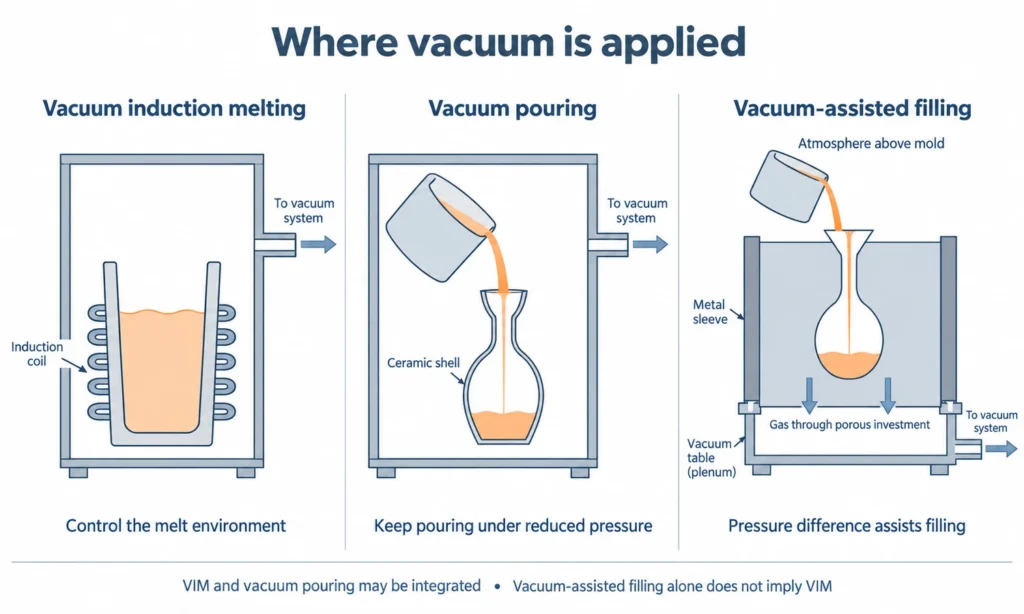
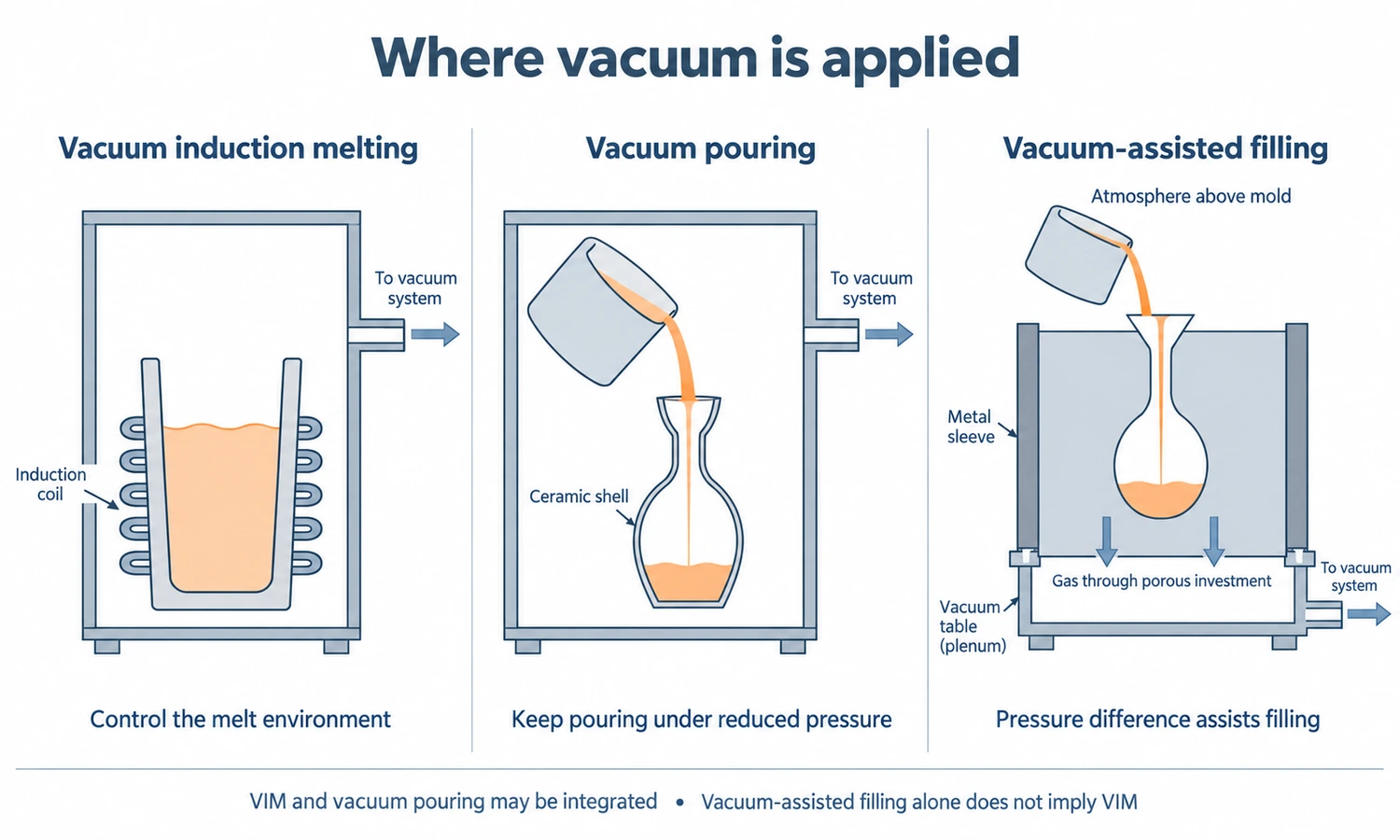
Vacuum Induction Melting
Vacuum induction melting, usually abbreviated VIM, melts the alloy inside a sealed chamber under reduced pressure.
An induction coil generates the electromagnetic field that heats the charge. The molten alloy is held in a suitable refractory crucible or liner while its temperature and condition are controlled before pouring.
Here, the main purpose of vacuum is metallurgical.
It reduces contact between the molten alloy and the normal atmosphere and provides better control over gases, oxidation, reactive alloying elements, and melt cleanliness.
Vacuum Pouring
In a full vacuum precision casting system, the ceramic shell can also be brought into the controlled chamber so the alloy is poured without first returning to normal atmospheric conditions.
This keeps the controlled environment through both melting and mold filling.
Industrial VPIC equipment may combine shell preheating, mold transfer, melting, temperature measurement, and pouring within one coordinated system.
Vacuum-Assisted Mold Filling
Some casting systems use a pressure difference across the mold primarily to assist filling.
This is common in smaller vacuum investment casting equipment and jewelry-type systems, where air is evacuated from around or beneath the investment mold as metal enters.
That is different from vacuum induction melting.
A process can use vacuum-assisted filling without performing metallurgical VIM, while a foundry can use vacuum melting because of alloy chemistry even when filling assistance is not the main reason for the vacuum.
These distinctions matter when comparing supplier capabilities. The statement “we have vacuum casting” does not tell you which part of the process actually operates under vacuum.
Atmospheric Control for Nickel-, Cobalt-, and Iron-Based Superalloys
Vacuum investment casting becomes especially relevant when an alloy contains elements that react strongly with the surrounding atmosphere at melting temperature.
Many nickel-based superalloys contain aluminum and titanium as intentional alloying additions. These elements contribute to the microstructures that give the alloys their high-temperature properties, but they are also chemically reactive when molten.
Exposure to oxygen and nitrogen can influence oxide and nitride formation, alloy cleanliness, and the amount of reactive alloying elements retained in the melt.
ASM’s discussion of polycrystalline cast superalloys identifies vacuum induction melting as an important route for controlling the chemistry and homogeneity of cast superalloys.
Vacuum does not make the alloy chemically inert. The melt can still interact with the crucible, liner, ceramic shell, and residual gases.
That is why vacuum melting also requires compatible refractory materials, controlled melt temperature, clean charge material, and limited unnecessary holding time.
Research on nickel-based superalloys has shown that vacuum conditions can influence oxygen and nitrogen levels as well as oxide and nitride inclusions. The vacuum level is therefore a real metallurgical process variable rather than simply an equipment specification.
Process Differences Between Air-Melt and Vacuum Investment Casting
Most of the investment casting process remains unchanged.
Both routes can begin with reusable tooling, injected wax patterns, tree assembly, and ceramic shell building.
The important difference appears when the shell is ready for metal.
In a conventional air-melt process, the alloy is melted in normal foundry equipment, conditioned, and poured into the prepared shell.
For vacuum processing, the metal charge is placed in a vacuum-compatible melting system. The chamber is evacuated, the alloy is induction melted, and the melt is brought to the required pouring condition.
Depending on the furnace configuration, the preheated ceramic shell may then enter the vacuum chamber for pouring.
After solidification, shell removal, cut-off, heat treatment, machining, and inspection continue in much the same way as other investment casting projects.
Unser Investment Casting Process guide covers those common production stages in detail.
Vacuum investment casting is therefore better understood as a specialized melting and pouring route inside investment casting, not as an entirely separate lost-wax process.
Vacuum Induction Melting Equipment and Process Control
Creating a vacuum is only one part of VIM.
The melting system also has to control how the alloy is heated, held, measured, and transferred to the shell.
The metal charge sits inside a refractory liner or crucible surrounded by an induction coil. Electromagnetic energy heats the metal and also creates movement within the melt.
This stirring helps homogenize temperature and composition, but the melt still has to be managed carefully because prolonged contact with refractory material can introduce contamination or inclusions.
The ICI’s technical work on vacuum precision investment casting identifies melt chemistry, crucible integrity, temperature measurement, charge cleanliness, vacuum control, and repeatability from one melt cycle to the next as key parts of the process.
For reactive alloys, crucible material is particularly important. Alumina, zirconia, and other refractory systems may be selected according to the alloy and melting conditions.
Temperature control matters for the same reason.
Holding a reactive superalloy hotter or longer than necessary increases the opportunity for melt-refractory reactions. Good VIM practice aims to produce a clean, compositionally controlled melt at the temperature needed for pouring without unnecessary exposure time.
Materials Used in Vacuum Investment Casting
Vacuum is not required simply because a part is investment cast.
The strongest applications are alloys whose chemistry or cleanliness benefits from atmospheric control.
Nickel-Based Superalloys
Nickel-based superalloys are among the most common materials associated with vacuum investment casting.
Grades containing reactive additions such as aluminum and titanium can benefit from VIM because the process reduces atmospheric interaction during melting.
Unser Nickel Alloy Casting guide explains how alloy chemistry, shell materials, heat treatment, and machining affect these castings beyond the melting stage.
Cobalt-Based Superalloys
Cobalt-based high-temperature alloys can also use vacuum melting where chemistry and melt cleanliness require tighter control than ordinary air melting provides.
Like nickel superalloys, these materials are commonly selected for severe heat, corrosion, or wear environments rather than because vacuum casting itself is the design goal.
Iron-Based Superalloys
Selected high-performance iron-based alloys may also use vacuum melting where their chemistry and specification justify it.
The material grade and required condition determine the melting route—not the broad label iron-based.
Titanium and Other Highly Reactive Metals
Titanium also requires very strict atmospheric control during melting, but titanium casting uses specialized melting and mold systems because molten titanium reacts aggressively with conventional refractories.
It should not simply be grouped with ordinary nickel-superalloy VIM practice.
For YTD projects, our confirmed in-house vacuum-melting capability applies to suitable nickel-, cobalt-, and iron-based superalloys.
Casting Quality: What Vacuum Changes and What It Does Not
Vacuum can improve control over several metallurgical risks, but many common investment casting problems originate elsewhere in the process.
Oxidation and Reactive Alloy Chemistry
Reducing atmospheric exposure helps limit reactions between the molten alloy and oxygen or nitrogen.
For alloys containing reactive elements, this can help maintain chemistry and reduce the formation of unwanted reaction products.
This is one of the clearest reasons to use VIM.
Gas and Melt Cleanliness
Vacuum processing can support lower gas content and cleaner melting conditions for suitable alloys.
It can also reduce some gas-related metallurgical problems compared with uncontrolled atmospheric melting.
But vacuum does not automatically make a casting pore-free.
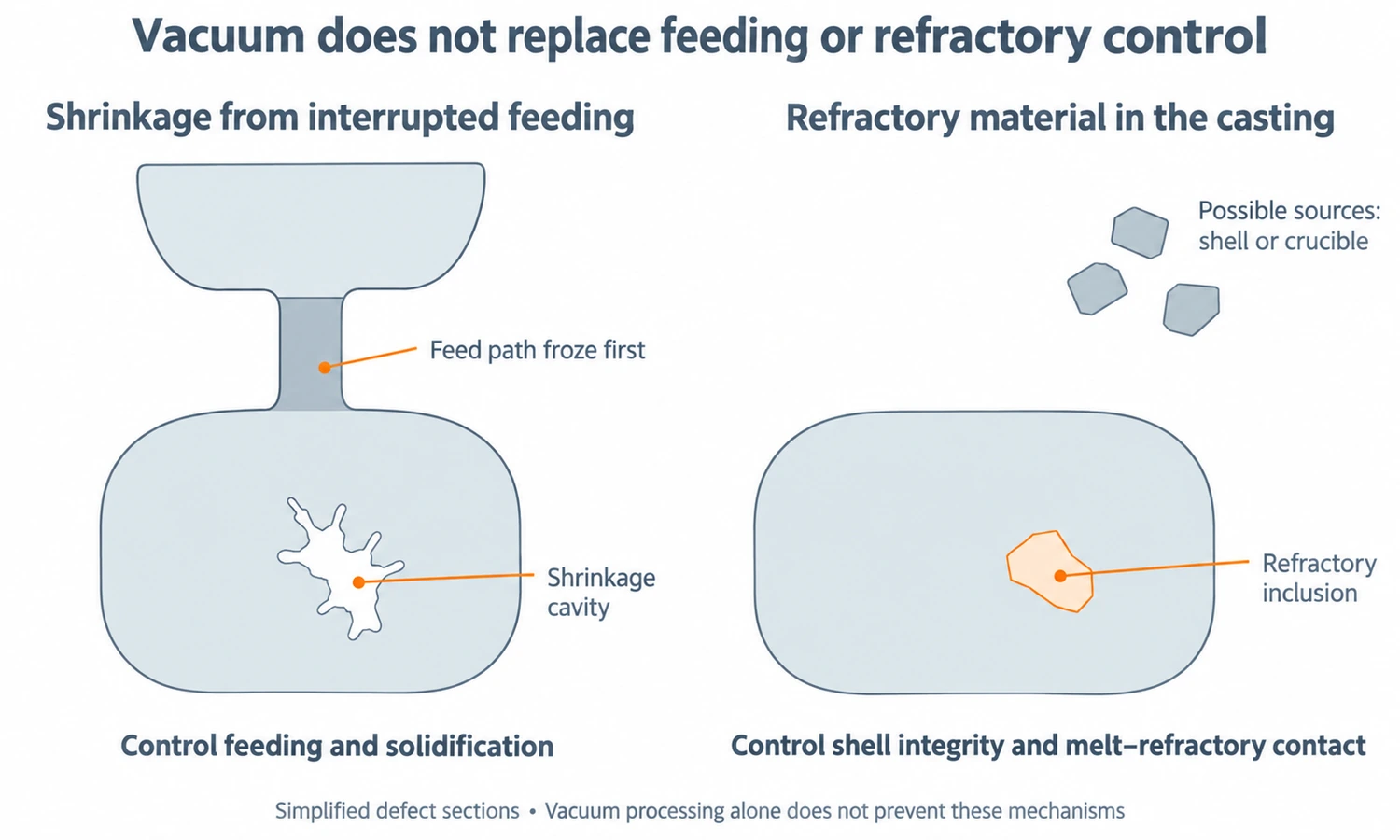
Shrinkage Porosity
Shrinkage porosity is primarily a solidification and feeding problem.
If a heavy section remains liquid after its feeding path freezes, vacuum melting does not provide the missing liquid metal needed to compensate for contraction.
Gate design, feeding, part geometry, shell temperature, and solidification control still determine this defect mechanism.
Ceramic Inclusions
Vacuum does not prevent loose shell material, crucible erosion, or refractory contamination from becoming inclusions.
In fact, the interaction between the molten superalloy and the crucible or liner remains an important VIM control issue.
Surface Finish and Dimensional Accuracy
Vacuum is not the main reason investment casting achieves fine detail and good dimensional control.
Surface finish begins with the wax pattern and ceramic face coat. Dimensions are influenced by tooling, wax shrinkage, shell behavior, metal contraction, distortion, and machining.
Those benefits come primarily from the investment casting process itself.
Unser Investment Casting Defects guide explains these defect mechanisms separately.
Air-Melt vs Vacuum Investment Casting
| Faktor | Air-Melt Investment Casting | Vacuum Investment Casting |
|---|---|---|
| Melting atmosphere | Normal foundry atmosphere | Reduced-pressure controlled environment |
| Typical materials | Carbon steel, stainless steel, many conventional cast alloys | Selected nickel-, cobalt-, and iron-based superalloys; other specialized reactive alloys |
| Main reason for process choice | Standard investment casting production | Chemistry, gas, oxidation, and melt-cleanliness control |
| Equipment | Conventional induction or other suitable furnace | Vacuum induction melting / VPIC equipment |
| Ceramic shell | Expendable ceramic shell | Expendable ceramic shell |
| Wax and tooling process | Standard investment casting | Standard investment casting |
| Process cost | Lower | Higher because of specialized equipment and cycle control |
| Main quality advantage | Depends on normal melt and casting controls | Better control of atmosphere-sensitive molten alloys |
For an ordinary stainless or carbon-steel casting, vacuum melting may add equipment cost without solving a material requirement.
For a superalloy whose chemistry is sensitive to atmospheric interaction, it can be part of the required manufacturing route.
When Vacuum Investment Casting Is Worth the Added Process Cost
Vacuum processing makes sense when the alloy or specification creates a real metallurgical reason for it.
A nickel-based superalloy containing reactive alloying elements is a much stronger candidate than an ordinary carbon-steel bracket.
Service conditions also matter.
Components selected for high-temperature strength, creep resistance, oxidation resistance, or severe corrosion are often using expensive alloys precisely because their metallurgy matters. Losing composition control during melting defeats the purpose of specifying those materials.
Vacuum investment casting becomes particularly relevant when three conditions come together:
the alloy chemistry is atmosphere-sensitive, the geometry benefits from investment casting, and the required quality justifies the additional melting control.
It is not a premium version that should automatically replace air-melt investment casting.
Vacuum Melting in YTD Investment Casting Projects
Investment casting is our core in-house casting process at YTD.
For ordinary steels and stainless steels, we use the melting route appropriate to the alloy and project rather than adding vacuum where it provides no technical benefit.
For suitable nickel-, cobalt-, and iron-based superalloys, we can use vacuum induction melting as part of the investment-casting workflow.
The vacuum stage is planned together with the rest of the process: tooling, wax patterns, silica-sol shell building, alloy selection, melting, heat treatment, CNC machining, and inspection.
Unser Superalloy Casting page covers the materials and finished-part capabilities in more detail, while the Feinguss-Service page covers the complete manufacturing route.
For us, the decision to use vacuum begins with the alloy specification. Vacuum equipment is useful when it protects the metallurgy the customer is paying for—not simply because “vacuum casting” sounds like a higher-grade process.
Schlussbetrachtung
Vacuum investment casting is most valuable when the molten alloy needs tighter atmospheric control than ordinary air melting can provide.
For selected superalloys, vacuum induction melting helps control oxidation, gases, melt cleanliness, and reactive alloy chemistry before the metal enters the ceramic shell. It does not replace good gating, shell quality, solidification control, heat treatment, or inspection.
The material specification should determine whether vacuum is necessary—not the assumption that vacuum automatically makes every investment casting better.
Häufig gestellte Fragen
Does Every Investment Casting Need Vacuum?
No. Many carbon steels, stainless steels, and conventional alloys can be investment cast using air-melting equipment. Vacuum becomes important when alloy chemistry, gas control, or the material specification requires a more controlled melting environment.
Is Vacuum Investment Casting the Same as Vacuum Induction Melting?
Not exactly. VIM describes the metal-melting method. Vacuum investment casting describes the broader casting route, which may combine VIM with ceramic-shell investment casting and, in some systems, vacuum pouring.
Does Vacuum Investment Casting Eliminate Porosity?
No. Vacuum can reduce atmosphere- and gas-related metallurgical problems, but shrinkage porosity is controlled by feeding and solidification. Poor gating, shell defects, and refractory inclusions also remain possible.
Which Metals Are Commonly Vacuum Investment Cast?
Selected nickel-based, cobalt-based, and iron-based superalloys are important applications. Titanium and other highly reactive metals also require controlled-atmosphere casting, but they use specialized melting and refractory systems.
Is Vacuum Investment Casting More Accurate Than Standard Investment Casting?
Not inherently. Dimensional accuracy is mainly controlled by tooling, wax patterns, ceramic shells, shrinkage, distortion, and machining. Vacuum primarily changes the molten-metal environment.
Is Vacuum Investment Casting the Same as Vacuum Die Casting?
No. Vacuum investment casting uses an expendable ceramic shell and is commonly associated with high-performance alloys. Vacuum die casting evacuates air from a reusable metal die during high-pressure casting, usually for aluminum and other die-casting alloys.