A mold can fill completely and still produce a casting with cavities inside. The problem may develop as the metal freezes and contracts. Risers supply the extra liquid metal needed during this stage—but their size, position and connection all affect whether they work.
What Is a Riser in Casting?
A riser, also called a feeder, is a reservoir of molten metal connected to a casting. It supplies replacement metal as the casting contracts during solidification, helping prevent shrinkage cavities and porosity. After cooling, the solidified riser is removed from the part.
Think of it as a reserve supply that remains available after the mold has filled. The Steel Founders’ Society of America’s riser tutorial emphasizes both sufficient feed metal and a short, direct route to the section being fed.
A useful riser must satisfy three conditions: it must retain liquid metal long enough, contain enough usable feed metal, and remain connected to the shrinking region through a feedable path. A large reservoir is ineffective if that path freezes shut.
How Does a Riser Work?
As a casting solidifies, its demand for feed metal continues even though pouring has stopped. Liquid from the riser moves into regions that would otherwise develop shrinkage voids. The aim is to keep the reservoir available until the section it feeds has finished solidifying.
For scale, SFSA’s Feeding and Risering Guidelines for Steel Castings gives approximately 3% volume contraction during carbon steel solidification, with additional contraction as the liquid cools before freezing. This is not a universal shrinkage figure for all metals—or a rule that a riser should be 3% of casting volume.
Some metal freezes inside the riser itself, so only part of its contents is available for feeding. A shrinkage cavity, often called a pipe, can form in the riser as feeding proceeds. The design must keep that cavity from extending into the useful casting.
This also explains why dimensional shrinkage allowance and risering solve different problems. Enlarging a pattern can compensate for dimensional contraction; it does not supply liquid metal to an isolated internal region.
Risers, Gates and Vents
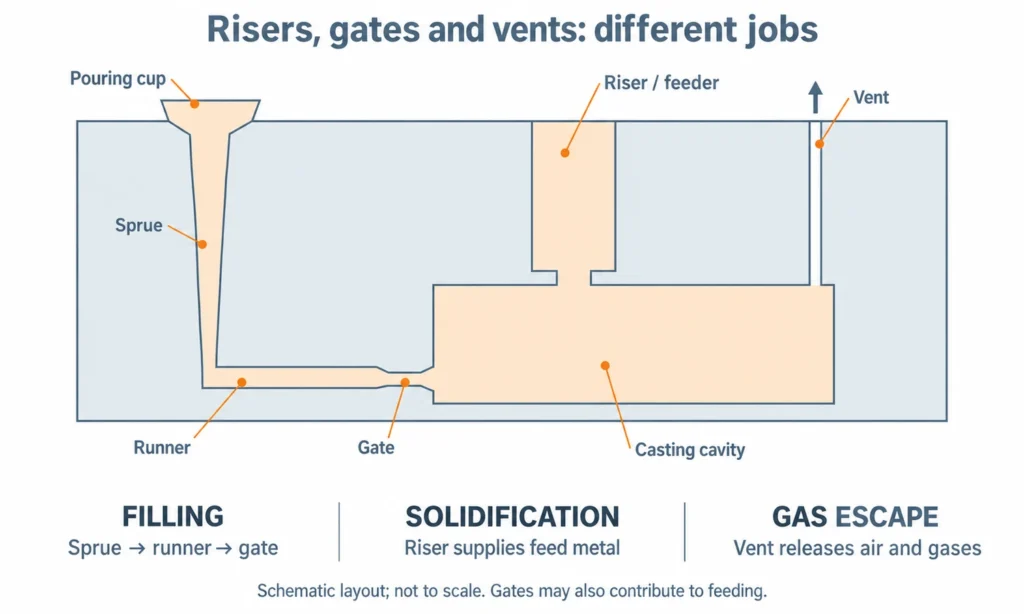
These features may appear together in a mold diagram, but they have different primary jobs.
| Besonderheit | Hauptzweck | When it matters most |
|---|---|---|
| Anguss | Carries poured metal down into the mold’s flow system | Füllung |
| Läufer | Distributes metal toward the gates | Füllung |
| Tor | Connects the flow system to the casting cavity | Filling; sometimes also feeding |
| Riser or feeder | Provides a liquid-metal reserve for shrinkage | Erstarrung |
| Vent | Provides an escape route for air and mold gases | Filling and gas evacuation |
The distinction is between getting metal into the cavity and replacing volume lost afterward. A mold that fills successfully can still have a feeding problem. Our guide to the gating system in casting explains the filling components in more detail.
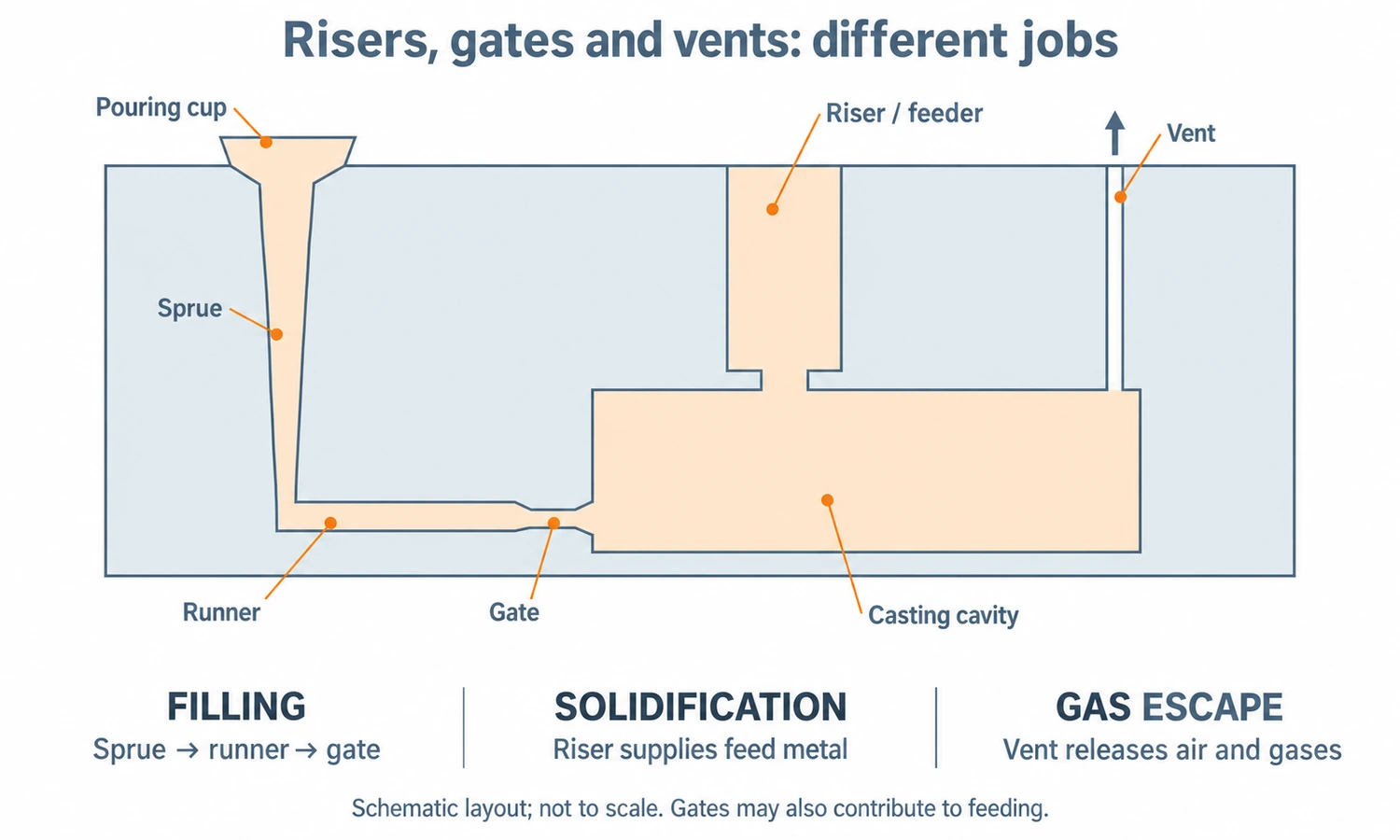
An open riser may also release air or indicate that metal has reached a particular level. Those secondary functions do not make a vent and a riser interchangeable.
Types of Risers
Riser names describe different features of the same reservoir. For example, a riser can be both a top riser and a blind riser.
Open and Blind Risers
An open riser extends to the top surface of the mold and is open to the atmosphere. A blind riser is enclosed within the mold rather than having an exposed top.
Blind risers allow feeding arrangements where an open riser would be inconvenient, but their pressure conditions need attention. A low-pressure pocket above the liquid can restrict feeding. Bradken’s study of blind-riser efficiency discusses how suitable venting arrangements help maintain feeding.
“Blind” therefore describes the riser’s enclosure, not a requirement to seal it airtight. Nor should a small vent that fills with metal be assumed to remain effective throughout solidification.
Top and Side Risers
A top riser sits above the casting section it feeds. A side riser connects beside it, usually through a connecting neck.
Top placement can provide a short, direct feeding route. Side placement can suit the mold layout or provide access to a section that is difficult to feed from above. The choice must also leave room for molding, riser removal and finishing.

Live and Dead Risers
These terms describe how metal reaches the riser. A live or hot riser receives metal directly from the gating system; a dead or cold riser fills through the casting cavity. The names describe relative filling conditions, not whether the metal is actually cold.
They should not be treated as synonyms for side and top risers. Position, exposure to the atmosphere and filling route are separate design choices.
How Are Riser Size and Position Chosen?
The starting point is the region that needs feeding. Choosing a convenient cylinder size first can leave the actual shrinkage problem unresolved.
Hot Spots and Feeding Paths
A hot spot is a local region that finishes solidifying later than its surroundings. Thick bosses and heavy junctions are common places to investigate.
Consider a hypothetical part with two thick bosses joined by a thin web. If the web freezes before the bosses, a riser beside one boss may no longer feed the other. Increasing that riser’s volume does not reopen the frozen web.
Possible changes include feeding the second boss separately, changing the connection, or adjusting local cooling so the region remains feedable. Which change works depends on the part geometry and process. SFSA’s steel casting design guidance explains the underlying problem: a solidifying section needs access to liquid metal from an adjoining section or a riser.
The intended freezing sequence is called directional solidification: solidification progresses toward the available feed-metal reservoir, rather than isolating liquid inside the part.

Riser Modulus and Feed Volume
Foundries use solidification modulus to help compare how quickly different shapes lose heat. The volume-to-cooling-area relationship is explained in NJIT’s casting fundamentals notes:
Modulus = volume ÷ cooling surface area
A compact shape holds more metal relative to its cooling surface than a thin, spread-out shape. Under comparable conditions, a higher modulus generally means slower solidification. This helps explain why cylindrical risers are common.
Modulus and feed volume answer different questions. Modulus helps assess how long metal remains available; usable feed volume addresses whether there is enough of it. Sleeves, mold materials and exposed surfaces change heat transfer, so equal geometric moduli do not guarantee equal freezing times.
Feeding Distance and the Riser Neck
Feeding distance is the distance over which a riser can supply enough metal to produce the required internal soundness. It is not simply the distance molten metal traveled during filling.
Research on feeding and risering of high-alloy steels accounts for alloy grade, mold material, superheat and chills when applying feeding-distance rules. A distance established for one alloy and mold condition should not be transferred unchanged to another.
The riser neck is the connection between the reservoir and casting. It must support feeding long enough, while also allowing practical removal. A narrow neck may be easier to cut off but can interrupt feeding prematurely; an unnecessarily large connection adds finishing work and changes the local thermal conditions.
For a design review, the useful questions are specific: Which section does each riser feed? When does its connection freeze? Where is the predicted last liquid? These questions reveal more than asking whether the riser looks large enough.
Riser Sleeves and Chills
Sleeves and chills control heat flow in different places. A sleeve helps keep the feeder hot; a chill extracts heat from a selected casting region. Used appropriately, they help establish the required freezing sequence.
Insulating sleeves slow heat loss. Exothermic sleeves release heat through a chemical reaction, and some products combine both effects. Foseco’s feeding-system overview describes these options and their purpose of extending feeder solidification time.
A sleeve can allow a smaller feeder to perform the thermal job of a larger unsleeved reservoir, provided adequate feed volume remains. It does not eliminate the need to check the neck and feeding distance.
Chills are placed where faster local cooling benefits the overall feeding arrangement. Their location matters: accelerating freezing along the only feeding route could make the problem worse. The goal is a controlled sequence, not simply the fastest cooling everywhere.
Risers and Casting Yield
Risers consume poured metal without becoming part of the finished component. Their size therefore affects casting yield, removal work and the amount of metal returned for remelting.
Using good casting weight after cut-off as the numerator:
Casting yield = good casting weight ÷ total poured weight × 100%
For a hypothetical 4 kg casting made from an 8 kg pour, yield is 50%. If a revised arrangement produces the same acceptable casting from 7 kg, yield becomes 57.1%. That is a 7.1-percentage-point improvement—not evidence that simply removing 1 kg of riser metal would work.
Unser casting yield guide explains the weight boundaries and the difference between returns and scrap. Riser metal can often be recycled, but cutting, handling and remelting still require work and energy.
A Published Feeder-Reduction Example
Foseco reports a 72 kg AlZn10Si8Mg machine slider, sand cast by Marsberger Metallguss, that originally used eight insulating feeders plus exothermic powder. The revised arrangement used six FEEDEX NF1 exothermic sleeves. The supplier reports a reduction of 9 kg of aluminum per casting, with less material to remove and remelt. See page 19 of its Energy Efficient Casting publication.
This is a documented result for that component and process. Its useful lesson is that feeder performance can improve through thermal control and layout changes, allowing less feeding metal while meeting the casting’s needs.
Risers in Investment Casting
Investment castings do not always have a separate riser shaped like the cylinders shown in sand-casting diagrams. The central sprue and gates of a casting tree can also provide feeding metal, depending on the design.
Der wax-tree arrangement determines both the filling connections and the paths available during solidification. A gate may fill a part successfully yet freeze too early to feed its thickest section.
For a designer, this makes gate location and removal allowance relevant before tooling is finalized. Identify surfaces that must remain clean, areas that will be machined and heavy sections that may need a feeding connection. That gives the foundry room to develop an arrangement that works thermally and can be finished efficiently.
Abschluss
Risers supply metal to compensate for solidification shrinkage. Effective feeding requires sufficient liquid metal, enough time and a connected feeding path. Evaluate placement, neck design and thermal control together; reduce riser metal only when the casting still meets its soundness requirements.
Häufig gestellte Fragen
What Is the Difference Between a Riser and a Gate?
A gate connects the mold’s flow system to the casting cavity and mainly serves filling. A riser is a liquid-metal reservoir that supplies replacement metal as the casting contracts during solidification. A gate sometimes also feeds, but the two features have different primary jobs.
Why Do Castings Need Risers?
Most alloys contract as they solidify. Without a source of replacement liquid metal, shrinkage cavities or porosity can form inside the casting. A riser keeps feed metal available long enough and connected to the shrinking region until it finishes solidifying.
How Big Should a Riser Be?
There is no universal size. The riser must retain liquid metal long enough (which relates to its modulus), contain enough usable feed metal, and stay connected to the region it feeds through a neck that does not freeze too early. Sleeves can extend solidification time and allow smaller risers when feed volume is adequate.
What Is the Difference Between an Open and a Blind Riser?
An open riser extends to the top of the mold and is exposed to the atmosphere. A blind riser is enclosed inside the mold. Blind risers suit layouts where an open top is impractical, but they need suitable venting so air pressure does not restrict feeding.
What Is Directional Solidification?
Directional solidification is a freezing sequence in which solidification progresses toward the available feed-metal reservoir, so no liquid region becomes isolated. Chills, sleeves, geometry changes, and riser placement are used together to establish that sequence.
Do Investment Castings Need Risers?
Not always in the separate-cylinder form used in sand casting. The central sprue and gates of an investment-casting tree can provide feeding metal when the design allows. The arrangement still has to keep a feedable path open until each section finishes solidifying.